Merger and Acquisition

Merger and Acquisition: Discover the expertise of Empower Legal, a leading corporate law firm, in navigating mergers and acquisitions. With 24/7 availability, tailored solutions, and a proven track record, Empower Legal ensures seamless transactions and minimized risks without a doubt.

Mergers and acquisitions (M&A) shape companies and industries, representing significant milestones in business. Furthermore, navigating these processes benefits from reputable guidance like Empower Legal, a corporate law firm.

Here are key reasons why Empower Legal stands out in the realm of M&A:

  1. Expertise in Corporate Law: With a dedicated team of company lawyers specializing in corporate law, Empower Legal possesses a deep understanding of the legal intricacies surrounding mergers and acquisitions.
  2. 24/7 Availability: M&A transactions often operate on tight timelines. Empower Legal offers round-the-clock availability, ensuring that clients receive timely legal counsel and support whenever they need it.
  3. Tailored Solutions: Recognizing that each M&A deal is unique, Empower Legal provides tailored legal solutions that address the specific needs and goals of their clients, maximizing value and minimizing risks.
  4. Comprehensive Support: Empower Legal offers comprehensive support throughout every stage of the M&A process. In fact, This support includes guiding clients seamlessly through complex legal procedures, from due diligence to negotiation and post-merger integration.
  5. Proven Track Record: With a history of successful Merger and Acquisition transactions, Empower Legal has earned a reputation for delivering results. Consequently, this success makes them a trusted partner for companies seeking to navigate mergers and acquisitions effectively.

Partnering with Empower Legal ensures that companies have the legal expertise and support necessary to navigate the complexities of mergers and acquisitions with confidence and success.

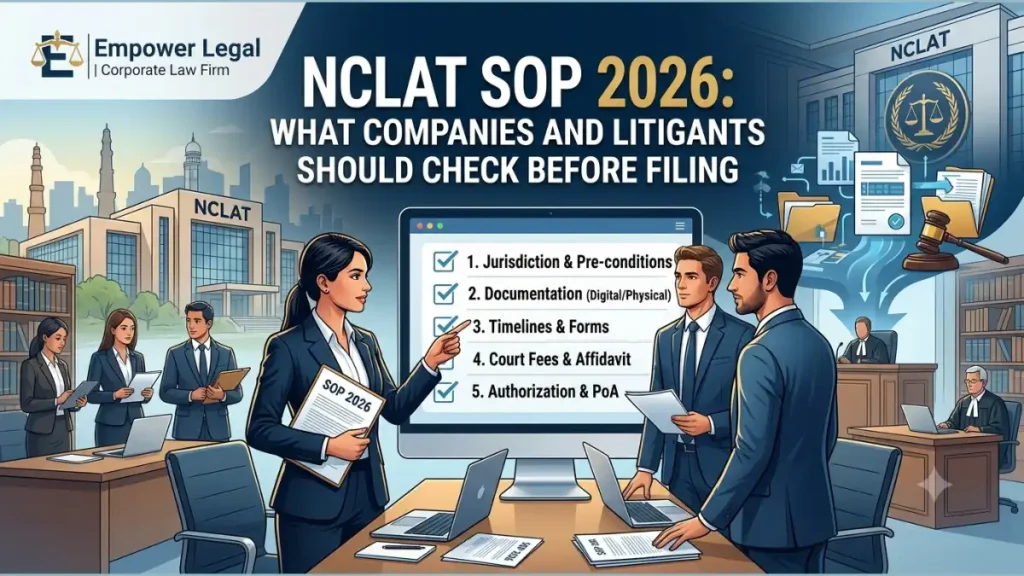
NCLAT SOP 2026: What Companies and Litigants Should Check Before Filing

NCLAT SOP 2026: What Companies and Litigants Should Check Before Filing

NCLAT published a new Standard Operating Procedure dated 10 September 2026 for submission and processing of applications. Learn what companies, directors, creditors and counsel should check before approaching NCLAT and how the IBC appeal framework fits into the process.

NCLAT SOP 2026: What Companies and Litigants Should Check Before Filing Read More »

Director KYC and Annual Confirmations: DIR-3 KYC and INC-20A

Director KYC and Annual Confirmations: DIR-3 KYC and INC-20A

Director KYC and Annual Confirmations – Director KYC is a statutory compliance requirement for individuals holding a Director Identification Number (DIN). The Ministry of Corporate Affairs uses DIR-3 KYC to maintain updated director information. Moreover, Rule 12A governs this annual KYC requirement under the Companies Act framework. Directors must verify their personal details, contact information,

Director KYC and Annual Confirmations: DIR-3 KYC and INC-20A Read More »

Related Party Transactions: Disclosure and Approval Requirements

Related Party Transactions: Disclosure and Approval Requirements

Related Party Transactions (RPTs) involve dealings between a company and persons or entities having a prescribed relationship. The Companies Act, 2013 regulates these transactions through disclosure, approval, reporting, and governance requirements. Section 188 covers specified contracts involving goods, property, leasing, services, agents, offices, and securities underwriting. Section 184 separately requires directors to disclose their interests

Related Party Transactions: Disclosure and Approval Requirements Read More »

Statutory Audit Requirements for Companies

Statutory Audit Requirements for Companies

Statutory Audit Requirements – Statutory audit ensures that eligible companies present reliable financial information to stakeholders. The Companies Act, 2013 provides the primary framework for statutory audit requirements in India. Companies must understand auditor appointment, eligibility, rotation, reporting, records, and compliance timelines. Additionally, auditors must follow applicable auditing standards and professional requirements. Therefore, directors should

Statutory Audit Requirements for Companies Read More »

Annual Return Filing: Form MGT-7 Complete Guide

Annual Return Filing: Form MGT-7 Complete Guide

Annual return filing remains a core corporate compliance requirement under the Companies Act, 2013. Form MGT-7 records important company information for the relevant financial year. Consequently, companies should reconcile statutory registers before preparing the annual return. Section 92 requires companies to provide prescribed information concerning their corporate structure and activities. The filing also supports transparency

Annual Return Filing: Form MGT-7 Complete Guide Read More »

Annual General Meeting (AGM): Conducting and Compliance

Annual General Meeting (AGM): Conducting and Compliance

An Annual General Meeting provides shareholders an important platform to review corporate affairs and exercise statutory rights. Section 96 requires companies, except One Person Companies, to hold an AGM annually. Generally, no more than fifteen months may pass between consecutive AGMs. The first AGM must occur within nine months from the first financial year’s closure.

Annual General Meeting (AGM): Conducting and Compliance Read More »

Board Meetings and Resolutions: Legal Requirements and Minutes

Board Meetings and Resolutions: Legal Requirements and Minutes

Board Meetings and Resolutions – The Companies Act, 2013 establishes essential requirements for conducting valid Board meetings in India. Every company generally holds its first Board meeting within thirty days after incorporation. Thereafter, the Board ordinarily conducts at least four meetings annually. The gap between consecutive meetings should not exceed 120 days. However, statutory exemptions

Board Meetings and Resolutions: Legal Requirements and Minutes Read More »

Annual Compliance Calendar for Private Limited Companies

Annual Compliance Calendar for Private Limited Companies

Annual Compliance Calendar – Private Limited Companies must satisfy statutory obligations throughout every financial year. Timely compliance protects directors, shareholders, investors, and business operations. Therefore, companies should maintain a structured annual compliance calendar. Empower Legal – Corporate Law Firm assists startups, MSMEs, family businesses, and established companies with regulatory compliance. Corporate obligations arise under the

Annual Compliance Calendar for Private Limited Companies Read More »

Environmental Clearances for Businesses: EC and CTE/CTO

Environmental Clearances for Businesses: EC and CTE/CTO

Environmental Clearances for Businesses – Environmental compliance protects businesses from regulatory action and promotes sustainable industrial growth. Empower Legal – Corporate Law Firm assists companies across India with environmental approvals and compliance strategies. Moreover, businesses must obtain statutory approvals before establishing or operating regulated industries. Environmental Clearance, Consent to Establish, and Consent to Operate remain

Environmental Clearances for Businesses: EC and CTE/CTO Read More »