
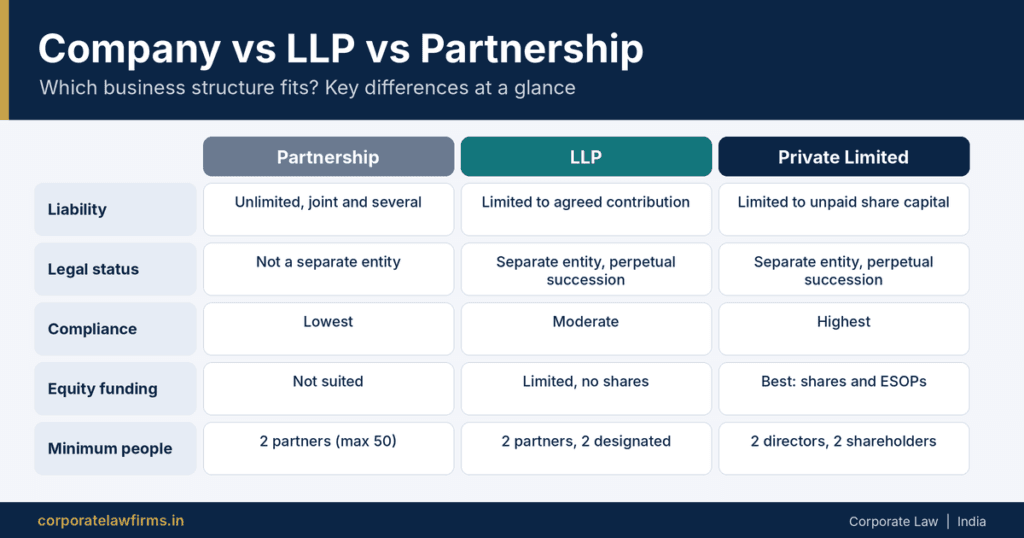
Choosing between a company vs LLP vs partnership is the first legal decision for most businesses in India, as it determines liability, compliance, tax, funding and exit options. Each structure is governed by its own law: the Companies Act, 2013, the Limited Liability Partnership Act, 2008, and the Indian Partnership Act, 1932.
Partnership firm
- Formed by an agreement between two or more partners, with a maximum of 50 partners under the Companies Act, 2013 and the rules. Registration is optional, but under Section 69 of the Partnership Act, 1932 an unregistered firm and its partners cannot sue third parties to enforce contractual rights.
- Partners have unlimited, joint and several liability for the firm’s debts.
- It has minimal compliance and low cost, but no separate legal personality, as the firm and the partners are treated as one for most purposes.
- Not suited to raising equity funding.
Limited Liability Partnership (LLP)
- Registered with the Registrar of Companies. It is a separate legal entity with perpetual succession, and needs at least two partners and two designated partners, one of whom must be resident in India.
- Partners’ liability is limited to their agreed contribution, apart from liability for their own wrongful acts or fraud.
- The LLP agreement governs internal affairs, which gives flexibility.
- Annual filings are required, such as a statement of accounts and solvency and the annual return. An audit is required if the turnover exceeds Rs 40 lakh or the contribution exceeds Rs 25 lakh, so check the current limits in the Rules.
- An LLP cannot issue shares, so it is not suitable for venture or angel equity funding in the usual form.
Private limited company
- Registered under the Companies Act, 2013, as a separate legal entity, with a minimum of two directors and two shareholders and a maximum of 200 shareholders. A one-person company is also possible for a single owner.
- Shareholders’ liability is limited to the unpaid share capital.
- Shares can be issued to investors and ESOPs can be granted, which makes the company the standard structure for startups.
- Compliance is higher: board and general meetings, statutory registers, annual accounts, audit and annual filings with the Registrar.
Company vs LLP vs partnership at a glance
- Liability: unlimited for partnership; limited for LLP and company.
- Legal status: separate entity for LLP and company; not for a partnership.
- Compliance burden: lowest for partnership; moderate for LLP; highest for company.
- Funding: company is best for equity investment; LLP and partnership are limited.
- Taxation: the rates and rules differ between companies and firms or LLPs, and they change, so check the current Income-tax Act, 2025 provisions and advice from a chartered accountant before choosing.
- Foreign investment: companies are generally preferred, though LLPs can receive foreign investment in the sectors permitted under the FDI policy.
- Exit and transfer: shares are easy to transfer, whereas LLP and partnership interests are transferred as per the agreement.
How to choose
1. Small, family or professional practice with limited risk: partnership or LLP.
2. Professionals who want limited liability and flexibility: LLP.
3. Startups aiming for funding, ESOPs or a future exit: private limited company.
4. A single founder: one-person company or a private company.
5. Regulated sectors: check the licensing and the rules of the regulator.
Consider also the cost of formation, annual compliance cost, the credibility with banks and customers, and the plan for raising capital. The Acts are on India Code, and the incorporation services are on the MCA portal.
Frequently Asked Questions
Is an LLP better than a private limited company?
It depends. An LLP has lower compliance, but a private company is better for equity funding and ESOPs.
Does a partnership have limited liability?
No. Partners are jointly and severally liable for the firm’s debts.
Can an LLP raise venture capital?
Usually not in the standard way, as it cannot issue shares, though other structured routes may be possible.
Is registration of a partnership firm compulsory?
Not compulsory, but an unregistered firm and its partners cannot sue third parties to enforce contractual rights under Section 69 of the Partnership Act, 1932.
Can I convert a partnership into an LLP or a company?
Yes, the law provides conversion routes, with compliance and tax considerations.
How many members are needed for a private company?
At least two shareholders and two directors, or one person in the case of a one-person company.
This article is general legal information and not a substitute for advice on your specific matter. Rules, rates and timelines change; verify the current position and consult an advocate before acting.