
Understanding Share Capital Structure for Indian Companies
Introduction to Share Capital Structure
Share capital forms the financial foundation of a company limited by shares. Therefore, directors must understand each capital category before issuing securities. Authorized capital, issued capital, subscribed capital, and paid-up capital serve different legal purposes. However, businesses often confuse these terms during incorporation, fundraising, and annual compliance. Such confusion can create filing errors, shareholder disputes, and governance concerns. Moreover, capital figures influence corporate records, investor documentation, and statutory disclosures. The Companies Act, 2013 provides the principal framework for these requirements in India. Consequently, companies should align their constitutional documents, resolutions, registers, and MCA filings. Empower Legal assists businesses with corporate compliance, share allotment, capital restructuring, and shareholder documentation. Legal support also becomes important when disputes involve unauthorized allotments or misleading capital statements. Proper planning can therefore reduce regulatory exposure and strengthen corporate governance.
Core Keywords and Search Intent
Companies researching this topic usually seek practical explanations alongside legal compliance guidance. Therefore, the following keyword cluster addresses commercial and legal search intent. It covers share capital structure, authorized share capital, issued share capital, subscribed capital, and paid-up capital. Additional terms include increase in authorized capital, alteration of share capital, share allotment, equity shares, preference shares, and company incorporation. Legal searches also include ROC compliance, MCA filings, PAS-3 filing, SH-7 filing, share capital reduction, and shareholder rights. Furthermore, dispute-related searches include illegal allotment, fraudulent share issue, oppression and mismanagement, and corporate litigation. Jurisdictional searches may include Chennai corporate lawyers, NCLT Chennai, Registrar of Companies Chennai, and Madras High Court. Remedies can include rectification, injunctions, declarations, regulatory complaints, tribunal proceedings, and civil actions. These keywords naturally support SEO while answering practical corporate-law questions for businesses.
Comparing Authorized, Issued, Subscribed and Paid-up Capital
Authorized Capital Explained
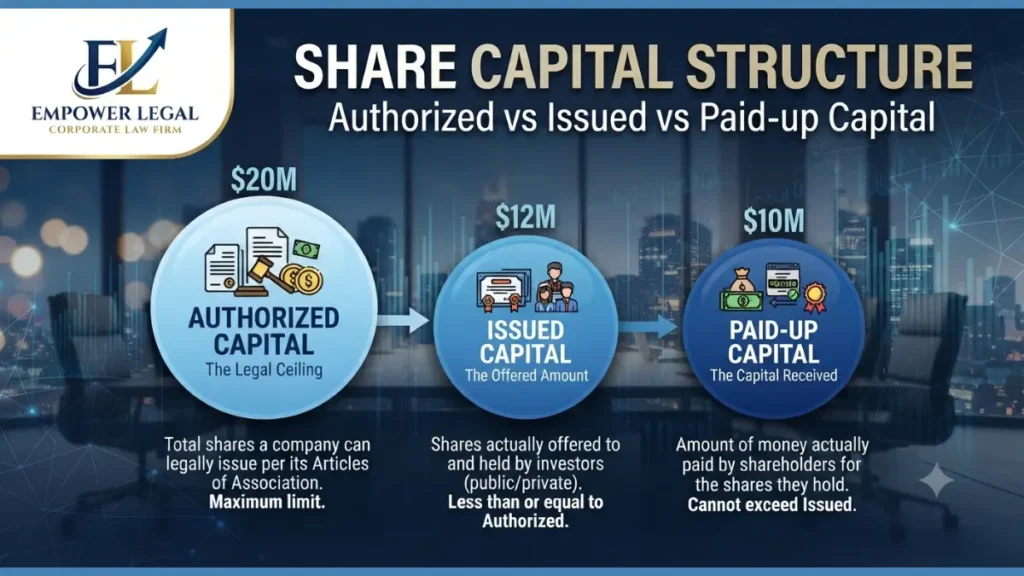
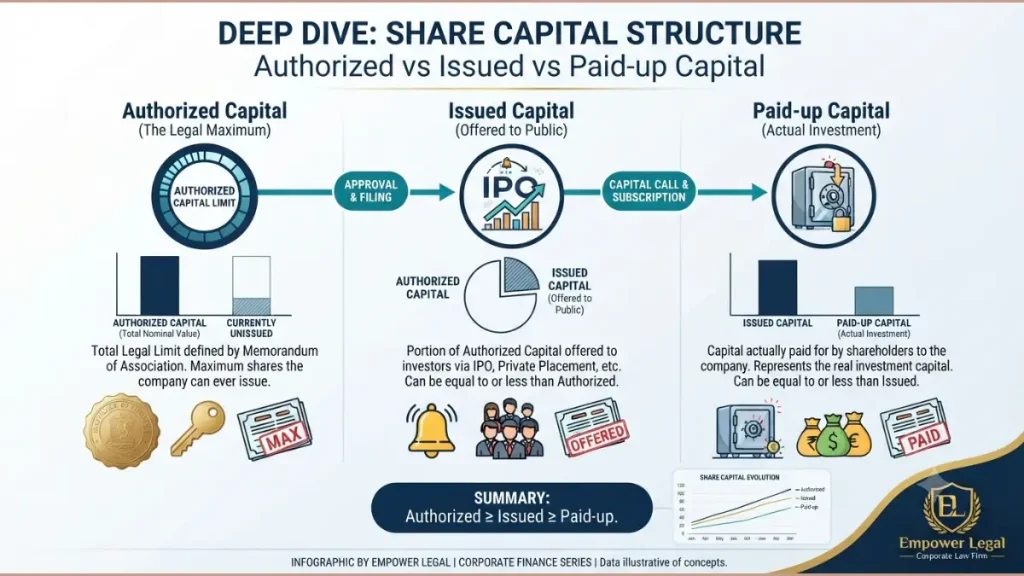
Authorized share capital represents the maximum share capital that a company’s constitutional documents permit. It creates the upper limit for issuing shares without further alteration. However, authorized capital does not automatically represent money received by the company. A company may authorize capital significantly above its immediate funding requirement. This approach can provide flexibility for future fundraising and ownership expansion. Nevertheless, the company must follow the Companies Act and its Articles during later issuances. An increase may require shareholder approval and prescribed regulatory filings. Therefore, directors should review the Memorandum of Association before proposing additional shares. Authorized capital also affects applicable statutory fees under the incorporation and capital framework. Companies should maintain consistent figures across statutory records and official communications. A mismatch can create compliance questions during due diligence, financing, audits, or corporate transactions.
Issued Capital Explained
Issued share capital represents the portion of authorized capital that the company offers or issues. Therefore, issued capital normally remains equal to or below authorized capital. A company does not need to issue its entire authorized capital immediately. Instead, directors can structure issuances according to business funding requirements. Issued shares may include equity shares or permitted preference share classes. The company must follow applicable procedures before making an allotment. These procedures may involve board action, shareholder approval, valuation, offer documents, and statutory filings. Consequently, the legal character of an issuance depends upon its circumstances and applicable provisions. Companies should also verify whether existing shareholders possess rights affecting the proposed issue. Pre-emptive rights, private placement requirements, preferential allotments, and other conditions may become relevant. Proper documentation helps establish the validity of issued capital during shareholder or regulatory scrutiny.
Subscribed Capital Explained
Subscribed capital represents the portion of issued capital that investors agree to take. Therefore, subscribed capital reflects commitments made by shareholders against shares offered by the company. The subscribed amount may equal the entire issued capital or remain lower. However, the exact treatment depends upon the company’s share issue and applicable legal requirements. Subscription records should identify shareholders, share quantities, class, face value, and payment obligations. Companies must also maintain accurate statutory registers and supporting allotment documentation. Subsequently, unpaid amounts may affect the distinction between subscribed and paid-up capital. Directors should therefore reconcile shareholder commitments with actual receipts and outstanding calls. This reconciliation becomes particularly important during fundraising, audits, and corporate restructuring. Investors also benefit from checking these figures during due diligence. A clear capital trail reduces uncertainty concerning ownership percentages and shareholder voting rights.
Paid-up Capital Explained
Paid-up capital represents the amount credited as paid on the company’s issued shares. Therefore, it reflects actual capital paid or treated as paid under applicable company records. Paid-up capital can differ from issued and subscribed capital when shares remain partly unpaid. Companies must maintain accurate records of amounts received against each shareholder’s securities. Furthermore, directors should ensure banking records support the stated capital position. Incorrect paid-up figures can affect annual returns, financial statements, and investor due diligence. They may also create disputes regarding ownership percentages and voting entitlements. Consequently, companies should reconcile share certificates, registers, allotment records, bank statements, and statutory filings. Where unpaid calls exist, the company should document the relevant terms and notices carefully. Professional corporate legal support can help identify inconsistencies before they become regulatory or shareholder disputes.
Capital Structure Comparison Table
The following comparison helps directors understand how each capital category functions within corporate records. Authorized capital establishes the permitted ceiling, while issued capital reflects shares actually offered. Subscribed capital records shareholder commitments, whereas paid-up capital records amounts credited as paid. Therefore, these categories should not appear as interchangeable terms in corporate documents. A simple example can demonstrate the relationship between the figures clearly. Suppose a company has authorized capital of ₹50 lakh. It issues shares worth ₹20 lakh and shareholders subscribe to ₹18 lakh. If shareholders pay ₹15 lakh, the paid-up capital may reflect that amount. However, exact treatment depends upon the terms and applicable statutory records. The company must therefore verify the underlying transactions before reporting figures. This distinction becomes valuable during investment negotiations, audits, and corporate restructuring.
| Capital Category | Basic Meaning | Typical Legal Function |
|---|---|---|
| Authorized Capital | Maximum permitted share capital | Establishes issuance ceiling |
| Issued Capital | Capital offered or issued | Records securities issued |
| Subscribed Capital | Capital accepted by shareholders | Records subscription commitments |
| Paid-up Capital | Amount credited as paid | Shows paid share capital |
Compliance, Alteration and Corporate Legal Issues
Increasing Authorized Share Capital
Companies may need higher authorized capital when existing limits cannot support planned issuances. Therefore, directors should examine the Memorandum and Articles before proposing an increase. The required corporate approval depends upon the company’s constitutional documents and applicable statutory provisions. After approval, the company must complete prescribed filings with the Registrar of Companies. MCA filings should accurately reflect the revised capital structure. The company should also update relevant registers, records, and constitutional documents. Furthermore, the board should preserve notices, resolutions, minutes, and supporting documents. Errors during this process can complicate later allotments or investment transactions. Investors may also request evidence showing that the company possessed sufficient authorized capital. Accordingly, corporate lawyers can review the proposed structure before filing. This approach helps prevent avoidable objections, resubmissions, penalties, and future shareholder challenges.
Issuing Shares Within Authorized Limits
A company can generally issue shares only within its available authorized capital. Therefore, directors should calculate the unutilized portion before approving a new allotment. The calculation should consider existing issued capital and proposed securities. Additionally, the company must examine the class and rights attached to proposed shares. Different issue routes can trigger different statutory procedures and disclosure requirements. Private companies should especially examine shareholder agreements and Articles before proceeding. Similarly, public companies may face additional securities-law requirements depending upon the transaction. The board should therefore identify the legal route before circulating offer documents. Supporting records should establish the commercial purpose and consideration for the issue. Moreover, valuation documentation may become important for certain issue structures. Careful preparation reduces risks involving defective allotments, shareholder objections, and regulatory scrutiny.
ROC and MCA Filing Requirements
Corporate capital changes frequently require filings through the Ministry of Corporate Affairs. Therefore, companies should identify the applicable form before completing a transaction. PAS-3 generally relates to returns of allotment, while SH-7 relates to alteration of share capital. The filing process also requires accurate corporate information and supporting resolutions. Consequently, companies should maintain a compliance checklist for each capital event. Important records can include board minutes, shareholder resolutions, valuation reports, offer letters, and payment evidence. Furthermore, companies should monitor statutory filing timelines carefully. Delayed filings can lead to additional fees and compliance complications. Incorrect information can create greater concerns during future audits or transactions. Accordingly, directors should obtain professional review when capital transactions involve complex structures. Regular reconciliation between MCA records and internal registers also strengthens corporate governance.
Shareholder Rights and Capital Dilution
New share issues can change existing ownership percentages and influence shareholder control. Therefore, directors should consider shareholder rights before approving additional capital. The Companies Act provides different mechanisms for issuing further securities. Depending upon the issue route, existing shareholders may receive statutory or contractual protections. Shareholder agreements can also impose consent requirements beyond statutory provisions. Consequently, a company should review all relevant documents before approving an issue. Dilution disputes often arise when shareholders believe an issue unfairly changes control. Such disputes may involve allegations concerning oppression, mismanagement, or improper corporate conduct. The National Company Law Tribunal can become relevant for statutory company-law remedies. However, the correct forum depends upon the specific cause of action. Early legal review can help identify procedural weaknesses before an allotment becomes contentious.
Reduction and Restructuring of Share Capital
Share capital reduction involves a different legal process from increasing authorized capital. Therefore, companies should not treat both transactions as routine administrative changes. Capital reduction can arise from restructuring, cancellation, adjustment of accumulated losses, or other permitted purposes. The Companies Act provides a statutory framework for reduction, including Tribunal involvement in relevant circumstances. NCLT proceedings can require notices, disclosures, creditor considerations, and procedural compliance. Consequently, directors should obtain detailed advice before approving a reduction proposal. The company must also evaluate accounting, tax, creditor, and shareholder consequences. Proper valuation and financial documentation can become important during restructuring. Additionally, the company’s Articles and existing contractual arrangements should receive careful review. A structured legal process reduces the risk of objections from creditors or shareholders. It also supports accurate post-restructuring corporate records.
Common Capital Structure Legal Issues
Share capital disputes can arise from procedural failures, inaccurate records, or contested ownership claims. Therefore, companies should identify potential risks before completing significant capital transactions. Common issues include unauthorized allotments, defective notices, forged signatures, unpaid subscriptions, and incorrect registers. Shareholders may also challenge transactions that allegedly dilute their interests unfairly. Additionally, disputes can arise when company records differ from shareholder agreements. The following risk areas deserve specific attention:
- Incorrect authorized capital stated in corporate documents.
- Unfiled or delayed allotment documentation.
- Disputed share ownership or transfer records.
- Inaccurate paid-up capital reported in filings.
- Procedural defects during preferential or private issues.
- Allegations of oppression or mismanagement.
These problems can affect corporate transactions, financing, and investor confidence. Therefore, timely legal review can prevent escalation into litigation.
Remedies for Capital Disputes
The appropriate remedy depends upon the transaction, evidence, statutory provision, and forum involved. Therefore, companies should avoid adopting a single remedy for every capital dispute. Legal options can include corporate representations, regulatory filings, rectification requests, injunctions, declarations, and tribunal proceedings. NCLT remedies may become relevant for matters falling within company-law jurisdiction. Civil courts may remain relevant for matters outside exclusive statutory forums. Additionally, criminal remedies can arise where conduct independently constitutes an offence. The following sequence can help organize a response:
- Preserve corporate records and transaction evidence.
- Identify the disputed capital transaction.
- Review the Articles and shareholder agreements.
- Issue appropriate legal notices where required.
- Approach the ROC or relevant authority.
- Consider NCLT, civil, or criminal proceedings where appropriate.
Legal strategy should follow the facts rather than assumptions about jurisdiction.
NCLT and Corporate Tribunal Proceedings
The National Company Law Tribunal handles numerous statutory company-law matters. Therefore, capital disputes may require careful assessment of NCLT jurisdiction. Applications involving oppression and mismanagement can involve shareholder conduct and corporate governance issues. Capital reduction and certain restructuring matters may also involve Tribunal processes. However, not every shareholder disagreement belongs before the NCLT. Counsel should first identify the statutory basis for the proposed proceeding. Evidence should establish the challenged transaction and the resulting legal prejudice. Board minutes, registers, notices, filings, financial statements, and correspondence can become important. Moreover, procedural compliance can significantly influence Tribunal proceedings. Companies should therefore prepare a chronological transaction file before initiating litigation. Professional representation can assist with pleadings, interim relief, evidence, and procedural strategy.
Civil Courts and Commercial Disputes
The Code of Civil Procedure, 1908 continues to provide the general procedural framework for civil litigation. However, statutory company-law forums may have exclusive jurisdiction over particular matters. Therefore, forum selection requires careful analysis before filing a suit. Commercial disputes can also involve contractual rights under shareholder agreements or investment arrangements. Such disputes may require examination under the Commercial Courts Act and applicable contractual principles. Consequently, lawyers should distinguish corporate statutory remedies from ordinary contractual remedies. Injunctions, declarations, recovery claims, and damages may arise depending upon the factual circumstances. Courts may also examine documentary evidence concerning agreements, payments, notices, and corporate records. Proper forum analysis can prevent dismissal or unnecessary procedural delay. Businesses should therefore obtain jurisdictional advice before commencing corporate litigation.
Fraud, Forgery and Criminal Complaints
Some capital disputes involve allegations beyond ordinary corporate non-compliance. For example, forged documents or dishonest conduct may create potential criminal-law consequences. The Bharatiya Nyaya Sanhita, 2023 now provides the principal general criminal-law framework. The Bharatiya Nagarik Suraksha Sanhita, 2023 governs criminal procedure. The Bharatiya Sakshya Adhiniyam, 2023 governs evidence principles in relevant proceedings. Therefore, companies should preserve original documents, electronic records, emails, payment records, and communication trails. A complaint may be considered before the police where facts disclose a cognizable offence. The appropriate police station depends upon jurisdiction and the facts of the alleged conduct. Chennai businesses may require assistance identifying the relevant local police jurisdiction. Lawyers can also coordinate corporate proceedings with appropriate criminal remedies. However, criminal allegations should rely upon evidence rather than merely commercial disagreement.
Police, Regulatory and Government Departments
Capital compliance primarily involves corporate authorities rather than ordinary police administration. The Registrar of Companies operates under the Ministry of Corporate Affairs. Therefore, routine capital filings should proceed through the prescribed MCA mechanisms. Regulatory concerns can involve the ROC, Regional Director, NCLT, or other authorities. SEBI may become relevant when listed entities or securities-market regulations apply. The Income Tax Department may become relevant where transactions create tax implications. Banks and financial institutions may also require capital records during financing or due diligence. Police authorities become relevant when facts disclose potential criminal conduct. Consequently, companies should map each issue to its proper government department. This avoids unnecessary complaints before authorities lacking jurisdiction. Empower Legal can help businesses organize regulatory communication and select appropriate legal forums.
Legal Support for Capital Transactions
Effective legal support begins before a company approves a significant capital transaction. Therefore, directors should seek advice during planning rather than after disputes emerge. Corporate lawyers can review the Articles, Memorandum, shareholder agreements, and previous allotments. They can also assess proposed resolutions and statutory filing requirements. Additionally, counsel can help structure documentation for equity issues and capital restructuring. Due diligence may reveal earlier allotments that require corrective action. Lawyers can also coordinate with company secretaries, accountants, valuers, and compliance professionals. This multidisciplinary approach supports accurate corporate records and commercially workable transactions. Furthermore, legal review can identify potential shareholder conflicts before implementation. The objective remains lawful execution, accurate documentation, and defensible corporate governance. Companies should retain a complete transaction file for future audits and investor reviews.
Capital Structure Due Diligence Checklist
Capital due diligence should verify whether corporate records tell one consistent story. Therefore, directors and investors should compare constitutional documents against MCA filings and internal registers. The following checklist provides a practical starting point:
- Verify authorized capital in the Memorandum.
- Reconcile issued and subscribed capital.
- Confirm paid-up amounts against bank records.
- Review every historical allotment.
- Check relevant PAS-3 filings.
- Check applicable SH-7 filings.
- Review board and shareholder resolutions.
- Examine share certificates and statutory registers.
- Identify shareholder agreements and transfer restrictions.
- Investigate disputed or unusual transactions.
This review can reveal inconsistencies before an investment or restructuring transaction. Moreover, it can help establish a reliable ownership history. Legal counsel should investigate material discrepancies before certifying transaction readiness. Early diligence generally provides better options for corrective action.
Corporate Records and Evidence Management
Capital transactions generate documents that may become important years after completion. Therefore, companies should maintain organized records for every issuance and alteration. Relevant records include notices, minutes, resolutions, valuation documents, applications, filings, certificates, and payment evidence. Electronic communications can also become important when disputes concern shareholder consent. The Bharatiya Sakshya Adhiniyam provides the current statutory evidence framework for relevant proceedings. Consequently, businesses should preserve electronic records with reliable audit trails. Companies should avoid deleting emails or transaction documents after disputes emerge. Directors should also maintain consistent versions of resolutions and supporting schedules. A clear document trail can assist auditors, investors, regulators, tribunals, and courts. Furthermore, organized records reduce the time required for legal due diligence. Empower Legal can assist with corporate record reviews and dispute-focused evidence organization.
Share Capital and Corporate Governance
Share capital directly connects ownership, voting rights, investment, and corporate control. Therefore, capital management forms an important part of corporate governance. Directors must exercise their powers consistently with statutory duties and constitutional documents. Shareholders also require transparent information concerning material capital transactions. Poor documentation can undermine confidence even when the underlying transaction has commercial merit. Conversely, clear procedures demonstrate disciplined corporate administration. Companies should therefore establish internal approval matrices for share issues and capital alterations. Finance teams should reconcile capital ledgers with statutory registers regularly. Secretarial teams should monitor filing deadlines and resolution requirements. Legal teams should review unusual transactions and potential shareholder conflicts. Together, these controls create a stronger corporate compliance framework. Sound governance also supports smoother fundraising, mergers, acquisitions, and investor due diligence.
Practical Capital Structure Example
Consider a private company that starts with authorized capital of ₹50 lakh. The founders initially issue shares worth ₹10 lakh. Therefore, issued capital remains below the authorized ceiling. Suppose shareholders subscribe to all ₹10 lakh but pay only ₹8 lakh. The company must then accurately record the relationship between subscription and payment. Later, an investor may subscribe to another ₹15 lakh. Before issuing those shares, the company should confirm sufficient authorized capital. It should also determine the correct statutory issue route and required approvals. If the company needs more authorized capital, it should complete the required alteration process first. Subsequently, the company should file the applicable forms and update records. This example demonstrates why capital categories cannot be treated as identical. Each figure describes a different stage within the company’s capital structure.
Legal Remedies and Corporate Action Roadmap
When capital problems arise, businesses should follow a structured response based on evidence and jurisdiction. First, identify whether the issue concerns authorization, allotment, subscription, payment, transfer, or recordkeeping. Next, examine the Articles, resolutions, statutory filings, and shareholder agreements. Then, determine whether corrective corporate action can resolve the problem. Regulatory communication may become appropriate where filing or record issues require correction. NCLT proceedings may become relevant for statutory company-law disputes. Civil proceedings may apply to contractual disputes outside exclusive Tribunal jurisdiction. Criminal complaints may become appropriate where evidence indicates an independent offence. Therefore, the remedy should match the legal character of the dispute. Businesses should also preserve evidence before sending contentious communications. Empower Legal provides corporate legal support covering compliance review, shareholder disputes, capital restructuring, and litigation strategy.
FAQs About Authorized, Issued and Paid-up Capital
What is authorized share capital?
Authorized share capital is the maximum share capital a company can issue under its constitutional documents. It does not represent money actually received from shareholders.
What is issued share capital?
Issued share capital represents the portion of authorized capital that the company offers or issues. Therefore, issued capital cannot normally exceed authorized capital.
What is paid-up share capital?
Paid-up share capital represents the amount credited as paid on issued shares. It can differ from subscribed capital when shares remain partly unpaid.
Can a company increase authorized capital?
Yes, a company may increase authorized capital by following the applicable Companies Act procedure. Required approvals, constitutional changes, and MCA filings must be completed.
Which form is used for share allotment?
PAS-3 generally records a company’s return of allotment. However, the precise filing requirements depend upon the nature and circumstances of the securities transaction.
Can shareholders challenge an improper share issue?
Yes, shareholders may have statutory or contractual remedies when an issue violates applicable rights. The appropriate forum depends upon the transaction and legal cause of action.
Conclusion: Building a Compliant Share Capital Structure
A clear share capital structure helps companies maintain accurate ownership and financial records. Therefore, directors should distinguish authorized, issued, subscribed, and paid-up capital carefully. Each category serves a separate function within corporate governance and statutory compliance. Companies should also monitor allotments, capital alterations, shareholder rights, and MCA filings consistently. Furthermore, businesses should investigate discrepancies before they affect fundraising or corporate transactions. NCLT, ROC, civil courts, regulatory authorities, and police may have different roles. The applicable forum depends upon the precise legal issue and available remedy. BNS, BNSS, and BSA may become relevant when capital disputes involve alleged criminal conduct or evidence issues. CPC may govern applicable civil proceedings where statutory jurisdiction does not displace ordinary civil procedure. Empower Legal supports businesses with corporate compliance, capital restructuring, shareholder disputes, due diligence, and litigation assistance. Early legal guidance can help companies preserve compliant records and protect legitimate corporate interests.