

Equity shares and preference shares represent distinct forms of ownership within Indian company law. The Companies Act, 2013 recognises equity share capital and preference share capital separately under Section 43. Equity shares generally carry broader voting rights and residual economic participation. Preference shares receive priority regarding specified dividends and capital repayment. Therefore, investors and promoters must understand their rights before selecting a share class. The distinction also affects corporate governance, fundraising, dividends, transfers, and shareholder remedies. Listed companies must additionally comply with applicable SEBI regulations and disclosure requirements. The Ministry of Corporate Affairs administers significant statutory compliance under the Companies Act. Meanwhile, the National Company Law Tribunal handles several company-law disputes and shareholder remedies. Consequently, proper documentation remains essential during share issuance and corporate restructuring. Empower Legal – Corporate Law Firm can assist with corporate compliance and shareholder matters. This article explains the legal differences using current Indian corporate-law principles.
Understanding Share Capital Under Indian Corporate Law
Equity Share Capital and Its Legal Character
Equity share capital forms the ordinary ownership structure of a company. Section 43 recognises equity shares with voting rights or prescribed differential rights. Equity shareholders usually participate in important company decisions through voting rights. They may also receive dividends when declared according to applicable law. However, dividends are not automatically guaranteed merely because shares are held. Equity shareholders generally participate in residual profits after required obligations and preferences. Their economic return can therefore rise or fall with company performance. Additionally, equity shares can provide substantial influence when ownership concentration becomes significant. Listed companies must follow SEBI requirements concerning disclosure, governance, and shareholder treatment. Private companies must also follow their articles and statutory restrictions. Therefore, reviewing constitutional documents remains important before assessing equity shareholder rights.
Voting Rights of Equity Shareholders
Equity shareholders generally possess voting rights on company resolutions. Section 47 states that equity shareholders can vote on every resolution placed before members. Voting rights on a poll generally correspond with paid-up equity share capital. Therefore, greater equity ownership can provide greater voting influence. However, voting structures may differ where valid differential voting rights apply. Shareholders should therefore examine the articles, share terms, and applicable statutory rules. Listed entities also face additional disclosure and governance requirements under SEBI regulations. Consequently, voting disputes can involve both company law and securities regulation. Common issues include improper notices, disputed voting eligibility, invalid resolutions, and alleged dilution. Shareholders should preserve meeting notices, attendance records, voting statements, and company correspondence. These documents can become important evidence during corporate litigation or tribunal proceedings.
Ordinary Voting Powers and Corporate Decisions
Voting rights influence resolutions involving directors, capital changes, and other corporate decisions. Equity shareholders can therefore participate directly in the company’s governance framework. However, the precise voting process depends upon the resolution and applicable statutory requirements. Special resolutions require higher voting thresholds under the Companies Act. Furthermore, shareholder agreements may create additional contractual obligations between parties. Such agreements cannot simply override mandatory statutory requirements. Consequently, companies should align shareholder agreements with their articles and statutory framework. Important records should include notices, explanatory statements, minutes, voting results, and scrutiniser reports. A shareholder facing procedural irregularities should promptly obtain corporate legal advice. Early review may identify whether correction, representation, or litigation is appropriate. Proper governance reduces disputes involving shareholder voting rights and corporate decision-making.
Dividend Participation and Residual Economic Rights
Equity shareholders normally participate in residual profits after statutory and contractual priorities. Dividend entitlement generally depends upon declaration and compliance with applicable requirements. Therefore, holding equity shares does not create an unconditional annual dividend guarantee. However, successful companies may distribute dividends according to approved corporate decisions. Equity shareholders can also benefit from appreciation in the value of their shares. Such appreciation depends upon company performance, market conditions, and investor expectations. Meanwhile, losses can reduce the economic value of equity holdings. This risk differs from preference arrangements carrying defined preferential rights. Investors should therefore assess both voting power and economic exposure. Companies should document dividend declarations accurately within statutory records and financial statements. Disputes may arise where shareholders allege unequal treatment or unlawful withholding. Legal review can clarify statutory rights, articles, resolutions, and available remedies.
Preference Share Capital and Priority Rights
Preference share capital carries preferential rights concerning specified dividends and capital repayment. Section 43 identifies preference capital through these preferential characteristics. Such shares may provide greater contractual certainty regarding dividend priority. However, preference shareholders do not ordinarily receive unrestricted voting rights. Their voting rights arise in specified circumstances under Section 47. Preference shares may also carry terms governing redemption, conversion, participation, or accumulation. Section 55 prohibits irredeemable preference shares under the Companies Act. Redeemable preference shares must satisfy statutory requirements and applicable conditions. Therefore, investors should examine the exact terms attached to every preference issue. Companies should also verify their articles before issuing preference shares. Proper approvals, disclosures, valuation, and statutory filings remain essential. Consequently, preference share documentation should clearly define dividend and redemption mechanics.
Preferential Dividend Rights
Preference shareholders generally receive priority regarding the dividend attached to their shares. The precise entitlement depends upon the terms governing the particular preference issue. Cumulative preference shares may carry unpaid dividends forward according to their terms. Non-cumulative preference shares generally do not accumulate unpaid dividends. Therefore, investors must distinguish contractual terms before assessing expected returns. Preference dividends still depend upon applicable statutory requirements and available distributable profits. The share terms should clearly identify the dividend rate and payment conditions. Companies should maintain accurate records concerning declarations, payments, arrears, and shareholder communications. Disputes may arise when companies interpret preference rights differently from investors. Legal review can examine the articles, resolutions, offer documents, and statutory filings. Additionally, listed companies must consider applicable SEBI disclosure obligations.
Cumulative and Non-Cumulative Preference Shares
Cumulative preference shares can preserve unpaid preferential dividends for future consideration. Non-cumulative preference shares generally do not carry forward unpaid dividends. Therefore, the difference can materially affect investor expectations during difficult financial periods. Companies should clearly state these terms in the relevant issue documentation. Investors should also verify whether participation rights accompany the preference shares. Participating preference shares may provide additional rights beyond basic preference entitlements. Non-participating shares normally remain limited to their specified preferential rights. Furthermore, convertible preference shares may provide conversion rights under agreed conditions. Redemption provisions can also determine the timing of capital repayment. Accordingly, investors should examine every term instead of relying upon the word preference. A corporate lawyer can review the issue structure before subscription or restructuring. Such review helps identify inconsistencies between documents and statutory requirements.
Voting Rights of Preference Shareholders
Preference shareholders generally have restricted voting rights compared with equity shareholders. Section 47 permits voting on resolutions directly affecting preference-share rights. Voting also applies to certain resolutions concerning winding up or capital repayment. Additional voting rights can arise where preference dividends remain unpaid for prescribed periods. The precise statutory position should be checked against the relevant share terms. Therefore, preference shareholders should not assume complete voting exclusion. Likewise, companies should not assume unrestricted voting rights for every preference class. Corporate notices should identify the relevant shareholder classes and voting entitlements accurately. Meeting procedures should also comply with statutory notice and record requirements. Disputes may involve improper exclusion from meetings or incorrect voting calculations. Appropriate corporate legal support can assess whether statutory or contractual rights were breached.
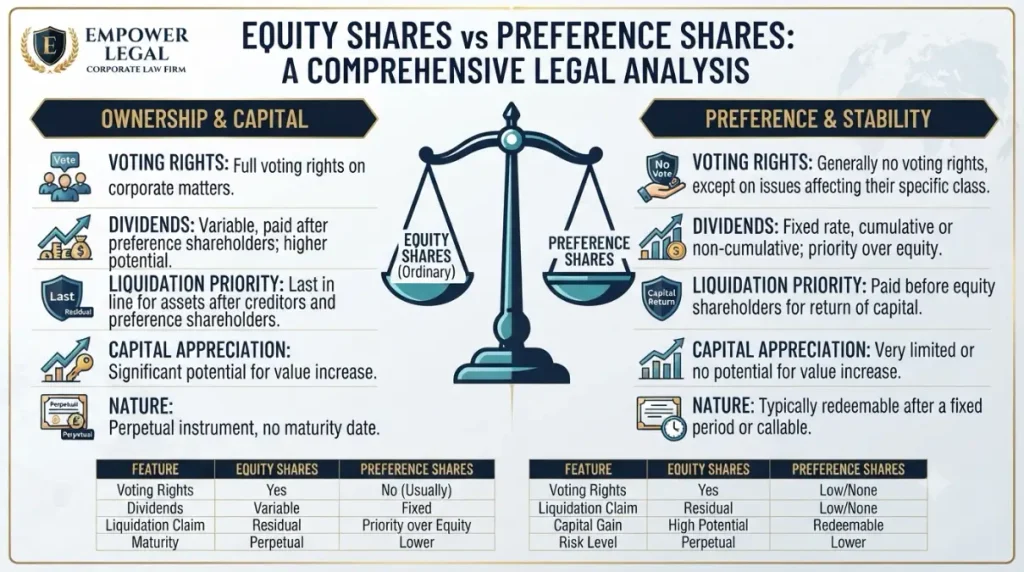
Equity Shares and Preference Shares Compared
Core Differences in Ownership and Financial Rights
Equity and preference shares differ mainly in voting, dividends, risk, and repayment priority. Equity shareholders usually possess broader voting rights across company resolutions. Preference shareholders generally receive priority regarding specified dividends and capital repayment. Equity shareholders usually carry greater residual participation after preferred claims. Preference shares may provide greater predictability through defined dividend arrangements. However, preference rights depend upon the specific terms governing each issue. The following comparison provides a practical starting point for corporate decision-making.
| Feature | Equity Shares | Preference Shares |
|---|---|---|
| Voting | Generally broad voting rights | Generally restricted voting rights |
| Dividend | Usually variable | Preferential according to terms |
| Capital repayment | Generally after preference capital | Preferential according to terms |
| Risk | Higher residual exposure | Priority protection, subject to terms |
| Redemption | Usually not structured as redeemable preference capital | Redemption permitted subject to Section 55 |
| Participation | Residual participation generally available | Depends upon participating terms |
| Governance | Stronger ordinary voting influence | Limited except statutory situations |
Therefore, the exact articles and issue terms remain critical for legal interpretation.
Shareholder Rights and Corporate Governance
Share rights directly influence corporate governance and shareholder participation. Equity investors commonly exercise greater influence through voting and board-related resolutions. Preference investors usually focus more strongly on dividend and capital protection. However, both classes remain members when legally recognised as shareholders. Therefore, companies must respect applicable rights attached to each share class. Corporate governance disputes can involve dilution, voting exclusion, dividend disputes, or improper allotment. Such disputes may require examination of board minutes and general meeting records. The articles of association can also contain important procedural provisions. Shareholder agreements may add contractual rights between identified parties. Yet mandatory statutory provisions continue to control where conflicts arise. Consequently, companies should obtain legal advice before changing rights attached to shares. Investors should also review corporate filings before purchasing significant holdings.
Key Factors for Investors and Promoters
Investors should assess the legal and commercial consequences before acquiring shares. Promoters should consider control, capital requirements, investor expectations, and future financing plans. A practical assessment can consider the following factors:
- Voting power and decision-making influence.
- Dividend structure and payment priority.
- Capital repayment priority during winding up.
- Conversion, participation, and redemption conditions.
- Transfer restrictions and shareholder agreements.
- Applicable SEBI requirements for listed entities.
- Potential shareholder dispute remedies.
Additionally, investors should review the company’s financial statements and statutory filings. Promoters should verify authorised capital and available issue capacity. Legal due diligence can identify inconsistencies before they become disputes. Therefore, structured advice often prevents expensive corporate litigation later.
Choosing the Appropriate Share Class
The appropriate share class depends upon the company’s financing objectives and investor expectations. Equity shares can support long-term ownership and broader governance participation. Preference shares can provide defined preferential economic rights under agreed terms. However, neither class automatically guarantees a particular financial outcome. Companies should match share terms with genuine funding and governance requirements. They should also assess future fundraising, conversion, redemption, and investor exit considerations. Listed companies must additionally consider applicable SEBI capital-market regulations. Private companies should review their articles and shareholder arrangements before issuing shares. A properly drafted term sheet can reduce ambiguity during negotiations. Furthermore, professional legal review can identify conflicts with existing shareholder rights. The final structure should align with the Companies Act and applicable rules.
Share Issuance, Transfer, and Documentation
Legal Requirements for Share Issuance
Share issuance requires careful compliance with the Companies Act and applicable rules. The company must identify the share class, number, price, and issue conditions. Board and shareholder approvals may apply depending upon the proposed transaction. Private placement transactions require compliance with specific statutory requirements. Listed companies face additional SEBI disclosure and securities-law obligations. The company should maintain accurate allotment records and statutory registers. Required filings must also be completed within applicable statutory timelines. Improper allotment can create disputes concerning ownership, voting, and corporate control. Therefore, companies should verify every document before completing an issue. Essential records include resolutions, offer documents, valuation materials, allotment returns, and shareholder communications. Corporate lawyers can coordinate legal review with company secretarial compliance teams.
Private Placement and Preferential Issue Considerations
Private placement and preferential issues involve specific statutory and regulatory procedures. Companies must identify eligible subscribers and follow prescribed approval requirements. Listed entities must also comply with applicable SEBI ICDR requirements. SEBI’s ICDR Regulations were last amended on March 21, 2026. Therefore, current regulatory verification remains essential before a listed-company issue. The process commonly requires careful attention to pricing, disclosures, approvals, and allotment records. Companies should avoid relying upon outdated templates or historical regulatory provisions. A current legal compliance checklist can reduce procedural errors. Key review points include:
- Board approval and shareholder approval.
- Valuation and pricing compliance.
- Disclosure of relevant material information.
- Allotment and statutory filing requirements.
- Dematerialisation and securities-law requirements.
Legal counsel should coordinate with the company secretary and authorised intermediaries.
Transfer Restrictions and Rectification Remedies
Share transfers can create disputes when companies refuse registration or delay updating membership records. Section 58 provides remedies concerning refusal of registration and related appeals. Section 59 addresses rectification of the register of members. Therefore, shareholders should preserve transfer instruments and company correspondence carefully. Public-company securities generally enjoy statutory transferability subject to applicable law. However, private companies may impose valid restrictions through their articles. A transferee may challenge an unjustified refusal before the appropriate tribunal. The tribunal can direct registration or rectification in qualifying circumstances. It may also grant appropriate relief concerning damages where legally available. Consequently, transfer disputes require prompt review of statutory timelines. Companies should provide legally compliant reasons when refusing registration. Proper documentation can prevent unnecessary escalation into corporate litigation.
Corporate Disputes, Remedies, and Legal Forums
Shareholder Disputes and Oppression Claims
Shareholder disputes can arise from dilution, exclusion, voting irregularities, or alleged unfair management. The Companies Act provides specialised remedies for oppression and mismanagement. NCLT handles several company-law disputes under its statutory jurisdiction. Its functions include oppression and mismanagement matters and rectification of membership records. Therefore, shareholders should identify the correct statutory remedy before filing proceedings. Evidence should connect the alleged conduct with specific shareholder prejudice. Mere disagreement with business decisions does not automatically establish legal oppression. Courts and tribunals examine the applicable statutory and factual framework. Consequently, detailed pleadings and supporting documents become especially important. Shareholders should preserve resolutions, notices, financial records, correspondence, and shareholding statements. Legal support can assist with jurisdiction, limitation, pleadings, evidence, and interim relief.
NCLT Chennai and Company Law Proceedings
The NCLT Chennai Bench handles company-law matters within its assigned territorial jurisdiction. NCLT jurisdiction includes several disputes involving shareholding and corporate governance. Relevant proceedings can involve oppression, mismanagement, rectification, capital reduction, and other statutory matters. Therefore, Chennai-based companies should assess NCLT jurisdiction before commencing proceedings. The tribunal process differs from ordinary civil litigation in structure and statutory foundation. Legal practitioners must identify the applicable section and prescribed procedural requirements. Supporting documents should demonstrate the factual basis for the requested remedy. Furthermore, corporate records should remain consistent throughout the proceeding. NCLT orders can have significant consequences for company management and shareholder rights. Parties should therefore assess interim and final remedies carefully. Empower Legal can provide legal assistance concerning corporate disputes and shareholder rights.
NCLAT Appeals and Appellate Remedies
NCLAT hears appeals against specified orders of NCLT under the Companies Act. NCLAT was constituted under Section 410 of the Companies Act. Its Chennai Bench operates from Ezhilagam Annex at Chepauk, Chennai. Therefore, eligible parties can pursue appellate remedies through the prescribed process. Appeals require careful attention to statutory limitation and filing requirements. The appellant should obtain the complete NCLT order and relevant case records. Grounds of appeal should identify legal or factual errors requiring appellate consideration. NCLAT filing procedures also require accurate case and jurisdiction details. Consequently, defective filings can create avoidable procedural complications. Legal counsel can assist with drafting, limitation review, evidence compilation, and appellate strategy. Parties should not assume that every company dispute automatically reaches NCLAT. Jurisdiction depends upon the statute and nature of the challenged order.
Civil Courts, CPC, and Ancillary Corporate Claims
The Code of Civil Procedure, 1908 governs procedure in civil courts. However, statutory company-law matters may fall within specialised tribunal jurisdiction. Therefore, parties must identify whether a civil court can entertain the particular claim. Contractual shareholder disputes can raise separate questions under the Indian Contract Act. Property, fraud, damages, or other ancillary issues may require different legal analysis. The CPC remains relevant where a competent civil court exercises jurisdiction. Courts may consider pleadings, documents, interim applications, and evidence under applicable procedural law. However, statutory bars or specialised remedies can affect maintainability. Consequently, corporate litigants should avoid filing overlapping proceedings without legal analysis. A lawyer should map every cause of action before selecting the forum. This approach can reduce jurisdictional objections and procedural delays.
Fraud, Forgery, and Criminal Complaint Issues
Share disputes can sometimes involve allegations of forged documents, dishonest transactions, or impersonation. Such allegations require separate criminal-law analysis from company-law remedies. The Bharatiya Nyaya Sanhita, 2023 replaced the Indian Penal Code framework from July 1, 2024. The Bharatiya Nagarik Suraksha Sanhita, 2023 governs criminal procedure from the same date. Therefore, criminal complaints arising from alleged share fraud should use the current statutory framework. Evidence may include electronic communications, corporate records, signatures, transaction records, and digital documents. The Bharatiya Sakshya Adhiniyam, 2023 governs evidence under the current framework. However, not every corporate disagreement constitutes a criminal offence. Parties should distinguish contractual breaches from conduct satisfying criminal-law ingredients. Appropriate legal advice can coordinate company-law and criminal-law remedies.
Evidence Preservation and Digital Corporate Records
Corporate disputes increasingly depend upon electronic records and digital communications. Relevant evidence may include emails, board communications, electronic voting records, and digital filings. The Bharatiya Sakshya Adhiniyam, 2023 provides the current Indian evidence framework. Therefore, parties should preserve original electronic records and relevant metadata where possible. Screenshots alone may not provide the complete evidentiary context. Companies should maintain reliable backups and controlled access to sensitive records. Shareholders should preserve communications concerning allotment, transfer, dividends, voting, and corporate meetings. A litigation hold can help prevent accidental deletion of relevant records. Furthermore, forensic review may assist where authenticity or alteration is disputed. Lawyers can coordinate evidence collection with technology and compliance professionals. Proper preservation improves the reliability of proceedings before courts and tribunals.
Police Complaints and Chennai Jurisdictional Support
Criminal allegations involving share fraud may require a complaint before the appropriate police authority. The applicable police jurisdiction depends upon the facts and location of the alleged offence. Chennai has multiple police stations serving different territorial areas. Therefore, parties should identify the correct station before submitting a complaint. Companies should provide clear facts rather than merely asserting legal conclusions. Supporting documents can include share certificates, transfer instruments, resolutions, emails, and financial records. Where specialised company remedies exist, police action does not necessarily replace tribunal proceedings. Conversely, serious allegations involving forgery or cheating may require criminal investigation. Legal counsel can coordinate parallel remedies while avoiding inconsistent pleadings. Parties should also consider whether complaints require escalation through senior police authorities. The appropriate strategy depends upon the evidence and statutory ingredients.
Practical Remedies for Shareholders and Companies
Statutory and Corporate Remedies
Shareholders and companies can consider several remedies depending upon the dispute. The correct remedy depends upon the statutory provision, facts, and available evidence. Potential remedies include:
- Rectification of the register of members.
- Appeal against refusal to register a share transfer.
- Proceedings concerning oppression and mismanagement.
- Corporate governance and regulatory complaints.
- NCLT proceedings under applicable Companies Act provisions.
- NCLAT appeals against eligible NCLT orders.
- Civil proceedings where jurisdiction legally exists.
- Criminal complaints for qualifying offences.
Each remedy carries separate limitation and procedural requirements. Therefore, parties should avoid treating all shareholder disputes identically. Early legal review can identify the appropriate forum and relief.
Documents Required for Corporate Legal Support
Effective corporate legal advice depends upon complete and accurate documentation. Lawyers should review the company’s constitutional and transactional records first. A useful document set can include:
- Memorandum and Articles of Association.
- Share certificates and dematerialised holding statements.
- Board and shareholder meeting minutes.
- Shareholder agreements and investment documents.
- Valuation reports and allotment records.
- Registrar of Companies filings.
- Dividend declarations and payment records.
- Transfer instruments and correspondence.
- SEBI disclosures for listed companies.
- Relevant financial statements and audit records.
Additionally, parties should preserve electronic communications connected with the dispute. Complete records help lawyers assess rights, liabilities, limitation, and jurisdiction. They also improve drafting quality before tribunals and courts. Therefore, documentation should begin before formal litigation whenever possible.
MCA, ROC, SEBI, and Regulatory Compliance
Corporate share transactions involve several regulatory institutions depending upon the company and transaction. The Ministry of Corporate Affairs administers the Companies Act framework. The Registrar of Companies maintains statutory corporate records and receives prescribed filings. SEBI regulates relevant securities-market activities involving listed entities and specified securities. Current SEBI regulations include LODR and ICDR frameworks. SEBI’s published regulatory database shows LODR amendments through July 14, 2026. Its ICDR regulations were amended through March 21, 2026. Therefore, listed-company transactions require current regulatory verification. Companies should also coordinate legal review with company secretarial and financial professionals. Regulatory compliance should cover disclosures, approvals, allotments, transfers, and governance obligations. Proper coordination reduces risks of penalties, shareholder disputes, and regulatory proceedings.
Current Compliance Checklist for Share Transactions
Companies can use a structured checklist before issuing or restructuring share capital. The checklist should cover legal authority, approvals, documentation, and regulatory filings. A practical sequence includes:
- Review the memorandum and articles.
- Confirm authorised and existing share capital.
- Determine the correct share class.
- Draft commercial and legal terms.
- Obtain required board approvals.
- Obtain shareholder approval where required.
- Complete valuation and pricing requirements.
- Prepare statutory notices and disclosures.
- Complete allotment and transfer records.
- File applicable forms with regulatory authorities.
- Update registers and beneficial ownership records.
- Provide required investor communications.
This process should be adapted to the transaction and company structure. Listed entities require additional SEBI compliance and exchange-related procedures.
Choosing Corporate Legal Assistance in Chennai
Corporate share disputes require legal advice that combines statutory interpretation and practical corporate knowledge. Empower Legal can assist companies, promoters, investors, and shareholders with corporate matters. Support may cover share issuance, shareholder agreements, voting disputes, transfers, and governance concerns. It can also include NCLT proceedings and eligible NCLAT appeals. Chennai-based clients may require coordination with the NCLT Chennai Bench. Listed companies may additionally require SEBI and stock-exchange compliance review. Legal assistance can also address documentation, evidence preservation, and regulatory correspondence. Criminal allegations may require coordination with separate criminal-law professionals. Therefore, the legal team should understand the complete factual background before recommending proceedings. Early advice can identify settlement opportunities and statutory remedies. Proper representation also helps maintain consistency across regulatory and judicial forums.
Strategic Legal Review Before Investing or Issuing Shares
A legal review before investment can identify risks attached to share rights. Investors should understand voting, dividend, conversion, redemption, and transfer conditions. Promoters should understand dilution, control, governance, and future fundraising implications. Companies should also confirm compliance with their articles and statutory requirements. Listed companies must review current SEBI regulations before completing securities transactions. Private companies should examine shareholder agreements and transfer restrictions carefully. A legal due diligence exercise can identify unresolved disputes or inconsistent corporate records. It can also examine past allotments, transfers, and capital restructurings. Consequently, legal review can support informed commercial negotiations. However, legal due diligence does not eliminate commercial or market risks. Shareholders should therefore combine legal analysis with appropriate financial evaluation. Empower Legal can assist with corporate documentation, compliance review, and shareholder dispute support.
Frequently Asked Questions
What is the main difference between equity and preference shares?
Equity shares generally provide broader voting rights and residual profit participation. Preference shares receive priority for specified dividends and capital repayment, subject to their terms and law.
Do preference shareholders have voting rights?
Yes, but their voting rights are generally restricted. Section 47 provides voting rights for specified resolutions affecting preference rights, winding up, and certain capital matters.
Can preference shares be redeemed in India?
Yes. Section 55 permits redeemable preference shares subject to statutory conditions. Companies cannot issue irredeemable preference shares under the Companies Act, 2013.
Which forum handles shareholder disputes?
NCLT handles several statutory company disputes, including oppression and mismanagement. Eligible appeals from NCLT orders generally proceed before NCLAT under applicable provisions.
Can a shareholder challenge refusal of share transfer?
Yes. Section 58 provides a statutory appeal mechanism against certain refusals. Section 59 also permits rectification of the register in qualifying circumstances.
Do BNS, BNSS, and BSA apply to share disputes?
They may apply when disputes involve alleged criminal conduct or evidentiary issues. Company-law remedies remain separate and depend upon the facts and statutory jurisdiction.