

Introduction: Building Reliable Corporate Records
Statutory registers and corporate records form the foundation of transparent company administration in India. Proper records support governance, audits, inspections, shareholder rights, and regulatory compliance. The Companies Act, 2013 requires companies to maintain specified registers, returns, minutes, and supporting documents. Section 94 addresses the place and inspection of statutory registers and annual returns. Therefore, companies should establish reliable systems for creating, updating, securing, and retrieving records. Good corporate record management also supports directors during regulatory reviews and shareholder disputes. Furthermore, accurate records can assist companies during mergers, investments, financing, restructuring, and due diligence. Listed entities face additional obligations under securities regulations and SEBI requirements. SEBI’s current regulatory framework includes continuing obligations concerning document preservation and corporate governance. Consequently, businesses should treat statutory registers as continuing governance responsibilities. Empower Legal – Corporate Law Firm provides corporate legal support for statutory registers and compliance systems. This article explains essential registers, maintenance duties, inspection rights, legal risks, forums, and remedies.
Statutory Register Framework for Indian Companies
Companies Act Requirements
Core Statutory Registers
Register of Members and Security Holders
The register of members remains one of the company’s fundamental statutory records. Companies should maintain accurate details concerning members, shareholding, transfers, and related security interests. Section 88 forms the statutory basis for prescribed registers concerning members and security holders. The Companies Act also regulates the location and inspection of these registers. Therefore, companies should update ownership records after valid transfers and corporate actions. Entries should correspond with supporting instruments and approved board decisions. Furthermore, companies should reconcile statutory records with financial and secretarial records periodically. Differences can create shareholder disputes and regulatory concerns. A company should maintain appropriate evidence supporting every material entry. This approach helps during annual return preparation and corporate due diligence. Listed companies may face additional requirements under securities regulations. SEBI’s LODR framework continues to govern listed entity obligations. Consequently, companies need coordinated company law and securities law compliance. Corporate lawyers can review registers and identify inconsistencies before they become serious legal issues.
Register of Directors and Key Managerial Personnel
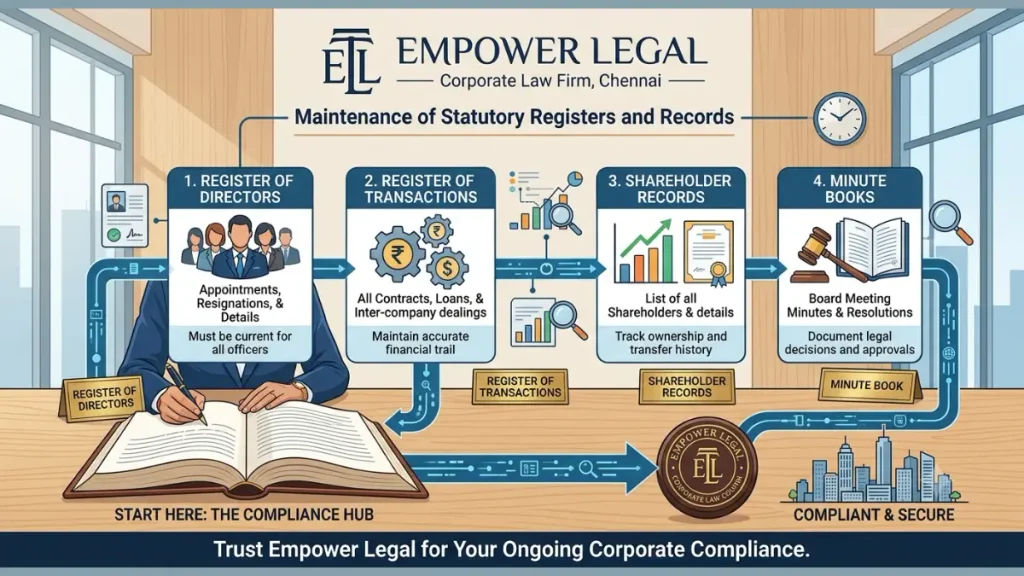
Companies should maintain current information concerning directors and key managerial personnel. The records should reflect appointments, resignations, changes, and relevant prescribed particulars. Director-related records support corporate governance and statutory disclosure obligations. Furthermore, companies should reconcile register information with MCA filings and board minutes. An inconsistency can create questions during regulatory scrutiny or corporate transactions. Companies should also retain supporting appointment documents, consent forms, disclosures, and resignation records. Section 94 establishes important requirements concerning statutory registers and inspection. Therefore, record maintenance should continue after each board or shareholder decision. Secretarial teams should use documented compliance calendars and verification procedures. Directors should receive timely advice about disclosure responsibilities and record updates. Corporate lawyers can conduct statutory register audits before annual compliance periods. This review can identify missing entries, outdated information, or incomplete supporting documents. Consequently, companies can correct records before regulatory authorities identify the problem.
Registers Concerning Corporate Interests
Contracts and Interested Transactions
Register of Contracts and Arrangements
Companies must maintain prescribed records concerning contracts and arrangements involving interested directors. Section 189 specifically addresses registers covering contracts or arrangements under sections 184 and 188. The register should contain prescribed particulars and remain available for specified inspection rights. Furthermore, relevant entries should receive appropriate board-level attention. The section requires the register to be placed before the next board meeting. Directors present at that meeting must sign the register. Therefore, companies should connect register maintenance with board meeting procedures. Secretarial professionals should reconcile contracts with declarations of interest and board approvals. Related party transactions require particularly careful documentation and compliance monitoring. Listed entities also face additional SEBI requirements concerning related party transactions. SEBI’s current LODR framework remains subject to continuing amendments and regulatory updates. Consequently, companies should review both Companies Act and securities requirements.
Register of Loans, Guarantees and Investments
Corporate records should accurately document loans, guarantees, securities, and investments made under applicable provisions. Such transactions can involve statutory approvals, board resolutions, shareholder approvals, and financial disclosures. Companies should maintain supporting documents alongside the relevant statutory register. The compliance team should verify transaction limits before recording or implementing transactions. Furthermore, directors should receive clear advice concerning applicable restrictions and approval requirements. The Companies Act contains provisions governing corporate loans, guarantees, securities, and investments. These provisions can create substantial compliance exposure when companies overlook procedural requirements. Therefore, every transaction should receive legal and secretarial review before completion. Records should identify transaction dates, counterparties, amounts, approvals, and supporting agreements. Companies should also reconcile these records with accounting and financial statements. This process can reveal mismatches before annual audit procedures begin. Corporate legal assistance can help companies establish transaction-specific compliance checklists. Consequently, proper records strengthen governance and reduce risks involving unauthorised corporate transactions.
Record Maintenance, Inspection and Preservation
Maintaining Records at the Registered Office
Location and Accessibility
Registered Office Compliance
Companies generally maintain statutory registers and annual returns at the registered office. Section 94 establishes the statutory framework concerning the location and inspection of these records. Certain records may qualify for alternative locations under prescribed conditions. Companies should therefore verify the statutory requirements before storing records elsewhere. The board and secretarial team should maintain a documented record-location policy. Furthermore, employees should know who controls access to statutory registers. Physical records require protection from fire, water, theft, and unauthorised alteration. Digital records require secure access controls, backups, and reliable audit trails. Companies should also maintain procedures for producing records during inspections. Members and specified security holders may have statutory inspection rights. Therefore, companies should avoid unnecessary barriers to lawful inspection. Proper access procedures protect both shareholder rights and confidential corporate information. Corporate lawyers can review record-location policies and inspection procedures periodically. This creates stronger governance and improves regulatory readiness.
Electronic Records and Digital Security
Modern companies increasingly maintain statutory records through secure electronic systems. Digital maintenance can improve searchability, access control, backups, and compliance monitoring. However, electronic records still require accuracy and reliable preservation. Companies should protect systems against unauthorised editing, deletion, or cyber incidents. Furthermore, access should follow defined roles based on corporate responsibilities. Every material change should retain an appropriate audit trail where technology permits. Digital records should remain readable and retrievable throughout the legally required preservation period. Listed entities face additional document-preservation requirements under SEBI regulations. SEBI guidance identifies permanent preservation categories and records requiring preservation for specified periods. Therefore, listed companies should maintain a formal document-preservation policy. Private companies should also adopt similar controls for important governance records. Secure backups should remain available at suitable intervals. Corporate legal and information-security teams should coordinate record retention procedures. Consequently, digital compliance can remain both efficient and legally defensible.
Annual Returns and Supporting Records
Connecting Registers With Filings
Annual Return Reconciliation
Annual returns depend heavily on accurate statutory registers and corporate records. Companies should reconcile member details, directors, share capital, and prescribed disclosures before filing. Section 92 governs annual return requirements under the Companies Act. Therefore, annual return preparation should not begin with data collection alone. Companies should first confirm the accuracy of underlying statutory registers. Differences between registers and MCA filings can create compliance concerns. Secretarial teams should document their reconciliation process for future reference. Furthermore, changes during the financial year should receive appropriate supporting evidence. Share transfers, allotments, director changes, and registered office changes require careful review. The company should also reconcile board minutes with statutory records. This process can identify transactions that require additional filings or approvals. Corporate compliance lawyers can conduct pre-filing reviews and statutory register audits. Consequently, companies can reduce errors before submitting annual returns to the Registrar. Reliable reconciliation also supports future investment due diligence and corporate restructuring.
Minutes and Board Records
Minutes provide important evidence of corporate decisions and governance processes. Companies should maintain minutes for board meetings and applicable general meetings. The Companies Act establishes requirements concerning minutes, records, and preservation. Companies should record decisions accurately without creating misleading or incomplete summaries. Furthermore, minutes should correspond with resolutions, statutory entries, and filed documents. An inconsistency can weaken the company’s position during disputes or regulatory scrutiny. Directors should receive adequate opportunities to review relevant minutes according to applicable procedures. Secretarial teams should maintain secure records of signed minutes and related documents. Digital storage should preserve authenticity and prevent unauthorised alterations. Companies should also maintain an organised index for rapid retrieval. Corporate lawyers can review sensitive resolutions before finalisation. This approach helps identify wording that may create unintended legal consequences. Therefore, strong minute management supports both statutory compliance and corporate governance. Proper records can also assist courts, tribunals, auditors, and regulators when disputes arise.
Inspection Rights and Confidentiality
Shareholder and Regulatory Inspection
Inspection by Members
Certain statutory registers remain open for inspection by eligible members and security holders. Section 94 addresses inspection rights concerning specified registers and returns. Companies should establish a clear procedure for handling inspection requests. The procedure should identify authorised personnel responsible for responding to requests. Furthermore, the company should verify the applicant’s statutory entitlement before providing access. Lawful inspection should not face arbitrary restrictions or unnecessary delays. Companies should also protect information that remains confidential under applicable law. Copies and extracts may have statutory implications depending on the relevant register. Therefore, compliance teams should follow prescribed procedures rather than informal practices. Directors and company secretaries should receive training on inspection requirements. Legal counsel can review disputed requests involving shareholder rights or confidentiality. This becomes particularly important during shareholder conflicts or management disputes. Consequently, a documented inspection process can protect both corporate rights and stakeholder rights.
Regulatory Inspection and Investigation
Government authorities can examine corporate records during statutory inspections and investigations. The Registrar of Companies can exercise powers under the Companies Act. Other authorities may examine records under specialised laws and regulatory frameworks. Listed companies may also face SEBI scrutiny concerning securities-law compliance. SEBI maintains extensive regulatory powers and publishes continuing regulatory requirements. Therefore, companies should maintain inspection-ready records throughout their operations. Records should remain complete, consistent, indexed, and accessible to authorised personnel. Employees should avoid destroying documents that may relate to pending investigations. A legal hold process can help preserve relevant records during disputes. Furthermore, companies should route regulatory communications through designated compliance personnel. Lawyers can advise companies when notices, summons, or inspection requests arrive. They can also assess whether responses require board approval or professional certification. Consequently, timely legal support can reduce procedural errors during regulatory scrutiny.
Corporate Legal Risks, Forums and Remedies
Common Statutory Record Issues
Compliance Failures and Disputes
Missing or Inaccurate Entries
Missing entries can weaken corporate governance and create regulatory compliance concerns. Errors may involve incorrect names, dates, shareholding details, transaction values, or approval references. Some mistakes arise from delayed updates after corporate events. Others result from inconsistent information across different registers and MCA filings. Therefore, companies should conduct periodic statutory register verification. A structured audit can identify missing entries before annual filing deadlines. Furthermore, corrections should follow legally appropriate procedures and preserve an adequate audit trail. Companies should never manipulate historical records to conceal earlier mistakes. Instead, management should obtain professional advice before making material corrections. Corporate secretarial professionals can determine the appropriate corrective process. Lawyers can assess whether a mistake requires additional filing, disclosure, or regulatory communication. This approach can reduce the consequences of accidental non-compliance. It also helps demonstrate responsible corporate governance during later inspections. Consequently, companies should treat register accuracy as an ongoing responsibility.
Non-Compliance by Directors and Officers
Directors and officers may face consequences when companies fail to maintain required statutory records. Responsibility depends on the specific statutory provision and the person’s role. The Companies Act contains penalties for various compliance failures. Section 189, for example, provides a penalty for specified director non-compliance. Therefore, directors should understand their responsibilities before approving transactions. Company secretaries should maintain compliance calendars covering registers, filings, meetings, and disclosures. Furthermore, board members should receive reminders before statutory deadlines. Internal compliance reviews can identify gaps in governance processes. Directors should also document decisions relating to complex transactions and regulatory risks. Legal counsel can advise directors when a compliance failure becomes apparent. Prompt corrective action may reduce continuing exposure in appropriate circumstances. Companies should avoid assuming that delegation completely eliminates director responsibilities. Consequently, strong compliance systems protect both companies and responsible officers.
Courts, Tribunals and Regulatory Forums
Corporate Dispute Resolution
National Company Law Tribunal
The National Company Law Tribunal handles specified company-law matters under its statutory jurisdiction. Corporate disputes can involve oppression, mismanagement, shareholder rights, restructuring, and related company-law issues. Statutory record disputes may become relevant within larger corporate proceedings. However, not every register issue belongs before the NCLT. Jurisdiction depends on the governing provision and facts of the dispute. Therefore, companies should identify the statutory basis before initiating proceedings. NCLT proceedings require careful preparation of pleadings and supporting corporate records. Board minutes, registers, resolutions, agreements, and MCA filings may become important evidence. The tribunal may examine corporate conduct through statutory and documentary records. Consequently, inaccurate records can affect the credibility of a company’s position. Corporate lawyers can assess jurisdiction, limitation, evidence, and available remedies. They can also coordinate litigation strategy with company secretarial professionals. Proper preparation can improve procedural efficiency and reduce avoidable objections.
NCLAT, High Courts and Appeals
Certain NCLT decisions can become subject to statutory appellate mechanisms. The National Company Law Appellate Tribunal handles appeals within its prescribed jurisdiction. High Courts may also become relevant in appropriate company-law matters. The correct forum depends on the statute, order challenged, and available remedy. Therefore, companies should avoid filing proceedings without jurisdictional analysis. Appeals require careful attention to limitation periods and certified orders. Corporate records can become central evidence during appellate proceedings. Furthermore, electronic records may require appropriate authentication under applicable evidence law. The Bharatiya Sakshya Adhiniyam, 2023 provides India’s current statutory framework concerning evidence. Legal teams should preserve documents that may become relevant during corporate litigation. They should also maintain consistent versions of important corporate records. Consequently, reliable records can strengthen a company’s position during appeals. Empower Legal can assist companies with forum assessment, documentation, notices, and corporate litigation support.
Registrar of Companies and Other Authorities
The Registrar of Companies remains a principal corporate compliance authority under the Companies Act. Companies submit prescribed forms and records through the MCA regulatory system. The Ministry of Corporate Affairs administers the Companies Act framework and related rules. MCA materials identify the statutory foundations for management and administration rules. Therefore, companies should monitor MCA notifications and regulatory changes. Other government departments may become relevant depending on the company’s business activities. SEBI regulates listed entities and securities-market participants within its statutory mandate. Labour authorities, tax departments, competition authorities, and sector regulators may also require records. Consequently, companies should map records according to every applicable regulatory jurisdiction. Legal counsel can help identify overlapping compliance obligations. This approach prevents companies from treating Companies Act compliance as their only responsibility. A coordinated compliance matrix can improve accountability across departments.
Legal Remedies and Corporate Support
Corrective and Preventive Remedies
Compliance Rectification
Companies can often address record deficiencies through appropriate corrective compliance measures. The exact remedy depends on the nature, duration, and impact of the error. Options may include correction, additional filing, disclosure, board approval, or professional certification. Certain matters may require applications or regulatory interaction under applicable provisions. Therefore, companies should first identify the statutory source of the defect. Legal counsel can evaluate whether rectification requires shareholder or board action. Secretarial professionals can prepare updated registers and supporting documentation. Furthermore, companies should preserve evidence explaining the correction. A documented corrective process demonstrates responsible governance. It can also help auditors and regulators understand the circumstances. Companies should never backdate records or fabricate missing approvals. Such conduct can create more serious legal exposure. Consequently, transparent rectification generally provides a safer compliance approach. Empower Legal can advise management on corrective steps and continuing compliance controls.
Legal Notices and Negotiated Resolution
Shareholder disputes concerning statutory records may sometimes be resolved through communication and negotiated arrangements. A legal notice can clarify the requested inspection, correction, disclosure, or corporate action. However, notices should accurately identify statutory rights and factual circumstances. Companies should avoid aggressive correspondence that creates unnecessary escalation. Furthermore, shareholders should receive responses within legally appropriate timelines. Negotiation can address access arrangements, disputed entries, document production, and governance concerns. Mediation may provide another option where parties seek structured settlement discussions. Corporate lawyers can draft notices, responses, settlement terms, and governance undertakings. This approach can reduce litigation costs in suitable cases. However, settlement cannot override mandatory statutory duties or regulatory requirements. Therefore, legal review remains necessary before finalising any corporate settlement. Companies should document agreed actions through appropriate board or shareholder resolutions. Consequently, negotiated solutions can support efficient corporate governance when legally permissible.
24×7 Corporate Legal Assistance
Statutory register issues can emerge during audits, financing, acquisitions, shareholder disputes, and regulatory inspections. Prompt advice can prevent small documentation issues from becoming larger compliance problems. Empower Legal – Corporate Law Firm provides corporate legal support for statutory registers and records. Assistance can cover register reviews, corporate governance, board documentation, regulatory notices, and compliance audits. Lawyers can also support NCLT matters, shareholder disputes, and corporate restructuring. Listed entities may require additional assistance with SEBI and LODR obligations. SEBI’s current regulations continue to evolve through amendments and regulatory updates. Therefore, companies should review compliance frameworks periodically rather than relying on old checklists. Legal teams can coordinate with company secretaries, auditors, directors, and finance departments. This multidisciplinary approach improves record accuracy and regulatory readiness. Furthermore, preventive reviews can identify weaknesses before disputes or inspections occur. Strong statutory records support transparency, accountability, and informed corporate decision-making. Consequently, ongoing corporate legal support can become an important governance investment.
Frequently asked Questions
What are statutory registers?
Statutory registers are mandatory company records containing prescribed information about members, directors, interests, contracts, securities, and other corporate matters.
Who must maintain statutory registers?
Companies must maintain applicable statutory registers under the Companies Act, 2013 and relevant rules. Requirements can vary according to company type and activities.
Where should statutory registers be maintained?
Statutory registers generally remain at the registered office, subject to statutory exceptions. Section 94 also addresses inspection and alternative locations under prescribed conditions.
Can statutory registers be maintained electronically?
Electronic record systems can support corporate record maintenance when they satisfy applicable legal requirements. Companies should ensure security, accessibility, accuracy, preservation, and reliable audit trails.
What happens when statutory registers contain errors?
Companies should identify the legal requirement involved before correcting errors. Appropriate rectification, disclosure, filing, or regulatory action may become necessary depending on circumstances.
Can shareholders inspect statutory registers?
Eligible members and security holders may have inspection rights over specified statutory registers. Companies should follow the applicable statutory procedure while protecting legitimate confidential information.