

Director KYC and Annual Confirmations – Director KYC is a statutory compliance requirement for individuals holding a Director Identification Number (DIN). The Ministry of Corporate Affairs uses DIR-3 KYC to maintain updated director information. Moreover, Rule 12A governs this annual KYC requirement under the Companies Act framework. Directors must verify their personal details, contact information, and identification particulars. Therefore, every eligible DIN holder should monitor annual filing obligations carefully. MCA guidance states that directors with DIN allotted by March 31 must complete KYC by September 30. Failure can cause the DIN to become deactivated for non-filing. Consequently, directors may face difficulties signing statutory filings. Companies should therefore maintain compliance calendars for every director. Furthermore, corporate secretaries and compliance teams should verify records before filing. Professional legal support can prevent avoidable compliance errors, notices, penalties, and regulatory complications.
Director KYC and Annual Confirmations: DIR-3 KYC and INC-20A – Empower Legal – Corporate Law Firm
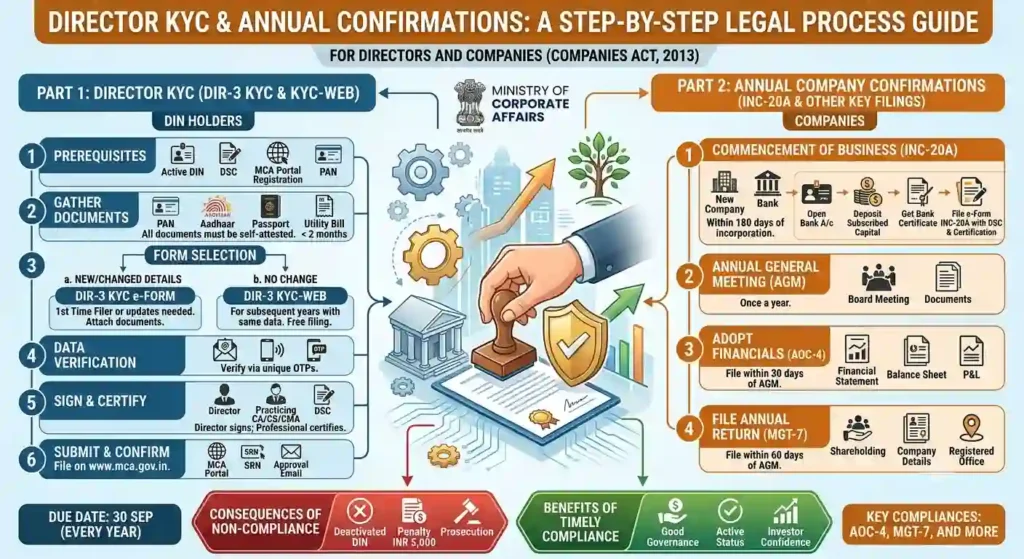
DIR-3 KYC Filing Requirements and Verification
DIR-3 KYC requires accurate identification and communication information from eligible DIN holders. The MCA webform requires appropriate personal details and supporting information. Additionally, directors must ensure their mobile number and email address remain correctly updated. MCA guidance states that DIR-3 KYC updates relevant details within the MCA master database. Directors also require appropriate digital-signature arrangements for electronic submission. Therefore, expired or invalid Digital Signature Certificates can obstruct timely filing. Companies should verify PAN, passport, Aadhaar, and other identification details carefully. Moreover, mismatches can create validation problems during submission. Foreign nationals serving Indian companies require particular attention to identification documentation. NRIs and overseas directors should also coordinate authentication and digital-signature requirements early. Legal professionals can review documents before filing. Consequently, businesses reduce the possibility of rejected forms, deactivated DINs, additional fees, and subsequent compliance disputes.
Annual Confirmation Versus Company-Level Compliance
Director KYC differs from annual company filings and should not replace broader corporate compliance. Each DIN holder has individual KYC responsibilities under the applicable rules. Meanwhile, companies must complete separate annual returns, financial statements, board records, and statutory disclosures. Therefore, directors should distinguish personal DIN compliance from company-level obligations. MCA maintains separate forms for different statutory purposes. For example, INC-20A addresses commencement of business requirements, while DIR-3 KYC addresses director identification information. Furthermore, changes in directorship generally require appropriate filings, including DIR-12 where applicable. Companies should reconcile director records against MCA master data regularly. Additionally, board minutes should accurately record appointments, resignations, and compliance decisions. Proper reconciliation helps identify discrepancies before regulatory filings. Corporate legal counsel can conduct compliance audits covering directors, statutory registers, resolutions, filings, and MCA records. This approach strengthens governance and reduces regulatory exposure.
INC-20A and Commencement of Business Compliance
Understanding Section 10A and INC-20A
INC-20A relates to the declaration of commencement of business under Section 10A. Certain companies incorporated after the relevant statutory commencement must satisfy this requirement. The declaration confirms that subscribers have paid the agreed share subscription amounts. The company must also satisfy applicable registered-office requirements before commencing relevant business activities. India Code identifies Section 10A within the Companies Act framework. Additionally, MCA’s INC-20A instruction kit identifies the form as a declaration of commencement of business. Therefore, newly incorporated companies should examine eligibility immediately after incorporation. Directors must understand the statutory timeline applicable to their company. Missing the prescribed filing period can trigger significant consequences. Furthermore, directors should maintain bank evidence, subscription records, board resolutions, and incorporation documents. Legal review can confirm whether the company satisfies Section 10A requirements. Consequently, timely compliance supports lawful commencement and protects directors from avoidable regulatory action.
Documents Required for INC-20A Filing
INC-20A requires careful preparation because supporting evidence demonstrates compliance with commencement requirements. Companies should maintain proof showing receipt of subscription money from subscribers. Bank statements can help establish the required financial transaction. Additionally, companies should verify registered-office information and related statutory filings. MCA’s instruction kit specifies documentary and declaration requirements for the webform. The form also requires appropriate digital signing by an authorised director. Therefore, the company should confirm board authorisation before submission. Directors should ensure every statement matches the company’s statutory records. Furthermore, discrepancies between incorporation documents and bank records can create filing complications. Companies should preserve challans, acknowledgements, resolutions, bank records, and supporting attachments. Proper documentation also helps during MCA inspections or regulatory correspondence. If authorities question compliance, organised records support a clear response. Corporate lawyers can review the entire filing package before submission. This reduces risks arising from inaccurate declarations, incomplete documentation, or inconsistent corporate records.
Consequences of Delayed or Incorrect INC-20A
Delayed INC-20A compliance can restrict business operations and create personal consequences for responsible directors. Section 10A contains restrictions concerning commencement or exercise of borrowing powers until applicable conditions are satisfied. India Code identifies commencement requirements under the Companies Act. Therefore, directors should avoid treating INC-20A as a routine administrative form. Incorrect declarations can also create additional regulatory concerns. Moreover, companies may encounter difficulties while demonstrating statutory compliance during transactions or due diligence. Banks, investors, auditors, and counterparties may request evidence of proper incorporation compliance. Consequently, an unresolved filing issue can affect commercial credibility. Directors should immediately review the company’s incorporation documents when a missed deadline arises. Legal counsel can assess whether filing remains possible, whether additional fees apply, and whether corrective action is necessary. Furthermore, counsel can prepare representations against inappropriate regulatory demands. Early intervention generally provides better compliance options. Companies should also update internal compliance calendars to prevent similar failures during future statutory filing cycles.
Director Liability and Corporate Compliance Risks
Directors carry important responsibilities for maintaining accurate corporate information and ensuring statutory compliance. The Companies Act creates various obligations for directors, officers, and companies. Consequently, directors should understand the distinction between genuine mistakes and deliberate misstatements. False declarations can create more serious legal consequences than ordinary filing delays. Furthermore, inaccurate information may trigger regulatory scrutiny or adjudication proceedings. Directors should therefore verify every material statement before approving statutory filings. Companies should also maintain appropriate board oversight over compliance functions. Additionally, professional advisors should receive complete and accurate corporate records before preparing forms. Where a compliance failure already exists, immediate legal assessment becomes important. Lawyers can examine the nature of the default, responsible persons, statutory provisions, and available remedies. They can also assist with MCA correspondence, adjudication matters, compounding where legally available, and tribunal proceedings. Therefore, structured compliance management can substantially reduce director liability risks. Proper governance also improves investor confidence, transaction readiness, and long-term corporate credibility.
MCA Portal, Digital Signatures and Filing Accuracy
Electronic corporate filings require technical accuracy alongside substantive legal compliance. MCA’s current filing environment requires users to follow applicable electronic filing procedures. Directors should maintain valid Digital Signature Certificates before statutory deadlines approach. Additionally, authorised professionals should verify that signatures remain registered correctly. Technical errors can delay otherwise compliant submissions. Therefore, companies should avoid waiting until the final filing date. Directors should also review prefilled information against internal statutory records. Furthermore, discrepancies in PAN, DIN, email addresses, mobile numbers, or names require early correction. MCA guidance specifically highlights validation requirements concerning identity information. Consequently, businesses should maintain a central compliance database. Legal teams can coordinate with company secretaries and accountants to resolve inconsistencies. This multidisciplinary approach helps identify technical and legal risks together. If MCA rejects or flags a filing, prompt professional review can determine the appropriate corrective response. Accurate electronic records remain essential for smooth corporate compliance.
Special Issues for NRIs and Foreign Directors
NRIs and foreign directors often face additional practical challenges during DIR-3 KYC compliance. Overseas residence can complicate document verification, digital signatures, and communication requirements. Therefore, foreign directors should begin KYC preparation well before statutory deadlines. Passport information must match relevant corporate and government records. Additionally, directors should carefully verify their email and mobile details. MCA guidance permits DIR-3 KYC to update relevant contact information within its database. Foreign directors should also check whether existing DSC arrangements remain valid. Furthermore, companies should maintain proper records supporting foreign director appointments and identification. Cross-border documentation may require appropriate certification or authentication depending on circumstances. Legal professionals can coordinate with overseas directors and Indian compliance teams. They can also examine FEMA-related considerations where foreign investment or cross-border transactions arise. Consequently, integrated corporate legal advice can prevent disconnected compliance failures. NRIs should not assume overseas residence removes Indian corporate filing obligations. Indian company law generally continues applying to directors holding DINs under applicable statutory requirements.
Common Legal Issues in DIR-3 KYC Compliance
Common DIR-3 KYC disputes arise from incorrect information, deactivated DINs, missed deadlines, and technical filing failures. Directors may also encounter mismatches involving PAN, passport, Aadhaar, names, or contact information. MCA’s instructions identify several validation checks for submitted identification details. Therefore, companies should investigate mismatches before attempting repeated submissions. Repeated incorrect filings can complicate the compliance position. Additionally, directors may discover that their DIN status changed because of earlier non-filing. Such situations require careful assessment of applicable MCA procedures. Legal professionals can review filing history and identify outstanding requirements. Furthermore, they can assist with representations and rectification requests where appropriate. Directors should preserve previous SRNs, challans, acknowledgements, and MCA correspondence. These records can establish the compliance history during disputes. Consequently, evidence-based legal representation can improve the response to regulatory notices. Companies should also conduct annual compliance reviews rather than reacting only after receiving notices. Preventive corporate legal support remains more efficient than prolonged regulatory dispute management.
Remedies for Non-Compliance and MCA Notices
Companies and directors have several potential legal and administrative remedies when compliance defaults occur. The appropriate remedy depends on the nature and stage of the default. First, professionals should verify the MCA master data and filing history. Next, they should identify the precise statutory provision causing the compliance problem. Where permitted, the company should complete pending filings with applicable fees. Additionally, directors can respond to MCA notices within prescribed timelines. Lawyers can prepare legally supported representations explaining factual circumstances. Furthermore, adjudication proceedings may require evidence, statutory interpretation, and formal submissions. Appropriate matters may also involve appeals before competent authorities or tribunals. Companies should not ignore notices merely because the original default appears technical. Instead, management should document corrective measures and supporting evidence. Corporate counsel can also advise on compounding or other statutory mechanisms where legally available. Consequently, early legal intervention can reduce escalation risks. A structured remediation plan should address immediate filings, historical defaults, governance controls, and future compliance monitoring.
Role of NCLT, NCLAT and Other Forums
Corporate compliance disputes can involve specialised statutory forums depending on the underlying legal issue. The National Company Law Tribunal handles numerous company-law matters under the Companies Act. NCLAT hears specified appeals arising from orders of the NCLT. Therefore, businesses should identify the correct forum before pursuing formal proceedings. However, ordinary MCA filing corrections may not automatically require tribunal litigation. Legal counsel should first examine administrative remedies and statutory procedures. Furthermore, adjudication orders may create specific appellate routes under applicable provisions. Companies should carefully track limitation periods because delayed appeals can create additional procedural difficulties. Where criminal allegations arise, the matter may involve police authorities and criminal courts under applicable law. Since BNS, BNSS, and BSA now govern India’s general criminal-law framework, counsel should assess those provisions where relevant. Corporate disputes may also involve civil courts depending on jurisdiction and subject matter. Accordingly, lawyers should select the appropriate forum based on statutory jurisdiction and available remedies.
Police Complaints and Fraudulent Corporate Filings
Fraudulent corporate filings can create issues extending beyond ordinary MCA compliance defaults. Examples may include forged documents, impersonation, fabricated resolutions, or deliberate submission of false information. Such conduct can potentially attract criminal-law consequences depending on the facts. Since BNS replaced the IPC framework from July 2024, lawyers must examine applicable current offences. Therefore, companies should preserve electronic records, emails, board documents, filing acknowledgements, and communications. Where criminal conduct appears involved, appropriate police authorities may become relevant. BNSS governs criminal procedure, while BSA governs evidence under India’s current criminal-law framework. Counsel should assess whether a police complaint, regulatory representation, civil action, or corporate proceeding provides the appropriate remedy. Furthermore, businesses should avoid making unsupported allegations against directors or employees. Evidence should establish the suspected conduct before escalation. Legal professionals can coordinate corporate, civil, and criminal remedies where necessary. Consequently, prompt evidence preservation becomes essential whenever suspected filing fraud affects company records or governance.
Corporate Compliance Audit and Preventive Strategy
A structured compliance audit helps companies identify director KYC and commencement-of-business risks before regulators intervene. Companies should maintain a master compliance calendar covering every statutory deadline. Additionally, directors should receive reminders well before DIR-3 KYC filing dates. Compliance teams should reconcile DIN records against MCA master data annually. Furthermore, newly incorporated companies should immediately review INC-20A requirements. Bank records should confirm receipt of subscription money where applicable. Board resolutions should authorise filings wherever required. Legal teams should also review director appointments, resignations, registered-office records, and statutory registers. Consequently, companies can identify inconsistencies before filing forms electronically. Periodic legal audits should also examine historical defaults and unresolved MCA notices. Where foreign directors participate, additional documentation controls should apply. Businesses should train directors regarding statutory responsibilities and approval procedures. Therefore, preventive compliance creates stronger corporate governance than reactive filing. Empower Legal – Corporate Law Firm can provide compliance reviews, documentation assistance, legal opinions, regulatory responses, and representation before appropriate corporate forums.
Latest Corporate Law Compliance Approach in India
Indian corporate compliance increasingly requires accurate digital records, timely filings, and stronger director accountability. MCA continues developing electronic filing systems and digital corporate services. Current MCA materials identify DIR-3 KYC and INC-20A within the statutory electronic filing framework. Therefore, companies should monitor MCA notifications, circulars, filing instructions, and statutory amendments. The Companies Act remains the primary legislative framework for these obligations. Additionally, directors should monitor changes affecting corporate governance and statutory disclosures. Businesses operating across jurisdictions should also consider FEMA, taxation, labour, securities, and sector-specific requirements. Furthermore, listed entities may face additional SEBI compliance obligations. Companies should maintain professional coordination between directors, company secretaries, accountants, auditors, and lawyers. Consequently, legal compliance should form part of regular corporate decision-making. Empower Legal can assist companies with director KYC, INC-20A review, MCA notices, corporate governance, compliance audits, and regulatory representation. Timely professional advice helps companies manage legal exposure while supporting sustainable business operations.
How Empower Legal Supports Corporate Compliance
Empower Legal – Corporate Law Firm provides practical legal support for director and company compliance matters. Our approach begins by identifying the company’s statutory obligations and existing compliance gaps. Next, legal professionals review MCA records, corporate documents, filing history, and relevant supporting evidence. Additionally, we can assist with DIR-3 KYC preparation and INC-20A compliance assessment. Directors can receive guidance regarding identification records, DSC requirements, declarations, and filing procedures. Companies can also obtain assistance responding to MCA notices and compliance objections. Furthermore, legal counsel can advise on director liability, corporate governance, and regulatory risk management. Where disputes escalate, appropriate representation can be considered before NCLT, NCLAT, adjudicating authorities, courts, or other competent forums. Criminal-law issues involving suspected fraud may require coordination with police authorities under current BNS and BNSS provisions. Therefore, businesses benefit from integrated legal strategy rather than isolated form filing. Empower Legal focuses on timely advice, accurate documentation, preventive compliance, and effective legal remedies for corporate clients.
Key Takeaways for Directors and Companies
DIR-3 KYC and INC-20A serve different statutory purposes and require separate compliance planning. DIR-3 KYC focuses on maintaining updated DIN-holder information under Rule 12A. MCA guidance specifies September 30 as the annual filing deadline for eligible DIN holders. INC-20A concerns the declaration required for commencement of business under Section 10A. Therefore, directors should never treat these forms as interchangeable. Companies should maintain accurate records, valid digital signatures, and timely compliance calendars. Furthermore, directors should review MCA master data regularly for discrepancies. Any notice, rejection, deactivation, or suspected fraudulent filing requires prompt assessment. Legal support can help identify the correct remedy and competent forum. Consequently, preventive compliance remains the strongest protection against avoidable regulatory disputes. Businesses should also monitor statutory amendments and MCA filing-system changes. With professional corporate legal guidance, companies can strengthen governance, reduce compliance risks, and maintain reliable statutory records.
Frequently Asked Questions
What is DIR-3 KYC?
DIR-3 KYC updates a DIN holder’s identification and contact details with MCA. Eligible DIN holders generally complete the annual filing by September 30.
Who needs to file DIR-3 KYC?
Individuals holding DINs allotted up to March 31 of the relevant financial year generally require KYC compliance under Rule 12A.
What is INC-20A?
INC-20A is the declaration concerning commencement of business under Section 10A. Eligible companies must satisfy prescribed requirements before commencing covered activities.
What happens if DIR-3 KYC is not filed?
Non-filing can result in DIN deactivation for non-compliance. The director may face difficulties completing filings requiring an active DIN.
What happens after INC-20A default?
A company may face statutory restrictions and regulatory consequences. Legal review can identify applicable corrective filings, fees, representations, or other remedies.
Can lawyers help with MCA compliance notices?
Yes. Corporate lawyers can review MCA notices, assess statutory defaults, prepare responses, advise directors, and represent companies before competent authorities or tribunals.
Read More
- Related Party Transactions: Disclosure and Approval Requirements
- Statutory Audit Requirements for Companies
- Annual Return Filing: Form MGT-7 Complete Guide
- Annual General Meeting (AGM): Conducting and Compliance
- Board Meetings and Resolutions: Legal Requirements and Minutes
- Ministry of Corporate Affairs (MCA)
- Corporate Governance & Compliance: A Comprehensive Legal Framework for Indian
- NCLAT SOP 2026: What Companies and Litigants Should Check Before Filing
- Information Technology Act in India: The Best Legal Support
- Removal of Directors Disqualification: Expert Legal Services
- Company Law Compliance Services | Trusted Expert Solutions