
Related Party Transactions: Disclosure and Approval Requirements – Empower Legal – Corporate Law Firm
Statutory Framework for RPTs
Companies Act Requirements
The Companies Act, 2013 remains the principal statute governing RPT compliance for Indian companies. Section 184 requires directors to disclose their interests at prescribed Board meetings and whenever relevant changes occur. Section 188 generally requires Board approval for specified related party contracts through a resolution at a Board meeting. However, transactions in the ordinary course of business may receive statutory treatment where they satisfy applicable arm’s-length requirements. Companies must also examine the Companies (Meetings of Board and its Powers) Rules, 2014. Rule 15 provides thresholds relevant to shareholder approval for specified transactions. Furthermore, Section 177 assigns the Audit Committee an important RPT oversight role. Thus, legal review should precede execution rather than follow a compliance failure.
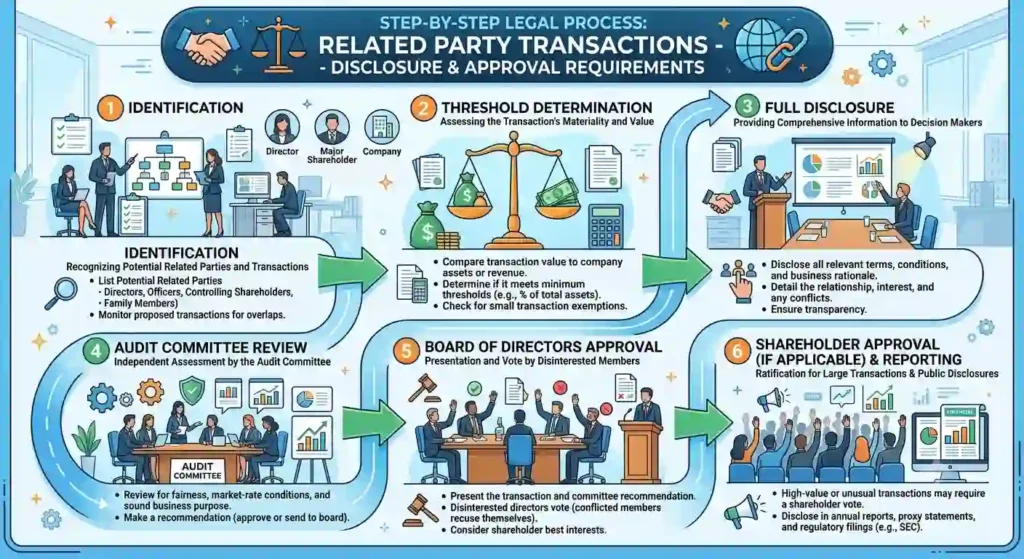
Disclosure and Approval Process
Director Interest Disclosure
Maintaining Accurate Disclosures
Directors must disclose their concern or interest in companies, firms, bodies corporate, or other associations. Section 184 requires disclosure at the first Board meeting where the director participates. The disclosure must also occur at the first Board meeting each financial year. Additionally, directors must update disclosures after relevant changes occur. Where a director has a prescribed interest in a proposed contract, the director must disclose that interest during the relevant Board discussion. The concerned director must also avoid participating in that discussion. A company should therefore maintain updated disclosure records, declarations, minutes, and supporting documents. Importantly, failure to follow Section 184 can create statutory consequences and corporate governance concerns. Legal teams should periodically verify director interests against subsidiaries, associates, joint ventures, promoters, relatives, and significant business relationships. This approach strengthens transparency and reduces later challenges.
Board and Audit Committee Approval
Approval Before Execution
Companies should determine the correct approval route before signing or performing an RPT. Section 188 generally requires Board consent through a resolution passed at a Board meeting for specified transactions. Listed entities must additionally consider Regulation 23 and Audit Committee requirements. Section 177 assigns the Audit Committee responsibility for approval or subsequent modification of related party transactions. Therefore, internal approval matrices should clearly identify management, Audit Committee, Board, and shareholder responsibilities. The approval papers should explain the related party relationship, transaction value, commercial rationale, pricing basis, tenure, and material terms. Moreover, valuation reports or independent fairness assessments may help where transactions involve significant assets or unusual pricing. Companies should avoid retrospective approvals wherever prior approval is legally mandatory. A carefully documented approval process provides stronger protection during audits, inspections, shareholder challenges, and regulatory proceedings.
Shareholder Approval and Voting
Where statutory thresholds trigger shareholder approval, companies must obtain the required resolution before proceeding. Section 188 contains restrictions concerning voting by related party members, subject to statutory exceptions. The company should therefore identify interested shareholders before preparing the general meeting notice. Explanatory statements should provide sufficient information for shareholders to understand the transaction. Relevant information may include the related party’s identity, relationship, transaction nature, value, tenure, material terms, and business justification. Furthermore, listed entities must comply with additional SEBI disclosure and approval requirements. SEBI has strengthened the information expected for Audit Committee and shareholder consideration of RPTs. Consequently, companies should coordinate legal, secretarial, finance, audit, and investor-relations teams before shareholder meetings. Proper voting controls also reduce challenges alleging conflicted decision-making, oppression, mismanagement, or inadequate disclosure.
Listed Company RPT Compliance
SEBI LODR Requirements
Listed companies face a separate and more detailed compliance framework under Regulation 23 of SEBI LODR. The framework requires a policy on RPT materiality and dealings with related parties. Recent amendments introduced scale-based materiality thresholds for equity-listed entities. For entities with turnover up to ₹20,000 crore, the threshold is 10% of annual consolidated turnover. Higher turnover categories use specified formula-based thresholds, subject to the prescribed cap. These rules require companies to aggregate transactions during the financial year when testing materiality. A recent SEBI order emphasized aggregation of transactions with the same related party. Therefore, companies should maintain real-time transaction registers rather than relying only on annual calculations. Listed entities should also monitor subsidiary-level transactions and applicable Audit Committee approval requirements. Legal compliance should align with SEBI filings, stock-exchange disclosures, Board policies, and shareholder approvals.
Recent SEBI Developments
SEBI has continued strengthening RPT transparency through updated standards and regulatory amendments. SEBI records show industry standards concerning minimum information for Audit Committee and shareholder review. The current framework also contains revised materiality thresholds introduced through later amendments. Consequently, listed companies should not rely exclusively on older RPT policies or historical approval templates. Legal teams should review policies against current LODR provisions, SEBI circulars, stock-exchange requirements, and applicable amendments. Moreover, subsidiary transactions can create additional approval questions under Regulation 23. SEBI materials identify separate thresholds for certain subsidiary transactions involving listed entities. Companies should therefore perform entity-level and group-level RPT mapping. This exercise helps identify transactions requiring Audit Committee approval, shareholder approval, valuation support, or enhanced disclosure. Regular compliance reviews also help prevent avoidable regulatory proceedings and investor disputes.
Legal Risks, Remedies and Dispute Resolution
RPT Disputes and Corporate Remedies
Common Legal Issues
Typical RPT Compliance Failures
RPT disputes commonly arise from undisclosed interests, inadequate approvals, excessive pricing, non-arm’s-length terms, or incomplete disclosures. Companies may also face questions regarding transactions executed without mandatory prior approval. Another concern involves splitting transactions to avoid applicable approval thresholds. SEBI has specifically emphasized aggregation of relevant transactions when determining materiality. Shareholders may challenge arrangements that appear prejudicial to company interests or minority investors. Furthermore, auditors, independent directors, regulators, or lenders may raise concerns about unusual related party dealings. Companies should investigate unexplained payments, asset transfers, guarantees, service agreements, management fees, and inter-company arrangements. Internal investigations should preserve contracts, emails, invoices, Board minutes, valuation reports, and accounting records. Where fraud allegations arise, legal counsel should separately assess civil, corporate, regulatory, and criminal consequences. Early intervention can limit financial losses and strengthen available remedies.
Remedies and Legal Forums
Corporate and Civil Remedies
Companies and stakeholders can consider several legal remedies depending upon the nature of the RPT dispute. These may include corrective disclosures, ratification where legally permissible, recovery of amounts, contract challenges, injunctions, and claims concerning corporate misconduct. The National Company Law Tribunal (NCLT) may become relevant for statutory company-law proceedings, including oppression and mismanagement matters. Appeals from appropriate NCLT orders may proceed before the National Company Law Appellate Tribunal (NCLAT). Civil courts may remain relevant for disputes falling within their jurisdiction, subject to statutory exclusions and specialised forums. The High Court can exercise jurisdiction in appropriate writ, appellate, supervisory, or corporate matters. SEBI and stock exchanges may address listed-company compliance violations. Additionally, ROC and the Ministry of Corporate Affairs may examine statutory non-compliance. Therefore, the appropriate remedy depends upon the company type, transaction, relief sought, and governing statute.
Fraud, Evidence and Police Complaints
Some RPT disputes may involve allegations of cheating, forgery, criminal breach of trust, falsification, or fraudulent diversion. Such allegations require separate assessment under the Bharatiya Nyaya Sanhita, 2023, rather than relying on the repealed IPC framework. Criminal procedure now operates principally through the Bharatiya Nagarik Suraksha Sanhita, 2023. Electronic records may require consideration under the Bharatiya Sakshya Adhiniyam, 2023. Companies should preserve original electronic records, transaction trails, emails, accounting data, and relevant communications. Depending on the allegations, complaints may reach the jurisdictional police station, Economic Offences Wing, or specialised cybercrime authorities. Near the user’s Chennai location, relevant government options include Economic offence wing and Cyber Crime Police Station, Central Crime Branch. However, forum selection depends on territorial and statutory jurisdiction. Corporate counsel should coordinate criminal, civil, NCLT, ROC, and regulatory strategies.
Corporate Legal Support
Practical Compliance Strategy
A strong RPT compliance programme should combine preventive controls, legal review, financial oversight, and continuous monitoring. Companies should first create an updated related-party database covering directors, relatives, promoters, subsidiaries, associates, and connected entities. Next, finance teams should flag transactions before contractual commitments become binding. Legal counsel should then determine applicable approvals under the Companies Act, Rules, SEBI LODR, and internal policies. Audit Committees should receive complete commercial and valuation information before deciding. Board minutes should clearly record disclosures, recusals, discussions, and approval conditions. Listed companies should additionally monitor stock-exchange reporting and shareholder disclosure requirements. Furthermore, companies should conduct periodic RPT audits and test aggregate transaction values. Where concerns arise, counsel can advise on corrective action, regulatory responses, recovery proceedings, negotiations, or litigation. This structured approach supports corporate governance while protecting directors, shareholders, creditors, and business interests.
Why Empower Legal Can Help
Empower Legal – Corporate Law Firm can assist companies with end-to-end related party transaction compliance. Legal support may include identifying related parties, reviewing contracts, analysing approval requirements, preparing Board papers, and advising Audit Committees. Counsel can also assist with shareholder resolutions, explanatory statements, disclosure documents, RPT policies, and regulatory correspondence. Listed companies may require additional support for SEBI LODR compliance and stock-exchange disclosures. Moreover, legal teams can investigate suspected unauthorised transactions and recommend corrective remedies. Where disputes escalate, representation may extend to NCLT, NCLAT, High Courts, civil courts, SEBI proceedings, or regulatory authorities. Criminal allegations may require coordinated action under BNS, BNSS, and BSA. Companies can also obtain assistance with internal investigations, evidence preservation, settlement strategy, and recovery claims. Ultimately, timely legal advice helps prevent procedural defects from becoming expensive corporate disputes.
Frequently Asked Questions
What is a Related Party Transaction?
An RPT involves a company transaction with a related person or entity. The Companies Act and SEBI LODR impose disclosure and approval duties.
Does every RPT require shareholder approval?
No. The required approval depends on the transaction, company type, applicable thresholds, and governing rules. Some transactions require only Board or Audit Committee approval.
What must directors disclose?
Directors must disclose relevant interests, including prescribed interests in companies, firms, and entities. They must also abstain from concerned Board discussions.
Do listed companies follow SEBI rules?
Yes. Listed entities must consider Regulation 23 of SEBI LODR alongside Companies Act requirements. Recent amendments have changed materiality thresholds.
Can an RPT be challenged?
Yes. Depending on circumstances, stakeholders may seek regulatory action, recovery, corrective measures, contractual relief, or proceedings before appropriate tribunals and courts.
Can criminal proceedings arise from an RPT?
Yes. Fraudulent conduct may trigger BNS offences. BNSS governs criminal procedure, while BSA governs applicable evidence issues, including electronic records.