
Annual return filing remains a core corporate compliance requirement under the Companies Act, 2013. Form MGT-7 records important company information for the relevant financial year. Consequently, companies should reconcile statutory registers before preparing the annual return. Section 92 requires companies to provide prescribed information concerning their corporate structure and activities. The filing also supports transparency before the Registrar of Companies, Ministry of Corporate Affairs. Therefore, directors should treat MGT-7 as a substantive compliance document, not merely an annual formality. Empower Legal – Corporate Law Firm assists companies with preparation, verification, certification, filing, and compliance remediation. Our legal support covers companies, directors, shareholders, foreign investors, NGOs, and other stakeholders. Additionally, we review corporate records for inconsistencies before electronic submission. Proper annual return compliance can reduce regulatory exposure, filing errors, penalties, and future corporate disputes.
Annual Return Filing: Form MGT-7 Complete Guide – Empower Legal – Corporate Law Firm
Understanding MGT-7 Compliance
Legal Foundation Under Section 92
Section 92 establishes the statutory foundation for annual return filing by companies. The return captures information existing at the close of the relevant financial year. Importantly, disclosures cover registered office details, business activities, and corporate relationships. They also cover shares, securities, members, promoters, directors, and key managerial personnel. Furthermore, companies must disclose relevant meetings, attendance, remuneration, penalties, and prescribed compliance matters. The annual return generally requires signatures according to the company’s applicable legal status. Listed companies and prescribed companies require professional certification by a company secretary in practice. Small companies and OPCs follow the applicable abridged annual return requirements. Therefore, identifying the correct form remains an essential first compliance step. Errors can create difficulties during regulatory reviews, corporate transactions, or due diligence.
Companies Required to File MGT-7
Most companies must determine whether Form MGT-7 applies to their annual return. Rule 11 distinguishes ordinary companies from One Person Companies and small companies. Since 2021, OPCs and small companies generally use Form MGT-7A for annual returns. Other applicable companies continue using Form MGT-7 under the prescribed framework. However, companies should verify current MCA forms and notifications before filing. The distinction matters because incorrect form selection can cause filing rejection or compliance complications. Moreover, eligibility depends upon statutory definitions and applicable rules for the relevant financial year. Listed companies may also face additional certification and disclosure requirements. Consequently, corporate secretaries should review company classification before preparing the return. Empower Legal can examine incorporation records, capital structure, turnover, and statutory status. This approach helps identify the correct annual return form and supporting documentation.
Information Disclosed in MGT-7
Form MGT-7 requires extensive corporate information covering the company’s position during the financial year. Key disclosures include registered office details, principal activities, and holding relationships. The form also records share capital, securities, members, and changes in shareholding. Additionally, directors, promoters, and key managerial personnel require accurate disclosure. Companies must reconcile these particulars with statutory registers and filed forms. Meeting information also requires careful verification, including board and members’ meetings. Furthermore, remuneration and prescribed compliance details may require supporting records. Penalties, punishments, compounding matters, and appeals can also require disclosure where applicable. Therefore, companies should prepare a disclosure checklist before entering information electronically. Any mismatch with previous filings should receive legal and secretarial review. Accurate disclosure protects directors from avoidable compliance concerns and supports reliable corporate records.
Annual General Meeting and Filing Deadline
Section 92 requires filing the annual return within sixty days from the AGM date. Where an AGM does not occur, the statutory calculation follows the applicable AGM deadline. Companies should therefore complete annual return preparation before the filing window expires. First, accounts and corporate records should undergo reconciliation with statutory registers. Next, the company should complete its AGM and preserve relevant resolutions and minutes. Then, the annual return should reflect information accurately as required by law. Consequently, companies should maintain an internal filing calendar with responsible compliance personnel. Delays can result in statutory additional fees and monetary penalties. Moreover, continuing defaults can increase exposure for the company and responsible officers. Legal review becomes especially important when earlier filings remain pending. Empower Legal can assess default periods and advise on available corrective strategies.
Certification and Professional Verification
Professional certification requirements depend upon the company category and applicable statutory provisions. Section 92 requires certification for listed companies and prescribed companies by a company secretary in practice. The certification confirms that disclosed information accurately reflects statutory requirements. Therefore, certification requires meaningful examination rather than mechanical approval. Corporate records, registers, resolutions, share transfers, and director changes should support the disclosures. Additionally, professional verification can identify inconsistencies before submission to the Registrar. Companies should resolve material discrepancies rather than conceal them through inconsistent reporting. Where previous filings contain mistakes, legal and secretarial advice can determine suitable correction mechanisms. Furthermore, certification may expose professionals to statutory consequences for improper certification. Directors should therefore provide complete records and truthful information to the certifying professional. Empower Legal coordinates legal review with appropriate corporate compliance professionals when required.
Documents and Records Required
Effective MGT-7 preparation begins with collecting complete corporate and financial records. Companies should gather the certificate of incorporation, constitutional documents, and current registered office particulars. They should also maintain updated registers of members, directors, charges, and securities. Share capital records should reconcile with allotments, transfers, transmissions, and other corporate actions. Additionally, companies should provide AGM details, board minutes, shareholder resolutions, and attendance information. Financial statements and board reports can assist with cross-checking disclosures. Foreign investment records may require additional scrutiny where overseas shareholders participate. Furthermore, beneficial ownership information should remain consistent with applicable statutory filings. Companies should review director appointments, resignations, disclosures, and key managerial personnel changes. Consequently, a document checklist reduces omissions during electronic filing. Empower Legal can conduct a compliance audit before finalising the annual return submission. This process supports accurate, defensible, and consistent corporate reporting.
Shareholding and Director Particulars
Shareholding information requires particular care because changes can occur throughout the financial year. Companies should reconcile the register of members with share certificates and transfer documentation. They should also verify allotments, transmissions, buybacks, and other securities transactions. Director particulars must similarly match statutory records and MCA filings. Changes involving appointment, resignation, disqualification, or designation require careful verification. Furthermore, promoter and key managerial personnel information should remain consistent across corporate records. Beneficial ownership disclosures may also require separate consideration under applicable provisions. Therefore, companies should compare MGT-7 information against relevant forms filed during the year. Discrepancies can create questions during due diligence, investment transactions, or regulatory inspections. Consequently, early reconciliation provides stronger protection against avoidable corporate compliance disputes. Empower Legal assists companies with corporate record review and statutory discrepancy identification. Proper documentation also helps directors respond confidently to regulatory queries.
Meetings, Remuneration and Compliance Disclosures
Annual return preparation requires accurate information about corporate meetings and governance activities. Companies should record AGM details, board meetings, committee meetings, and applicable attendance information. Meeting dates should correspond with statutory registers, notices, minutes, and resolutions. Additionally, remuneration disclosures should align with payroll, board approvals, financial statements, and applicable legal requirements. Penalties, compounding proceedings, appeals, and prescribed compliance matters require careful consideration. Therefore, companies should not assume that only financial information matters within MGT-7. Governance information can reveal significant compliance issues affecting directors and shareholders. Moreover, incomplete meeting disclosures may undermine confidence in corporate governance records. Legal counsel can review unusual transactions, disputed resolutions, or governance concerns before filing. Where litigation affects corporate disclosures, companies should assess relevant facts carefully. Empower Legal provides corporate legal advice concerning statutory reporting and governance documentation. Such review helps create consistent disclosures across annual compliance documents.
Filing Process and Legal Remedies
Preparing and Submitting MGT-7
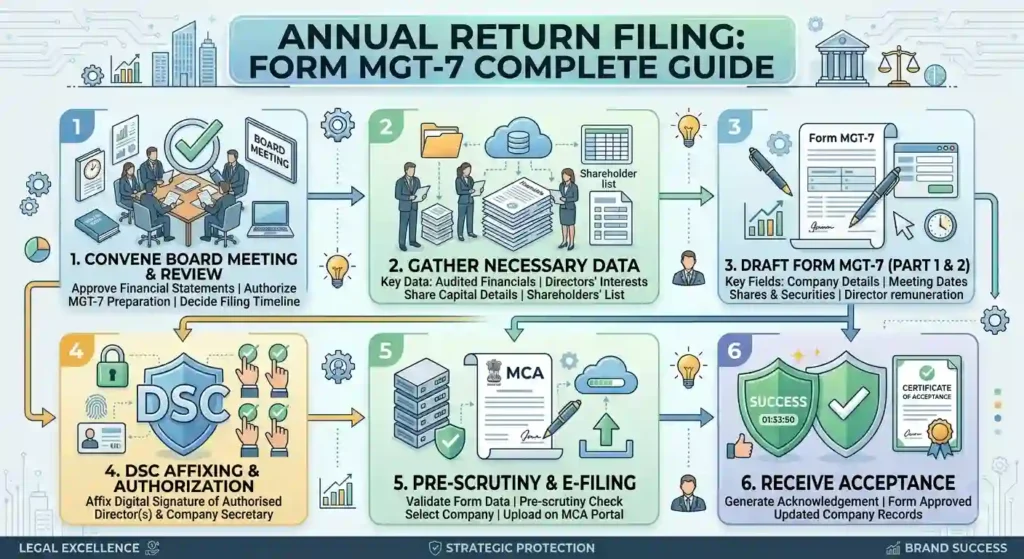
The electronic filing process requires accurate information and appropriate digital authentication. Companies should first verify their MCA master data and statutory records. Next, compliance personnel should compile information required by the applicable annual return form. Supporting documents should then undergo internal review before uploading the filing. The company must complete applicable declarations, certifications, and electronic signatures. Subsequently, the filing should be submitted through the MCA electronic platform. Companies should preserve the Service Request Number and filing acknowledgement after submission. Any filing error should receive prompt attention instead of remaining unresolved. Furthermore, companies should monitor MCA communications concerning resubmission or defects. Legal assistance can become necessary where technical defects overlap with substantive compliance issues. Empower Legal can coordinate filing review, defect analysis, and corrective compliance strategies. This systematic approach reduces administrative errors and supports timely annual return completion.
Common MGT-7 Filing Errors
Several recurring mistakes can create unnecessary annual return compliance problems. Incorrect company classification remains one common issue, especially concerning MGT-7 and MGT-7A. Another problem involves mismatched shareholding information between registers and electronic records. Companies may also overlook director changes recorded through separate MCA filings. Furthermore, incorrect AGM dates can affect the statutory filing deadline calculation. Missing professional certification can create additional problems for companies requiring certification. Inconsistent registered office details may also trigger questions during compliance review. Therefore, companies should conduct a pre-filing reconciliation rather than relying solely on accounting records. Errors concerning beneficial ownership and foreign shareholders require additional scrutiny. Additionally, previous year discrepancies should receive legal review before submitting current information. Empower Legal helps identify these issues through structured corporate compliance audits. Early correction usually provides a stronger remedy than addressing defects after regulatory action.
Penalties for Delayed Filing
Failure to file an annual return within the statutory period can attract monetary penalties. Section 92 currently provides a penalty framework for the company and officers in default. The company can face an initial penalty of ₹10,000. Continuing default can attract ₹100 for each day after the first day. The statutory maximum can reach ₹2 lakh for the company and ₹50,000 for an officer. Therefore, prolonged non-compliance can become financially significant. Companies should calculate exposure based on the actual period of continuing default. Moreover, additional filing fees may apply under the applicable filing framework. Directors should avoid assuming that payment automatically resolves every underlying compliance issue. Legal review may be necessary where several annual returns remain outstanding. Empower Legal can assess defaults and recommend appropriate remedial filing strategies.
Correcting Errors and Defective Filings
Companies sometimes discover mistakes after submitting or completing annual return filings. The appropriate correction depends upon the nature, timing, and significance of the error. Technical defects may require resubmission or correction through available MCA procedures. Substantive discrepancies may require examination of earlier statutory filings and corporate records. Therefore, companies should preserve evidence explaining how the error occurred. Legal counsel can determine whether additional filings, rectification, or regulatory representation may become necessary. Furthermore, material inconsistencies should not be ignored merely because the filing was accepted electronically. Acceptance does not necessarily eliminate underlying statutory obligations. Where directors face allegations, professional advice can help identify appropriate legal remedies. Empower Legal can review defective filings and advise on practical compliance pathways. Corrective action should remain transparent, documented, proportionate, and legally supported.
ROC Notices and Regulatory Proceedings
The Registrar of Companies can examine corporate compliance and initiate statutory action where violations arise. Companies receiving ROC notices should respond within the prescribed period. Ignoring correspondence can increase regulatory risk and potentially worsen the company’s position. Therefore, directors should obtain the notice, filing history, and supporting records immediately. Legal counsel can then analyse the alleged default and applicable statutory provisions. Where appropriate, companies may submit explanations, supporting documents, or corrective filings. Additionally, professional representation can assist during regulatory proceedings involving annual return defaults. Serious matters may require consideration of adjudication, compounding, or other statutory remedies. The appropriate forum depends upon the nature of proceedings and the governing provision. Empower Legal assists companies and directors with ROC notices, compliance responses, and corporate litigation support. Prompt action generally provides better opportunities for resolving procedural and substantive compliance issues.
Corporate Disputes and Available Remedies
Annual return information can become relevant during shareholder disputes, director conflicts, investment disputes, and corporate litigation. Incorrect disclosures may support allegations concerning governance failures or statutory non-compliance. Consequently, companies should treat annual return information as potentially important evidence. Remedies depend upon the underlying dispute and applicable statutory provisions. Parties may consider representations before the ROC, statutory applications, adjudication responses, or appropriate tribunal proceedings. NCLT jurisdiction can become relevant for specific company law disputes under the Companies Act. NCLAT may hear appeals from applicable NCLT orders. Additionally, civil courts may have jurisdiction over matters not exclusively assigned to company law forums. CPC principles can remain relevant where civil proceedings lawfully arise. However, BNS, BNSS, and BSA may become relevant when conduct involves criminal allegations or evidentiary issues. Empower Legal evaluates jurisdiction before recommending litigation or regulatory remedies.
Legal Support for Companies and Directors
Corporate annual return compliance often requires coordinated legal, secretarial, accounting, and governance support. Empower Legal provides legal assistance for companies facing routine or disputed compliance requirements. Our support can include MGT-7 preparation review, document verification, and statutory reconciliation. We can also examine ROC notices and continuing filing defaults. Additionally, our lawyers can advise directors concerning personal exposure arising from statutory non-compliance. Shareholders may seek assistance where annual return disclosures affect ownership or governance disputes. Foreign investors and NRIs may require additional support involving Indian corporate records and regulatory compliance. Furthermore, companies can obtain representation for appropriate proceedings before statutory authorities and tribunals. Police stations are not ordinarily the forum for routine MGT-7 filing issues. However, criminal allegations arising from separate conduct may require appropriate police or court remedies. Legal strategy should therefore match the actual dispute and statutory jurisdiction.
Government Authorities and Relevant Forums
The Ministry of Corporate Affairs administers major corporate compliance functions through its statutory framework. The Registrar of Companies handles company filings, records, and specified regulatory proceedings. NCLT exercises jurisdiction over designated company law matters under the Companies Act. NCLAT hears applicable appeals from NCLT decisions. Additionally, High Courts may exercise jurisdiction in appropriate constitutional or statutory matters. Civil courts can address disputes within their lawful jurisdiction where company law provisions do not exclude them. Police authorities may become relevant only when separate criminal conduct is alleged. BNS governs specified substantive criminal offences, while BNSS governs criminal procedure. BSA governs evidentiary matters in applicable proceedings. Therefore, companies should identify the correct forum before pursuing any remedy. Empower Legal provides jurisdiction-focused corporate legal advice for Chennai and wider India.
MGT-7 Compliance Checklist
A structured checklist can substantially reduce annual return filing risks. Companies should verify their statutory classification before selecting MGT-7 or another prescribed form. They should reconcile share capital, members, directors, promoters, and beneficial ownership records. AGM dates and meeting particulars should match official minutes and statutory registers. Additionally, remuneration, penalties, compounding, appeals, and prescribed disclosures require careful verification. Companies should review previous annual returns for unresolved inconsistencies. Professional certification should be arranged wherever Section 92 requires it. Furthermore, digital signatures and authorised filing credentials should remain valid before submission. After filing, companies should preserve acknowledgements, SRNs, documents, and supporting evidence. Any MCA resubmission notice should receive immediate attention. Finally, directors should maintain an annual compliance calendar for future filing periods. Empower Legal can independently review the checklist before submission and advise on identified legal risks.
Practical Compliance Strategy
How Empower Legal Can Assist
Empower Legal – Corporate Law Firm provides practical legal support for annual return compliance. Our approach begins by identifying the company’s statutory filing obligations and relevant deadlines. Next, we review corporate records against information proposed for the annual return. We can identify inconsistencies involving shareholders, directors, capital structure, or governance records. Additionally, our lawyers can assess continuing defaults and potential statutory exposure. Where ROC correspondence exists, we examine allegations and develop appropriate responses. Companies may also require representation during regulatory or tribunal proceedings. Furthermore, shareholders and directors can obtain advice concerning disputes arising from corporate disclosures. We focus on preventive compliance because early intervention can reduce litigation and regulatory costs. Our services extend to companies, startups, NGOs, foreign investors, NRIs, and directors. Consequently, clients receive jurisdiction-specific advice rather than generic filing assistance. For Chennai-based businesses, we can coordinate corporate legal support involving relevant authorities and forums.
Conclusion and Compliance Takeaway
Form MGT-7 represents an important annual corporate disclosure obligation under Indian company law. Accurate filing requires more than copying information from financial statements. Companies must reconcile statutory registers, governance records, shareholder information, and MCA filings. Therefore, directors should begin preparation well before the statutory deadline. Small companies and OPCs should separately confirm whether MGT-7A applies. Other companies should verify whether MGT-7 and professional certification requirements apply. Furthermore, delayed filing can create continuing monetary penalties and regulatory complications. Companies facing ROC notices should obtain legal advice before submitting explanations or corrective filings. Appropriate remedies depend upon the statutory issue, jurisdiction, and procedural stage. Empower Legal offers corporate compliance review, ROC representation, dispute assistance, and tribunal support. Ultimately, proactive annual compliance strengthens corporate governance and reduces avoidable legal exposure.
Frequently Asked Questions
1. Who must file Form MGT-7?
Most companies file MGT-7, subject to prescribed exemptions and classification rules. OPCs and small companies generally use MGT-7A under the applicable framework.
2. What is the MGT-7 filing deadline?
Section 92 generally requires filing within sixty days from the AGM date. If no AGM occurs, the applicable statutory AGM deadline determines the calculation.
3. What happens after delayed MGT-7 filing?
Delayed filing can attract additional fees and statutory penalties. Continuing default can increase monetary exposure for both the company and responsible officers.
4. Can an incorrect MGT-7 filing be corrected?
Correction depends upon the error and applicable MCA procedures. Companies should review the filing history and seek professional advice before taking corrective action.
5. Can directors face liability for MGT-7 defaults?
Yes. Section 92 specifically provides penalties for officers in default. However, liability depends upon statutory responsibility and the circumstances surrounding the compliance failure.
6. Can Empower Legal handle ROC disputes?
Yes. Empower Legal can assist with MGT-7 compliance, ROC notices, corrective strategies, corporate disputes, and appropriate proceedings before company law forums.
Read More
- Annual General Meeting (AGM): Conducting and Compliance
- Board Meetings and Resolutions: Legal Requirements and Minutes
- Annual Compliance Calendar for Private Limited Companies
- Environmental Clearances for Businesses: EC and CTE/CTO
- Factory License Under Factories Act 1948: Complete Guide
- Ministry of Corporate Affairs (MCA)