
Statutory Audit Requirements – Statutory audit ensures that eligible companies present reliable financial information to stakeholders. The Companies Act, 2013 provides the primary framework for statutory audit requirements in India. Companies must understand auditor appointment, eligibility, rotation, reporting, records, and compliance timelines. Additionally, auditors must follow applicable auditing standards and professional requirements. Therefore, directors should establish effective financial controls and maintain complete accounting records. Non-compliance can create penalties, regulatory scrutiny, qualification issues, and reputational risks. The Ministry of Corporate Affairs administers the Companies Act and related corporate compliance framework. Companies may also interact with the Registrar of Companies, National Company Law Tribunal, and other authorities. Consequently, businesses need timely corporate legal advice alongside professional audit services. Empower Legal – Corporate Law Firm assists companies with audit-related corporate compliance, governance, notices, and regulatory representation. Proper planning helps companies complete statutory audits efficiently while reducing avoidable legal and procedural exposure.
Statutory Audit Requirements for Companies – Empower Legal – Corporate Law Firm
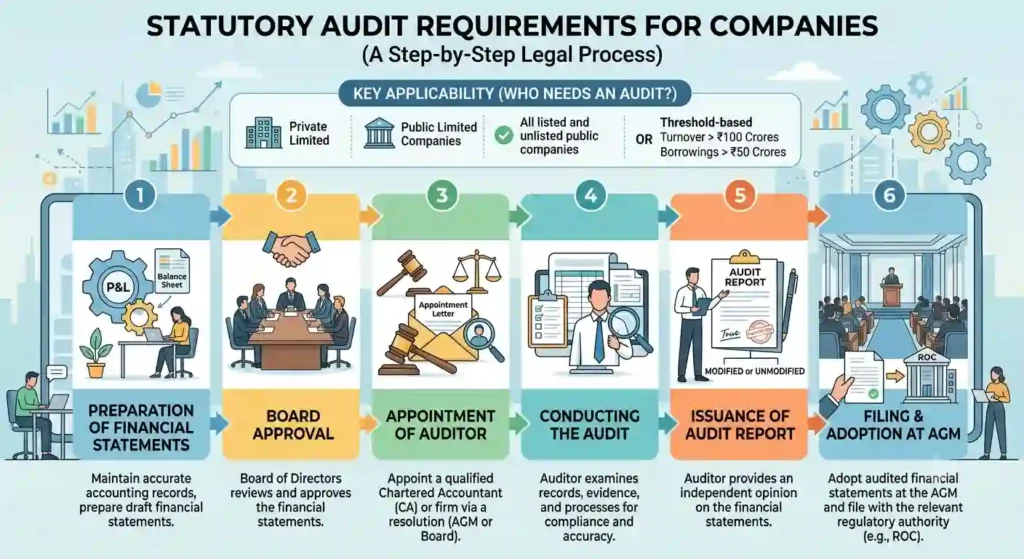
Statutory Audit Framework Under Indian Company Law
Applicability and Auditor Appointment
Who Must Have a Statutory Audit?
Every company must examine statutory audit requirements according to its legal status and applicable exemptions. Section 139 requires companies to appoint an auditor or auditors at the annual general meeting. Section 139 also governs appointment procedures and related requirements. Therefore, directors should confirm the company’s classification before beginning annual compliance planning. Private companies, public companies, one-person companies, and specified entities may have different compliance considerations. Additionally, subsidiary and holding structures require careful examination of applicable provisions. The auditor must satisfy statutory eligibility requirements before appointment. Companies should maintain board records, shareholder resolutions, auditor consent, and required declarations. Furthermore, filings with the Registrar of Companies must follow prescribed timelines. Consequently, corporate secretarial teams should coordinate closely with auditors. Legal counsel can review appointment procedures and identify potential Companies Act compliance risks. Empower Legal provides corporate legal assistance for statutory audit planning and governance requirements.
Appointment and Auditor Eligibility
Auditor appointment requires compliance with statutory eligibility and disqualification provisions. Section 139 establishes the general appointment framework, while Section 141 addresses auditor qualifications and disqualifications. Therefore, companies should obtain the auditor’s consent and eligibility confirmation before appointment. An auditor must meet the qualifications prescribed under the Companies Act and applicable professional standards. Additionally, disqualifications can prevent an individual or firm from accepting an audit engagement. Companies should document the appointment through proper board and shareholder processes. Furthermore, auditor changes require careful attention to resignation, casual vacancy, and communication requirements. Corporate records should clearly reflect the appointment period and relevant resolutions. Consequently, procedural accuracy helps prevent disputes with shareholders and regulators. Legal professionals can review proposed appointments where independence or eligibility concerns arise. Proper auditor appointment strengthens corporate governance and supports reliable financial reporting.
Auditor Rotation and Independence
Auditor rotation promotes independence and reduces prolonged concentration between auditors and companies. Section 139 contains statutory rotation requirements for specified companies. Therefore, eligible companies should monitor individual auditor and audit firm tenure carefully. Rotation requirements can differ between individual auditors and audit firms. Additionally, prescribed companies must observe cooling-off periods following completed tenure. Directors should maintain an audit appointment calendar to avoid accidental non-compliance. Furthermore, auditor independence remains important throughout the engagement. Section 144 restricts auditors from providing specified non-audit services to the company. Consequently, companies should review proposed professional services before engagement. Audit committees and boards should examine independence concerns where applicable. Legal advice can help assess whether a proposed service creates statutory restrictions. Empower Legal can support governance teams reviewing auditor appointment, rotation, independence, and related corporate compliance matters.
Audit Process and Financial Records
Maintaining Proper Books of Account
Statutory audit depends upon complete and accurate books of account and supporting records. Section 128 requires companies to maintain books and relevant papers at the registered office or permitted location. Therefore, accounting systems should capture transactions accurately and preserve supporting documentation. Records may include invoices, bank statements, ledgers, contracts, payroll information, inventory records, and tax documents. Additionally, companies should maintain appropriate electronic accounting records where applicable. Directors remain responsible for establishing suitable financial controls and recordkeeping systems. Furthermore, accounting records should permit auditors to trace significant transactions. Poor documentation can create audit qualifications and regulatory concerns. Consequently, companies should conduct periodic internal reviews before statutory audit commencement. Legal counsel can assist when records involve related-party transactions, disputed contracts, or regulatory investigations. Reliable books provide the foundation for accurate financial statements and effective statutory audit completion.
Financial Statements and Board Responsibility
Companies must prepare financial statements that comply with applicable statutory and accounting requirements. Section 134 addresses approval and related responsibilities concerning financial statements. Directors should review financial information carefully before placing statements before shareholders. Additionally, the board’s responsibility statement forms an important part of corporate reporting. Management should disclose material matters accurately and avoid misleading financial presentation. Furthermore, companies should coordinate accounting teams, auditors, secretarial professionals, and directors before finalisation. Therefore, unresolved accounting issues should receive attention before board approval. Auditors independently examine financial statements and supporting evidence. However, management remains responsible for preparing appropriate financial information. Consequently, directors should not treat statutory auditors as substitutes for internal financial controls. Legal professionals can review governance concerns arising from disclosures, related-party transactions, or shareholder disputes. Proper board oversight reduces compliance risks and strengthens corporate accountability.
Audit Report and Qualifications
The statutory auditor issues an audit report after examining financial statements and supporting evidence. The report communicates the auditor’s opinion and relevant statutory observations. Therefore, management should understand every qualification, adverse observation, or emphasis included in the report. Companies should investigate material issues rather than treating qualifications as routine paperwork. Additionally, audit committees should evaluate significant accounting and control concerns where applicable. Furthermore, Section 143 defines important auditor powers, duties, and reporting responsibilities. Auditors may seek information and explanations necessary for performing their statutory functions. Consequently, management should provide complete and timely information. Disagreements with auditors should receive careful documentation and professional review. Legal counsel can assist companies responding to serious audit observations or regulatory consequences. Empower Legal helps businesses assess corporate governance implications arising from statutory audit findings and reporting concerns.
Internal Financial Controls
Specified companies must address internal financial controls as part of corporate financial governance. Section 134 includes board responsibility concerning internal financial controls where applicable. Auditors also consider prescribed internal financial control requirements during their reporting process. Therefore, companies should establish approval systems, segregation of duties, reconciliation procedures, and access controls. Additionally, management should document important financial processes and review control effectiveness periodically. Weak controls can increase risks involving fraud, accounting errors, unauthorised payments, and inaccurate reporting. Furthermore, control failures can attract auditor observations and regulatory attention. Consequently, businesses should address recurring weaknesses before annual audit completion. Internal controls should match the company’s size, complexity, operations, and risk profile. Legal counsel can help investigate governance concerns involving management decisions and financial irregularities. Effective controls improve audit readiness while strengthening overall corporate risk management.
Corporate Compliance and Regulatory Oversight
Registrar of Companies Compliance
Companies must complete statutory filings arising from audited financial statements within prescribed timelines. Financial statements and annual returns require filing with the Registrar of Companies under applicable provisions. Therefore, companies should coordinate audit finalisation with annual compliance calendars. Delays can trigger additional fees and potential statutory penalties. Additionally, directors should verify that filed information matches approved corporate records. Furthermore, discrepancies between audited statements and statutory filings can create regulatory concerns. Companies should preserve acknowledgements and filed documents for future reference. Consequently, corporate secretarial teams should complete post-audit filings promptly. Legal professionals can assist when filings contain errors, delays, or disputed corporate information. Empower Legal can review compliance records and help address Registrar communications. Accurate filings demonstrate responsible corporate governance and reduce unnecessary regulatory exposure. Directors should monitor compliance deadlines rather than relying solely upon external reminders.
MCA Compliance and Corporate Governance
The Ministry of Corporate Affairs oversees major aspects of company law administration through its statutory framework. Companies interact with MCA systems for corporate filings, registrations, and compliance processes. Therefore, directors should maintain accurate master data and corporate records. Changes involving directors, registered offices, share capital, charges, or auditors may require prescribed filings. Additionally, companies should monitor MCA notices and regulatory communications. Furthermore, significant compliance failures can lead to adjudication or other proceedings. Corporate governance policies should establish responsibility for monitoring statutory obligations. Consequently, businesses benefit from integrated legal, secretarial, accounting, and audit functions. Empower Legal assists companies with corporate compliance reviews and regulatory response strategies. Timely action can reduce penalties and prevent unresolved compliance issues from becoming larger disputes. Directors should treat MCA compliance as an ongoing responsibility rather than an annual exercise.
NCLT and Corporate Disputes
Certain corporate disputes may ultimately reach the National Company Law Tribunal. NCLT jurisdiction covers specified matters under the Companies Act and insolvency framework. However, ordinary statutory audit completion does not automatically create NCLT proceedings. Therefore, companies should distinguish audit compliance issues from shareholder, oppression, management, insolvency, or restructuring disputes. Additionally, serious governance failures may intersect with other statutory proceedings. Legal counsel can determine the appropriate forum based on the dispute and requested relief. Furthermore, NCLT proceedings involve specialised procedures and documentation requirements. Companies should preserve board minutes, shareholder resolutions, financial statements, audit reports, and correspondence. Consequently, organised corporate records become essential during tribunal proceedings. Empower Legal can advise companies facing corporate disputes involving governance, financial reporting, or management decisions. Appropriate forum selection can prevent unnecessary procedural complications and improve litigation strategy.
Audit Fraud and Criminal Issues
Audit-related irregularities may sometimes involve suspected fraud, falsification, or dishonest financial conduct. Companies should investigate credible allegations through appropriate governance and legal processes. The Bharatiya Nyaya Sanhita, 2023 now governs criminal offences under India’s current framework. The Bharatiya Nagarik Suraksha Sanhita, 2023 governs criminal procedure. Therefore, suspected criminal conduct requires separate analysis from ordinary accounting disagreements. Additionally, the Bharatiya Sakshya Adhiniyam, 2023 governs applicable evidence principles, including electronic records. Companies should preserve emails, accounting data, audit files, and relevant digital communications. Furthermore, suspected offences may require police or other competent authority involvement. However, businesses should avoid making unsupported criminal allegations during commercial disagreements. Consequently, legal counsel should assess evidence and applicable provisions before escalation. Professional advice helps coordinate corporate, civil, regulatory, and criminal responses appropriately.
Practical Statutory Audit Compliance for Companies
Risk Management and Legal Assistance
Preparing for the Annual Audit
Effective audit preparation begins well before the statutory audit fieldwork starts. Companies should create an annual audit readiness checklist covering financial records and corporate documents. Useful preparations include:
- Reconcile bank accounts and major ledger balances.
- Review outstanding receivables, payables, provisions, and contingencies.
- Verify fixed assets, inventory, loans, and investments.
- Organise contracts, related-party transactions, and board approvals.
- Resolve previous audit qualifications and management-letter observations.
Additionally, management should prepare schedules requested by auditors. Furthermore, unresolved accounting matters should receive early professional attention. Directors should ensure auditors receive complete information within reasonable timelines. Consequently, preparation reduces avoidable audit delays and repeated information requests. Legal counsel can assist when documentation involves disputes, contracts, or regulatory investigations. A structured process also improves coordination between finance, management, auditors, and company secretaries.
Related-Party Transactions and Disclosures
Related-party transactions require careful compliance because they can create governance and conflict-of-interest concerns. Sections 177 and 188 contain important requirements concerning specified related-party transactions. Therefore, companies should identify related parties before approving significant transactions. Transactions may require board, committee, or shareholder approvals depending upon statutory requirements. Additionally, companies should maintain contracts, pricing records, resolutions, and supporting commercial rationale. Auditors may examine related-party transactions while reviewing financial statements. Furthermore, incomplete disclosures can create audit qualifications and regulatory concerns. Directors should disclose relevant interests according to applicable corporate requirements. Consequently, companies should integrate legal review with accounting and audit processes. Empower Legal can review related-party arrangements and corporate approval requirements. Proper documentation demonstrates commercial substance and supports transparent financial reporting. Early review also reduces risks associated with undisclosed or improperly approved transactions.
Auditor Requests and Management Cooperation
Management cooperation remains essential for completing a statutory audit efficiently. Auditors require access to financial records, explanations, supporting documents, and responsible personnel. Therefore, companies should establish a clear internal contact for audit information requests. Management should respond accurately rather than providing incomplete or speculative explanations. Additionally, material disagreements should receive written clarification and supporting evidence. Furthermore, directors should understand significant matters raised during audit discussions. Unresolved questions can delay finalisation or influence audit reporting. Consequently, businesses should maintain a documented process for responding to auditor queries. Legal counsel can assist where requests involve privileged information, litigation, fraud allegations, or regulatory investigations. However, companies should comply with lawful audit information requirements. Professional coordination supports auditor independence while protecting legitimate legal interests. Efficient communication ultimately improves audit quality and corporate compliance.
Non-Compliance, Penalties and Remedies
Statutory audit non-compliance can create financial penalties and governance consequences for companies and responsible officers. Relevant provisions may impose consequences for failures involving appointment, reporting, records, filings, or statutory duties. Therefore, directors should investigate non-compliance immediately after discovery. Rectification may involve revised filings, additional documentation, professional advice, or regulatory representations. Additionally, companies may need to respond to notices issued by the Registrar or other authorities. Serious matters can require adjudication or tribunal proceedings. Furthermore, criminal provisions may apply where deliberate fraudulent conduct independently satisfies statutory offences. Legal counsel can assess liability, available defences, limitation, evidence, and appropriate representations. Consequently, early response can reduce escalation risks. Companies should avoid destroying or altering records after receiving regulatory notices. Empower Legal provides compliance remediation and representation for corporate legal issues arising from statutory audit concerns. Prompt corrective action demonstrates responsible governance.
Legal Support for Audit Disputes
Companies may require legal support when statutory audit issues develop into disputes or regulatory proceedings. Lawyers can review auditor communications, board resolutions, financial records, contracts, and regulatory notices. Additionally, counsel can assist with governance investigations and responses to statutory authorities. The CPC may apply to civil proceedings where its provisions remain relevant. The BNS, BNSS, and BSA may become relevant where suspected criminal conduct and evidence issues arise. Therefore, legal strategy should match the nature of the underlying dispute. NCLT, Commercial Courts, High Courts, regulators, or other authorities may have jurisdiction over different matters. Furthermore, companies should preserve evidence before commencing contested proceedings. Empower Legal can provide corporate legal opinions, compliance reviews, notices, representations, negotiation, and litigation support. Consequently, integrated legal advice can protect directors and companies from avoidable procedural errors. Strong corporate governance remains the best foundation for successful statutory audit compliance.
Current Compliance Best Practices
Companies should treat statutory audit as a continuous governance process rather than an annual formality. Management should monitor accounting controls, statutory filings, board approvals, related-party transactions, and regulatory developments throughout the year. Additionally, audit findings should feed into internal control improvements. Directors should review material financial risks and ensure proper documentation. Furthermore, companies should maintain an updated compliance calendar covering auditor tenure and statutory filings. Businesses should also verify current MCA notifications, rules, and applicable accounting standards. Therefore, legal and professional advice should remain current with regulatory changes. Digital records should receive appropriate security and retention controls. Consequently, continuous compliance reduces last-minute audit pressure and regulatory exposure. Empower Legal can support companies through corporate compliance audits, legal opinions, governance advice, and dispute management. Proper preparation helps companies meet statutory duties while promoting transparency and stakeholder confidence.
Frequently Asked Questions
Is statutory audit mandatory for companies?
Yes. Companies generally require statutory audit under the Companies Act, 2013, subject to applicable statutory requirements. Eligible entities must appoint auditors following prescribed procedures.
Who appoints a company’s statutory auditor?
Members generally appoint the statutory auditor at the annual general meeting under Section 139. Companies must follow applicable appointment, consent, eligibility, and filing requirements.
What happens after an audit qualification?
Management should examine the qualification, understand its cause, and consider corrective measures. Significant issues may require disclosures, regulatory responses, or professional legal advice.
Can auditors provide other services?
Section 144 restricts auditors from providing specified non-audit services to the company. Companies should verify permitted services before engaging their statutory auditor.
What records should companies maintain?
Companies should maintain books, invoices, contracts, bank records, ledgers, tax documents, board records, and supporting evidence. Proper records help auditors verify financial statements.
Can audit fraud lead to criminal proceedings?
Potentially, where conduct independently constitutes an offence. BNS, BNSS, and BSA may become relevant, depending upon allegations, procedure, and available evidence.
Read More
- Financial Statements Filing: Form AOC-4 and Requirements
- Annual Return Filing: Form MGT-7 Complete Guide
- Annual General Meeting (AGM): Conducting and Compliance
- Board Meetings and Resolutions: Legal Requirements and Minutes
- Annual Compliance Calendar for Private Limited Companies
- Ministry of Corporate Affairs (MCA)