
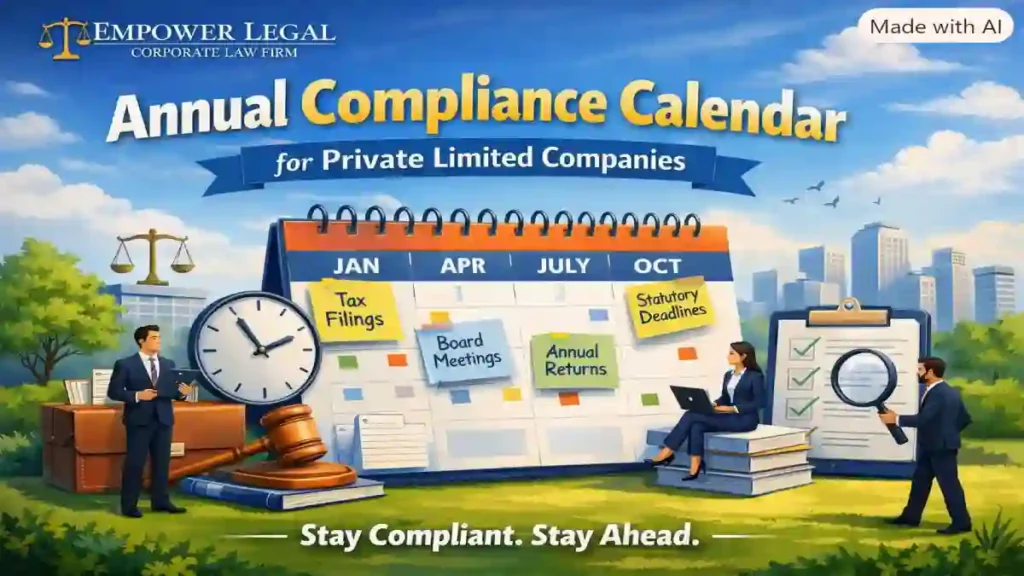
Annual Compliance Calendar – Private Limited Companies must satisfy statutory obligations throughout every financial year. Timely compliance protects directors, shareholders, investors, and business operations. Therefore, companies should maintain a structured annual compliance calendar. Empower Legal – Corporate Law Firm assists startups, MSMEs, family businesses, and established companies with regulatory compliance. Corporate obligations arise under the Companies Act, 2013, Income-tax Act, GST laws, labour laws, and sector-specific regulations. Moreover, timely filings reduce penalties, prosecution, and operational disruptions. Regulatory authorities regularly monitor corporate governance and statutory disclosures. Consequently, businesses should implement internal compliance systems and periodic legal audits. Proper documentation strengthens legal compliance while improving investor confidence. This guide explains mandatory annual compliances, government authorities, legal issues, remedies, and compliance strategies for Private Limited Companies across India.
Annual Compliance Calendar for Private Limited Companies – Empower Legal – Corporate Law Firm
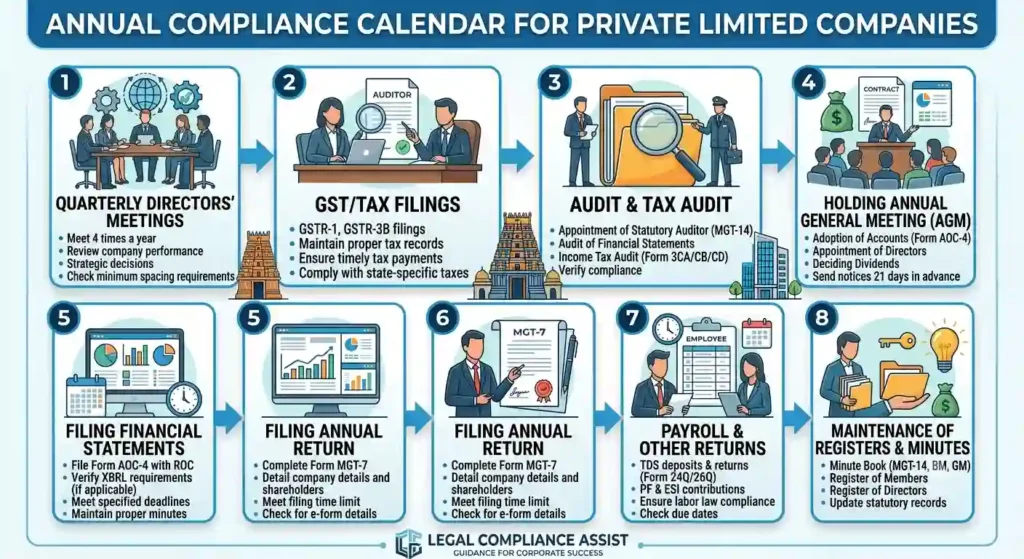
Understanding the Annual Compliance Framework for Private Limited Companies
Every Private Limited Company must comply with recurring statutory obligations irrespective of business turnover. Directors should understand annual, quarterly, monthly, and event-based compliance requirements. Consequently, systematic compliance planning prevents avoidable defaults. Companies regularly interact with the Ministry of Corporate Affairs, Registrar of Companies, Income Tax Department, Goods and Services Tax authorities, EPFO, ESIC, and State Labour Departments. Corporate governance also requires maintaining statutory registers, board resolutions, financial statements, and secretarial records. Moreover, proper compliance supports funding opportunities and commercial credibility. Legal professionals review statutory obligations before filing mandatory forms. Businesses should monitor amendments affecting corporate governance continuously. Therefore, proactive legal guidance strengthens regulatory compliance while minimizing litigation and enforcement risks before competent authorities and judicial forums.
Why an Annual Compliance Calendar Matters
A compliance calendar helps companies monitor statutory deadlines efficiently. Every organization should assign compliance responsibilities to qualified personnel. Additionally, automated reminders reduce filing delays. Annual planning covers board meetings, annual general meetings, financial statements, income tax filings, GST returns, labour compliances, and statutory registers. Companies also review director disclosures, auditor appointments, shareholding records, and beneficial ownership information periodically. Consequently, businesses avoid financial penalties and regulatory scrutiny. Investors appreciate companies maintaining transparent governance practices. Professional legal advisors conduct compliance audits identifying deficiencies before authorities discover violations. Therefore, organized compliance systems strengthen business continuity while protecting directors from avoidable legal exposure under applicable corporate legislation.
Mandatory Corporate Compliance Requirements
Private Limited Companies must complete several recurring statutory obligations every financial year. Businesses should verify every requirement before statutory deadlines. Furthermore, timely compliance strengthens corporate governance.
- Annual Return filing.
- Financial Statement filing.
- Annual General Meeting.
- Board Meetings.
- Director disclosures.
- Auditor appointment compliance.
- Income Tax Return filing.
- GST compliance.
- TDS compliance.
- Statutory register maintenance.
Regular monitoring improves compliance efficiency significantly. Consequently, companies reduce enforcement actions while maintaining strong regulatory credibility. Professional legal review also minimizes procedural errors during statutory filings.
Key Government Authorities Regulating Corporate Compliance
Several regulatory authorities supervise statutory compliance for Private Limited Companies. Companies should understand every regulator’s jurisdiction before filing statutory documents. Therefore, legal awareness remains essential.
| Government Authority | Primary Function |
|---|---|
| Ministry of Corporate Affairs | Corporate regulation |
| Registrar of Companies | Company filings |
| Income Tax Department | Direct tax compliance |
| Central Board of Indirect Taxes and Customs | GST administration |
| EPFO | Provident Fund compliance |
| ESIC | Employee insurance compliance |
| State Labour Department | Labour law enforcement |
Proper interaction with these authorities reduces procedural complications. Professional legal guidance improves compliance accuracy and regulatory communication.
Principal Corporate Laws Governing Compliance
Corporate compliance depends upon multiple statutory enactments regulating governance, taxation, employment, and commercial activities. Every company should remain updated with legislative amendments. Moreover, compliance strengthens legal certainty.
Important laws include:
- Companies Act, 2013.
- Income-tax Act, 1961.
- Central Goods and Services Tax Act, 2017.
- Limited Liability Partnership Act, where applicable.
- Code of Civil Procedure, 1908.
- Bharatiya Nyaya Sanhita, 2023.
- Bharatiya Nagarik Suraksha Sanhita, 2023.
- Bharatiya Sakshya Adhiniyam, 2023.
Fraud, forgery, falsification of accounts, or criminal misconduct may require investigation through nearby police stations wherever cognizable offences arise. Civil and criminal proceedings may continue independently according to applicable laws.
Benefits of Professional Corporate Compliance Support
Professional legal advisors simplify complex compliance obligations through structured planning and timely execution. Businesses receive practical solutions supporting sustainable corporate governance. Therefore, legal assistance creates long-term operational stability.
Key advantages include:
- Compliance calendar preparation.
- ROC filing support.
- Board documentation.
- Corporate governance advisory.
- GST compliance.
- Income tax compliance.
- Labour law compliance.
- Regulatory representation.
Comprehensive legal services reduce compliance risks substantially. Consequently, companies strengthen governance standards while protecting directors, shareholders, and business operations from avoidable legal consequences under evolving corporate laws.
Annual Statutory Filings and Corporate Governance Compliance
Private Limited Companies should complete statutory filings within prescribed timelines throughout every financial year. Moreover, directors should monitor recurring obligations through internal compliance systems. Every company must conduct board meetings, hold the Annual General Meeting, approve financial statements, and maintain statutory registers accurately. Companies should also file annual returns, financial statements, director disclosures, and beneficial ownership information with the Registrar of Companies wherever applicable. Consequently, timely filings reduce regulatory scrutiny and financial penalties. Empower Legal – Corporate Law Firm advises businesses regarding corporate governance, documentation, and statutory reporting. Periodic legal reviews identify compliance gaps before authorities initiate enforcement proceedings. Therefore, organized governance practices improve operational transparency while protecting directors and shareholders from avoidable legal exposure.
Tax, Labour, and Regulatory Compliance Obligations
Corporate compliance extends beyond company law into taxation, employment, and regulatory governance. Businesses should maintain coordinated compliance across every applicable statute. Additionally, timely reporting strengthens commercial credibility. Companies must file Income Tax Returns, GST returns, Tax Deducted at Source statements, Professional Tax returns where applicable, EPFO filings, ESIC contributions, and labour law registers. Businesses should also preserve payroll records, employment contracts, attendance registers, and statutory notices carefully. Consequently, regulators verify compliance efficiently during inspections or audits. Legal advisors recommend periodic reconciliations between accounting records and statutory filings. Effective compliance management reduces litigation risks while protecting business continuity. Therefore, companies should integrate taxation, labour, and corporate governance into one structured annual compliance calendar.
Essential Corporate Records Every Company Should Maintain
Proper documentation strengthens regulatory compliance and supports efficient corporate governance. Companies should preserve records throughout prescribed statutory periods. Furthermore, organized documentation simplifies inspections and legal proceedings.
Important records include:
- Certificate of Incorporation.
- Memorandum of Association.
- Articles of Association.
- Statutory Registers.
- Board Meeting Minutes.
- AGM Minutes.
- Share Certificates.
- Financial Statements.
- Auditor Reports.
- Tax Records.
Comprehensive documentation establishes legal compliance effectively. Consequently, companies respond confidently to regulatory inspections, shareholder requests, and judicial proceedings whenever necessary. Systematic record management also supports business expansion and investment.
Legal Remedies for Corporate Compliance Disputes
Companies facing regulatory disputes possess several statutory remedies. Businesses should evaluate available legal options before initiating proceedings. Moreover, professional legal advice improves litigation strategy.
| Legal Remedy | Purpose |
|---|---|
| Compounding Applications | Resolve specified compliance defaults |
| Appeal before Regional Director | Challenge eligible MCA orders |
| National Company Law Tribunal | Corporate dispute resolution |
| High Court Writ Petition | Constitutional remedies |
| Supreme Court Appeal | Final judicial remedy |
| Arbitration | Contractual commercial disputes |
| Mediation | Negotiated settlements |
| Rectification Applications | Correct statutory errors |
Selecting appropriate remedies depends upon applicable legislation and factual circumstances. Consequently, businesses protect corporate interests through timely legal action.
Regulatory Authorities Monitoring Corporate Compliance
Several government authorities supervise different aspects of corporate compliance. Companies should maintain transparent communication with every applicable regulator. Additionally, regulatory awareness reduces procedural delays.
Relevant authorities include:
- Ministry of Corporate Affairs.
- Registrar of Companies.
- National Company Law Tribunal.
- Income Tax Department.
- Central Board of Indirect Taxes and Customs.
- Employees’ Provident Fund Organisation.
- Employees’ State Insurance Corporation.
- State Labour Departments.
Effective compliance promotes smooth regulatory interactions. Consequently, companies strengthen governance while minimizing enforcement actions and legal disputes.
Common Legal Issues Faced by Private Limited Companies
Corporate entities frequently encounter compliance-related legal challenges during business operations. Companies should identify these issues proactively. Therefore, preventive legal guidance remains essential.
Common legal issues include:
- Delayed ROC filings.
- Director disqualification risks.
- GST compliance failures.
- Income tax notices.
- TDS defaults.
- Labour law violations.
- Shareholder disputes.
- Statutory register deficiencies.
- Beneficial ownership non-disclosures.
- Corporate governance lapses.
Timely legal intervention resolves many compliance concerns efficiently. Consequently, companies preserve business continuity while maintaining statutory compliance and stakeholder confidence.
Corporate Compliance Services by Empower Legal – Corporate Law Firm
Professional legal assistance covers every stage of corporate compliance management. Businesses require strategic support beyond routine statutory filings. Moreover, experienced advisors reduce long-term compliance risks.
Empower Legal – Corporate Law Firm offers:
- Annual compliance calendar preparation.
- ROC filing assistance.
- Corporate governance advisory.
- Board and AGM documentation.
- GST compliance support.
- Income tax compliance guidance.
- Labour law compliance.
- NCLT representation.
- High Court litigation.
- Corporate legal audits.
Comprehensive legal services improve compliance accuracy significantly. Therefore, companies confidently satisfy statutory obligations while protecting directors, shareholders, investors, and commercial interests under India’s evolving corporate regulatory framework.
Managing Corporate Fraud and Regulatory Investigations
Corporate compliance failures may sometimes lead to regulatory investigations and legal proceedings. Therefore, companies should maintain transparent records and ethical governance practices. Fraudulent transactions, false statements, forged documents, and financial misconduct may attract serious consequences under applicable laws. Additionally, investigating authorities may examine corporate records, electronic communications, and financial documents. Proceedings involving criminal misconduct may involve police stations, economic offence wings, and other competent agencies. Courts evaluate evidence under the Bharatiya Sakshya Adhiniyam, 2023 while investigations follow the Bharatiya Nagarik Suraksha Sanhita, 2023. Furthermore, offences involving fraud or dishonest conduct may attract provisions under the Bharatiya Nyaya Sanhita, 2023. Legal representation helps companies respond effectively during investigations. Consequently, professional compliance management protects directors and businesses from unnecessary legal exposure.
Future Trends in Private Limited Company Compliance
Corporate compliance continues evolving through digital filings, automation, data governance, and enhanced regulatory monitoring. Companies increasingly require technology-driven compliance systems for accuracy and efficiency. Moreover, government authorities continue improving online platforms for corporate reporting and verification. Businesses should adopt proactive compliance strategies to address changing regulatory expectations. Digital records, electronic signatures, automated reminders, and compliance dashboards improve operational control. Consequently, companies reduce filing errors and strengthen governance standards. Legal advisors monitor legislative amendments, judicial decisions, and regulatory notifications regularly. Furthermore, periodic compliance audits identify risks before they become major disputes. Empower Legal – Corporate Law Firm helps businesses adapt to emerging corporate requirements. Therefore, future-ready compliance planning supports sustainable growth and protects companies from regulatory challenges.
Annual Compliance Calendar Checklist
Private Limited Companies should maintain a structured calendar covering all recurring statutory obligations. Proper scheduling improves accountability and reduces missed deadlines. Additionally, compliance tracking supports effective corporate governance.
| Period | Important Compliance Activity |
|---|---|
| Monthly | GST, TDS, PF, ESI filings |
| Quarterly | Tax reviews and compliance audits |
| Half-Yearly | Internal governance reviews |
| Before AGM | Financial statement approval |
| Annual | ROC annual return filing |
| Annual | Income Tax Return filing |
| Event-Based | Director or shareholding updates |
Companies should customize calendars according to industry requirements. Therefore, businesses achieve better compliance control while reducing legal risks.
Conclusion
Annual compliance management forms the foundation of responsible corporate governance for Private Limited Companies. Businesses should follow structured calendars covering company law, taxation, labour regulations, and sector-specific obligations. Moreover, timely compliance protects directors, shareholders, employees, and investors. Empower Legal – Corporate Law Firm provides comprehensive corporate legal services including ROC compliance, governance advisory, regulatory representation, legal audits, taxation support, and dispute resolution. Professional guidance helps companies prevent penalties, address notices, and resolve compliance challenges effectively. Consequently, businesses maintain operational stability while meeting statutory responsibilities under Indian laws. Strategic compliance planning also improves investor confidence and long-term commercial success. Therefore, every Private Limited Company should adopt professional legal support for continuous compliance management.
Frequently Asked Questions
1. What are the annual compliances required for a Private Limited Company?
Private Limited Companies must complete ROC filings, annual returns, financial statements, AGM requirements, tax filings, statutory registers, and other applicable regulatory compliances.
2. Which government authority regulates Private Limited Company compliance?
The Ministry of Corporate Affairs and Registrar of Companies regulate corporate filings, governance requirements, and statutory obligations under the Companies Act, 2013.
3. What happens if a company fails to complete annual compliance?
Non-compliance may result in penalties, additional fees, director disqualification, prosecution, regulatory notices, and restrictions on company operations.
4. Can directors face legal action for company compliance failures?
Yes. Directors may face personal liability for certain defaults, including fraud, misstatements, statutory violations, and failure to perform legal duties.
5. How can Empower Legal help with corporate compliance?
Empower Legal provides ROC filings, compliance calendars, legal audits, corporate governance advice, regulatory representation, and dispute resolution support for companies.
6. Can companies challenge regulatory orders or penalties?
Yes. Companies may pursue remedies through appeals, NCLT proceedings, High Court petitions, statutory applications, or other available legal forums depending upon circumstances.
Read More
- Environmental Clearances for Businesses: EC and CTE/CTO
- Factory License Under Factories Act 1948: Complete Guide
- FSSAI License for Food Businesses: Types and Registration Process
- Import Export Code (IEC) Registration for Trading Companies
- Shops and Establishments Act Registration: State-wise Requirements
- Ministry of Corporate Affairs (MCA) – Government of India