
Environmental Clearances for Businesses – Environmental compliance protects businesses from regulatory action and promotes sustainable industrial growth. Empower Legal – Corporate Law Firm assists companies across India with environmental approvals and compliance strategies. Moreover, businesses must obtain statutory approvals before establishing or operating regulated industries. Environmental Clearance, Consent to Establish, and Consent to Operate remain fundamental legal requirements. Non-compliance may invite financial penalties, operational closure, prosecution, or environmental compensation. Therefore, early legal advice minimizes regulatory risks and project delays. Our legal team advises manufacturers, infrastructure developers, logistics companies, healthcare facilities, renewable energy projects, mining entities, chemical industries, and commercial establishments. We evaluate statutory obligations under applicable environmental laws before project implementation. Comprehensive compliance strengthens investor confidence and regulatory credibility. Professional legal guidance also reduces disputes before regulatory authorities, tribunals, and courts while supporting responsible business expansion.
Environmental Clearances for Businesses: EC and CTE/CTO – Empower Legal – Corporate Law Firm
Understanding Environmental Clearance and CTE/CTO Requirements
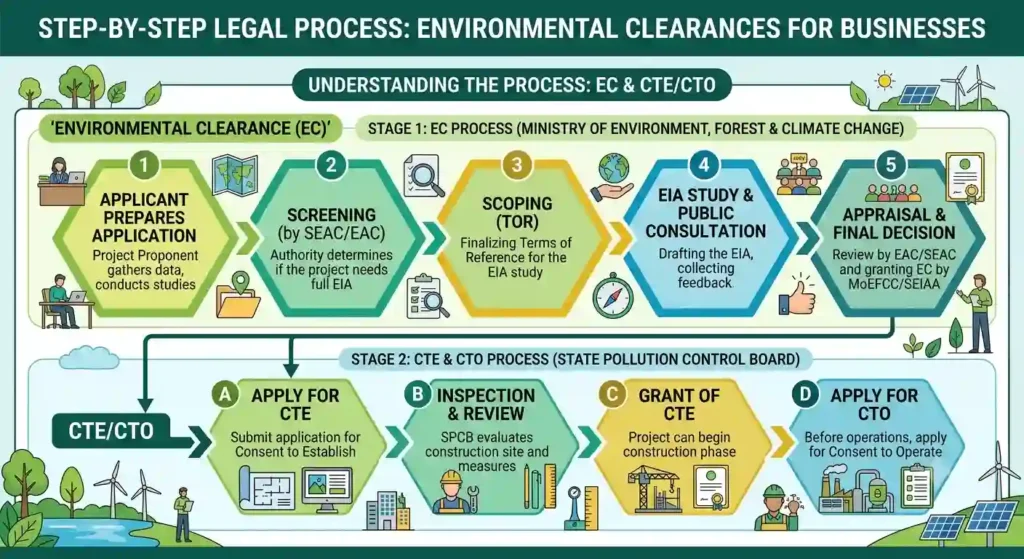
Environmental Clearance, commonly called EC, authorizes eligible development projects after environmental impact assessment under applicable laws. Furthermore, Consent to Establish, known as CTE, permits industries to construct facilities before operations commence. Consent to Operate, called CTO, authorizes commercial production after compliance verification. Each approval serves a distinct statutory purpose. Businesses must identify applicable approvals according to industry category, pollution potential, project capacity, and location. Additionally, authorities evaluate environmental safeguards, pollution control systems, waste management, emissions, water consumption, and ecological impact. Missing approvals frequently delay investments and commercial operations. Proper legal planning reduces compliance failures considerably. Our lawyers coordinate technical experts, regulatory consultants, and project stakeholders throughout approval processes. Accurate documentation and timely submissions improve approval efficiency while reducing avoidable objections from environmental authorities.
Legal Framework Governing Environmental Approvals
India regulates environmental approvals through several interconnected statutes and regulatory notifications. Moreover, the Environment (Protection) Act, 1986 provides broad regulatory authority for environmental governance. The Water (Prevention and Control of Pollution) Act, 1974 governs water pollution control and consent requirements. The Air (Prevention and Control of Pollution) Act, 1981 regulates emissions affecting ambient air quality. Environmental Clearance primarily follows the Environmental Impact Assessment Notification, 2006, including subsequent amendments. Additionally, Central Pollution Control Board guidelines and State Pollution Control Board regulations influence compliance obligations. Certain projects also require forest, wildlife, coastal, groundwater, hazardous waste, or construction-related approvals. Our lawyers interpret statutory provisions carefully before project commencement. Proper legal compliance prevents enforcement actions, unnecessary litigation, and commercial uncertainty during project implementation.
Authorities, Jurisdiction, and Approval Process
Environmental approvals involve several regulatory authorities depending upon project category, investment, location, and environmental impact. Moreover, the Ministry of Environment, Forest and Climate Change grants Environmental Clearance for notified projects within its jurisdiction. State Environment Impact Assessment Authorities examine eligible state-level projects with assistance from Expert Appraisal Committees. Central Pollution Control Board establishes national pollution standards, while State Pollution Control Boards issue Consent to Establish and Consent to Operate. Certain matters also involve local bodies, groundwater authorities, forest departments, coastal authorities, and industrial development agencies. Therefore, businesses must identify the competent authority before filing applications. Our lawyers prepare applications, legal opinions, compliance reports, representations, replies, and supporting documentation. Careful regulatory planning minimizes objections and approval delays. Timely compliance also strengthens long-term operational certainty while reducing enforcement risks before environmental authorities.
Common Legal Issues Affecting Businesses
Businesses frequently encounter legal challenges during environmental approval and compliance processes. Furthermore, incomplete applications, incorrect project categorization, and inadequate environmental studies often delay approvals. Regulatory inspections may identify pollution control deficiencies, unauthorized expansion, hazardous waste violations, untreated discharge, excessive emissions, or groundwater extraction concerns. Environmental complaints from nearby residents also create regulatory scrutiny. Therefore, prompt legal intervention reduces potential liability and operational disruption. Empower Legal advises manufacturing industries, infrastructure companies, healthcare facilities, logistics operators, renewable energy projects, pharmaceutical businesses, educational institutions, hospitality enterprises, and technology parks. We also assist during inspections, show-cause notices, closure notices, environmental compensation proceedings, and appellate litigation. Proper documentation, statutory compliance, and continuous legal monitoring significantly reduce regulatory disputes. Strategic legal planning protects investments while supporting sustainable industrial development.
Compliance, Remedies, and Corporate Legal Support
Legal Remedies and Dispute Resolution
Businesses facing environmental disputes have several statutory remedies under Indian environmental laws. Moreover, appropriate legal strategy depends upon the authority, project category, and alleged violation. Companies may submit replies to show-cause notices, seek reconsideration of rejected applications, challenge closure directions, contest environmental compensation, or file statutory appeals. The National Green Tribunal hears many environmental disputes involving statutory authorities and environmental damage. Certain civil disputes may proceed under the Code of Civil Procedure, 1908 where applicable. Criminal investigations involving environmental offences may also attract the Bharatiya Nyaya Sanhita, 2023, investigation under the Bharatiya Nagarik Suraksha Sanhita, 2023, and evidentiary provisions under the Bharatiya Sakshya Adhiniyam, 2023. Nearby Police Stations may investigate offences where criminal liability arises. Our lawyers develop practical litigation strategies that protect business continuity while ensuring statutory compliance and regulatory cooperation.
Corporate Environmental Compliance Checklist
Businesses should maintain continuous environmental compliance after obtaining approvals. Furthermore, periodic monitoring reduces enforcement risks and strengthens corporate governance.
| Compliance Area | Purpose | Authority |
|---|---|---|
| Environmental Clearance | Project approval | MoEFCC / SEIAA |
| Consent to Establish | Construction approval | SPCB |
| Consent to Operate | Operational permission | SPCB |
| Hazardous Waste Authorization | Waste management | SPCB |
| Water Compliance | Effluent control | SPCB / CPCB |
| Air Compliance | Emission standards | SPCB / CPCB |
| Environmental Monitoring | Regulatory reporting | Competent Authority |
| Renewal Applications | Continued compliance | SPCB |
Forums, Courts, and Government Authorities
Environmental compliance often involves multiple regulators and adjudicatory bodies. Therefore, selecting the correct forum ensures faster legal resolution.
- Ministry of Environment, Forest and Climate Change
- Central Pollution Control Board
- State Pollution Control Board
- State Environment Impact Assessment Authority
- Expert Appraisal Committee
- District Administration
- Local Municipal Authorities
- Ground Water Authorities
- Forest Department
- Coastal Zone Authorities
- National Green Tribunal
- High Courts
- Supreme Court of India
- Civil Courts
- Nearby Police Stations
- Industrial Development Authorities
Common Environmental Legal Issues
Businesses commonly require legal assistance for the following matters:
- Environmental Clearance applications
- Consent to Establish approvals
- Consent to Operate renewals
- Pollution control compliance
- Hazardous waste management
- Water pollution violations
- Air pollution compliance
- Industrial expansion approvals
- Environmental compensation notices
- Closure directions
- Show-cause notices
- Regulatory inspections
- Waste disposal disputes
- Environmental audits
- NGT litigation
- Compliance due diligence
- Corporate ESG compliance
- Environmental risk management
Why Choose Empower Legal – Corporate Law Firm
Empower Legal – Corporate Law Firm delivers practical environmental compliance solutions for businesses across diverse industries. Moreover, our lawyers combine regulatory knowledge with commercial understanding to reduce legal risks. We assist startups, manufacturers, infrastructure companies, multinational corporations, MSMEs, hospitals, educational institutions, logistics operators, renewable energy developers, and industrial parks. Our services include legal opinions, environmental due diligence, application drafting, regulatory representation, appellate proceedings, compliance audits, and litigation support. Consequently, clients receive clear advice before investing substantial resources. We coordinate with environmental consultants and technical professionals whenever necessary. Strategic legal planning prevents avoidable disputes while supporting business expansion. Our commitment focuses on lawful growth, sustainable operations, regulatory compliance, and effective representation before environmental authorities, tribunals, and courts throughout India.
Frequently Asked Questions
Q1. Is Environmental Clearance mandatory for every business?
No. Only notified projects require Environmental Clearance. However, many industries still require Consent to Establish and Consent to Operate before beginning commercial operations.
Q2. What is the difference between CTE and CTO?
Consent to Establish permits construction before operations. Consent to Operate authorizes business activities after authorities verify pollution control compliance and statutory requirements.
Q3. Which authority grants Environmental Clearance?
MoEFCC or the State Environment Impact Assessment Authority grants Environmental Clearance depending upon project category, jurisdiction, and statutory requirements.
Q4. Can businesses challenge rejection of environmental approvals?
Yes. Businesses may pursue statutory appeals, judicial review, or proceedings before the National Green Tribunal or competent courts where permitted by law.
Q5. What happens if a company operates without CTE or CTO?
Authorities may impose penalties, issue closure directions, recover environmental compensation, prosecute responsible persons, or initiate other statutory enforcement proceedings.
Q6. How can Empower Legal help businesses?
Our lawyers manage approvals, compliance reviews, legal notices, regulatory representation, due diligence, environmental litigation, appeals, and ongoing compliance strategies for businesses.
Read More
- Factory License Under Factories Act 1948: Complete Guide
- FSSAI License for Food Businesses: Types and Registration Process
- Import Export Code (IEC) Registration for Trading Companies
- Shops and Establishments Act Registration: State-wise Requirements
- Professional Tax Registration: State-wise Guide and Procedures
- Ministry of Environment, Forest and Climate Change (MoEFCC)