

Professional Tax Registration – Professional Tax is a state levy imposed on salaried employees, professionals, traders, and specified business entities under respective State Professional Tax Acts. Therefore, every employer and eligible professional should determine registration requirements before commencing business operations. Empower Legal – Corporate Law Firm provides comprehensive legal guidance for Professional Tax registration, compliance, assessments, appeals, and litigation across India. Since Professional Tax remains a state subject, registration procedures, tax slabs, due dates, exemptions, and penalties differ among states. Businesses operating in multiple states must comply separately within each jurisdiction. Our legal professionals evaluate statutory obligations before recommending suitable compliance strategies. Proper registration minimizes regulatory risks while avoiding unnecessary penalties. Early legal advice strengthens corporate governance and statutory compliance. Timely Professional Tax registration also improves business credibility before government authorities, financial institutions, and commercial stakeholders during regulatory inspections and contractual transactions.
Professional Tax Registration: State-wise Guide and Procedures – Empower Legal – Corporate Law Firm
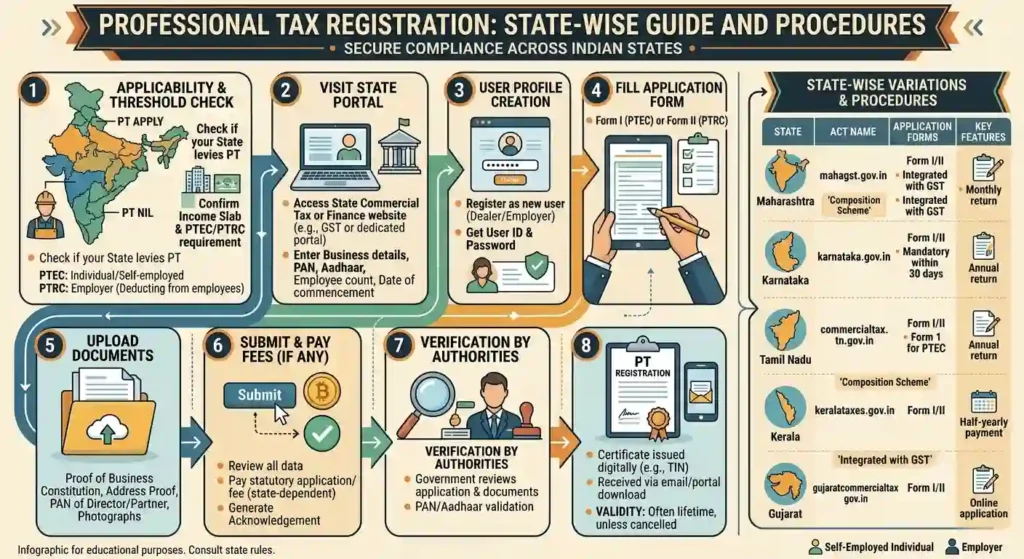
State-wise Professional Tax Laws and Registration Framework
Each state administers Professional Tax through its designated Commercial Taxes Department, State Tax Department, Labour Department, or other notified authority. Moreover, Maharashtra, Karnataka, Tamil Nadu, West Bengal, Andhra Pradesh, Telangana, Gujarat, Kerala, and several other states prescribe separate registration procedures and compliance requirements. Employers generally obtain Professional Tax Registration Certificates and Professional Tax Enrollment Certificates where applicable. Registration timelines depend upon state legislation and business commencement dates. Empower Legal – Corporate Law Firm reviews organizational structures before recommending registration obligations. Proper legal analysis prevents duplicate registrations and statutory violations. Businesses should monitor state notifications because compliance requirements frequently change. Correct documentation simplifies departmental verification and future audits. Professional legal assistance ensures accurate filings while reducing disputes before appellate authorities, competent courts, and regulatory forums across applicable jurisdictions.
Registration Requirements for Employers and Professionals
Who Must Obtain Professional Tax Registration
Professional Tax registration applies to employers deducting tax from employee salaries and eligible individuals carrying professions, trades, callings, or businesses under applicable state laws. Consequently, companies, partnership firms, LLPs, proprietorships, startups, consultants, doctors, architects, chartered accountants, advocates, contractors, manufacturers, retailers, service providers, educational institutions, hospitals, and branch offices should verify statutory obligations carefully. Every establishment requires legal evaluation before determining registration liability. Our lawyers assess employee strength, salary structures, business locations, applicable exemptions, and state-specific provisions. Correct registration prevents penalty proceedings and compliance failures. Businesses expanding across multiple states require separate registration wherever legislation mandates compliance. Preventive legal review significantly reduces regulatory exposure. Early compliance protects commercial operations while supporting uninterrupted statutory approvals and business growth.
Essential Documents and Registration Procedure
Professional Tax registration requires organized documentation supported by accurate business information. Furthermore, complete records accelerate approval and reduce departmental objections. Common documents include incorporation certificates, partnership deeds, LLP agreements, GST registration, PAN, Aadhaar, address proof, employee details, salary records, bank account information, lease agreements, utility bills, authorization letters, identity documents, and business licenses where applicable. Registration generally occurs through designated state portals followed by verification procedures. Empower Legal – Corporate Law Firm reviews documentation before submission to ensure statutory compliance. Proper document management strengthens future audits and departmental inspections. Businesses should preserve registration certificates, payment records, returns, acknowledgments, and correspondence securely. Accurate documentation minimizes legal complications while supporting successful compliance across multiple state jurisdictions.
Common Legal Issues During Professional Tax Compliance
Professional Tax disputes commonly arise from delayed registration, incorrect employee classification, calculation errors, late payments, return filing defaults, branch registration issues, exemption disputes, jurisdictional disagreements, penalty notices, assessment proceedings, recovery actions, and documentation deficiencies. Therefore, businesses should seek legal guidance immediately after receiving departmental communications. Our legal professionals analyze statutory notices using current state legislation and judicial precedents. We prepare detailed replies supported by documentary evidence and applicable legal provisions. Where disputes continue, clients receive representation before appellate authorities, competent tribunals, and constitutional courts according to jurisdiction. Allegations involving forged records or deliberate fraud may attract proceedings under the Bharatiya Nyaya Sanhita, 2023. Procedural matters follow the Bharatiya Nagarik Suraksha Sanhita, 2023, while evidentiary issues receive examination under the Bharatiya Sakshya Adhiniyam, 2023.
Compliance, Authorities, and Legal Remedies
Professional Tax Compliance After Registration
Professional Tax compliance continues after successful registration and requires consistent statutory attention. Therefore, employers should maintain accurate payroll records and deposit tax within prescribed timelines. Regular compliance includes employee tax deductions, return filing, tax payment, record preservation, reconciliation, responding to departmental notices, and updating registration details whenever business information changes. Empower Legal – Corporate Law Firm assists clients with ongoing compliance across multiple states. Businesses operating through branches should monitor each state’s separate obligations carefully. Proper compliance reduces audits, inspections, and penalty proceedings. Timely legal advice also prevents avoidable disputes before tax authorities. Strong internal compliance systems improve regulatory confidence and financial governance. Businesses should periodically review statutory notifications because state governments frequently revise tax slabs, exemptions, filing procedures, and compliance requirements. Preventive legal support always reduces future litigation costs.
Government Departments, Forums, and Authorities
Professional Tax administration depends upon the concerned state’s designated authority. Moreover, businesses should identify the correct department before submitting applications or appeals. Common authorities include Commercial Taxes Departments, State Tax Departments, Labour Departments, Municipal Corporations, and designated Professional Tax Officers. Appeals generally proceed before Appellate Authorities constituted under relevant State Professional Tax Acts. Constitutional remedies remain available before High Courts wherever jurisdictional or legal errors arise. Civil courts may examine limited issues wherever maintainable under applicable law. Nearby police stations may investigate criminal complaints involving forged records, fraudulent registrations, or fabricated documents when supported by evidence under the Bharatiya Nyaya Sanhita, 2023. Procedural safeguards operate under the Bharatiya Nagarik Suraksha Sanhita, 2023, while evidentiary standards follow the Bharatiya Sakshya Adhiniyam, 2023. Proper legal representation protects statutory rights throughout proceedings.
Legal Remedies for Professional Tax Disputes
Businesses and professionals possess several statutory remedies against adverse departmental actions. Consequently, early legal intervention improves dispute resolution and reduces financial exposure. Available remedies include registration rectification, correction applications, delayed filing condonation where permissible, replies to notices, assessment objections, appellate proceedings, revision petitions, writ petitions before High Courts, settlement discussions, refund claims, penalty challenges, recovery objections, and compliance audits. Empower Legal – Corporate Law Firm evaluates every matter individually before recommending suitable legal strategies. Proper documentation strengthens legal claims before authorities. Timely filing remains essential because limitation periods affect available remedies. Experienced lawyers prepare legally sustainable submissions supported by statutes, notifications, judicial precedents, and documentary evidence. Professional legal advice safeguards commercial interests while ensuring statutory compliance across different Indian states.
State-wise Compliance Checklist
Businesses should complete the following compliance measures for Professional Tax registration:
| Compliance Requirement | Purpose |
|---|---|
| Registration Certificate | Legal compliance |
| Enrollment Certificate | Individual liability compliance |
| Employee Records | Salary verification |
| Monthly or Periodic Returns | Statutory filing |
| Tax Payment Records | Audit support |
| Payroll Registers | Deduction verification |
| Assessment Orders | Legal reference |
| Appeal Documents | Dispute resolution |
Key compliance points include:
- Verify applicable state law.
- Register within prescribed timelines.
- Maintain payroll records.
- File returns promptly.
- Preserve payment receipts.
- Respond to departmental notices.
- Monitor legislative amendments.
- Obtain legal review periodically.
Recommended compliance steps:
- Identify applicable state legislation.
- Obtain required registration.
- Verify employee tax deductions.
- Deposit Professional Tax timely.
- File statutory returns.
- Maintain documentary evidence.
- Address notices immediately.
- Consult experienced corporate lawyers.
Why Choose Empower Legal – Corporate Law Firm
Empower Legal – Corporate Law Firm delivers practical Professional Tax advisory services for startups, companies, LLPs, partnership firms, proprietorships, NGOs, educational institutions, hospitals, manufacturers, traders, professionals, and multinational businesses. Furthermore, our legal team provides registration assistance, compliance management, departmental representation, appeals, documentation review, regulatory advisory, due diligence, legal audits, and litigation support. Every client receives customized legal solutions based upon applicable state legislation and business structure. We simplify complicated statutory requirements through practical legal guidance. Our lawyers identify compliance risks before authorities initiate enforcement proceedings. Preventive legal planning strengthens corporate governance while minimizing financial exposure. Professional representation improves confidence during assessments, audits, inspections, and appellate proceedings. Timely legal advice protects businesses against avoidable penalties while ensuring sustainable statutory compliance across India.
Frequently Asked Questions
Q1. Who must obtain Professional Tax Registration?
Employers, eligible professionals, businesses, LLPs, companies, firms, and establishments covered under applicable State Professional Tax laws generally require registration or enrollment.
Q2. Is Professional Tax applicable in every Indian state?
No. Professional Tax applies only in states that have enacted relevant legislation. Registration procedures and tax rates vary between states.
Q3. What documents are necessary for Professional Tax registration?
Common documents include PAN, business registration, GST details, address proof, employee records, bank details, identity proof, and authorization documents.
Q4. What happens if Professional Tax registration is delayed?
Delayed registration may attract penalties, interest, notices, assessments, recovery proceedings, and other statutory consequences under applicable state laws.
Q5. Can businesses challenge Professional Tax assessment orders?
Yes. Aggrieved taxpayers may file statutory appeals, revision petitions, or approach the High Court where legally maintainable under applicable provisions.
Q6. How can Empower Legal assist with Professional Tax compliance?
Our lawyers provide registration, compliance reviews, documentation, legal notices, departmental representation, appeals, litigation support, and preventive legal advisory services.
Read More
- ESI Registration for Companies: Employee Health Insurance Guide
- EPFO Registration: Provident Fund Compliance for Employers
- GST Registration for Companies: When and How to Register
- PAN and TAN Registration for Companies: Complete Process
- Post-Incorporation Compliance Checklist for New Companies
- Department of Revenue, Government of India – State Commercial Tax Department Links