
GST Registration for Companies – Goods and Services Tax registration forms the foundation of lawful business operations in India. Every eligible company must evaluate turnover, business activities, and statutory obligations before commencing taxable supplies. Moreover, proper registration improves tax compliance and strengthens commercial credibility. Empower Legal – Corporate Law Firm advises startups, private companies, public companies, subsidiaries, foreign companies, LLPs, and multinational businesses regarding GST registration and compliance. Our lawyers assist with documentation, departmental representation, legal notices, and dispute resolution. Timely registration prevents penalties, interest, prosecution, and business interruptions. Consequently, businesses maintain uninterrupted input tax credit benefits while complying with the Central Goods and Services Tax Act, 2017, Integrated Goods and Services Tax Act, 2017, State GST laws, and applicable GST Rules.
GST Registration for Companies: When and How to Register – Empower Legal – Corporate Law Firm
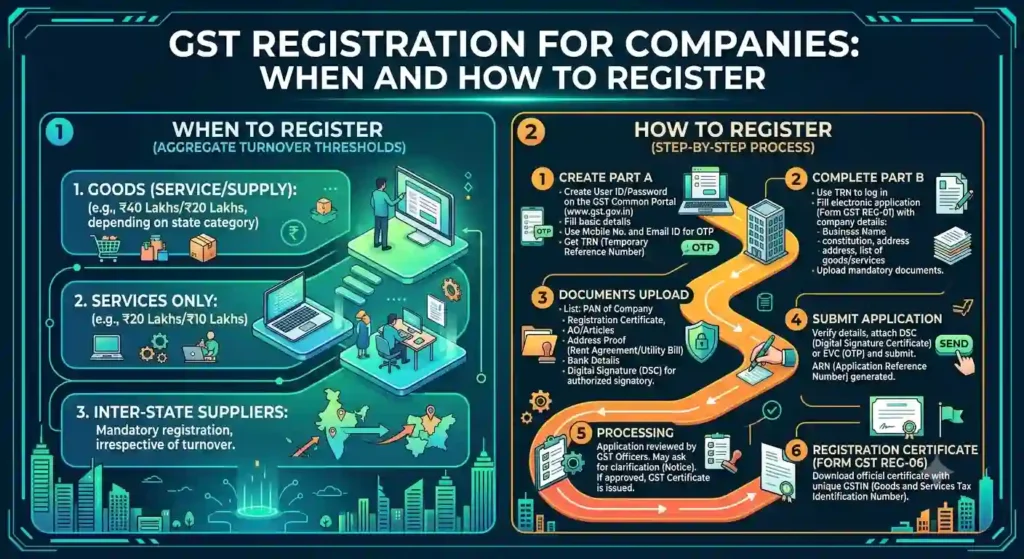
When GST Registration Becomes Mandatory
GST registration depends upon statutory thresholds and specified business activities. Therefore, companies should assess legal requirements before commencing taxable operations. Certain entities require compulsory registration regardless of turnover.
Mandatory registration generally applies for:
- Interstate taxable supplies
- E-commerce operators
- Casual taxable persons
- Non-resident taxable persons
- Input Service Distributors
- TDS deductors
- Agents supplying taxable goods
- Reverse charge liabilities
- Online information service providers
- Voluntary registration applicants
Professional legal review minimizes compliance risks while ensuring statutory obligations receive timely attention.
Documents Required for GST Registration
Essential Documentation Checklist
Proper documentation accelerates GST registration approval. Every document should remain accurate, complete, and legally valid. Furthermore, inconsistencies frequently trigger departmental clarification notices.
| Document | Purpose |
|---|---|
| PAN of Company | Tax identification |
| Certificate of Incorporation | Business proof |
| Memorandum and Articles | Corporate records |
| Director PAN and Aadhaar | Identity verification |
| Registered office proof | Address verification |
| Bank account proof | Financial verification |
| Digital Signature Certificate | Online authentication |
| Board Resolution | Authorized signatory proof |
Experienced legal professionals verify documentation before submission, reducing rejection risks and unnecessary procedural delays.
GST Registration Process and Legal Compliance
Step-by-Step GST Registration Procedure
Registration Process Before GST Authorities
The GST registration process requires careful compliance with statutory requirements. Initially, applicants complete the online application using prescribed information. Subsequently, authorities examine supporting documents before granting registration.
Registration steps include:
- PAN verification
- Aadhaar authentication
- Business information submission
- Upload supporting documents
- Verification by GST officer
- Clarification response if required
- GSTIN allotment
- Registration certificate issuance
Our corporate lawyers supervise every procedural stage while addressing departmental objections through legally sustainable responses.
Authorities, Jurisdiction and Legal Forums
GST compliance involves several statutory authorities. Accordingly, companies should understand departmental jurisdiction before initiating legal proceedings. Proper representation improves dispute resolution efficiency.
Relevant authorities include:
- Central Board of Indirect Taxes and Customs
- State GST Department
- GST Commissioner
- GST Proper Officer
- Appellate Authority
- GST Appellate Tribunal
- High Court
- Supreme Court
- Commercial Courts
- Civil Courts where maintainable
Nearby police stations investigate criminal allegations involving forgery, fraud, fake invoices, or document fabrication under applicable criminal laws.
Legal Issues, Remedies and Professional Assistance
Common GST Registration Disputes and Solutions
Businesses frequently encounter registration-related legal challenges despite careful planning. Therefore, immediate legal intervention protects commercial interests and statutory compliance. Our firm represents companies before GST authorities and appellate forums. Additionally, we prepare replies, appeals, rectification applications, and writ petitions wherever necessary. Applicable laws include the Central Goods and Services Tax Act, 2017, Integrated Goods and Services Tax Act, 2017, State GST Acts, Code of Civil Procedure, Bharatiya Nyaya Sanhita, Bharatiya Nagarik Suraksha Sanhita, and Bharatiya Sakshya Adhiniyam. These laws govern civil recovery, criminal offences, procedural safeguards, and electronic evidence. Strategic legal representation reduces compliance exposure while preserving valuable business operations and reputation.
Available Legal Remedies for Companies
Companies possess several statutory remedies against adverse departmental actions. Every remedy depends upon factual circumstances and legal provisions. Consequently, timely legal advice strengthens successful outcomes.
Available remedies include:
- Fresh registration application
- Clarification submission
- Revocation application
- Appeal before Appellate Authority
- Rectification petition
- Review proceedings
- Writ petition before High Court
- Refund application
- Stay application
- Penalty challenge
- Interest dispute resolution
- Input Tax Credit restoration
- Criminal defence representation
- Compliance advisory
- Litigation support
Early legal assistance prevents avoidable disputes while strengthening long-term GST compliance.
Frequently Asked Questions
1. When should a company obtain GST registration?
A company should register before commencing taxable supplies whenever statutory thresholds or compulsory registration provisions become applicable.
2. Can a company voluntarily obtain GST registration?
Yes. Voluntary registration remains available and provides lawful tax compliance with input tax credit benefits where eligible.
3. What happens if GST registration gets rejected?
Applicants may respond to notices, correct deficiencies, submit fresh applications, or pursue statutory legal remedies where available.
4. Can GST registration be cancelled?
Yes. Authorities may cancel registration for statutory violations. Businesses may seek revocation or file appropriate legal appeals.
5. Which court hears GST disputes?
GST disputes generally proceed before appellate authorities, GST Appellate Tribunal, High Courts, and the Supreme Court under applicable laws.
6. Why should companies engage GST lawyers?
Professional lawyers ensure accurate registration, departmental compliance, dispute resolution, litigation support, and effective protection against penalties and prosecution.
Read More
- PAN and TAN Registration for Companies: Complete Process
- Post-Incorporation Compliance Checklist for New Companies
- Certificate of Incorporation: Understanding Your Company’s Birth Certificate
- Registered Office Requirements and Documentation
- Memorandum and Articles of Association: Drafting Guidelines
- GST Portal (GST Registration, GSTIN, Returns, Payments)