
Registered Office Requirements and Documentation – A registered office forms the official communication address of a company. Every company must maintain this address throughout its existence. The requirement arises under the Companies Act, 2013. Regulatory authorities send notices and statutory communications to this location. Therefore, businesses must ensure continuous accessibility. A compliant office address strengthens corporate governance and legal transparency. Moreover, investors often review registered office details during due diligence. Non-compliance may attract penalties and regulatory scrutiny. Common legal issues include incorrect address disclosures, delayed filings, and unauthorized office shifts. Relevant authorities include the Registrar of Companies, Ministry of Corporate Affairs, and state authorities. Legal support often involves compliance audits and document verification.
Registered Office Requirements and Documentation – Empower Legal – Corporate Law Firm
Key requirements include:
• Valid business address
• Occupancy proof
• Utility documents
• ROC filings
| Authority | Function |
|---|---|
| ROC | Registration |
| MCA | Compliance |
| NCLT | Corporate disputes |
Importance of Maintaining a Valid Registered Office
A registered office establishes jurisdiction for legal proceedings and regulatory oversight. Courts determine territorial jurisdiction through the registered office location. Consequently, companies must update address changes promptly. Government departments rely on these records for inspections and notices. Financial institutions also verify registered office details before approvals. An incorrect address may result in missed legal communications. Such failures can trigger penalties and compliance risks. Corporate disputes frequently involve service of notices and statutory correspondence. Businesses should preserve address records carefully. Professional legal review reduces future complications. Important benefits include:
- Regulatory compliance
- Corporate credibility
- Effective communication
- Jurisdictional certainty
| Legal Concern | Possible Remedy |
|---|---|
| Wrong address | ROC correction filing |
| Missed notice | Legal representation |
| Compliance default | Compounding applications |
Essential Documents for Registered Office Registration
Documentation confirms lawful occupation and operational legitimacy. Companies generally submit ownership records or occupancy evidence. Utility bills establish address authenticity. Furthermore, authorities may request supporting declarations during scrutiny. Documentation standards vary according to occupancy arrangements. Property owners provide title documents. Tenants usually provide lease agreements and owner consent. Accurate records prevent future disputes and compliance objections. Legal practitioners often verify documents before incorporation. Typical documentation includes:
• Sale deed or title proof
• Rental agreement
• No Objection Certificate
• Electricity bill
• Water tax receipt
| Document | Purpose |
|---|---|
| NOC | Owner consent |
| Utility bill | Address proof |
| Lease deed | Occupancy proof |
Ownership-Based Registered Office Documentation
Companies operating from owned premises enjoy comparatively straightforward compliance procedures. Ownership documents establish legal possession and occupancy rights. Registrars generally accept recent utility bills alongside ownership records. However, documents should match company disclosures accurately. Any discrepancy may delay incorporation approvals. Corporate lawyers often conduct document verification before submission. Proper record maintenance assists during inspections and due diligence exercises. Recommended records include:
- Sale deed
- Property tax receipt
- Encumbrance records
- Utility bill copies
Ownership disputes may require proceedings before civil courts under the CPC framework. Additionally, documentary evidence gains significance under the BSA. Early legal intervention protects corporate interests and reduces litigation exposure.
Sale Deed and Title Verification Requirements
Title verification ensures the company occupies a legally recognized property. Lawyers review ownership chains to identify encumbrances. Therefore, title examination remains a critical compliance exercise. Defective title records may create future legal challenges. Financial institutions also assess title clarity before lending decisions. Businesses should preserve certified copies securely. Important verification points include:
• Ownership continuity
• Property description accuracy
• Encumbrance status
• Revenue record consistency
Courts evaluate documentary evidence carefully during property disputes. Consequently, strong documentation reduces litigation risks and enhances regulatory confidence.
Utility Bills and Supporting Address Evidence
Utility documents validate actual usage of the registered office premises. Authorities generally prefer recent bills. Electricity bills remain the most commonly accepted records. Nevertheless, water and gas bills may support verification. Names and property details should remain consistent across documents. Businesses should maintain updated records for inspections. Essential practices include:
- Retain current bills
- Preserve digital copies
- Verify address accuracy
- Update records regularly
Incomplete documentation may attract compliance notices from regulatory authorities. Timely rectification usually resolves minor discrepancies efficiently.
Rented Premises Documentation Requirements
Many startups and growing businesses operate from leased premises. Rental arrangements require additional documentation. The landlord’s consent remains a significant requirement. Moreover, tenancy records should clearly identify the property. Authorities frequently verify occupancy rights during incorporation reviews. Legal professionals often examine lease clauses before filing. Important documents include:
• Lease agreement
• Rent receipts
• Owner NOC
• Utility bills
Disputes involving tenancy rights may reach civil courts. Therefore, carefully drafted agreements strengthen legal protection and compliance reliability.
No Objection Certificate from Property Owner
The No Objection Certificate confirms owner consent for business registration. Registrars generally require this document when companies occupy rented premises. Furthermore, the certificate should identify the property accurately. Ambiguous language may create verification concerns. Landlords should execute the document voluntarily. Important contents include:
- Owner identification
- Property details
- Consent declaration
- Signature and date
A properly drafted NOC reduces disputes regarding occupancy rights. Consequently, businesses experience smoother incorporation and compliance procedures.
Lease Agreement Compliance Considerations
A lease agreement establishes contractual rights between parties. Clear drafting prevents misunderstandings and future disputes. Therefore, businesses should review lease terms carefully. Commercial usage permissions require special attention. Agreements should define duration, rent, renewal rights, and obligations. Key compliance points include:
• Commercial usage clause
• Property description
• Renewal provisions
• Termination conditions
Contractual disputes may proceed before civil courts. Professional legal review significantly improves enforceability and compliance certainty.
Procedure for Changing a Registered Office Address
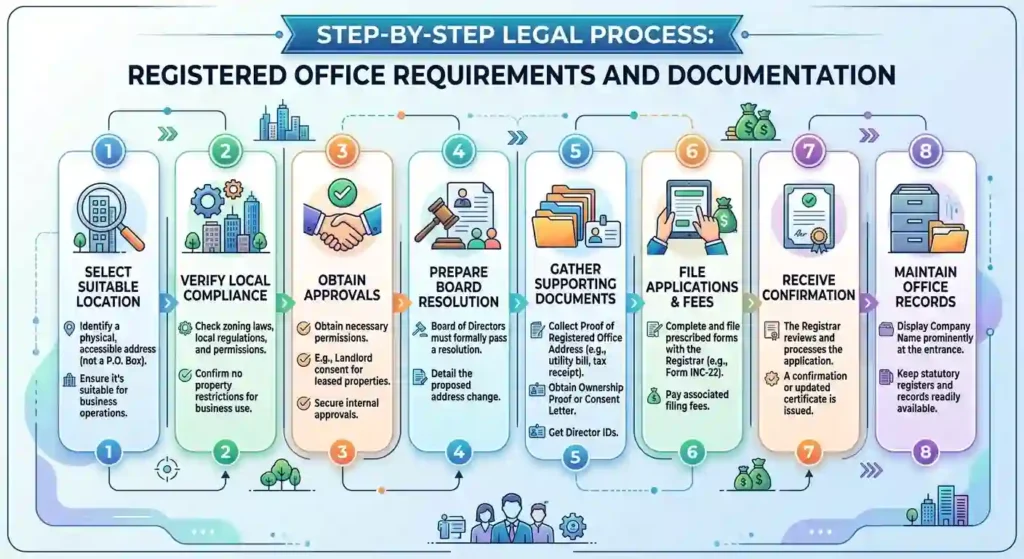
Companies may relocate due to operational expansion or strategic decisions. The Companies Act prescribes specific procedures for address changes. Consequently, timely filings remain essential. Board approvals often initiate the process. Certain changes require shareholder resolutions. ROC filings must follow prescribed timelines. Businesses should preserve all supporting records. Standard procedure includes:
- Board resolution
- Shareholder approval where required
- ROC filing
- Address record updates
Failure to complete statutory filings may attract penalties. Legal professionals assist companies throughout the transition process.
Legal Consequences of Non-Compliance
Non-compliance may expose companies to regulatory penalties and operational disruptions. Authorities expect accurate and updated records. Moreover, service of legal notices depends upon registered office disclosures. Persistent violations may invite enforcement actions. Common consequences include:
• Monetary penalties
• Compliance notices
• Inspection proceedings
• Litigation risks
Serious corporate disputes may proceed before the NCLT. Criminal conduct involving false records may trigger investigation under the BNS and BNSS. Nearby police stations may receive complaints involving forgery, fraud, or document manipulation. Early legal representation often minimizes adverse consequences.
Available Legal Remedies and Professional Support
Businesses facing compliance concerns should seek prompt legal guidance. Lawyers evaluate records and identify corrective measures. Consequently, companies can restore compliance efficiently. Available remedies include:
- ROC rectification filings
- Compounding applications
- Corporate advisory services
- Representation before tribunals
- Litigation support
Relevant forums include ROC offices, NCLT benches, commercial courts, civil courts, and appellate forums. Professional assistance strengthens compliance management and reduces future legal exposure.
Conclusion
Registered office compliance remains a fundamental corporate obligation. Accurate documentation protects businesses from avoidable disputes. Furthermore, timely filings enhance transparency and regulatory confidence. Companies should maintain ownership, tenancy, and utility records carefully. Legal review helps identify deficiencies before they become significant issues. A proactive compliance strategy reduces litigation risks and strengthens corporate governance. Businesses that prioritize documentation enjoy smoother regulatory interactions and stronger legal protection.
FAQs
FAQ 1: Is a registered office mandatory for every company?
Yes. Every company must maintain a registered office. Authorities use it for notices, compliance communication, inspections, and jurisdiction purposes.
FAQ 2: Can a rented property serve as a registered office?
Yes. Companies may use rented premises. They usually need a lease agreement, owner consent, and recent address proof documents.
FAQ 3: What happens if the registered office changes?
The company must pass resolutions, file prescribed ROC forms, and update statutory records within applicable legal timelines.
FAQ 4: Which documents commonly prove a registered office address?
Utility bills, ownership records, lease agreements, NOCs, tax receipts, and occupancy documents commonly support address verification.
FAQ 5: Which authorities oversee registered office compliance?
The Registrar of Companies and Ministry of Corporate Affairs primarily monitor compliance, filings, disclosures, and statutory obligations.
FAQ 6: What legal remedies exist for compliance defaults?
Businesses may file rectification applications, seek legal representation, submit delayed filings, and pursue compounding where permitted.
Read More
- Memorandum and Articles of Association: Drafting Guidelines
- SPICe+ Form Filing: Step-by-Step Incorporation Guide
- Company Name Approval: RUN Portal Guidelines and Best Practices
- Director Identification Number (DIN): Application and Compliance
- Digital Signature Certificate (DSC) for Company Directors: Complete Guide
- Ministry of Corporate Affairs (MCA)