
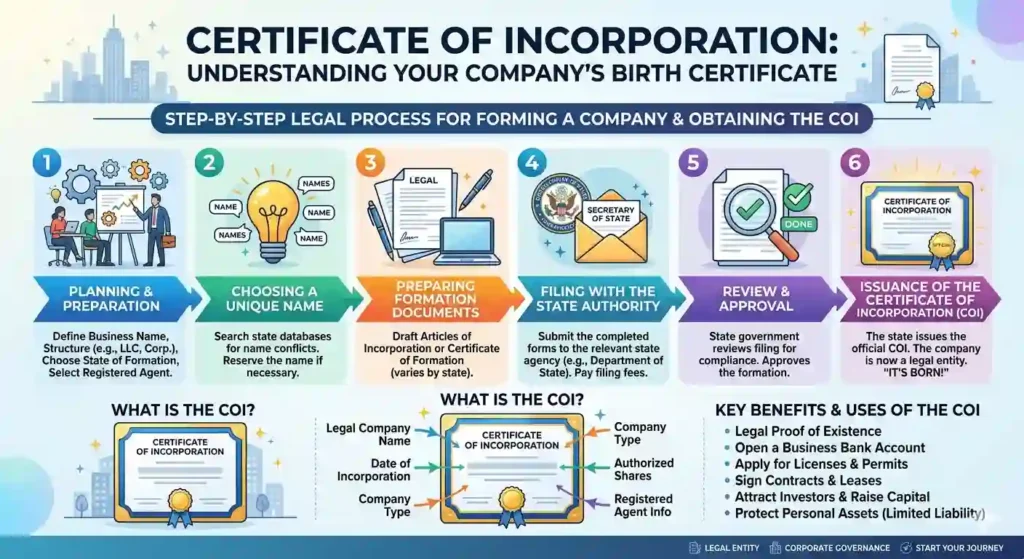
A Certificate of Incorporation marks the legal birth of a company. The Registrar of Companies issues this document after successful registration. Therefore, the certificate confirms the company’s legal existence under the Companies Act, 2013. Businesses require this document for banking, taxation, licensing, and contractual transactions. Investors, lenders, and government departments often verify incorporation details before engagement. The certificate also establishes the Corporate Identification Number and registration date. Entrepreneurs should preserve this document carefully throughout business operations. Legal disputes frequently arise from incorrect incorporation records or compliance failures. Empower Legal – Corporate Law Firm assists companies with incorporation, regulatory compliance, and dispute resolution.
Certificate of Incorporation: Understanding Your Company’s Birth Certificate – Empower Legal – Corporate Law Firm
Proper legal guidance reduces future corporate risks significantly.
| Key Element | Purpose |
|---|---|
| CIN | Company Identity |
| ROC Registration | Legal Recognition |
| Incorporation Date | Corporate Existence |
| Company Name | Legal Identity |
Legal Foundation of Company Incorporation
The Companies Act, 2013 governs company incorporation in India. Additionally, the Ministry of Corporate Affairs administers registration procedures. Applicants must satisfy statutory requirements before obtaining incorporation approval. The Registrar of Companies reviews submitted documents and declarations. Consequently, errors may delay registration or invite regulatory scrutiny. Businesses should ensure accuracy in constitutional documents and disclosures. Proper incorporation creates credibility and facilitates commercial growth. Corporate lawyers assist founders with legal structuring and compliance planning. Strategic advice helps prevent governance issues later.
Core Requirements
- Approved company name.
- Registered office.
- Directors’ details.
- Memorandum of Association.
- Articles of Association.
Information Contained in the Certificate
A Certificate of Incorporation contains essential corporate identification details. Authorities, banks, and stakeholders frequently rely upon these particulars. Moreover, the certificate serves as prima facie evidence of incorporation. It generally includes the company name, CIN, incorporation date, and jurisdiction. Businesses must verify details immediately after issuance. Inaccuracies may create operational and legal complications. Timely correction requests help avoid future disputes. Empower Legal – Corporate Law Firm supports clients during rectification proceedings and regulatory communications.
Types of Companies Receiving Incorporation Certificates
Different business structures receive incorporation certificates upon successful registration. Private limited companies remain popular among startups and growing enterprises. Furthermore, public companies, one-person companies, and Section 8 entities require incorporation. Limited liability partnerships follow a separate registration framework. Each structure carries unique compliance obligations and governance requirements. Founders should evaluate business objectives before selecting a structure. Appropriate legal advice ensures regulatory alignment and operational efficiency.
Common Structures
- Private Limited Company.
- Public Limited Company.
- One Person Company.
- Section 8 Company.
- Producer Company.
Common Incorporation Errors and Legal Issues
Several legal issues arise during company incorporation procedures. Incorrect director information often leads to regulatory complications. Additionally, defective constitutional documents may attract objections from authorities. Name approval disputes and registered office issues frequently occur. Businesses should address concerns before commencement of operations. Legal review minimizes compliance risks and administrative delays. Professional guidance strengthens the registration process and future governance practices.
Compliance Duties After Incorporation
Receiving a Certificate of Incorporation marks the beginning of compliance obligations. Companies must comply with statutory filing requirements regularly. Therefore, directors should establish effective governance systems immediately. Businesses must maintain registers, records, and financial documentation. Authorities may impose penalties for non-compliance. Early compliance planning supports sustainable corporate growth. Empower Legal – Corporate Law Firm advises businesses regarding post-incorporation obligations and risk management. Proper governance enhances investor confidence and regulatory standing.
Corporate Compliance and Regulatory Reporting
Every incorporated company must comply with ongoing reporting requirements. The Registrar of Companies monitors statutory filings and disclosures. Furthermore, companies should conduct board meetings and maintain minutes properly. Financial statements and annual returns require timely submission. Delays may trigger penalties and regulatory proceedings. Businesses should create compliance calendars and monitoring systems. Professional legal assistance reduces administrative risks substantially.
| Compliance Area | Authority |
|---|---|
| Annual Returns | ROC |
| Financial Statements | MCA |
| Director Filings | ROC |
| Corporate Changes | ROC |
Government Departments and Regulatory Authorities
Several government departments oversee corporate compliance activities. The Ministry of Corporate Affairs remains the principal regulatory authority. Additionally, income tax authorities supervise tax registrations and obligations. GST authorities regulate indirect tax compliance where applicable. Labour departments may monitor employment-related requirements. Companies should maintain transparency during regulatory interactions. Legal professionals assist businesses with notices, inspections, and compliance reviews.
Relevant Authorities
- Ministry of Corporate Affairs.
- Registrar of Companies.
- Income Tax Department.
- GST Department.
- Labour Authorities.
Legal Remedies for Corporate Disputes
Corporate disputes may arise despite careful planning and compliance. Shareholder conflicts frequently affect governance and decision-making. Moreover, contractual disputes may impact commercial operations. Companies can pursue remedies through negotiation, mediation, arbitration, or litigation. Appropriate strategy depends upon facts and legal objectives. Early intervention often prevents costly disputes and reputational damage. Empower Legal – Corporate Law Firm provides comprehensive dispute management support.
Forums, Tribunals and Courts
Corporate disputes may proceed before various forums and adjudicatory bodies. The National Company Law Tribunal handles many company-related matters. Furthermore, appellate remedies exist before the National Company Law Appellate Tribunal. High Courts exercise jurisdiction in suitable cases. The Supreme Court remains the highest constitutional forum. CPC procedures govern civil litigation where applicable. Businesses should evaluate jurisdiction before initiating proceedings.
Corporate Fraud and Regulatory Investigations
Serious corporate violations may attract regulatory investigations and enforcement actions. Authorities may examine fraud, forgery, or misrepresentation allegations. In certain situations, BNS, BNSS, and BSA provisions become relevant. Local police stations may investigate criminal complaints where necessary. Consequently, businesses should respond promptly to notices and inquiries. Effective legal representation protects corporate interests and statutory rights. Compliance-focused governance significantly reduces enforcement exposure.
Risk Areas
- Fraud allegations.
- False disclosures.
- Director misconduct.
- Financial irregularities.
- Regulatory violations.
Why Choose Empower Legal – Corporate Law Firm
Empower Legal – Corporate Law Firm delivers comprehensive corporate legal solutions. Our team assists startups, entrepreneurs, investors, and established businesses. Moreover, we provide incorporation services, compliance advisory, and dispute resolution support. Clients receive practical guidance tailored to commercial objectives. We represent businesses before regulators, tribunals, and courts. Strong legal support helps companies navigate regulatory complexities confidently. Our proactive approach protects business interests and promotes sustainable growth.
Frequently Asked Questions
1. What is a Certificate of Incorporation?
A Certificate of Incorporation confirms a company’s legal existence after registration under the Companies Act, 2013.
2. Who issues the Certificate of Incorporation?
The Registrar of Companies issues the certificate through the Ministry of Corporate Affairs after approval.
3. Why is the Certificate of Incorporation important?
It serves as proof of legal existence for banking, taxation, contracts, licensing, and regulatory compliance.
4. Can incorporation details be corrected later?
Yes. Companies may seek corrections through prescribed procedures before the Registrar of Companies.
5. Which forum handles company disputes?
The National Company Law Tribunal commonly handles company law disputes and related proceedings.
6. What legal support helps after incorporation?
Businesses benefit from compliance advisory, governance assistance, regulatory representation, and dispute resolution services.
Read More
- Registered Office Requirements and Documentation
- Memorandum and Articles of Association: Drafting Guidelines
- SPICe+ Form Filing: Step-by-Step Incorporation Guide
- Company Name Approval: RUN Portal Guidelines and Best Practices
- Director Identification Number (DIN): Application and Compliance
- Ministry of Corporate Affairs (MCA)