
Company name approval forms the first compliance step for business incorporation in India. The Reserve Unique Name (RUN) facility allows promoters to reserve suitable company names through the Ministry of Corporate Affairs. Entrepreneurs must follow statutory naming rules under the Companies Act, 2013 and related rules. A strong name supports branding, legal compliance, investor confidence, and market recognition. Applicants should avoid prohibited expressions, misleading terms, and identical names. Moreover, careful planning reduces rejection risks and incorporation delays. The Registrar of Companies reviews proposed names before granting approval. Common legal issues include trademark conflicts, resemblance objections, and sector-specific restrictions. Professional legal support helps applicants prepare compliant submissions. Businesses should also review intellectual property considerations before filing. Effective name selection strengthens corporate identity and minimizes future disputes. Therefore, promoters should understand applicable regulations, procedural requirements, and best practices before accessing the RUN portal.
Company Name Approval: RUN Portal Guidelines and Best Practices – Empower Legal – Corporate Law Firm
RUN Portal Framework
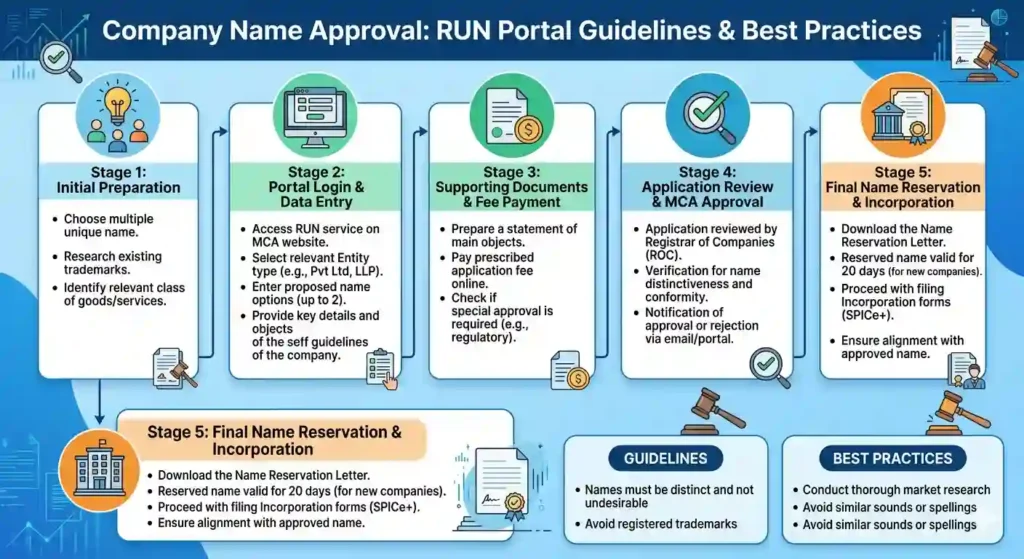
The RUN portal offers a simplified mechanism for reserving company names. Applicants access the service through the Ministry of Corporate Affairs platform. The process requires basic applicant information and proposed company names. Authorities examine names against statutory restrictions and existing records. Furthermore, officials assess trademark concerns and public interest considerations. Applicants should provide meaningful justifications supporting proposed names. Strong explanations often improve approval prospects. Companies operating in regulated sectors may require additional approvals. Jurisdiction generally rests with the Registrar of Companies. However, disputes can reach higher forums through statutory remedies. Businesses should maintain accurate records supporting name selection. Proper due diligence reduces compliance risks and administrative objections. Consequently, strategic preparation remains essential for successful name reservation.
Key Eligibility Requirements
Promoters must ensure that proposed names satisfy legal standards before submission. Names should remain unique, distinctive, and lawful. Applicants should avoid offensive expressions and prohibited words. Additionally, names must not suggest government patronage without authorization. Trademark screening plays a critical role during preparation. Businesses should compare proposed names against registered marks and corporate databases. Legal advisors often conduct comprehensive searches before filing. Common concerns include deceptively similar names and misleading business descriptions. Authorities may reject applications creating public confusion. Therefore, applicants should prioritize originality and transparency. Compliance efforts at this stage prevent future litigation and administrative complications. Early legal review frequently saves time and costs.
Best Practices for Name Selection
Businesses should develop multiple naming options before filing applications. Alternative names reduce delays if authorities reject the primary choice. Promoters should align names with business objectives and future expansion plans. Moreover, names should remain simple, memorable, and legally compliant. Consider the following best practices: 1. Conduct trademark searches. 2. Review MCA records. 3. Avoid generic expressions. 4. Maintain sector relevance. 5. Prepare clear justifications. These measures strengthen application quality. Professional advisors often identify hidden legal risks. Strategic planning improves approval rates and brand value. Therefore, thoughtful name selection remains a valuable investment for emerging businesses.
Common Reasons for Rejection
Authorities reject applications for several recurring reasons. Identical or similar names represent the most common issue. Trademark conflicts also trigger objections. Furthermore, misleading descriptions frequently attract scrutiny. Names suggesting government affiliation without approval face rejection. Applicants sometimes submit insufficient justifications supporting proposed names. Administrative authorities expect meaningful explanations. Businesses should also avoid restricted words requiring regulatory approval. Failure to follow naming conventions can delay incorporation. Legal support helps identify compliance gaps before filing. Companies should review rejection trends and regulatory guidance regularly. Consequently, proactive risk management improves approval prospects and operational efficiency.
Legal Issues and Remedies
Company name disputes can create significant legal challenges. Trademark owners may oppose confusingly similar names. Regulatory authorities can direct corrective action where violations occur. Applicants may seek professional advice regarding available remedies. Relevant forums include the Registrar of Companies, Regional Director, and certain judicial forums. Corporate disputes may also involve civil proceedings under applicable laws. CPC principles may become relevant in civil litigation. Additionally, evidence assessment may involve BSA principles where disputes arise. Businesses should preserve records supporting good-faith adoption. Early intervention often reduces costs and reputational damage. Therefore, companies should respond promptly to legal notices and regulatory concerns.
Government Departments and Forums
Several authorities influence company name approval and compliance. The Ministry of Corporate Affairs administers incorporation procedures. Registrars of Companies evaluate name applications. Trademark authorities manage intellectual property registrations. Moreover, appellate remedies may involve designated forums under applicable laws. Businesses should understand jurisdictional boundaries before pursuing remedies. Regulatory approvals may apply in banking, insurance, education, or healthcare sectors. Companies operating nationally should review sector-specific requirements carefully. Legal counsel often coordinates communications with multiple authorities. Effective compliance management reduces administrative delays. Consequently, organizations benefit from a structured regulatory strategy covering incorporation and post-incorporation obligations.
Compliance Table
| Requirement | Purpose |
|————|———|
| Name Search | Uniqueness |
| Trademark Review | Risk Reduction |
| RUN Filing | Reservation |
| ROC Review | Compliance |
| Incorporation Filing | Company Formation |
This compliance framework supports efficient name approval. Businesses should document every stage carefully. Organized records help address future regulatory questions. Furthermore, strong compliance practices improve governance standards. Companies should review legal developments regularly. Ongoing monitoring reduces future disputes and administrative risks.
Role of Legal Professionals
Corporate lawyers assist businesses throughout the name approval process. Legal teams conduct due diligence, draft justifications, and assess regulatory risks. Moreover, professionals help address objections and resubmissions. Experienced advisors understand evolving MCA practices and naming standards. Businesses often benefit from strategic guidance during incorporation planning. Legal professionals also coordinate trademark reviews and compliance assessments. Early advice reduces avoidable mistakes. Organizations seeking investment frequently require stronger governance documentation. Therefore, professional support contributes to efficient approvals and long-term compliance. Businesses should view legal assistance as a risk-management tool rather than a procedural formality.
Interaction with Modern Legal Frameworks
Company incorporation primarily follows corporate legislation. However, businesses operate within broader legal systems. Contract disputes may involve CPC procedures. Criminal misconduct allegations can attract BNS and BNSS provisions. Evidence issues may require consideration under BSA principles. These laws generally do not govern routine RUN applications. Nevertheless, businesses should understand wider compliance obligations. Strong governance reduces regulatory exposure and operational risks. Corporate structures should support transparency and accountability. Furthermore, legal awareness strengthens investor confidence. Therefore, incorporation planning should align with broader compliance strategies and governance objectives.
Conclusion
Company name approval through the RUN portal requires careful preparation and legal awareness. Promoters should prioritize originality, compliance, and trademark clearance. Authorities evaluate applications using statutory standards and public interest considerations. Furthermore, strong justifications improve approval prospects. Businesses should understand relevant departments, forums, and remedies. Professional legal support often reduces delays and rejection risks. Effective planning strengthens brand identity and governance foundations. Consequently, organizations can proceed toward incorporation with greater confidence. A structured compliance approach supports sustainable growth and regulatory stability. Thoughtful name selection remains one of the most important early corporate decisions.
Advanced RUN Portal Guidance 1
Successful company name approval depends upon research, compliance, and documentation. Applicants should evaluate branding, trademark exposure, sector restrictions, and future expansion plans. Moreover, the Registrar examines proposed names carefully before granting approval. Businesses should maintain consistency between objects and proposed names. Clear explanations often support stronger outcomes. Legal advisors can identify conflicts that applicants may overlook. Organizations should preserve search reports, board records, and supporting documents. Where objections arise, timely responses improve procedural efficiency. Regulatory compliance strengthens credibility with authorities, investors, lenders, and commercial partners. Therefore, businesses should approach RUN applications as strategic legal exercises rather than administrative formalities. This guidance supports better outcomes, reduced rejection rates, and smoother incorporation procedures. Successful company name approval depends upon research, compliance, and documentation.
Applicants should evaluate branding, trademark exposure, sector restrictions, and future expansion plans. Moreover, the Registrar examines proposed names carefully before granting approval. Businesses should maintain consistency between objects and proposed names. Clear explanations often support stronger outcomes. Legal advisors can identify conflicts that applicants may overlook. Organizations should preserve search reports, board records, and supporting documents. Where objections arise, timely responses improve procedural efficiency. Regulatory compliance strengthens credibility with authorities, investors, lenders, and commercial partners. Therefore, businesses should approach RUN applications as strategic legal exercises rather than administrative formalities. This guidance supports better outcomes, reduced rejection rates, and smoother incorporation procedures.
Advanced RUN Portal Guidance 2
Successful company name approval depends upon research, compliance, and documentation. Applicants should evaluate branding, trademark exposure, sector restrictions, and future expansion plans. Moreover, the Registrar examines proposed names carefully before granting approval. Businesses should maintain consistency between objects and proposed names. Clear explanations often support stronger outcomes. Legal advisors can identify conflicts that applicants may overlook. Organizations should preserve search reports, board records, and supporting documents. Where objections arise, timely responses improve procedural efficiency. Regulatory compliance strengthens credibility with authorities, investors, lenders, and commercial partners. Therefore, businesses should approach RUN applications as strategic legal exercises rather than administrative formalities. This guidance supports better outcomes, reduced rejection rates, and smoother incorporation procedures. Successful company name approval depends upon research, compliance, and documentation.
Applicants should evaluate branding, trademark exposure, sector restrictions, and future expansion plans. Moreover, the Registrar examines proposed names carefully before granting approval. Businesses should maintain consistency between objects and proposed names. Clear explanations often support stronger outcomes. Legal advisors can identify conflicts that applicants may overlook. Organizations should preserve search reports, board records, and supporting documents. Where objections arise, timely responses improve procedural efficiency. Regulatory compliance strengthens credibility with authorities, investors, lenders, and commercial partners. Therefore, businesses should approach RUN applications as strategic legal exercises rather than administrative formalities. This guidance supports better outcomes, reduced rejection rates, and smoother incorporation procedures.
Advanced RUN Portal Guidance 3
Successful company name approval depends upon research, compliance, and documentation. Applicants should evaluate branding, trademark exposure, sector restrictions, and future expansion plans. Moreover, the Registrar examines proposed names carefully before granting approval. Businesses should maintain consistency between objects and proposed names. Clear explanations often support stronger outcomes. Legal advisors can identify conflicts that applicants may overlook. Organizations should preserve search reports, board records, and supporting documents. Where objections arise, timely responses improve procedural efficiency. Regulatory compliance strengthens credibility with authorities, investors, lenders, and commercial partners. Therefore, businesses should approach RUN applications as strategic legal exercises rather than administrative formalities. This guidance supports better outcomes, reduced rejection rates, and smoother incorporation procedures. Successful company name approval depends upon research, compliance, and documentation.
Applicants should evaluate branding, trademark exposure, sector restrictions, and future expansion plans. Moreover, the Registrar examines proposed names carefully before granting approval. Businesses should maintain consistency between objects and proposed names. Clear explanations often support stronger outcomes. Legal advisors can identify conflicts that applicants may overlook. Organizations should preserve search reports, board records, and supporting documents. Where objections arise, timely responses improve procedural efficiency. Regulatory compliance strengthens credibility with authorities, investors, lenders, and commercial partners. Therefore, businesses should approach RUN applications as strategic legal exercises rather than administrative formalities. This guidance supports better outcomes, reduced rejection rates, and smoother incorporation procedures.
Advanced RUN Portal Guidance 4
Successful company name approval depends upon research, compliance, and documentation. Applicants should evaluate branding, trademark exposure, sector restrictions, and future expansion plans. Moreover, the Registrar examines proposed names carefully before granting approval. Businesses should maintain consistency between objects and proposed names. Clear explanations often support stronger outcomes. Legal advisors can identify conflicts that applicants may overlook. Organizations should preserve search reports, board records, and supporting documents. Where objections arise, timely responses improve procedural efficiency. Regulatory compliance strengthens credibility with authorities, investors, lenders, and commercial partners. Therefore, businesses should approach RUN applications as strategic legal exercises rather than administrative formalities.
This guidance supports better outcomes, reduced rejection rates, and smoother incorporation procedures. Successful company name approval depends upon research, compliance, and documentation. Applicants should evaluate branding, trademark exposure, sector restrictions, and future expansion plans. Moreover, the Registrar examines proposed names carefully before granting approval. Businesses should maintain consistency between objects and proposed names. Clear explanations often support stronger outcomes. Legal advisors can identify conflicts that applicants may overlook. Organizations should preserve search reports, board records, and supporting documents. Where objections arise, timely responses improve procedural efficiency. Regulatory compliance strengthens credibility with authorities, investors, lenders, and commercial partners. Therefore, businesses should approach RUN applications as strategic legal exercises rather than administrative formalities. This guidance supports better outcomes, reduced rejection rates, and smoother incorporation procedures.
Advanced RUN Portal Guidance 5
Successful company name approval depends upon research, compliance, and documentation. Applicants should evaluate branding, trademark exposure, sector restrictions, and future expansion plans. Moreover, the Registrar examines proposed names carefully before granting approval. Businesses should maintain consistency between objects and proposed names. Clear explanations often support stronger outcomes. Legal advisors can identify conflicts that applicants may overlook. Organizations should preserve search reports, board records, and supporting documents. Where objections arise, timely responses improve procedural efficiency. Regulatory compliance strengthens credibility with authorities, investors, lenders, and commercial partners. Therefore, businesses should approach RUN applications as strategic legal exercises rather than administrative formalities. This guidance supports better outcomes, reduced rejection rates, and smoother incorporation procedures. Successful company name approval depends upon research, compliance, and documentation.
Applicants should evaluate branding, trademark exposure, sector restrictions, and future expansion plans. Moreover, the Registrar examines proposed names carefully before granting approval. Businesses should maintain consistency between objects and proposed names. Clear explanations often support stronger outcomes. Legal advisors can identify conflicts that applicants may overlook. Organizations should preserve search reports, board records, and supporting documents. Where objections arise, timely responses improve procedural efficiency. Regulatory compliance strengthens credibility with authorities, investors, lenders, and commercial partners. Therefore, businesses should approach RUN applications as strategic legal exercises rather than administrative formalities. This guidance supports better outcomes, reduced rejection rates, and smoother incorporation procedures.
Advanced RUN Portal Guidance 6
Successful company name approval depends upon research, compliance, and documentation. Applicants should evaluate branding, trademark exposure, sector restrictions, and future expansion plans. Moreover, the Registrar examines proposed names carefully before granting approval. Businesses should maintain consistency between objects and proposed names. Clear explanations often support stronger outcomes. Legal advisors can identify conflicts that applicants may overlook. Organizations should preserve search reports, board records, and supporting documents. Where objections arise, timely responses improve procedural efficiency. Regulatory compliance strengthens credibility with authorities, investors, lenders, and commercial partners. Therefore, businesses should approach RUN applications as strategic legal exercises rather than administrative formalities. This guidance supports better outcomes, reduced rejection rates, and smoother incorporation procedures. Successful company name approval depends upon research, compliance, and documentation.
Applicants should evaluate branding, trademark exposure, sector restrictions, and future expansion plans. Moreover, the Registrar examines proposed names carefully before granting approval. Businesses should maintain consistency between objects and proposed names. Clear explanations often support stronger outcomes. Legal advisors can identify conflicts that applicants may overlook. Organizations should preserve search reports, board records, and supporting documents. Where objections arise, timely responses improve procedural efficiency. Regulatory compliance strengthens credibility with authorities, investors, lenders, and commercial partners. Therefore, businesses should approach RUN applications as strategic legal exercises rather than administrative formalities. This guidance supports better outcomes, reduced rejection rates, and smoother incorporation procedures.
Advanced RUN Portal Guidance 7
Successful company name approval depends upon research, compliance, and documentation. Applicants should evaluate branding, trademark exposure, sector restrictions, and future expansion plans. Moreover, the Registrar examines proposed names carefully before granting approval. Businesses should maintain consistency between objects and proposed names. Clear explanations often support stronger outcomes. Legal advisors can identify conflicts that applicants may overlook. Organizations should preserve search reports, board records, and supporting documents. Where objections arise, timely responses improve procedural efficiency. Regulatory compliance strengthens credibility with authorities, investors, lenders, and commercial partners. Therefore, businesses should approach RUN applications as strategic legal exercises rather than administrative formalities. This guidance supports better outcomes, reduced rejection rates, and smoother incorporation procedures. Successful company name approval depends upon research, compliance, and documentation.
Applicants should evaluate branding, trademark exposure, sector restrictions, and future expansion plans. Moreover, the Registrar examines proposed names carefully before granting approval. Businesses should maintain consistency between objects and proposed names. Clear explanations often support stronger outcomes. Legal advisors can identify conflicts that applicants may overlook. Organizations should preserve search reports, board records, and supporting documents. Where objections arise, timely responses improve procedural efficiency. Regulatory compliance strengthens credibility with authorities, investors, lenders, and commercial partners. Therefore, businesses should approach RUN applications as strategic legal exercises rather than administrative formalities. This guidance supports better outcomes, reduced rejection rates, and smoother incorporation procedures.
Advanced RUN Portal Guidance 8
Successful company name approval depends upon research, compliance, and documentation. Applicants should evaluate branding, trademark exposure, sector restrictions, and future expansion plans. Moreover, the Registrar examines proposed names carefully before granting approval. Businesses should maintain consistency between objects and proposed names. Clear explanations often support stronger outcomes. Legal advisors can identify conflicts that applicants may overlook. Organizations should preserve search reports, board records, and supporting documents. Where objections arise, timely responses improve procedural efficiency. Regulatory compliance strengthens credibility with authorities, investors, lenders, and commercial partners. Therefore, businesses should approach RUN applications as strategic legal exercises rather than administrative formalities. This guidance supports better outcomes, reduced rejection rates, and smoother incorporation procedures. Successful company name approval depends upon research, compliance, and documentation.
Applicants should evaluate branding, trademark exposure, sector restrictions, and future expansion plans. Moreover, the Registrar examines proposed names carefully before granting approval. Businesses should maintain consistency between objects and proposed names. Clear explanations often support stronger outcomes. Legal advisors can identify conflicts that applicants may overlook. Organizations should preserve search reports, board records, and supporting documents. Where objections arise, timely responses improve procedural efficiency. Regulatory compliance strengthens credibility with authorities, investors, lenders, and commercial partners. Therefore, businesses should approach RUN applications as strategic legal exercises rather than administrative formalities. This guidance supports better outcomes, reduced rejection rates, and smoother incorporation procedures.
Advanced RUN Portal Guidance 9
Successful company name approval depends upon research, compliance, and documentation. Applicants should evaluate branding, trademark exposure, sector restrictions, and future expansion plans. Moreover, the Registrar examines proposed names carefully before granting approval. Businesses should maintain consistency between objects and proposed names. Clear explanations often support stronger outcomes. Legal advisors can identify conflicts that applicants may overlook. Organizations should preserve search reports, board records, and supporting documents. Where objections arise, timely responses improve procedural efficiency. Regulatory compliance strengthens credibility with authorities, investors, lenders, and commercial partners. Therefore, businesses should approach RUN applications as strategic legal exercises rather than administrative formalities. This guidance supports better outcomes, reduced rejection rates, and smoother incorporation procedures. Successful company name approval depends upon research, compliance, and documentation.
Applicants should evaluate branding, trademark exposure, sector restrictions, and future expansion plans. Moreover, the Registrar examines proposed names carefully before granting approval. Businesses should maintain consistency between objects and proposed names. Clear explanations often support stronger outcomes. Legal advisors can identify conflicts that applicants may overlook. Organizations should preserve search reports, board records, and supporting documents. Where objections arise, timely responses improve procedural efficiency. Regulatory compliance strengthens credibility with authorities, investors, lenders, and commercial partners. Therefore, businesses should approach RUN applications as strategic legal exercises rather than administrative formalities. This guidance supports better outcomes, reduced rejection rates, and smoother incorporation procedures.
Advanced RUN Portal Guidance 10
Successful company name approval depends upon research, compliance, and documentation. Applicants should evaluate branding, trademark exposure, sector restrictions, and future expansion plans. Moreover, the Registrar examines proposed names carefully before granting approval. Businesses should maintain consistency between objects and proposed names. Clear explanations often support stronger outcomes. Legal advisors can identify conflicts that applicants may overlook. Organizations should preserve search reports, board records, and supporting documents. Where objections arise, timely responses improve procedural efficiency. Regulatory compliance strengthens credibility with authorities, investors, lenders, and commercial partners. Therefore, businesses should approach RUN applications as strategic legal exercises rather than administrative formalities.
This guidance supports better outcomes, reduced rejection rates, and smoother incorporation procedures. Successful company name approval depends upon research, compliance, and documentation. Applicants should evaluate branding, trademark exposure, sector restrictions, and future expansion plans. Moreover, the Registrar examines proposed names carefully before granting approval. Businesses should maintain consistency between objects and proposed names. Clear explanations often support stronger outcomes. Legal advisors can identify conflicts that applicants may overlook. Organizations should preserve search reports, board records, and supporting documents. Where objections arise, timely responses improve procedural efficiency. Regulatory compliance strengthens credibility with authorities, investors, lenders, and commercial partners. Therefore, businesses should approach RUN applications as strategic legal exercises rather than administrative formalities. This guidance supports better outcomes, reduced rejection rates, and smoother incorporation procedures.
FAQs
Q: What is the RUN Portal?
A: The RUN Portal allows reservation of company names before incorporation through MCA systems.
Q: How many names can I apply for?
A: Applicants should follow current MCA filing rules and provide compliant alternatives.
Q: Can trademark conflicts cause rejection?
A: Yes. Similar trademarks often lead to objections or rejection.
Q: Who approves company names?
A: The Registrar of Companies reviews and decides name reservation requests.
Q: Can rejected names be resubmitted?
A: Yes. Applicants may submit revised proposals after addressing objections.
Q: Why hire legal professionals?
A: Legal support improves compliance, reduces risk, and increases approval prospects.
Read More
- Director Identification Number (DIN): Application and Compliance
- Digital Signature Certificate (DSC) for Company Directors: Complete Guide
- Sole Proprietorship vs Company: Which Business Structure to Choose
- Partnership Firm Registration Under Partnership Act 1932
- Limited Liability Partnership (LLP) Registration: Complete Process
- Ministry of Corporate Affairs (MCA)