
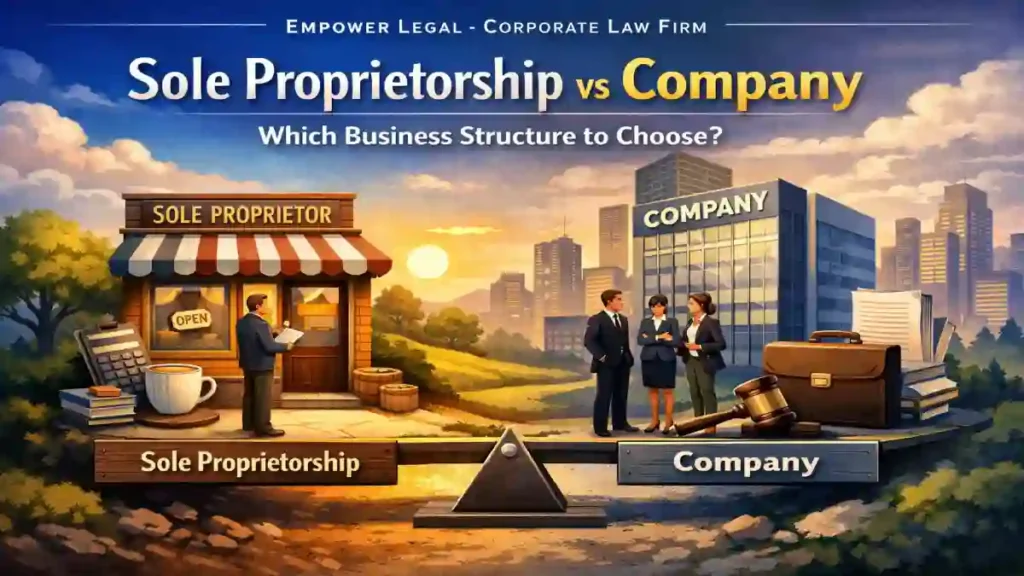
Sole Proprietorship vs Company – Selecting the proper business structure significantly affects taxation, liability, compliance, and long-term commercial growth. Therefore, entrepreneurs must evaluate operational goals before business registration. Sole proprietorships and companies operate under different statutory and regulatory frameworks in India. Moreover, business structure influences banking access, investment opportunities, and contractual enforceability. Startups, consultants, traders, manufacturers, and technology companies frequently compare both structures carefully.
Sole Proprietorship vs Company: Which Business Structure to Choose – Empower Legal – Corporate Law Firm
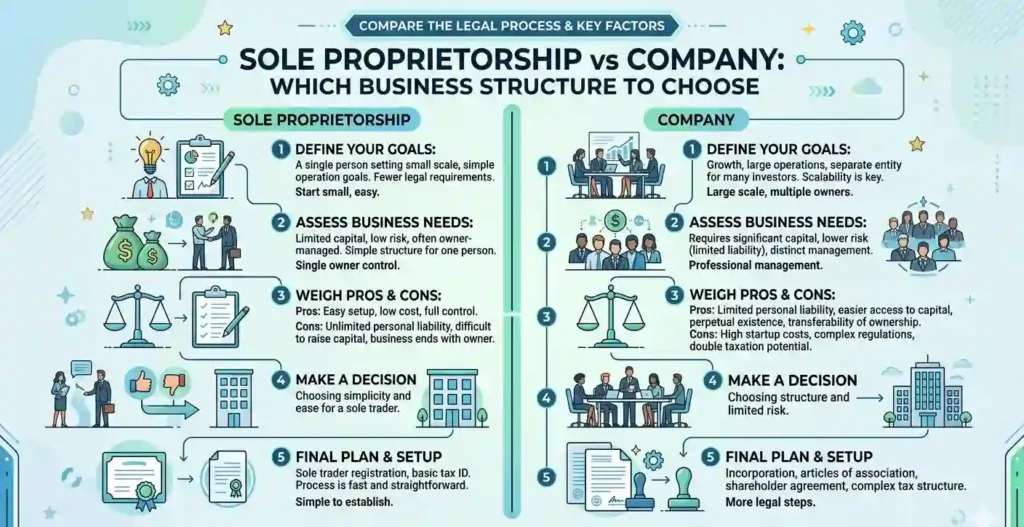
Important legal considerations include:
- Personal liability exposure.
- Taxation obligations.
- Regulatory compliance.
- Funding possibilities.
- Succession planning.
| Business Structure | Governing Authority |
|---|---|
| Sole Proprietorship | Local authorities |
| Private Company | Ministry of Corporate Affairs |
| One Person Company | Registrar of Companies |
| LLP | MCA and ROC |
Consequently, informed legal consultation prevents future commercial disputes and compliance complications effectively.
Legal Nature Of Sole Proprietorship Businesses
A sole proprietorship remains the simplest business structure available under Indian commercial practice. Therefore, small traders, freelancers, consultants, and local service providers commonly prefer this structure. Proprietorship businesses lack separate legal identity distinct from the proprietor personally. Consequently, owners bear unlimited liability for debts, losses, and contractual obligations. Important registrations usually include:
- GST registration.
- Shops and Establishments registration.
- MSME registration.
- Trade license.
- Professional tax registration.
Nearby authorities relevant for registration include:
- Municipal Corporations.
- GST Departments.
- Labour Departments.
- Commercial Tax Offices.
- Local Police Stations.
Moreover, proprietorships offer operational flexibility and minimal statutory compliance obligations compared with companies.
Legal Characteristics Of Private Limited Companies
Private limited companies operate as separate legal entities under the Companies Act, 2013. Therefore, shareholders enjoy limited liability protection against business losses and commercial liabilities. Companies may own property, enter contracts, and initiate litigation independently. Furthermore, companies continue existing despite shareholder death or ownership transfer. Important corporate characteristics include:
- Separate legal personality.
- Limited shareholder liability.
- Perpetual succession.
- Common corporate seal.
- Structured governance.
| Corporate Requirement | Governing Law |
|---|---|
| Incorporation | Companies Act |
| Director Duties | Companies Act |
| Taxation | Income Tax Act |
| Insolvency | IBC |
Consequently, companies attract investors and institutional lenders more effectively than sole proprietorship businesses.
Role Of MCA, ROC, And Regulatory Authorities
The Ministry of Corporate Affairs regulates companies and LLPs throughout India using statutory compliance frameworks. Therefore, companies must file annual returns, financial statements, and director disclosures regularly. Registrar of Companies offices supervise incorporation and corporate governance compliance. Furthermore, business disputes may involve multiple authorities and forums. Important authorities include:
- MCA.
- Registrar of Companies.
- National Company Law Tribunal.
- Income Tax Department.
- GST Authorities.
| Authority | Primary Function |
|---|---|
| MCA | Corporate regulation |
| ROC | Company registration |
| NCLT | Corporate disputes |
| SEBI | Securities regulation |
Additionally, non-compliance may trigger penalties, prosecution, and disqualification proceedings against company directors.
Comparing Sole Proprietorship And Company Structures
Liability Risks And Asset Protection
Liability exposure remains the most important distinction between proprietorships and companies under Indian commercial law. Therefore, entrepreneurs handling financial risk often prefer incorporated company structures. Sole proprietors remain personally liable for business debts, contractual defaults, and statutory violations. Consequently, creditors may proceed against personal assets during insolvency or litigation. Companies, however, provide limited liability protection for shareholders. Important legal risks include:
- Commercial contract breaches.
- GST liabilities.
- Employment disputes.
- Consumer complaints.
- Loan defaults.
| Structure | Liability Exposure |
|---|---|
| Proprietorship | Unlimited liability |
| Company | Limited liability |
| OPC | Limited liability |
| LLP | Limited liability |
Moreover, courts may lift the corporate veil during fraud, misrepresentation, or illegal corporate conduct cases.
Taxation And Financial Compliance Differences
Taxation obligations vary substantially between sole proprietorships and companies operating within India. Therefore, entrepreneurs should evaluate turnover, profit margins, and expansion plans carefully. Proprietorship income merges with personal income taxation under individual slabs. Companies, however, pay corporate tax under applicable statutory rates. Important financial compliance requirements include:
- Income tax returns.
- GST filings.
- TDS compliance.
- Audit obligations.
- Financial statement maintenance.
Nearby financial authorities include:
- GST Commissionerates.
- Income Tax Offices.
- MCA Regional Offices.
- Chartered Accountant Firms.
- Commercial Tax Departments.
Furthermore, companies generally maintain stronger financial transparency and institutional credibility before investors and lenders.
Funding And Investment Opportunities
Business growth frequently depends upon external investment, banking facilities, and institutional financial support. Therefore, companies enjoy substantial advantages while raising venture capital and investor funding. Investors usually avoid sole proprietorships due to unlimited liability and ownership limitations. Moreover, banks often prefer incorporated structures during substantial financing transactions. Important funding sources include:
- Venture capital investment.
- Angel investment.
- Bank term loans.
- Government startup schemes.
- Private equity financing.
| Funding Type | Preferred Structure |
|---|---|
| Venture capital | Company |
| Angel funding | Company |
| Personal loans | Proprietorship |
| Institutional finance | Company |
Consequently, entrepreneurs planning aggressive business expansion commonly select private limited company structures.
Compliance Burden And Administrative Costs
Compliance obligations significantly differ between proprietorship businesses and incorporated companies throughout India. Therefore, small business owners often prioritize simplified compliance frameworks during early commercial operations. Proprietorships involve fewer statutory filings and administrative formalities. Companies, however, require board meetings, annual filings, and secretarial compliance. Important compliance areas include:
- ROC annual filings.
- Director disclosures.
- Accounting audits.
- GST returns.
- Labour law compliance.
| Compliance Aspect | Proprietorship | Company |
|---|---|---|
| Annual ROC filing | No | Yes |
| Board meetings | No | Yes |
| Audit requirements | Limited | Mandatory |
| Incorporation formalities | Minimal | Extensive |
Additionally, non-compliance may invite penalties, prosecution, and corporate regulatory scrutiny before adjudicating authorities.
Business Credibility And Market Perception
Business structure substantially influences market reputation and commercial credibility within competitive industries. Therefore, companies often enjoy greater trust among suppliers, investors, and institutional clients. Corporate status enhances branding, contractual negotiation, and international commercial participation opportunities. Furthermore, government tenders frequently favor incorporated business entities. Important credibility factors include:
- Corporate governance standards.
- Financial disclosure practices.
- Banking relationships.
- Investor confidence.
- Vendor reliability.
Nearby forums resolving commercial disputes include:
- Commercial Courts.
- Consumer Commissions.
- NCLT benches.
- Arbitration Centres.
- High Courts.
Consequently, growing businesses often transition from proprietorships toward company incorporation for improved commercial positioning.
Employment Laws And Corporate Governance Obligations
Employment management obligations differ considerably between proprietorship businesses and companies operating within India. Therefore, business owners must understand labour compliance and employee protection requirements carefully. Companies usually maintain formal HR structures and statutory employment records. Moreover, labour disputes may trigger proceedings before labour authorities and industrial tribunals. Important employment laws include:
- Shops and Establishments Acts.
- EPF regulations.
- ESI provisions.
- Payment of Wages laws.
- POSH compliance requirements.
| Employment Issue | Relevant Authority |
|---|---|
| Wage disputes | Labour Commissioner |
| Sexual harassment | ICC Committee |
| PF violations | EPFO |
| Industrial disputes | Labour Courts |
Additionally, improper employment practices may create criminal liability under BNS and procedural proceedings under BNSS.
Intellectual Property And Commercial Asset Protection
Modern businesses increasingly depend upon trademarks, copyrights, patents, and confidential commercial information. Therefore, entrepreneurs should evaluate intellectual property protection during business formation decisions. Companies often maintain stronger ownership structures for trademarks and proprietary technologies. Proprietorship businesses may face succession and ownership complications during disputes. Important intellectual property protections include:
- Trademark registration.
- Copyright protection.
- Patent registration.
- Design registration.
- Trade secret agreements.
| Intellectual Property | Registration Authority |
|---|---|
| Trademark | CGPDTM |
| Patent | Patent Office |
| Copyright | Copyright Office |
| Industrial designs | Design Registry |
Consequently, structured companies generally provide superior commercial continuity and intellectual property management benefits.
Legal Disputes And Litigation Exposure
Business disputes may arise from contracts, taxation, employment, intellectual property, or partnership disagreements. Therefore, entrepreneurs should understand litigation exposure before selecting business structures. Proprietors personally defend legal proceedings and enforcement actions. Companies, however, litigate independently through authorized representatives and directors. Important legal disputes include:
- Breach of contract claims.
- Consumer complaints.
- GST investigations.
- Corporate fraud allegations.
- Recovery proceedings.
Relevant forums and authorities include:
- Civil Courts.
- Commercial Courts.
- NCLT.
- Debt Recovery Tribunals.
- Police Stations.
Furthermore, fraud allegations may trigger criminal proceedings under BNS, BNSS, and Bharatiya Sakshya Adhiniyam provisions.
Conversion From Proprietorship To Company
Many successful proprietorship businesses eventually convert into companies during commercial expansion stages. Therefore, structured conversion strategies help entrepreneurs maintain operational continuity and tax efficiency. Business conversion often improves funding access, brand credibility, and succession planning opportunities. Important conversion steps include:
- Company incorporation.
- Asset transfer agreements.
- GST migration procedures.
- Trademark assignment.
- Employee transition management.
| Conversion Benefit | Commercial Impact |
|---|---|
| Limited liability | Asset protection |
| Investor access | Funding opportunities |
| Corporate branding | Market expansion |
| Structured governance | Better compliance |
Consequently, legal advisors and chartered accountants play critical roles during business restructuring and corporate transition processes.
Choosing The Best Structure For Business Goals
Business owners should align organizational structure with commercial objectives, compliance tolerance, and expansion strategies carefully. Therefore, startups planning rapid growth generally prefer company incorporation from inception stages. Small traders and independent professionals, however, often choose proprietorships due to operational simplicity. Important decision-making considerations include:
- Funding requirements.
- Business risk exposure.
- Compliance budget.
- Long-term expansion plans.
- Tax optimization strategies.
| Business Need | Recommended Structure |
|---|---|
| Small retail shop | Proprietorship |
| Technology startup | Private company |
| Professional consultancy | Proprietorship or OPC |
| Venture-funded enterprise | Company |
Moreover, proper legal planning reduces future restructuring costs and commercial litigation risks substantially.
Conclusion On Sole Proprietorship Vs Company
Business structure selection significantly influences taxation, liability, governance, and long-term commercial sustainability. Therefore, entrepreneurs should carefully evaluate legal risks and operational objectives before registration. Proprietorships offer simplicity and lower compliance burdens for small commercial operations. Companies, however, provide stronger liability protection, funding opportunities, and institutional credibility. Furthermore, Indian commercial laws increasingly emphasize transparency, compliance, and structured governance practices. Important authorities and forums include:
- MCA.
- ROC.
- GST Departments.
- NCLT.
- Commercial Courts.
Professional legal consultation helps entrepreneurs choose suitable structures while ensuring statutory compliance and business protection. Consequently, informed decisions support sustainable growth, investor confidence, and long-term commercial success within India’s evolving business environment.
FAQs
Which structure offers better liability protection?
Companies provide limited liability protection, while proprietors remain personally liable for business debts and disputes.
Is company registration mandatory for startups?
No. Startups may operate as proprietorships initially, although companies attract funding and institutional credibility better.
Can proprietorships convert into companies later?
Yes. Businesses frequently convert into companies during expansion for liability protection and investment opportunities.
Which structure involves fewer compliance obligations?
Proprietorships generally involve lower compliance burdens than companies regulated under Companies Act provisions.
Can criminal liability arise from business operations?
Yes. Fraud, tax evasion, cheating, and document forgery may trigger proceedings under BNS and BNSS laws.
Which courts handle company and commercial disputes?
Commercial Courts, NCLT benches, High Courts, and arbitration tribunals commonly handle corporate and business disputes.
Read More
- Partnership Firm Registration Under Partnership Act 1932
- Limited Liability Partnership (LLP) Registration: Complete Process
- Public Limited Company Incorporation: Requirements and Process
- One Person Company (OPC) Formation: Solo Entrepreneur’s Guide
- Private Limited Company Registration in India: Complete Guide 2026
- Ministry of Corporate Affairs (MCA)