

Private Limited Company Registration in India – Starting a business is an exciting journey, but choosing the right legal structure is where everything truly begins. In India, a Private Limited Company remains one of the most preferred business structures, especially for startups, growing businesses, and investors. It offers credibility, limited liability, and better access to funding.
In this complete guide for 2026, we explain the process in simple words, so you can clearly understand how to register a Private Limited Company in India and why it might be the right choice for you.
Private Limited Company Registration in India: Complete Guide 2026 – Empower Legal – Corporate Law Firm
What is a Private Limited Company?
A Private Limited Company is a legally recognized business entity registered under the Companies Act. It is owned by shareholders and managed by directors. Most importantly, it has a separate legal identity from its owners.
This means the company can own property, enter into contracts, and even sue or be sued in its own name. At the same time, the liability of shareholders is limited to the amount they invest.
Because of these features, many entrepreneurs prefer this structure when they want to build a scalable and trustworthy business.
Why Choose a Private Limited Company?
Before moving ahead, it is important to understand why this structure is so popular.
First of all, limited liability protects personal assets. If the business faces losses or legal issues, the personal property of shareholders usually remains safe.
Secondly, it provides better credibility. Clients, investors, and banks often trust registered companies more than sole proprietorships or partnerships.
Moreover, it becomes easier to raise funds. Investors, including venture capitalists and angel investors, prefer investing in private limited companies.
In addition, ownership can be transferred easily through shares. This ensures business continuity even if founders change.
Therefore, if you are planning long-term growth, this structure offers strong advantages.
Basic Requirements for Registration
Now let us look at the basic requirements.
To register a Private Limited Company in India, you need:
- Minimum 2 directors
- Minimum 2 shareholders (can be the same individuals)
- At least 1 director must be an Indian resident
- A registered office address in India
- A unique company name
Although the requirements are simple, proper documentation and compliance are essential to avoid delays.
Documents Required
Next, documentation plays a crucial role. Proper documents help ensure smooth registration.
For Directors and Shareholders:
- PAN Card (mandatory for Indian nationals)
- Passport (for NRIs and foreign nationals)
- Identity proof (Aadhaar, Voter ID, Driving License)
- Address proof (bank statement, utility bill)
- Passport-size photograph
For Registered Office:
- Rental agreement or ownership proof
- No Objection Certificate (NOC) from owner
- Utility bill (not older than 2 months)
Therefore, organizing these documents in advance can save time during the process.
Step-by-Step Registration Process
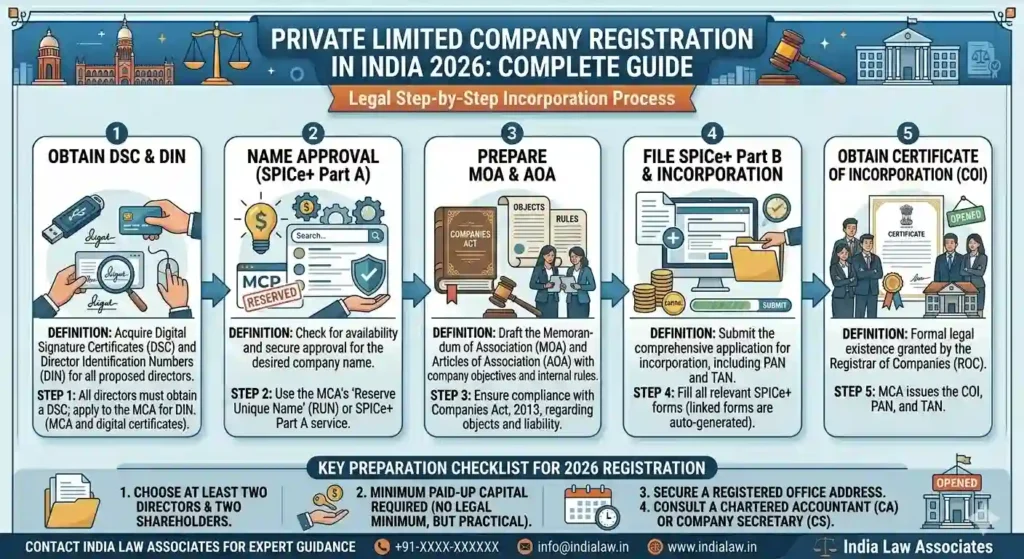
Now let us understand the process step by step. In 2026, company registration in India is mostly online and streamlined.
Step 1: Obtain Digital Signature Certificate (DSC)
First, all proposed directors must obtain a Digital Signature Certificate. Since the registration process is online, DSC is required to sign electronic documents securely.
Step 2: Apply for Director Identification Number (DIN)
Next, directors must obtain a Director Identification Number. This is a unique number issued by the government to individuals who wish to act as directors.
Step 3: Name Approval
After that, you need to choose a unique company name. The name must not be identical or too similar to an existing company.
It is always better to propose at least two or three name options. A well-chosen name not only ensures approval but also helps in branding.
Step 4: Filing Incorporation Application
Then comes the main step—filing the incorporation application. This includes submitting:
- Memorandum of Association (MOA)
- Articles of Association (AOA)
- Details of directors and shareholders
- Registered office details
All documents are filed online through the official portal.
Step 5: Certificate of Incorporation
Once the application is verified and approved, the government issues a Certificate of Incorporation.
This certificate is proof that your company legally exists. It also includes the Corporate Identification Number (CIN).
Step 6: PAN, TAN, and Bank Account
After incorporation, the company receives PAN and TAN automatically. Then, you can open a company bank account and start business operations.
Time Required for Registration
Generally, the registration process takes around 7 to 10 working days, provided all documents are correct.
However, delays can happen if there are issues with name approval or document verification. Therefore, professional guidance often helps speed up the process.
Cost of Registration in 2026
The cost of registering a Private Limited Company depends on several factors, such as professional fees, government fees, and stamp duty.
On average, the cost may range between ₹6,000 to ₹25,000 or more, depending on the complexity and service provider.
Although it may seem like an expense initially, it is actually an investment in building a legally strong business foundation.
Post-Registration Compliance
After registration, compliance becomes equally important. Many business owners overlook this part, but it is essential to avoid penalties.
Key Compliances Include:
- Appointment of auditor
- Filing of annual returns
- Maintaining statutory registers
- Conducting board meetings
- Filing income tax returns
In addition, companies must comply with GST regulations if applicable.
Therefore, staying compliant ensures smooth business operations and avoids legal trouble.
Advantages for Startups and NRIs
Interestingly, Private Limited Companies are also beneficial for startups and NRIs.
For Startups:
- Easy fundraising opportunities
- Eligibility for government schemes
- Better valuation and scalability
For NRIs:
- Permission to invest and own shares
- Ability to appoint directors
- Flexibility in business operations
Thus, this structure supports both domestic and international business growth.
Common Mistakes to Avoid
While registering a company, many people make avoidable mistakes. Being aware of them can save time and money.
- Choosing a confusing or already existing name
- Submitting incorrect documents
- Ignoring post-registration compliance
- Not clearly defining business objectives in MOA
- Delaying bank account opening
Therefore, careful planning and professional assistance can prevent these issues.
Why Legal Support Matters
Although the process is online, legal expertise still plays a crucial role. Drafting documents, selecting the right structure, and ensuring compliance require professional knowledge.
At Empower Legal – Corporate Law Firm, we assist clients at every step—from choosing the right company name to completing registration and ensuring ongoing compliance.
Moreover, we focus on making the process simple, transparent, and stress-free for entrepreneurs.
Future Trends in 2026
As we move into 2026, company registration in India continues to become more digital and efficient.
The government is focusing on:
- Faster approvals
- Simplified compliance
- Improved online systems
In addition, startup-friendly policies are encouraging more people to formalize their businesses.
Therefore, now is a great time to start your company with confidence.
Frequently Asked Questions
A Private Limited Company is a registered business entity with separate legal identity and limited liability for shareholders. It builds credibility, enables fundraising, ensures continuity, and protects personal assets, making it ideal for startups and growing businesses. It also supports structured governance and long-term growth planning.
You need at least two directors and two shareholders, one resident director, a unique company name, and a registered office address in India. Proper identity and address proofs are required for all applicants along with digital signatures and compliance with prescribed incorporation forms and declarations online.
First, obtain digital signatures and director identification numbers. Next, apply for name approval. Then file incorporation forms with MOA and AOA. After verification, authorities issue the Certificate of Incorporation, along with PAN and TAN. Open a bank account and start operations while ensuring accuracy of documents to avoid delays or rejection.
The process usually takes seven to ten working days if documents are correct. Costs vary depending on professional fees and government charges, typically ranging from ₹6,000 to ₹25,000 or more. Proper planning and expert assistance can help reduce delays and unexpected expenses and ensure smoother completion of the incorporation process.
Companies must appoint an auditor, maintain statutory records, conduct board meetings, and file annual returns and tax filings. They should also comply with GST if applicable. Timely compliance avoids penalties and builds credibility with investors and authorities. Regular monitoring and professional support help ensure ongoing legal compliance and smooth business operations.
Conclusion
To sum up, registering a Private Limited Company in India is a structured yet straightforward process. It offers multiple benefits, including limited liability, credibility, and growth opportunities. However, success depends not just on registration but also on proper planning and compliance.
With the right guidance, you can complete the process smoothly and focus on building your business. If you are planning to start your company, Empower Legal – Corporate Law Firm is here to guide you at every step—ensuring your business begins on a strong legal foundation.
Read More
- RERA Compliance & Valuation Dispute Solutions by Property Lawyers
- Interior Design & Construction Contract Drafting Services in India
- Property Disputes, Land Registration & Real Estate Legal Services
- Customs Clearance Disputes & Legal Solutions for Exporters & Importers
- Drafting Transportation & Warehousing Contracts – Law Firm Services
- Ministry of Corporate Affairs (MCA Portal)