
Interior design & construction contract are exciting. They bring ideas to life, transform empty spaces into beautiful environments, and turn dreams into reality. However, behind every successful project, there is one crucial element that ensures everything runs smoothly — a well-drafted contract.
At Empower Legal – Corporate Law Firm, we understand that interior design and construction projects in India involve multiple parties, large investments, tight timelines, and high expectations. Therefore, clear, strong, and legally sound contracts are not optional — they are essential.
Interior Design & Construction Contract Drafting Services in India – Empower Legal – Corporate Law Firm
Why Contracts Matter in Interior Design & Construction Projects
Interior design and construction work often begins with enthusiasm and creative discussions. However, without clear documentation, misunderstandings can quickly arise. For example, disputes may occur over payment terms, project delays, design changes, quality of materials, or scope of work.
Therefore, a properly drafted contract:
- Defines roles and responsibilities clearly
- Sets timelines and milestones
- Fixes payment schedules
- Protects intellectual property rights
- Allocates risks and liabilities
- Provides dispute resolution mechanisms
In short, a good contract prevents conflicts before they happen. And even if disputes arise, it gives you a strong legal foundation.
Understanding the Indian Legal Framework
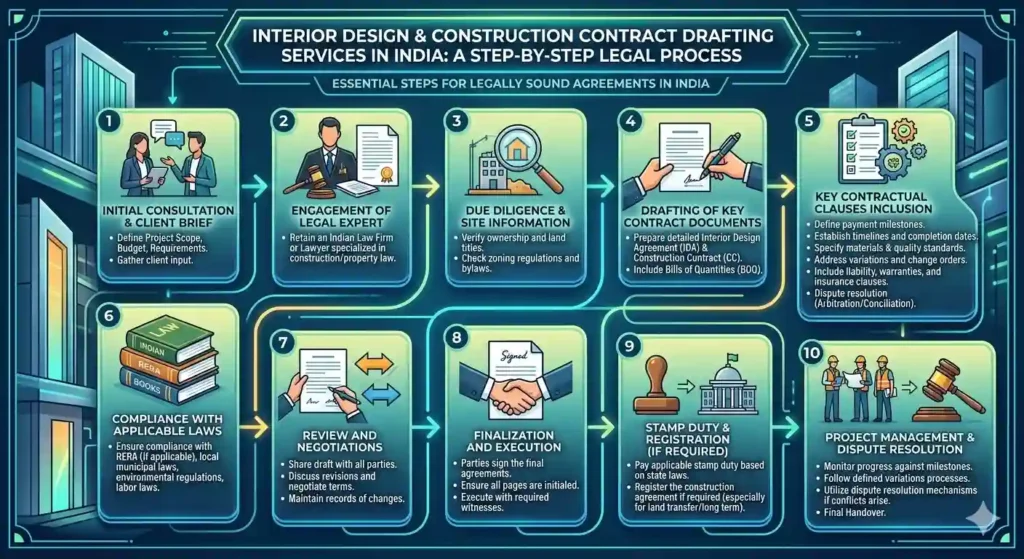
Interior design and construction contracts in India are primarily governed by the Indian Contract Act, 1872. This law lays down the basic requirements for a valid contract — offer, acceptance, lawful consideration, free consent, and lawful object.
In addition, construction projects may also involve:
- The Real Estate (Regulation and Development) Act, 2016 (RERA)
- Local municipal laws and building regulations
- Environmental and safety laws
- Labour laws
- GST and taxation regulations
Therefore, contract drafting in this sector requires deep legal knowledge, practical understanding, and careful risk management.
Types of Interior Design & Construction Contracts
Different projects require different types of agreements. At Empower Legal, we draft and review various contracts, including:
1. Interior Design Consultancy Agreements
These agreements define the relationship between the designer and the client. They clearly outline design scope, revisions, fees, intellectual property rights, and termination clauses.
2. Turnkey Construction Contracts
In turnkey projects, the contractor takes full responsibility from start to finish. Therefore, the contract must carefully define deliverables, timelines, and liability for delays.
3. Item Rate Contracts
Here, payment depends on actual quantities of work done. Hence, measurement methods and rate schedules must be clearly drafted.
4. Labour Contracts
These agreements focus only on labour supply. As a result, compliance with labour laws becomes extremely important.
5. Subcontractor Agreements
Main contractors often appoint subcontractors. Therefore, these agreements must align with the primary contract to avoid conflicts.
Key Clauses Every Contract Must Include
A strong interior design and construction contract must contain specific essential clauses. Let us understand them in detail.
Scope of Work
This is the heart of the contract. It should describe in clear language:
- Design specifications
- Material standards
- Quantity details
- Drawings and approvals
- Responsibilities of each party
If the scope is vague, disputes become unavoidable. Therefore, we ensure that every detail is documented properly.
Payment Terms
Money-related disputes are common in construction projects. Hence, payment clauses must clearly mention:
- Total contract value
- Advance payment
- Stage-wise payments
- Retention amounts
- GST applicability
- Mode of payment
We draft structured payment schedules that protect both parties.
Timeline and Milestones
Time is critical in construction projects. Therefore, contracts must specify:
- Project start date
- Completion date
- Milestone deadlines
- Consequences of delay
We also include force majeure clauses to address unexpected events like natural disasters or government restrictions.
Variation and Change Orders
Design changes are common in interior projects. However, without a formal change order process, conflicts arise. Therefore, contracts must clearly define:
- How variations are requested
- Approval procedures
- Cost implications
- Time extensions
This ensures transparency and avoids confusion.
Quality Standards and Defect Liability
Clients expect high-quality work. Therefore, contracts must define quality benchmarks and defect liability periods. We include clauses that ensure:
- Inspection rights
- Rectification timelines
- Warranty obligations
This protects clients from substandard work.
Intellectual Property Rights
Interior designers create original concepts, drawings, and designs. Therefore, contracts must clearly define:
- Ownership of designs
- Usage rights
- Copyright protection
This is especially important for commercial projects.
Indemnity and Liability
Construction projects carry risks — accidents, damages, third-party claims, and more. Therefore, indemnity clauses allocate responsibility clearly.
We carefully draft liability caps and risk-sharing provisions to ensure fairness.
Termination Clause
Sometimes projects must end early due to breach or unforeseen circumstances. Therefore, termination clauses must define:
- Grounds for termination
- Notice period
- Settlement of dues
- Consequences of termination
Clear termination terms reduce litigation risk.
Dispute Resolution
Even with strong contracts, disputes may arise. Therefore, we include clear dispute resolution clauses specifying:
- Negotiation process
- Mediation
- Arbitration
- Jurisdiction
Most construction contracts in India prefer arbitration under the Arbitration and Conciliation Act, 1996, as it offers faster resolution compared to court litigation.
Common Risks in Interior Design & Construction Projects
Interior and construction projects face various practical risks. For example:
- Project delays
- Cost escalation
- Labour issues
- Material shortages
- Regulatory non-compliance
- Design disputes
Without a proper contract, these risks can lead to financial losses and legal battles. Therefore, professional drafting becomes a powerful risk management tool.
Importance of Legal Review Before Signing
Many clients sign standard template contracts without legal review. However, templates often contain hidden risks, one-sided clauses, or outdated legal terms.
At Empower Legal, we:
- Review existing agreements
- Identify risky clauses
- Suggest modifications
- Ensure compliance with Indian laws
- Negotiate favourable terms
As a result, our clients enter contracts with confidence and clarity.
Customised Drafting for Different Clients
Interior design and construction contracts vary depending on the client type.
For Individual Homeowners
Homeowners need protection against delays, cost overruns, and poor quality. Therefore, we draft contracts that ensure transparency and accountability.
For Corporate Clients
Corporate projects involve larger budgets and compliance requirements. Hence, we focus on risk allocation, performance guarantees, and regulatory compliance.
For Developers and Builders
Developers often manage multiple vendors. Therefore, we create structured contract systems that maintain consistency across projects.
Compliance with Labour and Safety Laws
Construction projects involve workers on site. Therefore, compliance with labour laws is mandatory. Contracts must include clauses regarding:
- Worker safety
- Insurance coverage
- Payment of wages
- Statutory compliance
Failure to comply can lead to penalties and project stoppage. Hence, legal guidance becomes essential.
GST and Taxation Considerations
Interior design and construction services attract GST in India. Therefore, contracts must clearly define:
- Tax responsibility
- Invoice structure
- Input tax credit eligibility
We ensure that tax clauses align with current GST regulations to avoid future disputes.
Why Choose Empower Legal – Corporate Law Firm?
At Empower Legal, we combine legal knowledge with practical business understanding. We do not draft generic agreements. Instead, we:
- Understand your project goals
- Assess potential risks
- Structure legally sound agreements
- Protect your financial interests
- Ensure regulatory compliance
Moreover, we actively assist in negotiations and dispute prevention. Our approach focuses on clarity, precision, and enforceability.
Preventing Litigation Through Smart Drafting
Litigation in construction matters can be lengthy and expensive. However, strong drafting significantly reduces disputes. For instance:
- Clear scope prevents misunderstandings
- Structured payment terms reduce financial conflicts
- Defined timelines avoid delay claims
- Strong arbitration clauses enable faster resolution
Therefore, investing in professional drafting saves time, money, and stress in the long run.
The Future of Construction Contracts in India
India’s infrastructure and real estate sectors continue to grow rapidly. As projects become more complex, contract structures are also evolving. Today, clients demand transparency, accountability, and digital documentation.
Moreover, sustainability clauses, green building standards, and data protection concerns are becoming increasingly relevant. Therefore, modern contracts must address these emerging issues.
Empower Legal stays updated with legal developments and industry practices to provide forward-looking solutions.
Frequently Asked Questions
A written contract is essential because it clearly defines the rights and responsibilities of all parties involved. Under the Indian Contract Act, 1872, a valid agreement must include clear terms, lawful consideration, and free consent. In interior design and construction projects, misunderstandings often arise regarding scope of work, payment schedules, timelines, and material specifications. Therefore, a properly drafted contract prevents disputes before they begin. It also provides legal protection if conflicts arise. In addition, it ensures compliance with applicable regulations and tax laws. Ultimately, a well-drafted agreement builds transparency, reduces risk, and protects financial investments for both clients and contractors.
A strong contract must include scope of work, payment terms, project timelines, variation procedures, quality standards, defect liability, indemnity clauses, termination rights, and dispute resolution mechanisms. For example, the scope of work should describe design details, materials, and deliverables in clear language. Payment clauses must mention milestones, GST applicability, and retention amounts. Furthermore, variation clauses are important because design changes are common. Without these clauses, disputes may increase. Therefore, detailed drafting ensures clarity and smooth project execution.
Most construction contracts in India prefer arbitration instead of court litigation. The Arbitration and Conciliation Act, 1996 governs arbitration proceedings. Contracts typically include negotiation and mediation steps before arbitration. This approach saves time and costs while ensuring confidentiality.
Clear timelines, milestone-based payments, penalty clauses for delay, and structured change order procedures help control time and costs. Legal drafting reduces ambiguity and limits unexpected financial exposure.
Templates often contain outdated or one-sided clauses. A professional law firm customizes agreements, ensures legal compliance, negotiates fair terms, and protects long-term business interests.
Conclusion
Interior design and construction projects bring creativity and innovation into physical spaces. However, without clear contracts, even the most beautiful designs can turn into legal disputes.
Therefore, strong, customised, and legally compliant contracts are the foundation of every successful project in India.
At Empower Legal – Corporate Law Firm, we provide professional Interior Design & Construction Contract Drafting Services tailored to your needs. We draft, review, and negotiate agreements that protect your interests and reduce risks.
Read More
- Property Disputes, Land Registration & Real Estate Legal Services
- Customs Clearance Disputes & Legal Solutions for Exporters & Importers
- Drafting Transportation & Warehousing Contracts – Law Firm Services
- Legal Advisory for Freight, Courier & Logistics Companies in India
- Compliance Services for Skill Development & Corporate Training Firms
- Central Public Procurement Portal (CPPP)