

A One Person Company (OPC) is a distinct corporate entity introduced under Section 2(62) of the Companies Act, 2013. Consequently, a single natural person can now own and operate a legally recognised company. Previously, at least two shareholders were mandatory to incorporate any company in India. This progressive reform therefore empowers solo entrepreneurs to enjoy corporate benefits. The Ministry of Corporate Affairs (MCA) governs OPC registration through the Companies (Incorporation) Rules, 2014. Furthermore, the Registrar of Companies (ROC) of the respective state handles all filings. In Chennai, the Registrar of Companies, Tamil Nadu, located at Shastri Bhavan, is the concerned authority. Additionally, the Companies (Amendment) Act, 2020 relaxed OPC conversion thresholds significantly. Solo entrepreneurs can thus expand without immediate structural changes. The legal framework, moreover, aligns with India’s broader Ease of Doing Business initiative. Empower Legal ensures your OPC journey begins on solid statutory ground.
One Person Company (OPC) Formation: Solo Entrepreneur’s Guide – Empower Legal – Corporate Law Firm
What Is a One Person Company and Why Does It Matter for Solo Entrepreneurs?
Statutory Definition and Legislative Foundation of OPC in India
A One Person Company (OPC) is a distinct corporate entity introduced under Section 2(62) of the Companies Act, 2013. Consequently, a single natural person can now own and operate a legally recognised company. Previously, at least two shareholders were mandatory to incorporate any company in India. This progressive reform therefore empowers solo entrepreneurs to enjoy corporate benefits. The Ministry of Corporate Affairs (MCA) governs OPC registration through the Companies (Incorporation) Rules, 2014. Furthermore, the Registrar of Companies (ROC) of the respective state handles all filings. In Chennai, the Registrar of Companies, Tamil Nadu, located at Shastri Bhavan, is the concerned authority. Additionally, the Companies (Amendment) Act, 2020 relaxed OPC conversion thresholds significantly. Solo entrepreneurs can thus expand without immediate structural changes. The legal framework, moreover, aligns with India’s broader Ease of Doing Business initiative. Empower Legal ensures your OPC journey begins on solid statutory ground.
Key Differences Between OPC, Sole Proprietorship, and Private Limited Company
Understanding structural differences helps solo entrepreneurs choose the right vehicle effectively. Therefore, a comparative analysis is essential before filing incorporation documents. A sole proprietorship offers no separate legal identity, whereas an OPC provides complete corporate personality. Consequently, only OPC shields personal assets through limited liability protection. A Private Limited Company requires minimum two directors and two shareholders mandatorily. However, OPC needs just one member and one nominee. Furthermore, compliance requirements differ significantly across these structures. The table below clearly illustrates these critical distinctions for better decision-making.
| Feature | Sole Proprietorship | OPC | Pvt Ltd Company |
|---|---|---|---|
| Legal Identity | None | Separate | Separate |
| Min. Members | 1 | 1 | 2 |
| Liability | Unlimited | Limited | Limited |
| Annual Compliance | Minimal | Moderate | High |
| Foreign Ownership | Allowed | Not Allowed | Allowed |
| Perpetual Succession | No | Yes | Yes |
Eligibility Criteria: Who Can Register an OPC Under Indian Law?
Only specific individuals satisfy the statutory eligibility requirements for OPC incorporation in India. Therefore, carefully reviewing these criteria before proceeding is absolutely essential. The applicant must be a natural person who is an Indian citizen and resident. Residency means staying in India for at least 182 days during the preceding calendar year. Furthermore, the person must not already be a member of another existing OPC. Additionally, a minor cannot be a member or nominee of any OPC under any circumstances. The nominee must also satisfy the same citizenship and residency requirements independently. Moreover, the 2021 amendment notably removed the paid-up capital ceiling for OPC. Previously, paid-up capital could not exceed ₹50 lakh. Consequently, OPCs can now raise capital without statutory monetary restrictions. Non-Resident Indians (NRIs) are, however, still ineligible to form an OPC currently. Empower Legal verifies eligibility comprehensively before initiating your incorporation process.
Step-by-Step OPC Registration Process: From Application to Certificate
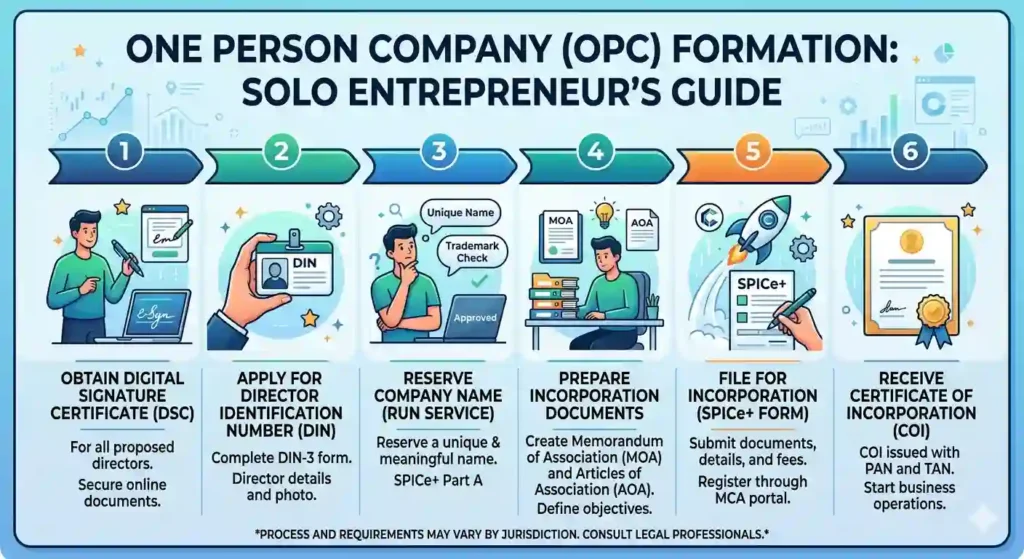
Step 1 – Obtaining Digital Signature Certificate (DSC) and Director Identification Number (DIN)
The registration journey begins with obtaining a valid Digital Signature Certificate (DSC) from a MCA-approved certifying authority. Therefore, the applicant must submit identity proof, address proof, and a passport-size photograph. Certifying authorities like eMudhra, NSDL, and Sify issue DSCs across India efficiently. Subsequently, a Director Identification Number (DIN) is applied through the SPICe+ portal seamlessly. DIN uniquely identifies every company director in the MCA21 database system. Furthermore, Form DIR-3 must be filed for directors not yet possessing a valid DIN. The ROC Chennai processes DIN applications within two to three working days typically. Additionally, all documents must be self-attested and notarised for authenticity. Aadhaar-based eKYC has simplified verification considerably in recent years. Consequently, digital submission has replaced cumbersome physical documentation processes. Empower Legal expertly manages DSC procurement and DIN filing for every client.
Step 2 – Name Reservation Through RUN (Reserve Unique Name) Portal
Name reservation is a crucial step requiring careful compliance with MCA naming guidelines. Therefore, entrepreneurs must ensure the proposed name is unique and not identical to existing entities. The RUN (Reserve Unique Name) facility on the MCA21 portal facilitates this process efficiently. Consequently, up to two name preferences can be submitted in a single application. Furthermore, names must not violate the Trade Marks Act, 1999 or existing trademarks. The name must also include “OPC Private Limited” as a mandatory suffix always. Additionally, names resembling government departments or regulatory bodies are strictly prohibited. The ROC examines the application and responds within three working days ordinarily. Moreover, offensive or misleading names are summarily rejected by the Registrar. Applicants should, therefore, conduct thorough trademark and MCA database searches beforehand. Empower Legal conducts comprehensive name availability searches before submitting your RUN application.
Step 3 – Filing SPICe+ Form and Linked Documents for Incorporation
The SPICe+ (Simplified Proforma for Incorporating Company Electronically Plus) form is the central incorporation document. Therefore, all relevant details including company name, address, and director information must be accurately provided. SPICe+ integrates multiple registrations, including PAN, TAN, GSTIN, ESIC, and EPFO, in a single unified application. Consequently, entrepreneurs save considerable time and administrative effort through this integrated system. The following documents must be attached mandatorily to the SPICe+ application.
- Memorandum of Association (MoA) in Form INC-33
- Articles of Association (AoA) in Form INC-34
- Consent of Nominee in Form INC-3
- Proof of Registered Office Address (utility bill not older than 2 months)
- NOC from property owner if the premises are rented
- Self-attested identity and address proof of sole member
- DSC of the sole director/member
Furthermore, the AGILE-PRO-S form linked to SPICe+ handles GST, ESIC, and bank account opening simultaneously. Empower Legal prepares and reviews all documents before filing to ensure zero-defect submission.
Step 4 – Certificate of Incorporation and Post-Registration Compliance
Upon successful verification, the ROC issues the Certificate of Incorporation (COI) digitally through the MCA21 portal. Therefore, the company officially comes into legal existence from the date mentioned in the COI. The COI includes the Company Identification Number (CIN), which is the company’s unique permanent identifier. Subsequently, the entrepreneur must complete several post-incorporation compliances without delay. Furthermore, a dedicated company bank account must be opened within 30 days of incorporation. The first board meeting must be held within 30 days of the COI date mandatorily. Additionally, the registered office must be established and Form INC-22 must be filed. Moreover, share certificates must be issued to the sole member within 60 days. The company seal, statutory registers, and minute books must be maintained properly. Consequently, non-compliance attracts penalties under the Companies Act, 2013 rigorously. Empower Legal provides complete post-incorporation support to keep your OPC fully compliant.
Step 5 – Nominee Appointment: Legal Obligations and Practical Considerations
Every OPC must compulsorily appoint a nominee at the time of incorporation under Section 3(1). Therefore, the nominee assumes membership rights upon the incapacity or death of the sole member. The nominee’s written consent in Form INC-3 is mandatory before filing the SPICe+ form. Consequently, the nominee must be an Indian citizen and resident satisfying all eligibility conditions. Furthermore, the sole member can change the nominee at any time with proper board approval. The nominee’s name and details must be mentioned explicitly in the Memorandum of Association. Additionally, the nominee cannot simultaneously be a member of another OPC. Moreover, if the nominee becomes a member, they must immediately appoint a new nominee. Failure to appoint a nominee makes incorporation defective and liable for rejection. The nominee, therefore, plays a crucial protective succession-planning role in the OPC framework. Empower Legal drafts nominee consent documents with precision and legal accuracy.
Annual Compliance Requirements for OPC Under the Companies Act, 2013
OPC compliance, though lighter than Pvt Ltd companies, remains legally mandatory throughout the company’s existence. Therefore, entrepreneurs must track all statutory deadlines to avoid penalties and disqualification. The following numbered list outlines the key annual compliance obligations for every OPC.
- Form AOC-4 – Filing of Annual Financial Statements within 180 days from financial year end.
- Form MGT-7A – Annual Return filing within 60 days from financial year closure.
- Income Tax Return – Filing by 31st October each year if audit is applicable.
- DIR-3 KYC – Annual Director KYC verification before 30th September every year.
- Statutory Audit – Accounts must be audited by a Chartered Accountant annually.
- Board Meeting – At least one board meeting per half-year must be conducted.
Furthermore, GST returns, TDS filings, and professional tax payments must continue alongside MCA compliances. Consequently, engaging professional legal and accounting support is strongly advisable. Empower Legal offers affordable annual compliance packages exclusively for OPC owners.
Tax Benefits and Financial Advantages Available to OPC Owners
OPCs enjoy several significant tax benefits that make them financially superior to sole proprietorships. Therefore, understanding these advantages helps entrepreneurs make informed business structure decisions. The corporate tax rate for OPC is 22% plus surcharge and cess under the Income Tax Act, 1961. Consequently, this rate is often lower than the highest individual income tax slab of 30%. Furthermore, OPCs can claim legitimate business expense deductions unavailable to individual proprietors. Salary paid to the sole director reduces taxable corporate income significantly. Additionally, depreciation on business assets can be claimed as allowable deductions. Moreover, OPCs are exempt from preparing cash flow statements under the Companies Act. They are also exempt from holding Annual General Meetings, reducing compliance burden. Consequently, the overall tax efficiency improves substantially compared to unregistered business structures. Empower Legal’s tax advisory team optimises OPC tax planning for maximum legitimate savings.
Common Legal Issues Faced by OPC Owners and Available Remedies
OPC owners frequently encounter legal disputes and regulatory challenges during business operations. Therefore, knowing the available legal remedies is critically important for every solo entrepreneur. Common legal issues include contractual disputes, intellectual property infringement, labour law violations, and GST non-compliance. Consequently, these issues can expose the company and director to significant civil and criminal liability. The National Company Law Tribunal (NCLT), Chennai Bench adjudicates corporate law disputes for Tamil Nadu companies. Furthermore, consumer complaints against OPCs are addressed by District Consumer Disputes Redressal Commissions. Labour disputes are settled before the Labour Court, Chennai, under relevant employment legislations. Additionally, GST disputes are appealed before the GST Appellate Authority and subsequently the GST Appellate Tribunal. Tax disputes can be escalated to the Income Tax Appellate Tribunal (ITAT), Chennai. Empower Legal provides comprehensive dispute resolution support across all concerned forums and tribunals.
Regulatory Authorities and Government Departments Governing OPC Operations
Multiple government departments and regulatory authorities oversee different aspects of OPC operations simultaneously. Therefore, entrepreneurs must understand each authority’s jurisdiction to maintain full regulatory compliance. The table below maps key regulatory bodies to their specific jurisdictional functions.
| Authority / Department | Jurisdiction / Function | Relevant Law |
|---|---|---|
| Registrar of Companies (ROC), Chennai | Incorporation, filing, compliance | Companies Act, 2013 |
| Ministry of Corporate Affairs (MCA) | Policy, e-governance, oversight | Companies Act, 2013 |
| Income Tax Department | Direct tax assessment and collection | Income Tax Act, 1961 |
| GST Council / GSTN | Indirect tax registration and returns | CGST Act, 2017 |
| NCLT, Chennai Bench | Corporate disputes, insolvency | Companies Act / IBC, 2016 |
| SEBI | Securities regulation (if applicable) | SEBI Act, 1992 |
| Labour Department, Tamil Nadu | Employment and labour compliance | Labour Codes, 2020 |
| Intellectual Property India (CGPDTM) | Trademark, patent, copyright | Trade Marks Act, 1999 |
| Environmental Department, TN | Environmental clearances | Environment Protection Act, 1986 |
Furthermore, FSSAI governs food businesses, and RBI regulates any financial services OPC may provide. Empower Legal maps all applicable regulatory requirements for your specific OPC business activity.
Mandatory Conversion of OPC to Private Limited Company: Rules and Timelines
OPCs must mandatorily convert to a Private Limited Company upon crossing prescribed financial thresholds. Therefore, monitoring turnover and paid-up capital figures annually is critically important. As per the 2021 amendment, OPC conversion is triggered when paid-up capital exceeds ₹50 lakh or average annual turnover exceeds ₹2 crore over three consecutive years. Consequently, the company must file Form INC-6 for conversion within six months of threshold breach. Furthermore, the company must amend its MoA and AoA to reflect the new structure. Additional directors and shareholders must be inducted during the conversion process. Additionally, the company name must be changed by removing “OPC” from its title. Moreover, the ROC issues a fresh Certificate of Incorporation upon successful conversion. Voluntary conversion is also permitted after two years of incorporation under the amended rules. Empower Legal handles the entire OPC-to-Pvt-Ltd conversion process seamlessly and efficiently.
Criminal and Civil Liability of OPC Directors Under BNS, BNSS, and BSA
The Bharatiya Nyaya Sanhita (BNS), 2023 replaced the Indian Penal Code and governs criminal offences by company directors. Therefore, OPC directors must understand their personal criminal exposure under this new legislation. Offences like cheating under Section 318 BNS and criminal breach of trust under Section 316 BNS directly apply to company officers. Consequently, the Bharatiya Nagarik Suraksha Sanhita (BNSS), 2023, which replaced CrPC, governs criminal procedure for such prosecutions. Furthermore, the Bharatiya Sakshya Adhiniyam (BSA), 2023 governs evidentiary rules in all corporate criminal proceedings. Electronic documents and digital records are now explicitly admissible under BSA provisions. Additionally, FIRs related to financial fraud can be registered at the nearest police station in Chennai.
Intellectual Property Protection Strategies for OPC Businesses
Protecting intellectual property is critically important for OPCs operating in competitive markets today. Therefore, solo entrepreneurs must proactively register all business-related intellectual assets. Trademark registration under the Trade Marks Act, 1999 protects brand names, logos, and slogans nationally. Consequently, a registered trademark provides exclusive rights enforceable through civil and criminal proceedings. Copyright in original works automatically vests under the Copyright Act, 1957 upon creation. Furthermore, patents for inventions must be registered under the Patents Act, 1970 through the Indian Patent Office. Design protection under the Designs Act, 2000 covers aesthetic product appearances uniquely. Additionally, geographical indications protect region-specific products under the GI Act, 1999. Moreover, trade secret protection relies on confidentiality agreements drafted under Indian Contract Act principles. IP disputes are adjudicated by the Intellectual Property Division, Madras High Court, in Tamil Nadu. Empower Legal registers and enforces all IP rights for OPC businesses effectively.
Labour Law Compliance for OPCs Employing Workers in Tamil Nadu
OPCs employing even a single worker must comply with applicable labour laws meticulously. Therefore, understanding the four Labour Codes, 2020 is essential for every OPC employer in India. The Code on Wages, 2019 mandates timely payment of minimum wages to all employees universally. Consequently, failure to pay minimum wages attracts penalties and prosecution before the Labour Court. The Code on Social Security, 2020 governs EPF, ESIC, gratuity, and maternity benefit obligations. Furthermore, OPCs with 10 or more employees must register with the Employees Provident Fund Organisation (EPFO). The Code on Industrial Relations, 2020 governs termination, retrenchment, and strike-related procedures. Additionally, the Occupational Safety, Health and Working Conditions Code, 2020 mandates workplace safety standards.
Insolvency and Winding Up of OPC Under the Insolvency and Bankruptcy Code, 2016
OPCs facing financial distress have structured insolvency resolution mechanisms under Indian law. Therefore, understanding the Insolvency and Bankruptcy Code (IBC), 2016 is critical for financially stressed OPCs. OPCs are classified as corporate persons and consequently fall under the IBC’s corporate insolvency framework. The Corporate Insolvency Resolution Process (CIRP) is initiated before the NCLT Chennai Bench. Furthermore, creditors holding debt above ₹1 crore can trigger insolvency proceedings against the OPC. The IBC Resolution Professional manages the company during the CIRP period professionally. Additionally, the Resolution Plan must be approved within 330 days of CIRP commencement mandatorily. Moreover, voluntary winding up under the Companies Act is available when the company is solvent. The Official Liquidator attached to the High Court supervises the liquidation process. Furthermore, directors may face personal liability if fraudulent trading is proved during insolvency. Empower Legal provides expert IBC advisory and NCLT representation for distressed OPC owners.
Dispute Resolution Forums and Legal Remedies Available to OPC Stakeholders
OPC stakeholders can access multiple dispute resolution forums depending on the nature of their legal grievance. Therefore, selecting the correct forum is essential for efficient and cost-effective resolution. The list below maps legal issues to their corresponding forums and available remedies comprehensively.
- Corporate Disputes: NCLT Chennai Bench under Companies Act, 2013 — Remedy: Oppression/Mismanagement relief, winding up orders.
- Tax Disputes: CIT (Appeals) → ITAT Chennai → Madras High Court — Remedy: Stay, revision, rectification of assessment orders.
- Consumer Complaints: District CDRC Chennai → State Commission TN → National Commission — Remedy: Compensation, refund, directions to stop unfair practices.
- Labour Disputes: Labour Court Chennai → Madras High Court — Remedy: Reinstatement, back wages, compensation orders.
- IP Infringement: Intellectual Property Division, Madras High Court — Remedy: Injunction, damages, account of profits.
- GST Disputes: GST Appellate Authority → GST Appellate Tribunal → High Court — Remedy: Refund, penalty waiver, input credit restoration.
- Criminal Fraud: Nearest Police Station (e.g., Anna Nagar, T.Nagar, Adyar PS, Chennai) → Economic Offences Wing — Remedy: FIR, arrest, chargesheet under BNS, 2023.
- Contract Disputes: City Civil Court Chennai / Madras High Court under CPC, 1908 — Remedy: Injunction, specific performance, damages.
- Environmental Violations: National Green Tribunal (NGT) — Remedy: Compensation, directions, penalties.
- Arbitration: Chennai International Arbitration Centre (CIAC) — Remedy: Binding arbitral award under Arbitration and Conciliation Act, 1996.
Furthermore, Mediation Centres under the Mediation Act, 2023 now provide structured pre-litigation settlement options. Empower Legal represents OPC clients across all these forums with strategic expertise.
Role of Empower Legal in OPC Formation, Compliance, and Litigation Support
Empower Legal – Corporate Law Firm provides end-to-end legal support exclusively tailored for OPC entrepreneurs. Therefore, clients receive seamless assistance from incorporation to ongoing compliance and dispute resolution. Our team of experienced corporate lawyers handles name reservation, DSC, DIN, and SPICe+ filings expertly. Consequently, clients avoid procedural errors that delay incorporation and attract regulatory scrutiny. Furthermore, our compliance calendar ensures every statutory deadline is met without exception. Our tax advisory team structures OPC financials to maximise legitimate tax advantages. Additionally, our litigation division represents OPCs before the NCLT, ITAT, Labour Courts, and High Courts. Moreover, our IP team registers trademarks, copyrights, and patents to protect business innovations. We also draft robust shareholders agreements, employment contracts, and vendor agreements. Consequently, OPC owners receive comprehensive 360-degree legal protection throughout their entrepreneurial journey. Contact Empower Legal today for a free OPC consultation and begin your solo entrepreneurship confidently.
Frequently Asked Questions (FAQs) on OPC Formation
FAQ 1: Can an NRI register an OPC in India?
No. Only Indian citizens who are residents of India can register an OPC. An NRI does not satisfy the 182-day residency requirement mandated under the Companies (Incorporation) Rules, 2014.
FAQ 2: What is the minimum capital required to start an OPC?
There is no minimum paid-up capital requirement for OPC incorporation after the 2021 Companies Act amendment. Entrepreneurs can incorporate with as little as ₹1 in paid-up capital.
FAQ 3: Is a nominee mandatory for OPC registration?
Yes. Appointing a nominee is compulsory under Section 3(1) of the Companies Act, 2013. The nominee must give written consent in Form INC-3 before incorporation. Failure makes the application incomplete.
FAQ 4: When must an OPC mandatorily convert to a Private Limited Company?
Mandatory conversion is triggered when paid-up capital exceeds ₹50 lakh or average annual turnover exceeds ₹2 crore over three consecutive years. Form INC-6 must be filed within six months.
FAQ 5: Which court handles corporate disputes for OPCs in Chennai?
The National Company Law Tribunal (NCLT), Chennai Bench, adjudicates corporate disputes including oppression, mismanagement, and insolvency matters for companies registered in Tamil Nadu.
FAQ 6: Can an OPC own property in its own name?
Yes. Since an OPC is a separate legal entity, it can acquire, hold, and transfer property in its own name independently. Personal assets of the sole member remain protected under the limited liability shield.
FAQ 7: What are the applicable criminal laws if an OPC director commits fraud?
Fraud by OPC directors is prosecuted under the Bharatiya Nyaya Sanhita (BNS), 2023, particularly Sections 316 and 318. The BNSS, 2023 governs the criminal procedure for such prosecutions in India.
FAQ 8: Is GST registration mandatory for all OPCs?
GST registration is mandatory when annual aggregate turnover exceeds ₹40 lakh (goods) or ₹20 lakh (services). Interstate supply or e-commerce operations trigger mandatory registration irrespective of turnover.
FAQ 9: How long does OPC incorporation take in India?
Typically, OPC incorporation takes 7 to 15 working days from DSC application to Certificate of Incorporation issuance, provided all documents are correctly submitted without deficiency or objection.
FAQ 10: What happens if OPC annual compliance is not filed on time?
Non-filing of Form AOC-4 or MGT-7A attracts a penalty of ₹100 per day per form. Continued default may lead to company strike-off and director disqualification under Companies Act, 2013.
Read More
- Private Limited Company Registration in India: Complete Guide 2026
- RERA Compliance & Valuation Dispute Solutions by Property Lawyers
- Interior Design & Construction Contract Drafting Services in India
- Property Disputes, Land Registration & Real Estate Legal Services
- Customs Clearance Disputes & Legal Solutions for Exporters & Importers
- Ministry of Corporate Affairs (MCA)