

A Limited Liability Partnership (LLP) combines the flexibility of a partnership with the protection of limited liability. Therefore, entrepreneurs and professionals across India increasingly prefer LLPs for business structuring. The Limited Liability Partnership Act, 2008 governs LLP registration and operations nationally. Additionally, the Ministry of Corporate Affairs (MCA) administers all LLP-related filings through its unified MCA21 V3 portal. Furthermore, the LLP (Amendment) Act, 2021 decriminalised several minor defaults, making compliance less punitive for genuine businesses. Consequently, LLPs are now a preferred vehicle for startups, professional firms, and MSMEs in 2026. The Registrar of Companies (RoC), functioning under the MCA, is the nodal authority for LLP incorporation. Moreover, India’s digital-first regulatory approach under BNSS 2023 and BSA 2023 supports fully online incorporation. Therefore, entrepreneurs can register an LLP entirely without physical office visits. Empower Legal guides founders through every step efficiently.
Limited Liability Partnership (LLP) Registration: Complete Process in India 2026 – Empower Legal – Corporate Law Firm | Updated: June 2026
Key Advantages of Choosing an LLP Structure Over Other Business Entities
Choosing the right business structure directly impacts liability, taxation, compliance costs, and scalability. Therefore, comparing LLPs against other entities is a critical first decision for every entrepreneur. The table below summarises key distinctions:
| Parameter | LLP | Partnership Firm | Private Limited Company |
|---|---|---|---|
| Governing Law | LLP Act, 2008 | Partnership Act, 1932 | Companies Act, 2013 |
| Liability of Partners | Limited to contribution | Unlimited personal liability | Limited to shareholding |
| Separate Legal Entity | Yes | No | Yes |
| Mandatory Audit | Turnover above ₹40 lakh | Turnover above ₹1 crore | Mandatory always |
| Minimum Partners/Directors | 2 Designated Partners | 2 Partners | 2 Directors |
| Foreign Investment (FDI) | Permitted (FEMA rules) | Not permitted | Permitted freely |
| Annual Compliance Cost | Low to Moderate | Minimal | High |
Furthermore, LLPs enjoy pass-through taxation, meaning profits are taxed only at the partner level, eliminating double taxation faced by companies. Consequently, professional service firms — lawyers, architects, consultants, and chartered accountants — overwhelmingly favour the LLP structure. Additionally, an LLP has perpetual succession, meaning the death or exit of a partner does not dissolve the entity. Therefore, business continuity is structurally protected from day one. Moreover, foreign nationals and NRIs may become designated partners in Indian LLPs subject to FEMA 1999 compliance. Accordingly, global entrepreneurs increasingly use Indian LLPs for market entry. Empower Legal provides comprehensive structural advisory to help founders choose the optimal business entity for their goals.
Governing Laws, Regulatory Authorities and Jurisdictional Forums for LLP Matters
LLPs in India are governed by a layered regulatory framework involving multiple statutes and authorities. Therefore, founders must understand which law applies to each aspect of their LLP’s operations. Key governing laws and regulatory bodies include:
- LLP Act, 2008 — Primary statute for incorporation, management, and winding up of LLPs.
- LLP (Amendment) Act, 2021 — Decriminalised 12 offences; introduced Small LLP and Startup LLP categories.
- Companies Act, 2013 — Applied selectively for conversion, merger, and insolvency matters.
- Income Tax Act, 1961 — Governs taxation of LLP income and partner distributions.
- FEMA, 1999 — Regulates foreign investment and cross-border transactions in LLPs.
- GST Act, 2017 — Applies to LLPs with taxable turnover above ₹20 lakh (₹10 lakh for special states).
- IBC, 2016 — Governs insolvency and liquidation proceedings for LLPs before NCLT.
- BNS 2023 / BNSS 2023 / BSA 2023 — Apply to criminal liability of partners for fraud, misrepresentation, and document falsification.
The dispute resolution forums for LLP-related matters include the National Company Law Tribunal (NCLT) for insolvency and oppression matters, High Courts for winding-up petitions, and Civil Courts under CPC for contractual disputes between partners. Furthermore, the Serious Fraud Investigation Office (SFIO) investigates fraud under Section 43 of the LLP Act. Accordingly, partners must maintain meticulous financial records to avoid SFIO scrutiny. Additionally, the Income Tax Appellate Tribunal (ITAT) adjudicates tax disputes of LLPs. Therefore, multi-forum awareness is critical for any LLP operating in India. Empower Legal maintains dedicated practice groups across all these forums.
Eligibility Criteria and Pre-Registration Requirements for LLP Formation
Meeting eligibility criteria before initiating the registration process prevents costly rejections at the RoC level. Therefore, founders must verify the following pre-registration requirements thoroughly before filing:
- Minimum 2 Partners: At least two individuals must agree to form the LLP; no maximum partner limit exists.
- Designated Partners (DPs): At least two partners must hold Designated Partner Identification Numbers (DPINs).
- At Least One Resident DP: One Designated Partner must be an Indian resident (resided in India for 182+ days in the preceding year).
- Digital Signature Certificate (DSC): All Designated Partners must obtain Class 3 DSCs for MCA21 e-filings.
- Registered Office: A valid physical address in India where official communications are received is mandatory.
- Contribution Agreement: Partners must agree on capital contributions (no minimum amount prescribed under the LLP Act).
- Name Availability: The proposed LLP name must be unique and comply with the LLP Name Guidelines, 2022.
Furthermore, body corporates (Indian companies) may also become partners in an LLP by nominating an individual to act on their behalf. Consequently, holding structures involving LLPs and companies are legally permissible. Additionally, minors cannot become partners; however, they may be admitted to the benefits of an existing LLP agreement. Therefore, founders involving family members must carefully structure the partnership agreement. Moreover, persons of unsound mind or those declared insolvent are disqualified from becoming partners under Section 5 of the LLP Act. Accordingly, due diligence on all proposed partners is essential before filing. Empower Legal conducts thorough eligibility assessments to ensure error-free LLP applications.
Step-by-Step LLP Registration Process on MCA21 Portal: Complete 2026 Guide
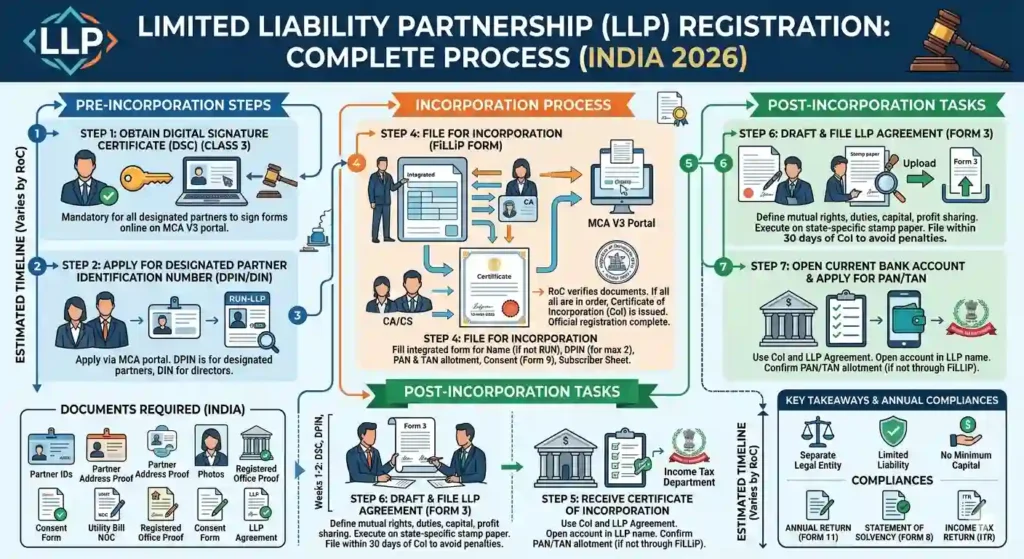
The LLP registration process in India is entirely digital through the MCA21 Version 3 portal as of 2026. Therefore, founders can complete the entire incorporation process from their office or home. The process involves six structured stages, each with specific filings and timelines. Consequently, understanding each stage prevents errors that delay incorporation. The Government of India has integrated DPIIT Startup recognition within the MCA21 portal, enabling simultaneous LLP registration and startup status application. Furthermore, the introduction of the FiLLiP form (Form for incorporation of LLP) consolidated multiple applications into a single submission. Additionally, the MCA’s Straight Through Processing (STP) system auto-approves applications that satisfy all algorithmic checks. Therefore, complete and accurate applications often receive approval within 3 to 7 business days. Accordingly, founders who invest time in preparation dramatically reduce registration timelines. Empower Legal’s dedicated incorporation team ensures first-time-right filings consistently.
Stage One: Obtaining Digital Signature Certificates and DPINs for Designated Partners
Digital Signature Certificates (DSCs) and Designated Partner Identification Numbers (DPINs) are mandatory prerequisites for every LLP filing on MCA21. Therefore, this stage must be completed before any other step begins. The process for obtaining these credentials includes:
- DSC Application: Apply to a licensed Certifying Authority (CA) empanelled under the IT Act, 2000 — such as eMudhra, Sify, or NSDL.
- DSC Class: Class 3 DSC is mandatory for all MCA21 filings as of January 2022.
- Documents for DSC: Aadhaar card, PAN card, passport-size photograph, and email/mobile for OTP verification.
- DPIN via FiLLiP: DPINs for new partners can be applied within the FiLLiP form itself (up to 2 DPs).
- Existing DIN holders: Directors with existing DINs under Companies Act may use their DIN as DPIN directly.
- Timeline: DSC issuance takes 1 to 3 working days; DPIN generation through FiLLiP is instant upon form approval.
Furthermore, foreign nationals seeking DPIN must submit apostilled and notarised identity documents translated into English. Consequently, the DPIN application timeline for foreign nationals may extend to 7–14 working days. Additionally, all DSCs must be registered on the MCA21 V3 portal before filing any form. Therefore, founders must allow sufficient lead time for DSC registration before initiating the FiLLiP filing. Moreover, DSCs are valid for 2 years and must be renewed before expiry to maintain uninterrupted filing access. Accordingly, calendar reminders for DSC renewal should be maintained from the outset. Empower Legal coordinates DSC procurement and MCA portal registration for all designated partners seamlessly.
Stage Two: LLP Name Reservation Through RUN-LLP Application
Reserving the correct LLP name is a critical step that shapes brand identity and prevents future legal disputes. Therefore, founders must invest adequate thought and research in name selection. The name reservation process involves:
- Access the RUN-LLP (Reserve Unique Name – LLP) service on the MCA21 V3 portal.
- Propose up to two name options in order of preference for the Registrar’s consideration.
- Verify name availability using the MCA’s free name search tool to check existing LLP and company names.
- Ensure the name ends with “LLP” or “Limited Liability Partnership” mandatorily under Rule 18, LLP Rules 2009.
- Confirm the name does not use prohibited words under LLP Name Guidelines, 2022 (e.g., “National,” “Government,” “Reserve Bank”).
- Pay the government fee of ₹200 per RUN-LLP application; name is reserved for 90 days upon approval.
Furthermore, names identical or deceptively similar to existing trademarks may be rejected by the Registrar under Rule 18(3) LLP Rules. Consequently, a trademark search on the IP India Portal (ipindia.gov.in) is strongly recommended before filing RUN-LLP. Additionally, the Registrar may approve names directly in the FiLLiP form without a prior RUN-LLP application in straightforward cases. Therefore, founders have the option of combining name reservation with the incorporation form. Moreover, rejected name reservations require fresh applications with new name proposals and additional fees. Accordingly, Empower Legal conducts comprehensive name availability and trademark conflict checks before any filing to ensure first-attempt approval.
Stage Three: Filing the FiLLiP Form for LLP Incorporation
The FiLLiP (Form for Incorporation of Limited Liability Partnership) is the primary document that legally creates an LLP in India. Therefore, accurate completion of FiLLiP is the most critical stage of the entire registration process. Key information required in FiLLiP includes:
| FiLLiP Section | Information/Documents Required |
|---|---|
| LLP Name | Approved name from RUN-LLP or proposed name for simultaneous approval |
| Registered Office Address | Complete address with PIN, state, and proof of address (utility bill/NOC) |
| Business Activity (NIC Code) | National Industry Classification code describing principal business |
| Partner Details | PAN, Aadhaar, address proof, and nationality of each partner |
| Designated Partner Details | DPIN/DIN, DSC, consent to act as DP (Form 9) |
| Contribution Details | Amount and nature of contribution (cash, kind, or intangibles) per partner |
| Subscriber Sheet | Signed by all partners and witnessed; attached as scanned PDF |
Furthermore, FiLLiP allows DPIN application for up to two new designated partners simultaneously within the form itself. Consequently, founders without existing DINs need not separately apply before filing FiLLiP. Additionally, the form must be digitally signed by all Designated Partners using their Class 3 DSCs. Therefore, DSC installation on the filing computer must be verified before submission. Moreover, FiLLiP is processed under the Straight Through Processing (STP) system, meaning auto-approval occurs where all validations pass. Accordingly, a complete and error-free FiLLiP filing typically receives the Certificate of Incorporation and LLPIN within 3–7 business days. Empower Legal’s expert filing team ensures every FiLLiP submission achieves STP approval on the first attempt.
Stage Four: Drafting and Filing the LLP Agreement Under Section 23
The LLP Agreement is the constitutional document governing the internal management of every LLP. Therefore, it must be carefully drafted to reflect partners’ rights, duties, profit-sharing ratios, and dispute resolution mechanisms. Under Section 23 of the LLP Act, 2008, every LLP must file its LLP Agreement in Form 3 within 30 days of incorporation. Key clauses every LLP Agreement must address include:
- Name and Registered Office — Clearly stated with provisions for change.
- Business Objects — Specific description of business activities the LLP will conduct.
- Capital Contribution — Amount, nature, and timeline of each partner’s contribution.
- Profit and Loss Sharing — Agreed ratios for distribution among partners.
- Management and Decision-Making — Voting thresholds, meeting procedures, and quorum requirements.
- Admission and Resignation of Partners — Procedure, notice period, and settlement of accounts.
- Dispute Resolution Clause — Arbitration under the Arbitration and Conciliation Act, 1996 is strongly recommended.
- Winding-Up Provisions — Grounds and procedure for voluntary dissolution.
Furthermore, an LLP operating without a filed LLP Agreement is governed by Schedule I of the LLP Act, which prescribes default rules that may not suit all business arrangements. Consequently, customised agreement drafting is strongly advisable before incorporation, not after. Additionally, the LLP Agreement must be executed on stamp paper of appropriate value as prescribed by each state’s Stamp Act. Therefore, stamp duty varies by state and must be calculated correctly to avoid document invalidity. Moreover, any subsequent amendments to the LLP Agreement must be filed in Form 3 within 30 days of change under Section 23(2). Accordingly, partners must not informally alter agreed terms without complying with statutory filing requirements. Empower Legal drafts comprehensive, litigation-proof LLP Agreements tailored to each client’s specific business model.
Stage Five: Post-Incorporation Compliance — PAN, TAN, GST, and Bank Account
Completing post-incorporation registrations is essential to making the LLP operationally ready. Therefore, founders must initiate these registrations immediately after receiving the Certificate of Incorporation. The mandatory post-incorporation compliance checklist includes:
- PAN Application: Apply for LLP’s Permanent Account Number through NSDL or UTI portal within 7 days of incorporation.
- TAN Registration: Required if the LLP will deduct TDS on salaries, rent, or professional fees.
- GST Registration: Mandatory if turnover exceeds ₹20 lakh (₹10 lakh for NE states); optional for lower turnover but may be commercially necessary.
- Bank Account Opening: Open a dedicated LLP current account; banks require Certificate of Incorporation, LLP Agreement, PAN, and DP identity proofs.
- MSME/Udyam Registration: Recommended for LLPs qualifying as micro, small, or medium enterprises to access government benefits.
- Professional Tax Registration: Mandatory in states like Maharashtra, Karnataka, Tamil Nadu, and West Bengal for LLPs with employees.
- Shops and Establishments Registration: Required under respective state Acts within 30 days of commencing business.
- DPIIT Startup Recognition: Eligible LLPs may apply for Startup India recognition for tax exemptions and regulatory benefits.
Furthermore, LLPs receiving foreign investment must file Form FC-GPR with the RBI within 30 days of receipt of foreign contribution under FEMA, 1999. Consequently, LLPs with NRI or foreign partners must proactively manage FEMA compliance from the outset. Additionally, all LLPs must maintain proper books of accounts under Section 34 of the LLP Act. Therefore, engaging a qualified Chartered Accountant from the date of incorporation is strongly advised. Empower Legal provides a comprehensive post-incorporation compliance package to ensure every LLP is operationally ready from day one without regulatory gaps.
Annual Compliance Calendar for LLPs: Key Filings and Deadlines in 2026
Annual compliance is a non-negotiable obligation for every LLP registered in India. Therefore, missing statutory deadlines attracts significant penalties under the LLP Act and MCA regulations. The mandatory annual filings and their deadlines are as follows:
| Form | Purpose | Due Date | Late Fee |
|---|---|---|---|
| Form 11 (Annual Return) | Details of partners and contributions | 30 May every year | ₹100 per day |
| Form 8 (Statement of Accounts) | Financial statements (solvency declaration) | 30 October every year | ₹100 per day |
| Income Tax Return (ITR-5) | Annual income tax filing | 31 July (non-audit); 30 Sept (audit) | ₹5,000–₹10,000 under IT Act |
| Form 3 (Agreement Amendment) | File any changes to LLP Agreement | Within 30 days of change | ₹100 per day |
| Form 4 (Partner Change) | Intimation of partner addition/cessation | Within 30 days of change | ₹100 per day |
Furthermore, LLPs with turnover exceeding ₹40 lakh or contribution exceeding ₹25 lakh must mandatorily get their accounts audited by a practising Chartered Accountant under Section 35 LLP Act. Consequently, these LLPs must also file audited financial statements in Form 8. Additionally, the MCA launched the LLP Settlement Scheme 2020 for regularising past defaults, and similar condonation schemes are periodically announced. Therefore, LLPs with outstanding defaults should promptly avail amnesty schemes when available to minimise penalties. Moreover, persistent non-filing may result in the RoC striking off the LLP under Section 75 of the LLP Act. Accordingly, active compliance monitoring is essential for maintaining the LLP’s legal standing. Empower Legal provides retainer-based annual compliance management for LLP clients across India.
Legal Remedies and Dispute Resolution Mechanisms for LLP Partners
Disputes between LLP partners are a practical reality that every founder must prepare for legally. Therefore, the LLP Agreement must include robust dispute resolution clauses from the outset. Available legal remedies and forums for LLP partner disputes in 2026 include:
- Arbitration — Fastest route; governed by Arbitration and Conciliation Act, 1996; enforceable as a decree.
- Mediation — Pre-litigation settlement through court-annexed or private mediators under Section 89 CPC.
- NCLT (National Company Law Tribunal) — For oppression and mismanagement under Section 61 LLP Act.
- Civil Court (CPC) — For breach of LLP Agreement, recovery of contribution, and damages claims.
- High Court — For winding-up petitions under Section 64 LLP Act on just and equitable grounds.
- SFIO Investigation — For fraud, falsification of accounts, or cheating under Section 43 LLP Act read with BNS 2023.
Furthermore, under BNS 2023, fraudulent conduct by a partner — such as misrepresentation to creditors or document falsification — attracts criminal prosecution under Sections 316–318 BNS (replacing IPC cheating provisions). Consequently, aggrieved partners may simultaneously pursue civil remedies before NCLT and criminal complaints at the nearest police station. Moreover, the BSA 2023 now permits digital evidence — email correspondence, accounting software records, and digital contracts — to be admitted in all forums handling LLP disputes. Therefore, preserving digital records from the commencement of business is critical for future litigation. Additionally, the BNSS 2023 mandates investigation completion within 60 days for financial offences. Accordingly, criminal complaints against fraudulent partners receive faster police action than under the previous CrPC regime. Empower Legal provides aggressive multi-forum dispute resolution strategies for LLP partners facing internal conflicts.
Foreign Investment in LLPs: FEMA Compliance and RBI Reporting Requirements
Foreign Direct Investment (FDI) in Indian LLPs is permitted under the automatic route in sectors where 100% FDI is allowed. Therefore, LLPs in sectors like IT services, consulting, and manufacturing can attract foreign capital without prior government approval. Key FEMA compliance requirements for LLPs with foreign investment include:
- FDI is permitted only in LLPs operating in sectors with 100% FDI allowance under the Consolidated FDI Policy 2020.
- Foreign partners must remit capital contribution through proper banking channels under FEMA Regulations, 2019.
- The LLP must file Form FC-GPR with the RBI within 30 days of receiving foreign contribution.
- Annual return on foreign liabilities and assets (FLA Return) must be filed with RBI by 15 July every year.
- Transfer of contribution between a resident and non-resident partner requires RBI approval under FEMA.
- FDI is prohibited in LLPs engaged in agriculture, print media, atomic energy, and multi-brand retail sectors.
Furthermore, NRI partners contributing to LLPs must ensure all remittances originate from Non-Resident External (NRE) or Foreign Currency Non-Resident (FCNR) accounts for repatriation eligibility. Consequently, incorrect remittance routes trigger FEMA violations attracting penalties up to three times the amount involved. Additionally, the Enforcement Directorate (ED) investigates serious FEMA violations by LLPs under the Foreign Exchange Management Act. Therefore, LLPs with foreign partners must engage FEMA-specialised counsel from the outset. Moreover, the RBI’s FIRMS portal (Foreign Investment Reporting and Management System) is the mandatory platform for all FDI-related filings by LLPs. Accordingly, founders must register on FIRMS immediately after incorporation if foreign investment is anticipated. Empower Legal provides comprehensive FEMA advisory and RBI reporting services for LLPs with international partners and investors.
Converting Existing Partnerships and Companies into LLPs: Legal Procedure
Existing businesses can convert into LLPs to benefit from limited liability protection without incorporating a new entity. Therefore, conversion is an attractive option for established firms seeking structural upgrade. The LLP Act provides two conversion pathways:
- Partnership to LLP Conversion — Governed by Schedule II of the LLP Act; filed through Form 17 on MCA21.
- Private Company to LLP Conversion — Governed by Schedule III; filed through Form 18; requires all shareholders to become partners.
- Public Company to LLP Conversion — Governed by Schedule IV; additional conditions including no outstanding security deposits.
- Key Pre-Condition (Company Conversion): No pending charges, no existing debentures or deposits, and no Section 8 company status.
- Tax Neutrality: Conversion from partnership to LLP is tax-neutral under Section 47(xii) Income Tax Act; company conversion has specific tax implications.
Furthermore, on conversion, all assets, liabilities, contracts, and employees of the converting entity automatically vest in the new LLP under the respective Schedule. Consequently, no fresh contracts or transfer documents are required for the transferred assets. Additionally, the converting entity’s PAN and registrations (GST, MSME) must be updated to reflect the new LLP identity within prescribed timelines. Therefore, a post-conversion compliance checklist must be executed immediately after the RoC issues the conversion certificate. Moreover, goodwill, trademarks, and intellectual property transferred during conversion must be separately valued and documented for tax purposes. Accordingly, a Chartered Accountant and legal counsel must jointly manage the conversion process. Empower Legal has successfully completed numerous partnership-to-LLP and company-to-LLP conversions across India’s major commercial jurisdictions.
Winding Up and Striking Off an LLP: Legal Process and Consequences
LLPs that cease operations must be properly wound up to avoid continuing statutory obligations and penalty accumulation. Therefore, founders must initiate the correct legal closure process as soon as the LLP becomes dormant. The available closure routes for LLPs in 2026 are:
- Voluntary Strike-Off (Form 24): Available if the LLP has been inactive since incorporation or for over 1 year; filed under Rule 37(1) LLP Rules.
- Voluntary Winding-Up: Partners pass a resolution; a liquidator is appointed; assets are distributed and liabilities discharged before striking off.
- Compulsory Winding-Up by NCLT: Ordered by NCLT under Section 64 LLP Act on grounds including just and equitable cause, inability to pay debts, or fraudulent purpose.
- IBC Process: LLPs declared insolvent may undergo CIRP (Corporate Insolvency Resolution Process) before NCLT under IBC, 2016.
Furthermore, LLPs struck off by the RoC for non-compliance under Section 75 remain legally liable for all pre-strike-off obligations. Consequently, partners of struck-off LLPs may face personal liability for unsettled debts and tax demands. Additionally, partners seeking revival of struck-off LLPs must file a restoration application before the NCLT within 5 years of striking off. Therefore, prevention through timely compliance is always preferable to the costly restoration process. Moreover, the MCA periodically announces condonation schemes allowing voluntarily struck-off LLPs to regularise filings and restore active status. Accordingly, founders of dormant LLPs should monitor MCA announcements for amnesty opportunities. Empower Legal provides efficient closure management, including Form 24 filings, voluntary winding-up coordination, and NCLT representation for LLP dissolution matters.
LLP Taxation, ITR Filing and GST Obligations: Financial Compliance Guide 2026
Taxation compliance is a continuous obligation for every operational LLP in India. Therefore, designated partners must understand LLP taxation thoroughly to avoid penalties. Key taxation obligations for LLPs in 2026 include:
- Income Tax Rate: LLPs pay flat 30% income tax on net profits plus applicable surcharge and health/education cess.
- Alternate Minimum Tax (AMT): LLPs are subject to AMT at 18.5% of adjusted total income under Section 115JC IT Act.
- Partner’s Share: Partners’ share of LLP profit is exempt from tax in their individual hands under Section 10(2A) IT Act.
- Remuneration to Partners: Deductible up to limits prescribed under Section 40(b) IT Act; excess treated as LLP income.
- Interest to Partners: Deductible up to 12% per annum; excess interest disallowed under Section 40(b).
- GST Filing: Monthly GSTR-1, GSTR-3B filings and annual GSTR-9 for GST-registered LLPs.
- TDS Compliance: Monthly TDS deduction and quarterly TDS returns (Form 24Q, 26Q) if LLP deducts tax at source.
Furthermore, LLPs claiming deductions under Sections 80IC, 80IB, or DPIIT Startup exemptions under Section 80-IAC must ensure all conditions are strictly satisfied. Consequently, improper claims attract tax scrutiny from the Income Tax Department’s Assessment Unit. Additionally, the ITAT (Income Tax Appellate Tribunal) is the prescribed forum for challenging IT assessments of LLPs. Therefore, LLPs facing tax demands must file appeals within 30 days of receiving the assessment order. Moreover, the Faceless Assessment Scheme 2022 now applies to most LLP tax assessments, making digital documentation even more critical. Accordingly, LLPs must maintain complete digital accounting records consistent with BSA 2023 electronic evidence standards. Empower Legal connects LLP clients with experienced tax practitioners and provides integrated legal-tax compliance advisory services.
Criminal Liability of LLP Partners: BNS 2023 and BNSS 2023 Implications
Partners of an LLP may incur personal criminal liability in specific situations under the new penal codes. Therefore, every designated partner must understand the criminal exposure dimensions of their role. Key criminal provisions applicable to LLP partners in 2026 include:
- Section 316–318 BNS 2023 — Cheating and misrepresentation to creditors or investors; imprisonment up to 7 years.
- Section 406 BNS 2023 — Criminal breach of trust regarding LLP funds or assets; imprisonment up to 3 years.
- Section 420 BNS 2023 equivalent — Fraudulent inducement to invest in LLP; imprisonment up to 7 years.
- Section 43 LLP Act — Fraud in LLP operations investigated by SFIO; imprisonment up to 5 years with fine.
- Section 448 Companies Act (applied via LLP Act) — False statements in official LLP documents; criminal prosecution.
- FEMA Violations — Prosecuted by Enforcement Directorate; penalties up to 3x the violation amount.
Furthermore, the BNSS 2023 mandates that economic offence investigations by police must be completed within 60 days, with the possibility of a 90-day extension. Consequently, LLP partners accused of financial fraud face faster criminal proceedings than under the old CrPC regime. Additionally, the BSA 2023 permits digital evidence — financial software records, email trails, and electronic contracts — to be used against accused partners in criminal courts. Therefore, honest partners must maintain impeccable documentation to defend against false allegations. Moreover, anticipatory bail under Section 482 BNSS 2023 (replacing Section 438 CrPC) is available to partners apprehending arrest in economic offence cases. Accordingly, immediate engagement of a criminal-corporate lawyer upon receiving any police notice is strongly advised. Empower Legal’s criminal-corporate practice group provides comprehensive protection for LLP partners facing legal disputes.
Government Schemes, Incentives and Benefits Available to Registered LLPs
Registered LLPs in India can access a wide range of government incentives, schemes, and financial support programmes. Therefore, founders should actively explore these benefits to reduce costs and accelerate growth. Key government benefits available to LLPs in 2026 include:
- Startup India Tax Exemption: DPIIT-recognised LLPs receive 3-year income tax holiday under Section 80-IAC IT Act.
- SIDBI MSME Loans: Registered LLPs qualifying as MSMEs access collateral-free loans under CGTMSE scheme up to ₹2 crore.
- GeM Portal Registration: LLPs can register as sellers on Government e-Marketplace (GeM) for government procurement contracts.
- Production Linked Incentive (PLI): LLPs in eligible manufacturing sectors can apply for PLI scheme benefits through DPIIT.
- SIDBI Make in India Soft Loan Fund: LLPs in manufacturing receive subsidised interest rate loans for capital equipment.
- National SC-ST Hub: SC/ST-owned LLPs receive preference in government procurement and special mentorship support.
- Women Entrepreneurship Platform (WEP): Women-led LLPs access NITI Aayog’s WEP network for mentoring, funding, and market access.
Furthermore, LLPs registered in Special Economic Zones (SEZs) or Software Technology Parks (STPs) enjoy additional tax benefits and customs exemptions under the SEZ Act, 2005. Consequently, technology and export-oriented LLPs derive significant competitive advantages from these location-based incentives. Additionally, the ASPIRE Scheme (Agro and Rural Industry) supports agri-based LLPs through NABARD-linked funding and market linkages. Therefore, rural entrepreneurs registering LLPs for agri-business should explore ASPIRE benefits proactively. Moreover, state governments offer additional subsidies, power tariff concessions, and land allocation benefits to LLPs investing in priority sectors. Accordingly, founders must research both central and state-level incentive programmes relevant to their industry. Empower Legal’s government relations advisory team helps LLP clients identify, apply for, and successfully avail every applicable government benefit and incentive.
Frequently Asked Questions (FAQs) — LLP Registration in India 2026
1. What is an LLP and why is it preferred for businesses in India?
A Limited Liability Partnership (LLP) is a hybrid business structure governed by the Limited Liability Partnership Act, 2008, combining features of partnerships and companies. It offers limited liability protection to partners while allowing flexible internal management. LLPs are preferred by startups, professionals, and small businesses because they involve fewer compliance requirements than companies, have no minimum capital requirement, and protect personal assets from business liabilities.
2. What are the basic requirements to register an LLP in India?
To register an LLP, at least two designated partners are required, and one must be a resident of India. Partners must obtain a Digital Signature Certificate (DSC) and Director Identification Number (DIN). A unique name must be reserved through the Ministry of Corporate Affairs portal.
3. What is the step-by-step process for LLP registration?
The process begins with obtaining DSCs and DINs. Next, reserve the LLP name using the RUN-LLP service on the MCA portal. After approval, file the incorporation form (FiLLiP) with required documents. Once approved, the Certificate of Incorporation is issued. Finally, file the LLP Agreement within 30 days, outlining rights and duties of partners.
4. How long does LLP registration take and what are the costs involved?
LLP registration usually takes 7–15 working days, depending on document accuracy and approvals. Costs include government fees, DSC charges, and professional fees. Government fees vary based on contribution amount, generally starting from a few hundred rupees and increasing with capital contribution.
5. What compliances are required after LLP registration?
After registration, LLPs must file annual returns and statements of accounts with the MCA. Maintaining proper books of accounts, filing income tax returns, and complying with applicable laws are mandatory. Non-compliance may result in penalties and legal consequences.
Read More
- Public Limited Company Incorporation: Requirements and Process
- One Person Company (OPC) Formation: Solo Entrepreneur’s Guide
- Private Limited Company Registration in India: Complete Guide 2026
- RERA Compliance & Valuation Dispute Solutions by Property Lawyers
- Interior Design & Construction Contract Drafting Services in India
- Ministry of Corporate Affairs (MCA Portal)