
Every commercial establishment must comply with applicable labour laws from the beginning of business operations. Therefore, Shops and Establishments Act registration remains a fundamental compliance requirement across Indian States and Union Territories. Each State enacts its own legislation, rules, and online registration procedures. Consequently, registration timelines, documentation, exemptions, and renewal requirements differ across jurisdictions. Empower Legal – Corporate Law Firm assists startups, companies, LLPs, partnerships, proprietorships, NGOs, trusts, educational institutions, and NRIs with statutory registrations and labour law compliance. Businesses should also understand obligations under the Code of Civil Procedure, 1908 during civil disputes. Additionally, the Bharatiya Nyaya Sanhita, 2023, Bharatiya Nagarik Suraksha Sanhita, 2023, and Bharatiya Sakshya Adhiniyam, 2023 apply whenever criminal violations, investigations, or evidentiary issues arise. Proper compliance minimizes penalties, strengthens business credibility, and supports uninterrupted commercial operations.
Shops and Establishments Act Registration: State-wise Requirements – Empower Legal – Corporate Law Firm
State-wise Registration Requirements and Legal Framework
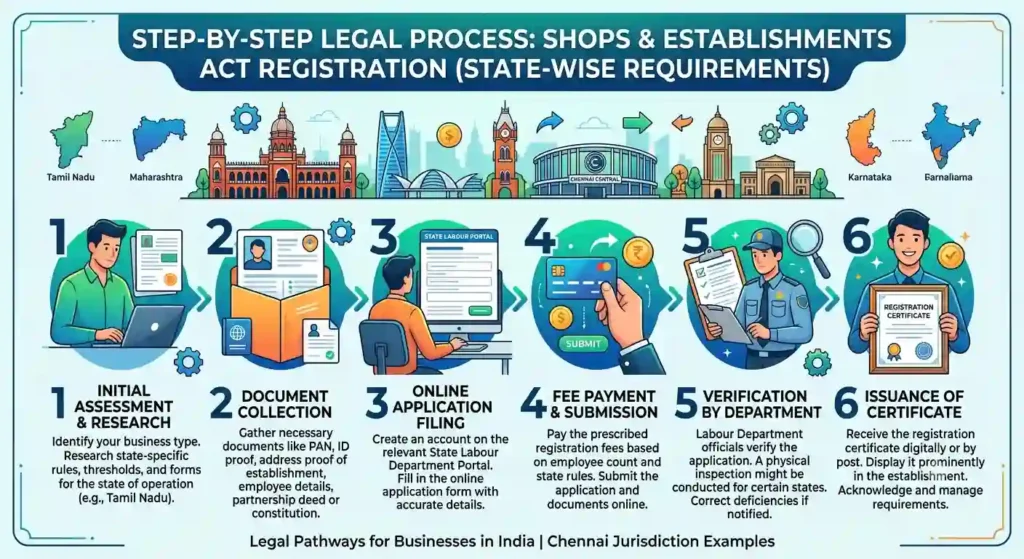
Each State prescribes separate rules governing commercial establishments, employee welfare, working hours, leave, holidays, wages, records, and inspections. Therefore, employers should verify applicable local legislation before commencing operations. Registration generally becomes mandatory after establishing a shop, office, warehouse, consultancy, retail outlet, factory office, or commercial establishment employing workers. Most States now provide online registration portals through Labour Departments. Authorities verify ownership documents, identity proofs, address records, business constitution documents, employee details, and applicable licences before issuing registration certificates. Businesses operating across multiple States require separate compliance according to local laws. Regular legal audits reduce compliance gaps and avoid enforcement actions. Professional legal assistance ensures timely registration, statutory reporting, document verification, licence renewals, and effective representation before competent authorities.
Businesses Covered Under the Shops and Establishments Laws
The legislation covers a broad range of commercial activities across India. Consequently, businesses should evaluate coverage before beginning operations. Retail stores, supermarkets, offices, restaurants, hotels, theatres, educational institutions, clinics, warehouses, service centres, e-commerce offices, logistics companies, information technology establishments, consultancies, financial service providers, and professional firms generally require registration according to State laws. Some States extend coverage to remote workplaces and digital establishments employing personnel. Government notifications determine exemptions for specified categories. Registration obligations frequently depend upon employee strength, establishment type, and business location. Employers should maintain updated employment records, attendance registers, wage details, leave records, and statutory notices. Comprehensive compliance reduces disputes, promotes employee welfare, and strengthens regulatory confidence during inspections.
Key Registration Documents and Compliance Requirements
Proper documentation accelerates registration approval and minimizes administrative objections. Accordingly, businesses should organize statutory records before filing applications. Common documents include proprietor identification, company incorporation certificates, partnership deeds, LLP agreements, trust deeds, PAN, GST registration, address proof, rental agreements, ownership documents, electricity bills, employee details, establishment photographs, authorization letters, and mobile numbers linked to government portals. Certain States may request additional declarations depending upon local rules. Online applications require accurate information because discrepancies delay approvals. Employers should preserve registration certificates and supporting records for future inspections. Timely amendments remain necessary after business expansion, relocation, ownership changes, or constitution modifications. Professional legal review significantly improves compliance accuracy and regulatory acceptance.
Benefits of Timely Registration
Early registration delivers important legal and commercial advantages. Moreover, statutory compliance enhances credibility with customers, investors, lenders, and government authorities. Registration supports bank account opening, business licensing, GST compliance, labour inspections, contractual eligibility, government tenders, and financial audits. Employers also demonstrate commitment toward employee welfare through lawful workplace practices. Registered establishments reduce exposure to penalties arising from delayed compliance. Proper documentation simplifies future renewals, inspections, and regulatory communications. Businesses expanding into multiple States benefit from organized compliance systems and standardized employment documentation. Strategic legal advice identifies State-specific obligations before operational challenges arise. Timely compliance therefore supports sustainable growth, regulatory confidence, and effective corporate governance.
State Labour Departments and Registration Authorities
State Labour Departments administer Shops and Establishments legislation within their respective jurisdictions. Therefore, employers should interact with the appropriate State authority for registration and compliance. Labour Commissioners, Deputy Commissioners, Inspectors, Facilitation Centres, and designated online portals supervise applications, amendments, inspections, and statutory compliance. Many States provide integrated digital services for registration, certificate downloads, status tracking, and grievance resolution. Authorities may inspect establishments to verify statutory records and workplace conditions. Employers should cooperate during inspections while maintaining accurate employment documentation. Legal professionals regularly assist businesses during departmental proceedings, compliance audits, inspections, replies to notices, and appellate matters. Organized regulatory compliance reduces operational risks and improves long-term business stability.
Common Legal Issues Faced by Employers
Several compliance challenges arise during registration and business operations. Consequently, proactive legal planning remains essential for employers across industries. Frequent issues include delayed registration, inaccurate employee records, non-maintenance of statutory registers, incorrect working hours, wage disputes, leave violations, inspection notices, licence amendments, branch registrations, business restructuring, and closure compliance. Cross-border operations further increase regulatory complexity because every State follows different statutory requirements. Businesses should conduct periodic legal audits to identify compliance deficiencies before enforcement proceedings begin. Early legal intervention minimizes financial exposure and operational disruption. Effective compliance management also protects employer reputation while improving workforce confidence and regulatory relationships.
Why Businesses Need Professional Legal Assistance
Professional legal guidance simplifies registration and strengthens ongoing compliance obligations. Furthermore, experienced lawyers identify State-specific requirements before avoidable violations occur. Empower Legal – Corporate Law Firm advises startups, MSMEs, multinational corporations, LLPs, partnerships, charitable organizations, educational institutions, hospitals, manufacturing units, technology companies, and NRIs on labour law compliance. Legal services include registration applications, document verification, legal opinions, departmental representation, compliance audits, employment documentation, statutory notices, inspection support, appeals, and litigation strategy. Lawyers also coordinate with Labour Departments and other regulatory authorities whenever necessary. Early legal support minimizes compliance risks, ensures procedural accuracy, and enables businesses to focus confidently on long-term commercial growth.
State-wise Compliance and Registration Variations
Every State follows its own Shops and Establishments legislation and procedural rules. Therefore, businesses operating nationally should never assume identical compliance requirements. Registration timelines, renewal obligations, employee thresholds, inspection methods, digital filing systems, display requirements, and record maintenance differ significantly between States and Union Territories. Tamil Nadu, Karnataka, Maharashtra, Delhi, Telangana, Gujarat, Kerala, and other jurisdictions maintain separate labour portals and prescribed formats. Employers should monitor official notifications because States regularly amend compliance procedures. Multi-location businesses must maintain independent registrations wherever required by local law. Regular compliance reviews reduce regulatory risks and improve operational consistency. Experienced legal advisors help organizations understand State-specific obligations before expansion, mergers, acquisitions, or establishment of new branches.
Inspections, Notices and Employer Obligations
Labour authorities possess statutory powers to inspect establishments and verify legal compliance. Consequently, employers should maintain complete records throughout business operations. Inspecting Officers generally review registration certificates, employee registers, attendance records, wage registers, leave records, holiday notices, working hour compliance, overtime details, and statutory displays. Authorities may issue notices seeking clarification, corrective action, or additional documents. Prompt and accurate responses reduce enforcement risks and unnecessary penalties. Businesses should cooperate professionally during inspections while preserving documentary evidence. Internal compliance audits frequently identify deficiencies before departmental action begins. Legal professionals prepare replies to notices, represent employers before authorities, and recommend corrective measures that strengthen long-term compliance with applicable State legislation.
Penalties, Litigation and Legal Remedies
Failure to comply with applicable labour laws may expose employers to statutory penalties. Accordingly, businesses should rectify violations immediately after receiving regulatory notices. Authorities may impose monetary penalties, direct corrective measures, or initiate prosecution according to applicable State legislation. Civil disputes relating to contractual obligations proceed before competent courts under the Code of Civil Procedure, 1908 where necessary. Criminal allegations involving forgery, fabricated records, cheating, criminal breach of trust, or obstruction may attract the Bharatiya Nyaya Sanhita, 2023. Criminal investigations follow procedures under the Bharatiya Nagarik Suraksha Sanhita, 2023. The Bharatiya Sakshya Adhiniyam, 2023 governs documentary and electronic evidence. Timely legal representation protects procedural rights while minimizing commercial disruption and reputational damage.
Government Departments and Regulatory Authorities
Several government departments supervise labour compliance and commercial establishment regulations across India. Therefore, businesses should identify the correct authority before submitting applications or responding to notices. State Labour Departments administer registration, inspections, renewals, amendments, and enforcement proceedings. Chief Labour Commissioners, Labour Commissioners, Deputy Commissioners, Labour Inspectors, and designated online service portals perform statutory functions under applicable State laws. Additional authorities may include Municipal Corporations, GST Departments, Registration Departments, Employees’ Provident Fund Organisation, Employees’ State Insurance Corporation, and local licensing authorities according to business activities. Coordinated compliance across departments strengthens operational efficiency and reduces legal exposure. Professional legal guidance ensures consistent documentation and timely regulatory reporting.
Corporate Legal Support for Complete Compliance
Comprehensive legal support extends beyond obtaining the registration certificate. Moreover, businesses require continuous compliance management throughout their operational lifecycle. Empower Legal – Corporate Law Firm advises startups, MSMEs, companies, LLPs, partnerships, NGOs, trusts, educational institutions, healthcare institutions, manufacturers, exporters, importers, and multinational corporations. Legal services include registration applications, branch registrations, compliance audits, employment documentation, labour policy reviews, departmental representation, inspection assistance, notice replies, appellate proceedings, risk assessments, and litigation management. Lawyers also coordinate with accountants, company secretaries, and human resource professionals to ensure integrated compliance systems. Strategic legal planning reduces regulatory risks while supporting sustainable corporate growth across multiple jurisdictions.
Practical Compliance Steps for Every Establishment
Businesses should adopt a structured compliance framework from the first day of operations. Therefore, management should verify State-specific registration requirements before employing staff or commencing commercial activities. Maintain updated employee registers, wage records, attendance records, leave registers, appointment letters, and statutory notices in prescribed formats. Display registration certificates and mandatory workplace notices wherever applicable. Review amendments issued by the concerned State Labour Department regularly. Conduct periodic internal compliance audits to identify deficiencies before inspections. Nearby police stations may investigate offences involving forged documents, fraud, criminal intimidation, or cheating where provisions of the Bharatiya Nyaya Sanhita, 2023 apply. Preserve electronic and physical records because the Bharatiya Sakshya Adhiniyam, 2023 recognizes admissible documentary and digital evidence. Professional legal monitoring significantly reduces regulatory risks and operational interruptions.
Compliance Checklist and Available Legal Remedies
The following table summarizes common compliance obligations and legal remedies.
| Compliance Issue | Legal Remedy | Competent Authority |
|---|---|---|
| Non-registration | Fresh registration and compliance | State Labour Department |
| Delayed amendments | File updated application | Labour Authority |
| Inspection notice | Submit reply with documents | Labour Inspector |
| Penalty proceedings | Appeal or legal representation | Competent Appellate Authority |
| Employee record deficiency | Rectify statutory registers | Labour Department |
| Contractual disputes | Civil proceedings | Civil Court |
| Fraud or forged records | Criminal complaint | Police and Criminal Court |
| Regulatory dispute | Writ or statutory remedy, where applicable | High Court or Competent Forum |
Jurisdiction, Authorities and Corporate Legal Support
Selecting the correct authority ensures timely compliance and effective dispute resolution. Accordingly, businesses should seek legal advice before initiating proceedings.
| Authority / Forum | Primary Function |
|---|---|
| State Labour Department | Registration, amendments and inspections |
| Labour Commissioner | Administrative supervision and compliance |
| Labour Inspector | Workplace inspections and enforcement |
| Civil Court | Contractual and civil disputes under CPC |
| Criminal Court | Offences under the Bharatiya Nyaya Sanhita, 2023 |
| High Court | Writ jurisdiction and statutory challenges |
| District Legal Services Authority | Legal aid and mediation support |
| Municipal Authority | Local trade and establishment permissions |
| EPFO and ESIC Authorities | Social security compliance |
| Registration Department | Business-related registrations where applicable |
Conclusion
Shops and Establishments Act registration forms the foundation of labour law compliance for every commercial establishment. Consequently, businesses should understand State-specific requirements before commencing operations or expanding into new jurisdictions. Timely registration strengthens regulatory compliance, improves employee confidence, and supports sustainable business growth. The Code of Civil Procedure, 1908 governs civil proceedings arising from contractual disputes, while the Bharatiya Nyaya Sanhita, 2023, Bharatiya Nagarik Suraksha Sanhita, 2023, and Bharatiya Sakshya Adhiniyam, 2023 apply where criminal issues or evidentiary questions arise. Empower Legal – Corporate Law Firm provides end-to-end legal assistance through registrations, compliance audits, departmental representation, inspection support, legal notices, appeals, litigation, and corporate advisory services. Professional legal guidance helps organizations minimize penalties, maintain statutory compliance, and confidently operate across multiple Indian States.
Frequently Asked Questions
1. Is Shops and Establishments Act registration mandatory for every business?
Most commercial establishments require registration under the applicable State law. Requirements differ by jurisdiction, establishment type, employee strength, and local statutory provisions.
2. Which documents are generally required for registration?
Authorities commonly require identity proof, business constitution documents, address proof, ownership or lease records, employee details, PAN, GST details, and supporting declarations.
3. Can businesses operating in multiple States obtain one registration?
Generally, no. Each State follows its own Shops and Establishments legislation. Businesses usually require separate registrations and compliance for every applicable location.
4. What happens if an employer fails to register?
Authorities may impose penalties, issue notices, conduct inspections, and initiate legal proceedings according to the applicable State legislation and compliance framework.
5. Can criminal proceedings arise from labour compliance violations?
Simple non-compliance usually attracts statutory penalties. However, offences involving fraud, forgery, or fabricated records may attract the Bharatiya Nyaya Sanhita, 2023.
6. Why should businesses engage corporate legal professionals?
Legal professionals ensure accurate registration, regulatory compliance, inspection readiness, documentation, departmental representation, risk management, and effective dispute resolution across jurisdictions.
Read More
- Professional Tax Registration: State-wise Guide and Procedures
- ESI Registration for Companies: Employee Health Insurance Guide
- EPFO Registration: Provident Fund Compliance for Employers
- GST Registration for Companies: When and How to Register
- PAN and TAN Registration for Companies: Complete Process
- Ministry of Labour & Employment, Government of India