
Factory License Under Factories Act – A factory license forms the legal foundation for operating manufacturing premises in India. The Factories Act, 1948, along with applicable State Factory Rules, regulates registration, licensing, worker safety, health, and welfare. Additionally, the Occupational Safety, Health and Working Conditions Code, 2020 guides future compliance wherever notified by the concerned State. Empower Legal – Corporate Law Firm assists manufacturers, industrial units, MSMEs, startups, multinational companies, and factory owners throughout the licensing process. Our advocates evaluate statutory applicability, employee strength, manufacturing activities, hazardous processes, and local regulatory requirements before filing applications. We also represent clients before Labour Departments, Chief Inspector of Factories, Industrial Tribunals, High Courts, and the Supreme Court whenever disputes arise. Where criminal violations occur, applicable provisions under BNS, BNSS, BSA, and jurisdictional police procedures may apply. Consequently, businesses receive comprehensive legal guidance from registration until complete statutory compliance.
Factory License Under Factories Act 1948: Complete Guide – Empower Legal – Corporate Law Firm
Legal Framework Governing Factory Licensing
Factory licensing depends upon several labour, environmental, municipal, and industrial regulations. Therefore, businesses should understand every applicable legal requirement before establishing manufacturing operations. The Factories Act, 1948, State Factory Rules, Environment Protection Act, Air Act, Water Act, Boilers Act, Electricity Rules, Fire Safety Regulations, and Building Rules collectively influence licensing decisions. Every applicant should satisfy statutory conditions regarding premises, machinery, ventilation, sanitation, worker welfare, and occupational safety. Moreover, our legal professionals review layout plans, ownership documents, approvals, compliance records, and inspection reports before submission. Proper documentation significantly reduces delays and objections from regulatory authorities. We also advise businesses regarding renewals, amendments, capacity expansion, hazardous manufacturing permissions, and labour compliance. Accordingly, factory owners maintain uninterrupted industrial operations while complying with applicable statutory obligations and regulatory requirements across India.
Eligibility and Applicability of Factory License
Factory licensing depends upon workforce strength, manufacturing processes, and use of power within industrial premises. Accordingly, businesses should determine statutory applicability before commencing production activities. Generally, factories employing the prescribed number of workers under applicable law require registration and licensing from the competent authority. Manufacturing units operating hazardous processes require additional regulatory scrutiny and compliance. Our lawyers evaluate operational activities, employee records, machinery installation, production methods, and industrial classifications before advising clients. Furthermore, we identify sector-specific approvals applicable to pharmaceuticals, chemicals, engineering, textiles, food processing, automobile manufacturing, electronics, and heavy industries. Proper legal evaluation prevents future licensing disputes and regulatory enforcement actions. We also assist businesses expanding production capacity or modifying manufacturing activities after obtaining licenses. Consequently, factory owners achieve lawful compliance while protecting commercial investments through effective regulatory planning and professional legal support.
Documents Required for Factory License Application
Accurate documentation remains essential for obtaining factory registration and licensing approvals. Therefore, businesses should organize statutory records before submitting applications. Common documents include:
- Ownership documents.
- Lease agreement.
- Approved building plan.
- Factory layout plan.
- Identity proof.
- Address proof.
- Partnership deed.
- Certificate of Incorporation.
- PAN and GST registration.
- Machinery details.
Additional documents may become necessary depending upon manufacturing activities, environmental approvals, fire safety clearances, and local authority requirements. Moreover, competent authorities carefully verify documentary accuracy before granting licenses. Our advocates review every document to ensure statutory compliance and reduce procedural delays. Proper documentation frequently prevents unnecessary objections during inspections. Consequently, applicants improve approval prospects while maintaining complete legal compliance under the applicable industrial regulatory framework.
Government Authorities Responsible for Factory Licensing
Several government departments regulate factory establishment, licensing, inspections, and compliance. Accordingly, businesses should coordinate with appropriate authorities before beginning manufacturing activities.
| Government Authority | Primary Responsibility |
|---|---|
| State Labour Department | Factory licensing |
| Chief Inspector of Factories | Inspection and approval |
| Directorate of Industrial Safety and Health | Worker safety |
| Pollution Control Board | Environmental clearance |
| Fire and Rescue Services | Fire safety approval |
| Local Municipality | Building approval |
| Electricity Board | Power connection |
| Boilers Department | Boiler certification |
| Industrial Development Authority | Industrial approvals |
| District Administration | Local regulatory support |
Every authority performs specific statutory functions affecting industrial operations. Therefore, coordinated compliance becomes essential before production commences. Our legal team represents clients before these authorities while ensuring timely approvals and regulatory compliance.
Legal Issues Commonly Faced by Factory Owners
Factory owners frequently encounter legal challenges during establishment and operational stages. Therefore, timely legal guidance remains essential for protecting commercial interests. Common legal issues include licensing delays, inspection objections, labour disputes, environmental compliance failures, hazardous process approvals, factory layout violations, machinery safety concerns, accident investigations, employment issues, wage disputes, and renewal delays. Businesses may also face prosecution for non-compliance with statutory obligations. Moreover, regulatory authorities conduct inspections and issue notices requiring immediate legal responses. Our advocates examine inspection reports, statutory records, compliance registers, employment documents, safety policies, and regulatory communications before recommending legal strategies. Appropriate preventive compliance significantly reduces litigation risks and operational interruptions. Consequently, factory owners receive practical legal solutions supporting uninterrupted manufacturing while ensuring compliance with labour, environmental, and industrial safety laws.
Benefits of Professional Legal Assistance
Professional legal support simplifies factory licensing and strengthens long-term regulatory compliance. Accordingly, Empower Legal – Corporate Law Firm provides comprehensive advisory services covering factory registration, document verification, inspection preparation, licence renewals, amendments, compliance audits, and litigation support. Our lawyers prepare statutory applications, replies to notices, appeals, legal opinions, and compliance reports according to current legal requirements. Furthermore, we coordinate with architects, engineers, environmental consultants, Chartered Accountants, and compliance professionals whenever multidisciplinary assistance benefits clients. Early legal intervention frequently prevents penalties, production delays, and licensing disputes. We also advise businesses regarding employment laws, industrial safety standards, contractor compliance, and statutory registers. Consequently, manufacturers establish legally compliant operations while minimizing regulatory exposure and protecting valuable commercial investments throughout the factory lifecycle.
Why Choose Empower Legal – Corporate Law Firm
Empower Legal – Corporate Law Firm delivers practical legal solutions for factory licensing, industrial compliance, labour law advisory, and regulatory litigation across India. Our advocates assist manufacturers, exporters, MSMEs, startups, multinational companies, and industrial groups from project planning until operational compliance. Moreover, we represent clients before Labour Departments, Chief Inspector of Factories, Industrial Tribunals, Civil Courts, High Courts, and the Supreme Court wherever necessary. Connected civil proceedings may involve CPC provisions, while criminal violations involving industrial accidents, negligence, or fraudulent documentation may attract BNS, BNSS, BSA, and jurisdictional police procedures. Every legal strategy emphasizes preventive compliance, regulatory efficiency, and commercial continuity. Consequently, clients receive reliable legal representation supporting lawful factory establishment, sustainable industrial growth, and effective resolution of regulatory challenges under applicable Indian laws.
Factory License Application Process and Regulatory Approval
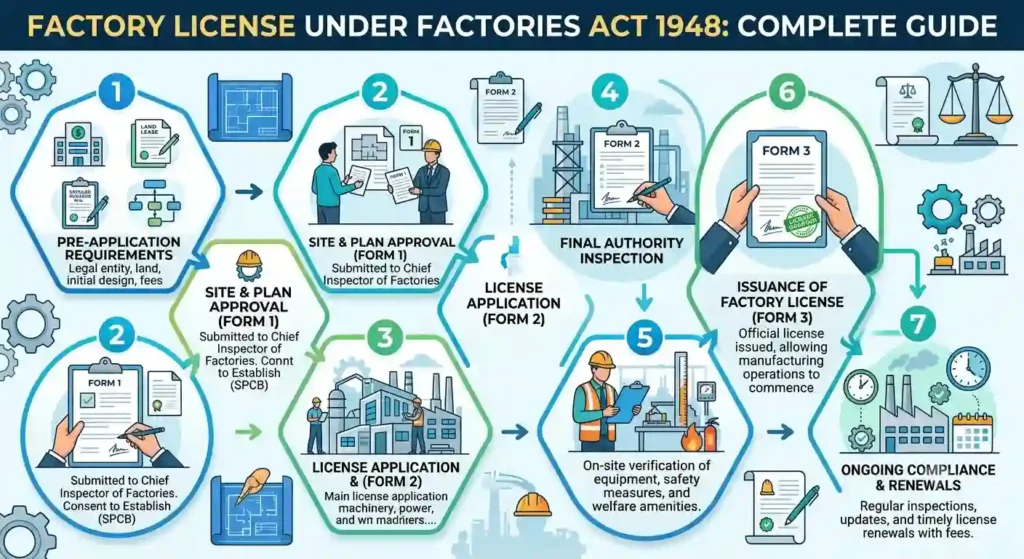
Obtaining a factory license requires systematic compliance with statutory procedures before production begins. Therefore, applicants should prepare documentation carefully before submitting applications to the competent authority. The process generally includes site verification, layout approval, document scrutiny, payment of prescribed fees, statutory declarations, and physical inspection by authorized officers. Moreover, authorities verify worker safety measures, sanitation facilities, machinery installation, emergency exits, ventilation, lighting, and welfare amenities before granting approval. Our legal team prepares applications, statutory forms, compliance declarations, and supporting documents according to applicable State Factory Rules. We also respond to departmental queries, inspection observations, and licensing objections promptly. Proper legal guidance minimizes approval delays and unnecessary compliance risks. Consequently, factory owners secure timely registration while maintaining uninterrupted industrial operations under applicable labour and industrial safety legislation.
Workplace Safety and Welfare Compliance
Worker safety remains a primary objective of factory legislation throughout India. Accordingly, factory owners should establish effective occupational health and safety systems before commencing manufacturing activities. Compliance generally includes machine guarding, emergency evacuation procedures, first-aid facilities, fire protection, drinking water, sanitation, ventilation, protective equipment, hazardous material handling, and welfare amenities. Businesses should also conduct periodic safety training and maintain statutory registers. Furthermore, accident reporting obligations require immediate compliance whenever workplace incidents occur. Our advocates review internal safety policies, inspection records, risk assessments, and statutory documentation before regulatory inspections. Early legal advice frequently prevents prosecution arising from avoidable compliance failures. We also represent employers during accident investigations, departmental inquiries, and enforcement proceedings. Consequently, industrial establishments strengthen workplace safety while satisfying statutory obligations governing employee welfare and occupational health.
Factory Inspections, Notices and Enforcement Proceedings
Regulatory inspections ensure continued compliance with labour and industrial safety laws. Therefore, factory owners should maintain complete statutory records throughout business operations. Inspecting authorities may examine licences, attendance registers, wage records, safety equipment, maintenance logs, accident reports, employment records, welfare facilities, and production processes. Non-compliance may result in notices, directions, penalties, suspension proceedings, or prosecution. Moreover, our legal professionals prepare comprehensive replies supported by statutory provisions and documentary evidence. Every response addresses factual findings and applicable legal requirements accurately. We also represent clients during personal hearings before competent authorities and appellate forums. Where investigations involve criminal allegations, appropriate remedies under BNS, BNSS, and BSA become relevant. Consequently, businesses protect operational continuity while responding lawfully to regulatory inspections and enforcement actions.
Legal Remedies Against Licensing Disputes
Indian law provides multiple remedies against adverse licensing decisions or enforcement actions. Accordingly, businesses should evaluate appropriate legal options immediately after receiving regulatory orders.
| Forum | Purpose |
|---|---|
| Labour Department | Administrative review |
| Chief Inspector of Factories | Licensing decisions |
| Industrial Tribunal | Labour disputes |
| Civil Court | Connected civil claims |
| High Court | Writ petitions |
| Supreme Court | Constitutional appeals |
Timely legal action preserves statutory rights while preventing operational disruptions. Furthermore, our advocates prepare appeals, review applications, writ petitions, legal notices, and supporting affidavits according to procedural requirements. Strong documentary evidence significantly improves litigation outcomes. We also advise clients regarding interim relief, limitation periods, compliance strategies, and enforcement procedures. Consequently, factory owners receive effective legal representation before regulatory authorities and judicial forums.
Best Practices for Factory Compliance
Continuous compliance reduces legal exposure and strengthens operational efficiency. Therefore, every factory should implement structured compliance systems covering licensing, labour, safety, and environmental obligations. Recommended practices include:
- Maintain valid factory licence.
- Update statutory registers.
- Conduct periodic safety audits.
- Train employees regularly.
- Renew licences promptly.
- Preserve inspection records.
- Monitor contractor compliance.
- Maintain accident registers.
- Verify environmental approvals.
- Obtain periodic legal reviews.
These measures strengthen regulatory compliance while reducing inspection objections and litigation risks. Moreover, organized documentation simplifies departmental verification and judicial proceedings whenever disputes arise. Our legal team designs customized compliance frameworks suited to each industrial establishment. Consequently, businesses maintain lawful manufacturing operations while protecting employees, commercial assets, and regulatory reputation.
Legal Support for Industrial Growth and Compliance
Professional legal guidance supports sustainable industrial development through proactive regulatory management. Accordingly, Empower Legal – Corporate Law Firm assists businesses with factory expansion, licence amendments, compliance audits, industrial agreements, labour advisory, accident response, environmental approvals, and litigation management. Our advocates prepare legal opinions, statutory documentation, inspection responses, appellate pleadings, and compliance strategies tailored to every industry. Furthermore, we coordinate with engineers, architects, environmental consultants, safety professionals, and Chartered Accountants whenever multidisciplinary support improves client outcomes. Connected contractual disputes may involve CPC remedies before Civil Courts. Criminal matters involving industrial negligence, forged records, or unlawful conduct may require proceedings under BNS, BNSS, BSA, and jurisdictional police authorities. Consequently, factory owners receive comprehensive legal assistance supporting compliance, business continuity, and long-term industrial success.
Future Compliance Under Occupational Safety Laws
Industrial compliance in India continues evolving with modern workplace safety standards and regulatory reforms. Therefore, businesses should prepare for changing obligations under the Occupational Safety, Health and Working Conditions Code, 2020. This Code seeks to consolidate multiple labour laws, including provisions relating to factories, occupational safety, health, and working conditions. Moreover, employers should monitor State notifications, rules, and implementation updates before modifying compliance systems. Our advocates assist businesses with regulatory transition planning, policy reviews, employment documentation, safety procedures, and statutory compliance assessments. We also advise manufacturers regarding contractor management, employee welfare obligations, workplace inspections, and safety documentation. Additionally, legal support becomes important during disputes involving labour authorities, tribunals, courts, or enforcement agencies. Consequently, businesses remain prepared for future regulatory changes while maintaining safe, lawful, and productive industrial environments across India.
Importance of Legal Compliance Audits for Factories
Regular legal compliance audits help identify risks before regulatory authorities initiate enforcement actions. Accordingly, Empower Legal – Corporate Law Firm conducts detailed reviews covering factory licences, labour records, safety procedures, environmental approvals, statutory registers, employment contracts, and operational practices. Every audit evaluates compliance gaps and recommends practical corrective measures. Furthermore, audits assist businesses during expansion, mergers, acquisitions, restructuring, and investment decisions. Our lawyers examine regulatory documents, inspection records, accident reports, and departmental communications before preparing compliance reports. Early identification of legal issues reduces penalties, production interruptions, and litigation expenses. We also support businesses during government inspections and departmental inquiries through effective legal representation. Consequently, factory owners maintain stronger compliance systems while protecting employees, business assets, and corporate reputation under Indian industrial laws.
Conclusion
Empower Legal – Corporate Law Firm provides complete legal assistance for obtaining and maintaining factory licences under the Factories Act, 1948 and related industrial regulations. Our advocates support manufacturers, MSMEs, startups, multinational companies, and industrial establishments with registration, licensing, compliance audits, inspections, renewals, labour advisory, and regulatory litigation. Every matter receives detailed legal analysis based on current labour laws, State Factory Rules, occupational safety standards, and judicial developments. Moreover, we represent clients before Labour Departments, Chief Inspector of Factories, Industrial Tribunals, Civil Courts, High Courts, and the Supreme Court whenever required. Connected disputes involving contractual matters may require CPC remedies, while criminal violations may involve BNS, BNSS, BSA, and police authorities. Consequently, businesses receive reliable legal solutions that ensure lawful operations, workplace safety, regulatory compliance, and sustainable industrial growth.
Frequently Asked Questions
FAQ 1: Who requires a factory licence under the Factories Act, 1948?
Manufacturing units meeting prescribed worker limits and production criteria generally require registration and licensing from the competent factory authority before commencing operations.
FAQ 2: Which documents are required for factory licence registration?
Applicants generally need ownership documents, building plans, layout approvals, machinery details, identity documents, incorporation records, and other statutory compliance documents.
FAQ 3: Which authority issues factory licences in India?
The Chief Inspector of Factories or the designated State factory authority generally issues licences according to applicable State Factory Rules and regulations.
FAQ 4: What happens if a factory operates without a valid licence?
Operating without required approval may result in penalties, prosecution, closure directions, and regulatory action under applicable factory and labour laws.
FAQ 5: Can a factory licence be renewed or amended?
Yes. Businesses may apply for renewal, modification, expansion approval, or changes in manufacturing activities according to applicable licensing procedures.
FAQ 6: Why should businesses hire legal support for factory licensing?
Legal assistance helps manage applications, inspections, compliance audits, notices, disputes, renewals, and litigation while reducing regulatory risks and operational delays.
Read More
- FSSAI License for Food Businesses: Types and Registration Process
- Import Export Code (IEC) Registration for Trading Companies
- Shops and Establishments Act Registration: State-wise Requirements
- Professional Tax Registration: State-wise Guide and Procedures
- ESI Registration for Companies: Employee Health Insurance Guide
- Ministry of Labour & Employment, Government of India