
Introduction: Share Allotment as a Critical Corporate Compliance Process
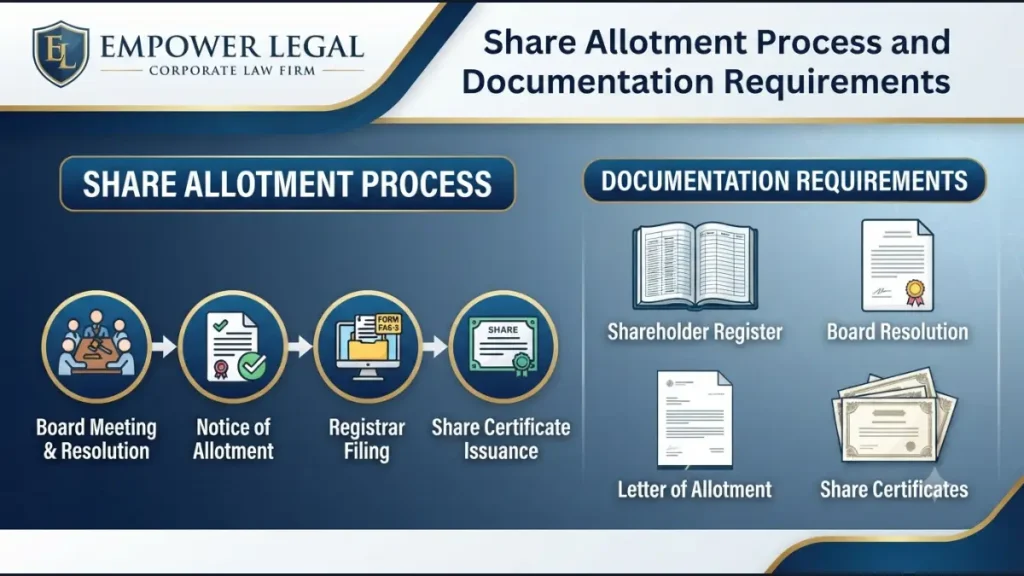
Share allotment creates legal ownership rights in a company’s issued share capital. Therefore, every allotment requires careful statutory planning, documentation, approval, and filing. Indian companies primarily follow the Companies Act, 2013 and applicable rules for allotment procedures. Listed companies must additionally follow applicable SEBI regulations and stock exchange requirements. Further, foreign investment may trigger FEMA and RBI reporting obligations. The process begins with verifying authorised capital, investor eligibility, issue terms, and corporate approvals. Next, the company receives subscription money through permitted banking channels. The Board then approves the allotment after satisfying applicable conditions. Finally, the company records the allotment and completes statutory filings. Proper documentation protects directors, shareholders, investors, and the company itself. Empower Legal assists businesses with share allotment compliance, corporate documentation, MCA filings, and dispute prevention. Our corporate lawyers can also address defective allotments, shareholder disputes, and regulatory proceedings. Consequently, systematic legal support reduces avoidable corporate compliance risks.
Legal Framework Governing Share Allotment in India
Companies Act Requirements for Share Allotment
The Companies Act, 2013 provides the principal legal framework for issuing and allotting company securities. Additionally, Section 117 may require filing of specified resolutions and agreements. Companies must also examine their articles before approving an issue. Moreover, shareholders may possess pre-emptive or contractual rights affecting proposed allotments. Listed entities must separately examine SEBI regulations and stock exchange obligations. Therefore, legal review should occur before accepting subscription money. This approach helps prevent defective corporate approvals, invalid allotments, and regulatory exposure.
Pre-Allotment Corporate Checks
A company should complete several internal checks before approving any share allotment. First, the authorised share capital must support the proposed issue. Next, the company should verify its existing issued and paid-up capital. The articles of association should permit the proposed issue structure. Directors should also review previous allotments and pending statutory filings. Furthermore, the company should verify shareholder agreements, investment agreements, and reserved matters. A practical pre-allotment review should include:
- authorised capital availability;
- investor identity and eligibility;
- issue price and valuation;
- payment route and subscription records;
- required Board and shareholder approvals;
- applicable MCA forms and deadlines.
The company should also confirm whether the transaction constitutes rights issue, private placement, preferential issue, bonus issue, or another route. Each route carries different legal conditions and documentation. Therefore, companies should not treat every investment round as an identical allotment exercise. Proper classification reduces compliance mistakes and later shareholder disputes.
Board Approval and Authorised Capital
The Board should examine the proposed allotment within the company’s constitutional and statutory powers. Directors should review the proposed number, class, face value, premium, investor identity, and consideration. They should also verify whether a previous shareholder approval remains effective. If authorised capital requires enhancement, the company should complete the necessary corporate procedure first. Similarly, the memorandum and articles should support the intended share structure. The Board resolution should clearly identify the securities and proposed allottees. It should also authorise designated officers to complete statutory filings and records. Where required, directors should approve notices for general meetings and explanatory statements. In addition, the resolution should record compliance with applicable valuation and pricing requirements. Proper minutes create an important corporate evidence trail. They can demonstrate that directors considered relevant documents before exercising their powers. Consequently, detailed Board documentation can reduce disputes concerning unauthorised allotment or misuse of corporate powers.
Application Money and Investor Verification
Subscription money should reach the company through legally permitted payment channels. Private placement investors should comply with the payment requirements applicable to the chosen issue route. Companies should preserve bank statements, transaction references, application forms, and investor correspondence. Investor verification should also cover identification documents and beneficial ownership information. The company should verify the subscriber’s legal name and registered address carefully. Additionally, companies should reconcile every payment against the corresponding application. A useful internal reconciliation process includes:
- Match the investor with the application.
- Verify the payment source and transaction reference.
- Confirm the amount against approved issue terms.
- Record the receipt date and proposed allotment.
- Preserve supporting documents within the corporate records.
These checks become particularly important during private placement and foreign investment transactions. Consequently, finance teams should coordinate closely with company secretaries and corporate lawyers. Proper reconciliation prevents incorrect allotment, duplicate credit, and unexplained subscription balances.
Special Resolution and Private Placement Approval
Private placement requires careful compliance with Section 42 and applicable rules. The company must identify eligible subscribers through the prescribed corporate process. The private placement offer should follow the statutory format and communication restrictions. The company should also maintain the required record of private placement offers. Subscription money should come through permitted banking channels rather than prohibited cash arrangements. Furthermore, the company should observe the statutory allotment period after receiving application money. If the company cannot allot within the prescribed period, refund consequences may arise. Directors should therefore monitor the deadline from the actual receipt date. The offer letter, application form, Board approval, shareholder resolution, valuation material, and payment evidence should remain connected. Moreover, the company should avoid public advertisements for a private placement. Non-compliance can expose the company and officers to statutory consequences. Hence, professional review becomes important before launching any private placement.
Preferential Allotment and Valuation Requirements
Preferential allotment involves issuing securities to identified persons on preferential terms. Companies must examine Section 62, Section 42, applicable rules, and the company’s articles. Unlisted companies may require valuation support from an eligible registered valuer, depending on the transaction. Listed companies must also examine the applicable SEBI framework and pricing requirements. The valuation should correspond with the securities and transaction structure. Directors should understand the commercial basis supporting the issue price. Additionally, the explanatory statement should provide legally required information to shareholders. The company should document the identity of proposed allottees and the purpose of the issue. Where consideration differs from cash, additional documentation may become necessary. Therefore, valuation, pricing, and disclosure documents should remain consistent. Any unexplained pricing difference can create allegations concerning preferential treatment or shareholder prejudice. Proper valuation evidence can therefore become important in future regulatory or NCLT proceedings.
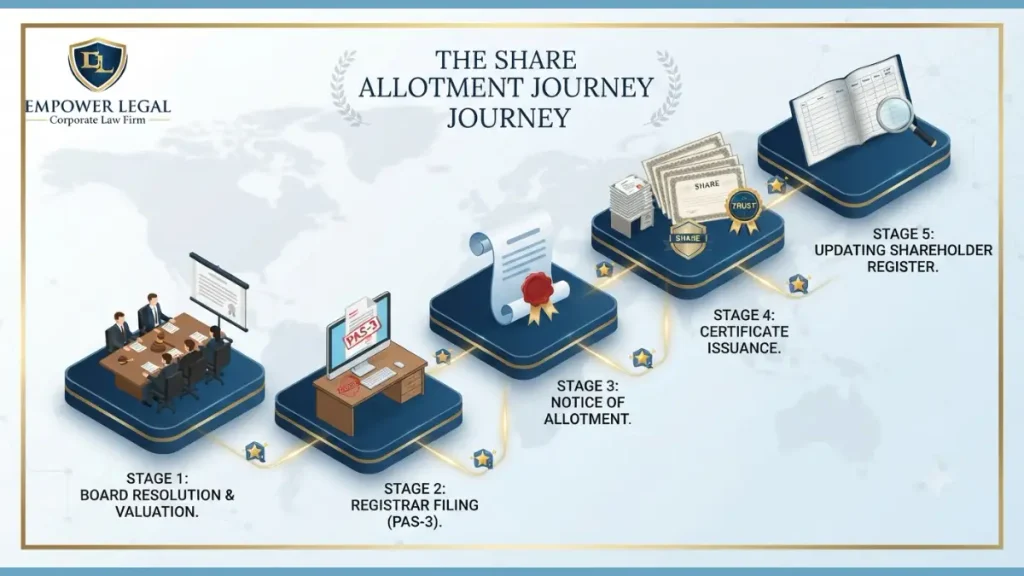
Post-Allotment Compliance and Documentation
Board Approval and Allotment Resolution
The final allotment should occur through a properly convened Board meeting or authorised mechanism. Directors should verify that all pre-allotment conditions have been satisfied before approving the allotment. The Board should review subscription money, investor applications, valuation reports, approvals, and supporting documents. The allotment resolution should identify each allottee and the securities allotted. It should also specify the number, class, face value, premium, and amount paid. Where appropriate, the resolution should authorise filing of PAS-3 and updating statutory registers. The company should preserve attendance records, agenda papers, minutes, and voting details. Additionally, directors should ensure that no allotment exceeds the approved issue terms. Any discrepancy should receive legal review before registration. Proper Board records create strong evidence concerning the company’s decision-making process. They also support subsequent MCA filings and investor documentation. Therefore, companies should treat the allotment meeting as a substantive compliance step. It should not become merely an administrative formality.
Return of Allotment and MCA Filing
The return of allotment is a central post-allotment compliance requirement. Companies generally file Form PAS-3 with the Registrar of Companies after allotment. The MCA instruction material links PAS-3 to Sections 39(4) and 42(9). Rule 12 of the Companies Prospectus and Allotment of Securities Rules prescribes the filing framework. The return should contain required particulars of the securities and allottees. Private placement filings also require prescribed information concerning security holders. Companies should verify the form before submitting it electronically through the MCA system. Supporting documents should match the Board resolution and underlying transaction. Common filing documents may include:
- Board resolution approving allotment;
- list of allottees;
- valuation documentation;
- special resolution where applicable;
- private placement records;
- payment evidence and supporting schedules.
Errors in PAS-3 can create avoidable regulatory complications. Accordingly, companies should reconcile every field against approved corporate records.
Share Certificates and Dematerialisation
After allotment, the company should complete the applicable evidence of ownership. Physical share certificates must follow the Companies Act and relevant rules. The certificate should accurately identify the company, shareholder, security class, and number of shares. Listed companies and other entities using dematerialised securities must follow depository procedures. Companies should coordinate with the relevant depository participant, registrar, or transfer agent. The allotment records should correspond with the demat credit instructions. Any mismatch may cause investor complaints or reconciliation problems. Furthermore, certificate issuance should follow the prescribed statutory timeline and authentication requirements. Companies should preserve counterfoils, dispatch records, and electronic confirmations where applicable. Directors should avoid issuing certificates before completing the necessary allotment process. A clean ownership trail strengthens the shareholder’s evidence of title. It also assists during later transfers, pledges, corporate actions, audits, and litigation. Therefore, post-allotment ownership documentation deserves the same attention as initial approvals.
Register of Members and Beneficial Ownership
Section 88 requires companies to maintain statutory registers concerning members and security holders. After allotment, the company should update the register using accurate investor information. The register should distinguish different classes of securities where applicable. Beneficial ownership requirements may also arise under Section 89 and related provisions. Companies should therefore identify situations where registered ownership differs from beneficial interest. Additionally, significant beneficial ownership requirements may require separate assessment under Section 90. The records should correspond with MCA filings and depository information. Any mismatch can create uncertainty regarding voting rights and dividend entitlement. A useful reconciliation should compare:
- Board-approved allotment details.
- PAS-3 information.
- Register of members.
- Demat or depository records.
- Beneficial ownership declarations.
Consistent records support corporate governance and shareholder transparency. They also help lawyers establish the ownership history during disputes. Therefore, statutory registers should receive regular review rather than annual attention only.
Documentation Checklist for Share Allotment
A complete allotment file should contain documents proving the transaction’s commercial and legal foundation. The exact checklist depends on the issue method and company status. However, most companies should maintain a structured transaction folder. Important documents commonly include the investment agreement, application form, Board papers, shareholder approvals, valuation report, and payment evidence. The file should also include applicable MCA forms and supporting attachments. Foreign investment transactions require additional FEMA and RBI records. Listed companies may require stock exchange communications and SEBI-related documentation. A practical checklist includes:
- constitutional documents;
- Board and shareholder resolutions;
- investor identification records;
- valuation and pricing evidence;
- subscription bank statements;
- PAS-3 filing acknowledgement;
- updated statutory registers;
- share certificates or demat confirmations.
The company should preserve versions of signed documents securely. Electronic records should remain accessible for audits and regulatory inspections. Proper document management also helps lawyers respond quickly to shareholder challenges.
Private Placement and Issue-Specific Compliance
Private placement transactions require a transaction-specific compliance map before funds arrive. Section 42 restricts the method and manner of offering securities. The company should identify eligible persons and maintain prescribed records. The offer should remain limited to the legally permitted group. Moreover, the company should avoid conduct that could convert the transaction into an apparent public offer. Subscription money should follow the statutory payment mechanism. The company should monitor the allotment deadline from receipt of application money. If the company fails to allot within the prescribed period, refund obligations can arise. The company should then complete PAS-3 and other applicable records. Additionally, the Board should confirm that no earlier private placement remains incomplete. Corporate lawyers should review the offer letter before circulation. They should also examine the explanatory statement and valuation documents. Consequently, private placement compliance should operate as a controlled workflow. This method reduces risks involving improper solicitation, delayed allotment, and defective filings.
FEMA Compliance for Foreign Investors
Foreign investors can create additional regulatory obligations during share allotment. The company should determine whether the transaction qualifies as foreign direct investment. Sectoral caps, entry routes, pricing rules, and prohibited sectors may require examination. The company should also identify the investor’s residential status under FEMA. RBI reporting requirements may apply after receiving consideration and issuing equity instruments. FC-GPR reporting commonly becomes relevant for eligible foreign investment equity issues. The company should coordinate with its authorised dealer bank for applicable reporting. Foreign investment records should include remittance evidence, valuation documents, investor declarations, and corporate approvals. Additionally, the company should maintain records supporting the issue price. A foreign investment checklist should cover:
- investor residency and category;
- sector and foreign investment cap;
- entry route;
- pricing compliance;
- banking documentation;
- RBI reporting;
- beneficial ownership information.
Failure to complete FEMA reporting can create regulatory exposure. Therefore, cross-border allotments should receive specialist legal and regulatory review before completion.
Listed Company and SEBI Compliance
Listed companies operate under an additional securities market regulatory framework. The SEBI ICDR Regulations can govern capital raising and preferential issues. LODR requirements may also apply to disclosures, governance, and shareholder communications. Stock exchange obligations should therefore form part of the allotment timetable. The company may need prior approvals, disclosures, certificates, or exchange filings. Pricing requirements can also differ according to the issue method. Additionally, listed companies should coordinate with their registrar and transfer agent. The company must reconcile allotment data with depository records. Public disclosures should remain accurate and timely. Any delay can create market disclosure concerns and regulatory scrutiny. Companies should therefore prepare an issue-specific compliance matrix before allotment. That matrix should identify each action, responsible person, statutory source, and deadline. Legal counsel can review the matrix before submission. Consequently, listed-company allotments require coordinated legal, secretarial, financial, and securities compliance.
Rights Issues, ESOPs, and Other Share Issues
Not every share allotment follows private placement or preferential issue procedures. Rights issues, employee stock options, sweat equity, bonus shares, and conversion-based allotments have distinct legal requirements. Section 62 provides the principal framework for further issue of share capital. The applicable rules may impose additional conditions concerning employee schemes and preferential offers. Companies should therefore classify the proposed allotment before preparing documents. A rights issue requires careful attention to offer terms and shareholder entitlements. ESOP-related allotments require scheme documentation and statutory register maintenance. Conversion-based allotments require review of the underlying instrument and conversion terms. Similarly, bonus allotments require adequate reserves and compliance with applicable statutory conditions. The Board should not use a generic allotment resolution for every transaction. Instead, the resolution should reflect the particular issue mechanism. Proper classification helps prevent incorrect forms and incomplete approvals. It also improves the company’s ability to defend its allotment decisions.
Shareholder Disputes and Legal Remedies
Common Share Allotment Legal Issues
Share allotment disputes can arise when investors or existing shareholders challenge the company’s process. Common allegations include unauthorised allotment, defective valuation, improper dilution, forged applications, and misleading disclosures. Existing shareholders may also allege unfair exclusion from rights or preferential treatment. Directors can face scrutiny where allotments allegedly advance personal interests. Disputes may also arise from breach of shareholder agreements or investment contracts. A company should immediately preserve Board minutes, emails, applications, payment records, and statutory filings. Lawyers should then identify whether the dispute concerns corporate law, contract law, securities regulation, or criminal conduct. Potential remedies depend upon the facts and forum. They may include:
- legal notice and negotiated settlement;
- rectification or correction of records;
- NCLT proceedings;
- civil proceedings where legally maintainable;
- regulatory complaints;
- criminal complaints for suspected fraud.
Early evidence preservation can significantly improve the legal response. Therefore, companies should avoid altering disputed records after receiving a legal complaint.
NCLT Remedies and Oppression Claims
The National Company Law Tribunal handles several company law disputes under the Companies Act. The NCLT Chennai Bench exercises jurisdiction over Tamil Nadu and Puducherry. Shareholders may approach the Tribunal in circumstances covered by statutory remedies. Oppression and mismanagement proceedings can become relevant where conduct affects eligible members. Applications may seek protective orders, governance directions, or other statutory relief. The Tribunal’s jurisdiction depends on the precise statutory provision and applicant eligibility. Therefore, legal counsel should examine maintainability before filing proceedings. Corporate records often become central evidence in these matters. Relevant documents may include minutes, share registers, allotment returns, valuation reports, and correspondence. A shareholder should also preserve evidence showing prejudice or procedural irregularity. Companies should prepare a complete factual chronology before responding. This helps counsel distinguish genuine compliance issues from contractual disagreements. Accordingly, NCLT strategy should combine statutory analysis, documentary evidence, and procedural planning.
Civil Proceedings and CPC Considerations
Some allotment disputes may involve contractual, declaratory, recovery, or injunctive claims. The Code of Civil Procedure, 1908 may govern civil proceedings where the civil court retains jurisdiction. However, statutory company law remedies and jurisdictional exclusions require careful examination. Counsel should identify the precise cause of action before choosing a forum. A contractual dispute may involve an investment agreement or shareholder agreement. A corporate dispute may instead fall within NCLT jurisdiction. Therefore, parties should avoid filing parallel proceedings without understanding jurisdictional consequences. Civil remedies can potentially include declarations, injunctions, recovery, damages, or other relief where legally available. The documents should establish the contractual relationship and alleged breach. Courts may also consider documentary evidence concerning corporate approvals and transactions. Consequently, the pleadings should identify the allotment event and resulting legal injury clearly. Proper forum selection can prevent unnecessary procedural delays and conflicting litigation strategies.
Criminal Complaints for Fraudulent Allotment
Fraudulent share allotment may involve conduct beyond ordinary corporate non-compliance. Examples can include forged documents, dishonest inducement, misappropriation, or manipulation of electronic records. Such allegations require careful factual assessment before approaching law enforcement. Companies should preserve original records and electronic evidence. Emails, digital signatures, payment trails, Board documents, and filing acknowledgements can become relevant. The jurisdictional police station should depend on the facts and applicable territorial rules. Serious financial fraud may also require consideration of specialised investigation mechanisms. However, a corporate dispute should not automatically become a criminal complaint. Lawyers should first identify evidence supporting the alleged criminal elements. A complaint should clearly describe the transaction, conduct, documents, loss, and suspected persons. Therefore, legal advice should precede allegations against directors, officers, or investors. Properly documented complaints can help investigators understand complex corporate transactions.
BNS, BNSS and BSA in Corporate Fraud
The Bharatiya Nyaya Sanhita, 2023 now provides the principal substantive criminal law framework. Forgery provisions can become relevant when false documents or electronic records support an alleged corporate fraud. The Bharatiya Nagarik Suraksha Sanhita, 2023 governs criminal procedure and investigation processes. The Bharatiya Sakshya Adhiniyam, 2023 governs evidence in applicable proceedings. Consequently, lawyers handling fraudulent allotment should examine these enactments alongside company law. Electronic evidence may include emails, digital signatures, accounting records, and MCA filing data. Investigators may also examine bank transactions and communications between parties. The legal assessment should distinguish genuine corporate mistakes from intentional criminal conduct. Section-specific applicability depends on the facts and evidence. Therefore, allegations should avoid assumptions unsupported by documentary material. Companies should preserve electronic evidence without unnecessary alteration. Proper evidence handling can support both regulatory and criminal proceedings. This integrated approach improves coordination between corporate and criminal legal strategies.
Chennai Forums, Police Stations, and Jurisdictional Support
Chennai-based companies may encounter several forums during allotment disputes. The NCLT Chennai Bench exercises company-law jurisdiction over Tamil Nadu and Puducherry. The Registrar of Companies, Chennai handles applicable MCA corporate filings and regulatory matters. SEBI and stock exchanges may become relevant for listed-company issues. RBI and authorised dealer banks may become relevant for foreign investment reporting. Criminal allegations should generally be addressed through the jurisdictionally appropriate police authority. The specific police station depends upon the registered office, transaction location, and applicable territorial rules. Therefore, companies should verify the correct station before filing a complaint. Chennai businesses should maintain a jurisdiction map containing:
- registered office location;
- RoC jurisdiction;
- NCLT Chennai jurisdiction;
- applicable police jurisdiction;
- stock exchange or SEBI contact point;
- authorised dealer bank details.
Legal counsel can coordinate proceedings across these forums. This prevents fragmented responses and inconsistent factual submissions.
Police Complaint and Evidence Preservation
A suspected fraudulent allotment requires immediate preservation of corporate and electronic evidence. Companies should secure Board minutes, registers, application forms, bank records, emails, and MCA filings. They should also preserve relevant digital signatures and access logs. A legal team can prepare a chronological evidence index before approaching authorities. The complaint should identify the transaction and explain the suspected unlawful conduct. It should distinguish documentary facts from assumptions or disputed interpretations. The jurisdictional police station should be selected after reviewing the relevant facts. Where specialised economic or cyber investigation mechanisms apply, counsel can assess appropriate escalation. Companies should also consider internal preservation notices for employees and service providers. Furthermore, investigators may request original documents or electronic records. Therefore, companies should maintain reliable copies and an evidence chain. Prompt preservation reduces the risk of accidental deletion or later authenticity disputes.
Available Legal Remedies and Corporate Relief
Legal remedies depend upon the nature, seriousness, and forum involved in the allotment dispute. A company or shareholder may pursue several lawful options after assessing the facts. Negotiated settlement can resolve documentation defects without prolonged proceedings. A legal notice may demand corrective action, repayment, rectification, or compliance. NCLT proceedings may provide statutory corporate remedies where jurisdiction and eligibility exist. Civil proceedings may apply to maintainable contractual or declaratory claims. Regulatory complaints may address securities or corporate compliance breaches. Criminal complaints may apply where evidence indicates cognizable criminal conduct. A practical remedies framework includes:
- Preserve documents and electronic evidence.
- Conduct a statutory compliance review.
- Identify the correct legal forum.
- Issue a focused legal notice where appropriate.
- Seek interim or final relief according to law.
- Complete corrective corporate filings when legally permissible.
The correct remedy depends upon transaction documents and applicable law. Therefore, legal strategy should follow evidence rather than assumptions.
Corporate Legal Support from Empower Legal
Empower Legal provides corporate legal support for companies managing share allotment transactions and disputes. Our lawyers can review proposed issue structures before the company receives subscription money. We can examine constitutional documents, shareholder agreements, valuation reports, and investor documentation. Our team can also assist with Board resolutions and shareholder approvals. Further, we can coordinate documentation for private placement and preferential allotment transactions. MCA filing support can include preparation and review of PAS-3 and related records. Foreign investment transactions may require coordination with FEMA advisors and authorised dealer banks. Listed companies may require additional SEBI and stock exchange compliance support. Where disputes arise, corporate lawyers can assess NCLT, civil, regulatory, or criminal remedies. Our legal support can cover:
- transaction structuring;
- corporate approvals;
- allotment documentation;
- MCA compliance;
- shareholder dispute management;
- NCLT proceedings;
- regulatory representation;
- corporate fraud response.
A disciplined legal process protects the company while supporting transparent shareholder relations. Therefore, early legal review can reduce both compliance costs and litigation exposure.
Frequently Asked Questions
What is the share allotment process in India?
The process generally includes issue approval, investor application, receipt of consideration, Board allotment, statutory records, and prescribed MCA filings. The exact steps depend on the issue type.
What is PAS-3 in share allotment?
PAS-3 is the MCA return of allotment filed with the Registrar after securities are allotted. It records prescribed details about the securities and allottees.
How long does a private placement allotment take?
Section 42 generally requires securities offered through private placement to be allotted within sixty days from receiving application money, subject to applicable law.
Is valuation required for share allotment?
Valuation requirements depend on the issue type, company status, consideration, and applicable law. Preferential and foreign investment transactions often require careful valuation review.
Can shareholders challenge an illegal allotment?
Yes, eligible shareholders may have statutory remedies before the NCLT in appropriate cases. Contractual, civil, regulatory, or criminal remedies may also arise.
Which forum handles company allotment disputes in Chennai?
The NCLT Chennai Bench handles applicable company-law matters for Tamil Nadu and Puducherry. Other disputes may involve the RoC, SEBI, RBI, civil courts, or police authorities.
Legal Disclaimer: This article provides general legal information and does not constitute case-specific legal advice. Share allotment requirements can vary according to the company structure, issue method, investor status, transaction documents, and applicable regulatory framework. Professional review should precede a transaction involving substantial capital, foreign investment, listed securities, or shareholder disputes.