

Introduction to Foreign Direct Investment in Indian Companies
However, FDI involves more than transferring money into an Indian company. Investors must examine sectoral caps, entry routes, pricing rules, ownership restrictions, and reporting duties. Therefore, every proposed investment requires coordinated corporate and foreign exchange compliance. India regulates FDI primarily through FEMA, DPIIT policy, RBI regulations, and the Companies Act. Additionally, sector-specific regulators may impose separate licensing or ownership requirements. Recent policy developments also require careful beneficial ownership analysis for certain foreign investors. Consequently, businesses should complete legal due diligence before accepting foreign capital. Empower Legal assists companies with FDI structuring, documentation, approvals, reporting, and dispute management. The firm can also coordinate with regulatory authorities and professional advisers. This guide explains the major FDI rules, procedures, risks, forums, and remedies.
Understanding the Indian FDI Regulatory Framework
FEMA, DPIIT and RBI: The Core Regulatory Structure
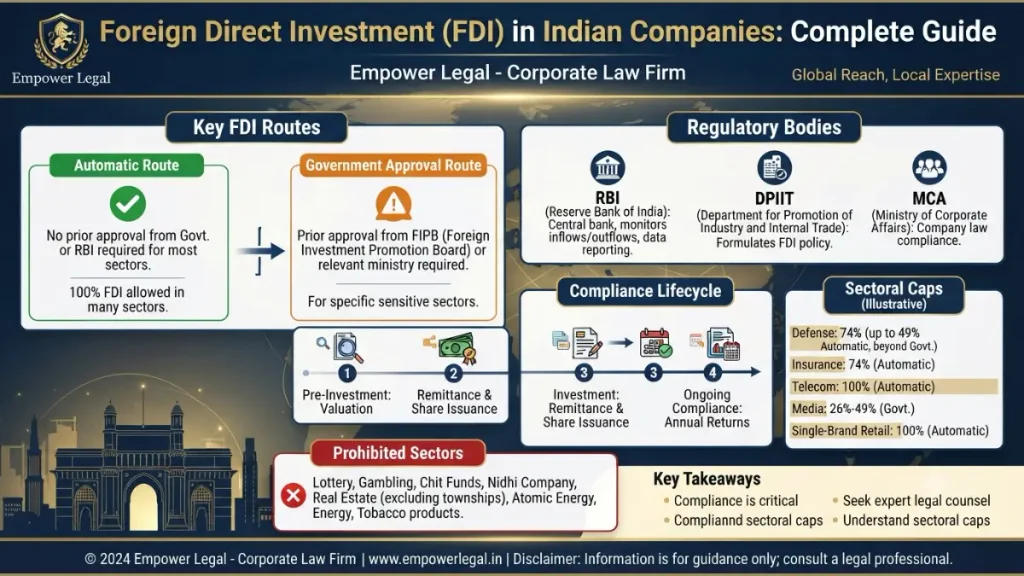
India’s FDI framework operates through several interconnected regulatory institutions and laws. FEMA provides the statutory foundation for foreign exchange transactions involving non-residents. The Central Government frames relevant rules under FEMA, including the Non-Debt Instruments Rules. RBI administers foreign investment regulations and issues operational directions to authorised dealer banks. Meanwhile, DPIIT formulates and periodically reviews India’s FDI policy. The policy determines prohibited sectors, sectoral caps, entry routes, and investment conditions.The transaction must satisfy foreign exchange, corporate, sectoral, and regulatory requirements together. Businesses should also check the latest policy notification before closing any transaction. This approach reduces compliance gaps and prevents avoidable regulatory disputes. Accordingly, professional FDI legal advice should begin with identifying every applicable regulatory layer.
Automatic Route and Government Route
The entry route determines whether prior Government approval becomes necessary for foreign investment. Under the automatic route, eligible investments generally proceed without obtaining prior Government approval. However, automatic entry does not eliminate FEMA reporting or corporate compliance duties. Sectoral conditions, ownership rules, pricing requirements, and licensing conditions can still apply. Under the Government route, the investor must obtain approval before completing the relevant investment. The approval process can involve DPIIT and the concerned administrative ministry or department. Businesses should therefore identify the applicable route before negotiating definitive transaction documents. A term sheet should also preserve conditions precedent for required regulatory approvals. Moreover, the transaction structure should avoid creating an obligation to close prematurely. Legal counsel should verify the applicable policy immediately before execution and funding.
Sectoral Caps and Prohibited Activities
Sectoral caps establish the maximum foreign investment permitted within particular Indian business activities. Some sectors permit substantial or complete foreign ownership under specified conditions. Other sectors retain lower caps or require Government approval. Certain activities remain prohibited for foreign investment under the prevailing policy framework. Therefore, companies must identify the precise business activity before calculating permissible foreign ownership. A broad industry description may produce an incorrect FDI classification. The legal review should examine the company’s actual revenue-generating activities and licenses. It should also consider downstream investments and indirect foreign ownership. Consequently, a compliance checklist should include the following items:
- Business activity classification and applicable sectoral cap.
- Automatic or Government entry route.
- FDI-linked performance conditions.
- Licensing and regulatory permissions.
- Direct and indirect foreign investment calculations.
Beneficial Ownership and Land-Border Restrictions
Beneficial ownership has become particularly important under India’s updated FDI framework. DPIIT’s 2026 policy update addresses investments involving countries sharing a land border with India. The amended policy also addresses beneficial ownership changes occurring through direct or indirect transfers. Certain investors connected with such countries may therefore require Government approval. The analysis must examine the ultimate beneficial ownership of the investing entity. A simple incorporation location may not provide sufficient compliance certainty. Furthermore, subsequent ownership changes can create fresh approval requirements. They should preserve constitutional documents, ownership charts, declarations, and supporting identification records. Legal counsel should also review changes proposed after the initial investment. This preventive process can reduce regulatory uncertainty during future funding rounds.
Government Approval and Administrative Ministries
Government-route FDI requires careful preparation because approval depends upon transaction-specific regulatory facts. The investor and Indian company should first determine the responsible administrative ministry. Different sectors may fall under different ministries or regulatory departments. For example, banking and pharmaceuticals can involve specialised administrative authorities. Security-sensitive transactions may also require additional governmental scrutiny. The application should accurately describe ownership, control, funding sources, business activities, and proposed investment. Incomplete disclosures can create delays or requests for additional information. Therefore, transaction documents should remain consistent with the information submitted for approval. Counsel should also monitor policy amendments during the approval period. Approval conditions should become contractual compliance obligations after closing. This creates a practical bridge between Government approval and ongoing corporate governance.
Foreign Investment Facilitation and Application Preparation
The Foreign Investment Facilitation framework provides an institutional pathway for Government-route investment proposals. Applicants should prepare transaction documents before submitting regulatory applications. Important materials may include incorporation records, ownership charts, financial information, investment agreements, and board approvals. The application should clearly explain the proposed investment structure and business purpose. Additionally, beneficial ownership disclosures should remain consistent across all submitted documents. Regulatory authorities may examine the source and structure of foreign investment. Therefore, unexplained intermediary entities can create unnecessary compliance concerns. Applicants should maintain a document trail showing commercial rationale and ownership relationships. Counsel can also prepare responses to regulatory queries during processing. After approval, companies must still complete applicable FEMA and Companies Act filings. Government approval therefore represents one stage rather than the entire compliance process.
Investment Instruments, Valuation and Transaction Documentation
Equity Instruments and Permitted Investment Structures
FDI commonly enters an Indian company through equity shares or permitted equity-linked instruments. The appropriate instrument depends upon the investor’s commercial objectives and applicable FEMA rules. Start-ups can also consider permitted convertible note structures where eligibility requirements are satisfied. However, the instrument must comply with sectoral, pricing, reporting, and corporate law conditions. The Companies Act also regulates issue procedures, shareholder approvals, and allotment documentation. Consequently, transaction lawyers should coordinate corporate and FEMA requirements from the beginning. Investment agreements should define funding milestones, representations, warranties, and regulatory conditions. They should also address consequences if required approvals or filings remain incomplete. Clear drafting can reduce disputes between founders, investors, and management. Furthermore, the documents should allocate responsibility for regulatory filings after closing. This structure supports better compliance and creates evidence if disputes later arise.
Valuation, Pricing and Fair Transaction Structuring
Pricing rules protect regulatory compliance when residents and non-residents transfer Indian securities. Transactions should therefore use appropriate valuation methods and supporting professional certificates. Depending upon the transaction, valuation may involve a Chartered Accountant, practising Cost Accountant, or SEBI-registered Merchant Banker. Listed-company transactions can also involve SEBI-prescribed pricing mechanisms. The valuation document should match the transaction structure and relevant regulatory requirements. Additionally, parties should maintain evidence supporting the commercial basis for the agreed price. Undervaluation or overvaluation can create FEMA, tax, and shareholder concerns. Therefore, independent valuation should occur before signing binding transaction documents. Counsel should also check whether special rules apply to deferred consideration or optionality arrangements. Proper pricing analysis reduces the risk of future regulatory objections. It also strengthens the company’s defence during audits, investigations, or shareholder disputes.
Mode of Payment and Authorised Dealer Banking Channels
Foreign investment consideration generally requires compliant payment through permitted banking channels. Authorised Dealer Category-I banks play an important role in processing foreign exchange transactions. Companies should coordinate payment instructions with the authorised dealer before receiving funds. The transaction should also maintain a clear audit trail for every remittance. Bank statements, remittance confirmations, investment agreements, and allotment records should remain consistent. Moreover, the company should avoid accepting foreign funds without confirming the regulatory basis. Improperly received funds can create reconciliation and reporting difficulties. Therefore, finance teams should involve legal and compliance professionals before receiving subscription money. The company should also document currency, conversion, investor identity, and transaction purpose. This approach simplifies later FC-GPR, FLA, tax, and statutory reporting. It also supports evidence-based responses if RBI or another authority requests clarification.
Share Transfers, Exits and Foreign Investor Repatriation
Foreign investors frequently require contractual exit mechanisms when investing in Indian companies. Exits can occur through share transfers, buybacks, strategic sales, or other permitted mechanisms. Each structure requires separate analysis under FEMA and corporate law. Pricing rules can apply when securities move between residents and non-residents. Listed-company exits can also trigger SEBI takeover and securities regulations. Tax obligations may arise before sale proceeds leave India. Therefore, the authorised dealer should receive appropriate documents before permitting repatriation. Shareholders’ agreements should clearly define permitted transfers and regulatory conditions. They should also address lock-ins, tag-along rights, drag-along rights, and dispute resolution. Proper planning prevents an exit clause from becoming legally unenforceable. Accordingly, FDI lawyers should review exit provisions during the initial investment stage.
FC-TRS Reporting and Transfer Compliance
FC-TRS reporting applies to specified transfers of equity instruments involving residents and non-residents. The reporting responsibility depends upon the transaction and parties involved. Companies should not assume that every foreign share transfer follows identical reporting rules. The authorised dealer bank normally assists with FEMA reporting and supporting documentation. Relevant records can include transfer agreements, valuation reports, tax documents, and share certificates. The parties should establish responsibility for each filing within the transaction documents. Late reporting can attract applicable late submission mechanisms under FEMA regulations. Therefore, closing checklists should include FC-TRS obligations wherever applicable. Counsel should also verify whether stock exchange or SEBI reporting applies. Proper reporting protects the investor’s repatriation rights and the company’s compliance position. It also creates a reliable record of the ownership transition.
Exit Pricing, Repatriation and Tax Considerations
Foreign investors should assess tax and FEMA implications before completing an exit. Sale proceeds may require deduction of applicable Indian taxes before repatriation. Pricing compliance also affects the ability to remit proceeds through authorised banking channels. Therefore, legal teams should coordinate with tax advisers before executing the transfer. The transaction documents should allocate responsibility for taxes, filings, and regulatory certificates. Parties should also verify whether withholding obligations apply to the specific transaction. Indirect transfers can create additional Indian tax reporting considerations. Consequently, cross-border exits require coordinated corporate, FEMA, securities, and tax analysis. An investor should retain the complete transaction record after receiving sale proceeds. This record can support future regulatory queries, tax assessments, or shareholder claims. Proper exit planning therefore begins well before the actual transfer date.
Corporate Governance, Reporting and Transaction Compliance
Companies Act Compliance for Foreign Investment
The Companies Act provides the corporate-law foundation for issuing and transferring securities. An Indian company receiving FDI must complete applicable board and shareholder approvals. Private placements require compliance with statutory procedures, disclosures, and allotment requirements. The company must also maintain registers and statutory records reflecting foreign ownership. Relevant filings can include PAS-3, MGT-14, annual returns, and financial statements. The exact filing requirements depend upon the transaction structure and company status. Therefore, FEMA compliance should never replace Companies Act compliance. Corporate secretarial teams should reconcile statutory registers with RBI reporting information. Any mismatch can create problems during audits, financing rounds, or regulatory inspections. Empower Legal can assist companies with transaction documentation and continuing corporate compliance. Early reconciliation remains one of the simplest ways to reduce regulatory risk.
Share Allotment, Private Placement and Corporate Approvals
Foreign investors subscribing to new shares require proper corporate authorization and allotment procedures. The board should approve the proposed issue in accordance with applicable law. Shareholder approval may also become necessary depending upon the issue structure. Private placement transactions require careful compliance with statutory procedures and prescribed documentation. The company should complete allotment within the applicable statutory period. It must also file the appropriate return of allotment with the Registrar. Consequently, corporate secretarial records should be prepared alongside the investment agreement. The following sequence provides a practical compliance workflow:
- Confirm FDI eligibility and entry route.
- Approve the investment structure.
- Complete valuation and transaction documentation.
- Receive consideration through permitted channels.
- Complete allotment and statutory reporting.
- Complete RBI reporting and ownership records.
Annual Returns, Registers and Foreign Ownership Records
Foreign ownership should remain accurately reflected in the company’s statutory registers. The annual return must disclose prescribed shareholding and corporate information. Companies should reconcile their register of members with FEMA records and financial statements. Any difference can indicate an incomplete transfer, reporting error, or corporate filing issue. Directors should also monitor changes in beneficial ownership and control. Significant ownership changes may affect sectoral caps or downstream investment calculations. Therefore, annual compliance should include a dedicated foreign investment reconciliation exercise. Companies should preserve board minutes, shareholder resolutions, valuation reports, and regulatory acknowledgements. Digital records should remain accessible throughout the statutory retention period. This documentation becomes valuable during due diligence, audits, disputes, and future fundraising. A disciplined records policy therefore supports both compliance and corporate governance.
FC-GPR, FLA and Other RBI Reporting Duties
RBI reporting forms a critical part of the FDI compliance lifecycle. An Indian company issuing qualifying equity instruments to a non-resident generally reports through FC-GPR. The prescribed reporting timeline is generally thirty days from issue. RBI’s current regulations prescribe July 15 as the FLA filing date. Transfer transactions can require FC-TRS reporting depending upon the parties and transaction structure. Downstream investments can create additional Form DI obligations. Therefore, the company should maintain a transaction-specific reporting calendar. Delayed filings can create late submission exposure and complicate future transactions. Compliance teams should coordinate with the authorised dealer bank for supporting documentation. This process reduces the risk of inconsistent information across regulatory systems.
Downstream Investment and Indirect Foreign Ownership
Ownership, Control and Downstream Investment Analysis
Downstream investment arises when qualifying foreign investment reaches another Indian entity indirectly. The rules apply an important principle against using indirect structures to bypass FDI restrictions. Therefore, companies must examine ownership and control at each relevant investment level. An Indian entity receiving indirect foreign investment can inherit applicable FDI conditions. These conditions may include entry routes, sectoral caps, pricing requirements, and performance conditions. Complex group structures require ownership mapping before the investment occurs. The analysis should identify voting rights, beneficial ownership, control rights, and investment vehicles. Additionally, the calculation should consider the prescribed fully diluted methodology. Counsel should prepare a group structure chart showing each relevant ownership layer. This chart can support regulatory filings and board-level decision-making. Proper downstream analysis prevents indirect investments from unintentionally breaching sectoral restrictions.
Sectoral Conditions and Indirect Investment Restrictions
Downstream investment must satisfy applicable foreign investment conditions when treated as indirect foreign investment. The investing Indian entity should verify the target’s sector before funding the transaction. It should also confirm whether performance-linked conditions attach to the activity. Some investment structures may therefore require additional regulatory analysis before closing. The board should record the basis for treating the transaction as compliant. Annual compliance should also monitor changes in the investor’s ownership or control. A later change can alter the foreign investment character of downstream holdings. Therefore, compliance cannot end on the date of the original investment. Companies should review their ownership structure during every major funding or restructuring event. Legal counsel can provide periodic FEMA compliance audits for groups with multiple subsidiaries. Such audits are especially useful for fast-growing companies and investment platforms.
Mergers, Acquisitions and Regulatory Dispute Management
CCI, SEBI and Corporate Transaction Approvals
Foreign acquisitions can trigger laws beyond FEMA and the Companies Act. Large combinations may require notification to the Competition Commission of India. The CCI examines applicable asset, turnover, and transaction-value thresholds. Certain transactions can also qualify for regulatory exemptions or ordinarily non-notifiable categories. Listed-company acquisitions may additionally trigger SEBI takeover regulations. Therefore, transaction counsel should conduct a regulatory mapping exercise before signing definitive agreements. The analysis should cover competition, securities, corporate, tax, foreign exchange, and sectoral regulations. Closing conditions should reflect all material regulatory approvals. Parties should also preserve alternative structures if a proposed route faces regulatory barriers. This approach can reduce renegotiation risks during long transaction timelines. Cross-border M&A therefore requires integrated legal planning rather than isolated FDI advice.
NCLT, NCLAT and Shareholder Dispute Remedies
Foreign investment disputes can involve shareholder rights, oppression, mismanagement, mergers, and insolvency issues. The National Company Law Tribunal handles several corporate disputes under the Companies Act. Its functions include oppression and mismanagement proceedings, mergers, reductions, and register rectification. NCLAT provides appellate jurisdiction over specified NCLT orders. Therefore, foreign investors should identify the correct corporate forum before filing proceedings. A shareholder agreement may also provide contractual arbitration for appropriate disputes. However, contractual arbitration does not automatically replace statutory tribunal jurisdiction. Lawyers should examine the precise relief sought and the legal source of that relief. Emergency measures may include injunction applications where legally available. Corporate records should be preserved immediately when a dispute becomes likely. Timely evidence preservation strengthens both tribunal proceedings and settlement negotiations.
Civil, Criminal and Regulatory Remedies for FDI Disputes
FDI disputes can involve contractual breaches, corporate misconduct, fraud, misrepresentation, or regulatory violations. Civil remedies may include injunctions, damages, specific contractual relief, declarations, or arbitration. Corporate remedies may involve NCLT proceedings where statutory requirements are satisfied. FEMA contraventions can lead to adjudication, penalties, and appellate proceedings under the statutory framework. Serious alleged criminal conduct can also require police or investigative agency involvement. The Bharatiya Nyaya Sanhita, BNSS, and BSA now form India’s principal criminal-law framework. They replaced the earlier IPC, CrPC, and Evidence Act framework from July 2024. The Code of Civil Procedure remains relevant to applicable civil proceedings. However, specialised statutes may determine jurisdiction instead of ordinary civil courts. Accordingly, counsel should select remedies based on the legal cause of action.
Police Complaints, Fraud and Evidence Preservation
Foreign investment disputes sometimes involve allegations of forged documents, cheating, criminal breach, or dishonest conduct. Companies should first distinguish commercial disagreement from conduct amounting to a criminal offence. A police complaint may become appropriate where facts disclose a cognisable offence. In Chennai, the appropriate jurisdiction depends upon the location and nature of the alleged offence. Depending upon circumstances, parties may approach the local police station or specialised economic or cybercrime authorities. The BNSS governs criminal procedure, while the BSA governs evidentiary principles. Companies should preserve emails, transaction records, bank statements, board minutes, and electronic communications. Digital evidence should retain reliable metadata and chain-of-custody documentation. Lawyers can also advise on civil injunctions alongside criminal complaints where legally appropriate. A coordinated strategy helps prevent contradictory proceedings and protects critical evidence.
FEMA Adjudication, Penalties and Appeals
FEMA creates a statutory process for investigating and adjudicating specified foreign exchange contraventions. An adjudicating authority can conduct proceedings after providing the affected person an opportunity to respond. Penalties may arise from contraventions established under the statute. The legislation also provides appellate mechanisms for eligible orders. Therefore, companies should respond carefully to regulatory notices instead of treating them as ordinary correspondence. A structured response should identify the transaction, explain the compliance position, and attach supporting records. Where a breach occurred, counsel can evaluate available regularisation or compounding mechanisms. The strategy should distinguish technical reporting delays from substantive violations. Companies should also assess whether voluntary corrective steps can reduce continuing exposure. Timely legal representation can protect procedural rights and improve regulatory clarity. FEMA proceedings should therefore receive specialist attention from experienced corporate counsel.
Chennai Forums, Authorities and Practical Legal Support
Companies operating in Chennai may encounter several regulatory and judicial forums during an FDI transaction. Relevant institutions can include the Registrar of Companies, RBI’s authorised dealer network, NCLT Chennai, NCLAT, SEBI, CCI, and sectoral regulators. Police involvement depends upon the factual nature and territorial jurisdiction of an alleged offence. Nearby police stations should not be selected solely because they are geographically convenient. The correct jurisdiction can depend upon where the offence, transaction, or relevant conduct occurred. Legal counsel can coordinate filings, notices, evidence, regulatory responses, and settlement discussions. Businesses should maintain a central compliance file containing all transaction records. That file should include approvals, agreements, valuation documents, remittance evidence, filings, and correspondence. Consequently, companies can respond faster when regulators, investors, or courts request information. Empower Legal can support corporate clients through transaction planning, compliance, disputes, and regulatory representation.
Practical FDI Compliance Strategy and Legal Support
FDI Due Diligence Before Investment
Foreign investors should complete legal due diligence before transferring investment funds. The review should verify the Indian company’s incorporation, ownership, contracts, licences, litigation, and regulatory history. Counsel should also review existing foreign investment and previous RBI filings. The company’s sector should be matched against the latest FDI policy classification. Beneficial ownership should be traced through every relevant corporate layer. Existing shareholder agreements should also be reviewed for consent or transfer restrictions. Tax exposure, intellectual property, employment obligations, and material disputes require parallel review. Therefore, FDI diligence should examine both the investor and the target company. A written red-flag report can identify issues requiring pre-closing correction. The investment agreement should then convert important findings into warranties and conditions. This process improves transparency and reduces post-closing disputes.
FDI Legal Compliance Checklist
A practical compliance checklist can help management coordinate the transaction efficiently. The checklist should cover legal, financial, corporate, regulatory, and operational requirements. Each responsible person should receive a clear deadline and evidence requirement. The following framework can assist companies:
- Identify investor nationality and beneficial ownership.
- Classify the Indian business activity.
- Confirm sectoral cap and entry route.
- Review Government approval requirements.
- Conduct valuation and pricing analysis.
- Prepare investment and shareholder agreements.
- Obtain corporate approvals.
- Receive permitted investment consideration.
- Complete share allotment requirements.
- File RBI and MCA forms.
- Update statutory registers.
- Monitor continuing FDI compliance.
This checklist should be customised for each transaction. Sector-specific rules can create additional approval and reporting requirements. Legal counsel should therefore validate every item before closing.
Common FDI Compliance Errors
Businesses frequently encounter avoidable errors because transaction teams focus only on funding documentation. One common mistake involves checking the sectoral cap after negotiations have already concluded. Another error involves receiving funds before completing required approvals or corporate authorisations. Companies may also submit inconsistent ownership information across RBI and MCA filings. Incorrect valuation documents can create additional pricing and tax complications. Delayed FC-GPR or FLA reporting can also create regulatory exposure. Downstream investments may be overlooked when calculating total foreign investment. Exit provisions can similarly ignore FEMA pricing or repatriation conditions. Therefore, compliance should begin during transaction structuring rather than after closing. An internal legal review should identify inconsistencies before regulatory submissions. This preventive approach usually costs less than correcting completed transactions.
Legal Support for Foreign Investors and Indian Companies
Professional legal support can simplify FDI transactions involving multiple regulators and documentation requirements. Empower Legal can assist with FDI eligibility analysis and transaction structuring. The firm can also review sectoral caps, Government approval requirements, and beneficial ownership concerns. Corporate support can cover board resolutions, shareholder approvals, agreements, allotment documentation, and statutory filings. FEMA support can include RBI reporting coordination and authorised dealer bank communication. Transaction counsel can also review valuation, pricing, transfer restrictions, and exit mechanisms. Where disputes arise, lawyers can evaluate arbitration, NCLT, NCLAT, civil, criminal, or regulatory remedies. The correct remedy depends upon the facts, statutory jurisdiction, and relief requested. Therefore, early legal intervention can prevent a compliance problem from becoming litigation. A coordinated legal strategy also helps investors maintain transaction certainty throughout the investment lifecycle.
FDI Risk Management and Continuing Compliance
FDI compliance continues after the investor receives shares and completes initial filings. Companies should monitor ownership changes, board rights, voting arrangements, downstream investments, and business expansion. Changes in business activities can alter the applicable sectoral classification. New funding rounds can also change foreign ownership percentages and control analysis. Therefore, every major corporate transaction should include an FDI compliance review. Annual compliance should reconcile RBI records, MCA records, statutory registers, and financial statements. Management should also monitor new DPIIT policy changes and RBI regulatory amendments. Where potential breaches appear, companies should seek advice before making further transfers. Corrective measures may include delayed filings, compounding, rectification, restructuring, or regulatory applications. Continuous monitoring therefore provides stronger protection than one-time transaction advice.
FDI Dispute Prevention and Resolution Strategy
A strong dispute strategy begins with careful drafting before the investment becomes operational. Shareholders’ agreements should define governance rights, reserved matters, transfer rights, and exit procedures. Dispute clauses should identify appropriate arbitration mechanisms and governing law. Regulatory matters should remain subject to mandatory statutory jurisdiction. Parties should also specify notice procedures and escalation mechanisms for commercial disagreements. Evidence preservation protocols can protect electronic records when disputes emerge. If negotiations fail, counsel should select the forum according to the legal relief required. NCLT, NCLAT, civil courts, arbitral tribunals, SEBI, CCI, RBI authorities, and criminal forums have different mandates. Therefore, filing in the wrong forum can waste time and resources. Empower Legal can evaluate the facts and develop a coordinated legal response. Early strategy can protect business continuity while preserving statutory and contractual remedies.
Why Empower Legal for FDI and Corporate Assistance
Foreign investment requires coordination between corporate law, FEMA, regulatory policy, taxation, securities rules, and dispute resolution. Empower Legal provides corporate legal assistance designed around these interconnected requirements. The firm can support investors and Indian companies from preliminary structuring through post-closing compliance. Its legal review can identify sectoral restrictions, approval requirements, ownership risks, and reporting obligations. Counsel can also coordinate transaction documents with regulatory requirements. Where disputes arise, the firm can assess tribunal, arbitration, civil, criminal, and regulatory remedies. The approach should remain evidence-based and focused on the client’s commercial objectives. Therefore, companies can address legal risks before they disrupt investment timelines. Proper documentation also improves confidence among foreign investors, directors, lenders, and shareholders. Businesses should obtain transaction-specific advice before implementing any FDI structure. Indian FDI rules can change, so current regulatory verification remains essential.
Frequently Asked Questions
What is Foreign Direct Investment in India?
FDI means investment by a person resident outside India into eligible Indian securities or business structures. The investment must satisfy FEMA, FDI policy, sectoral, pricing, and reporting requirements.
What is the difference between automatic and Government FDI routes?
The automatic route generally does not require prior Government approval. The Government route requires approval before investment, while both routes require applicable FEMA and corporate compliance.
What is FC-GPR reporting for foreign investment?
FC-GPR reports qualifying issue of equity instruments to non-residents. The applicable RBI regulations generally require reporting within thirty days from the issue date.
When is FC-TRS filing required?
FC-TRS applies to specified transfers of equity instruments involving residents and non-residents. The exact reporting responsibility depends upon the transaction parties and applicable FEMA rules.
Can foreign investors hold 100% of an Indian company?
Some sectors permit up to 100% foreign investment under the automatic route. Other sectors impose caps, conditions, approval requirements, or restrictions.
What remedies exist for FDI-related disputes?
Available remedies can include regulatory responses, FEMA proceedings, arbitration, NCLT applications, appeals, civil proceedings, or criminal complaints. The correct remedy depends upon the facts and forum jurisdiction.
Conclusion: Building Compliant Foreign Investment Structures
Foreign Direct Investment can provide Indian companies with capital, technology, expertise, and international market opportunities. However, the transaction must satisfy several interconnected legal and regulatory requirements. FEMA and RBI rules govern important foreign exchange and reporting aspects. DPIIT policy determines sectoral conditions, routes, and foreign investment restrictions. The Companies Act governs corporate approvals, allotment, records, and governance. CCI and SEBI requirements can become relevant during acquisitions and listed-company transactions. NCLT and NCLAT can become relevant when corporate disputes require specialised statutory remedies. BNS, BNSS, and BSA may become relevant where alleged misconduct creates criminal proceedings or evidentiary issues. Therefore, FDI compliance should begin before funds enter India. Empower Legal can assist companies with FDI structuring, documentation, regulatory compliance, due diligence, and dispute management. Businesses should verify the current rules before completing any cross-border investment.