
Corporate mergers and acquisitions represent transformative business transactions that reshape industries. Moreover, these strategic corporate restructuring mechanisms enable companies to achieve accelerated growth objectives. The M&A landscape in India has evolved significantly since the implementation of the Companies Act, 2013. Consequently, businesses seeking expansion through acquisitions require comprehensive legal guidance. Corporate merger transactions involve intricate regulatory compliance across multiple jurisdictions. Furthermore, the legal framework encompasses provisions under the Competition Act, SEBI regulations, and FEMA guidelines. Understanding the complete M&A process helps organizations navigate complex transactional challenges effectively. Therefore, engaging experienced M&A legal consultants ensures successful deal execution and regulatory adherence.
Understanding Mergers and Acquisitions: Legal Framework and Regulatory Architecture
Fundamental Concepts of M&A Transactions
Definition and Types of Corporate Mergers
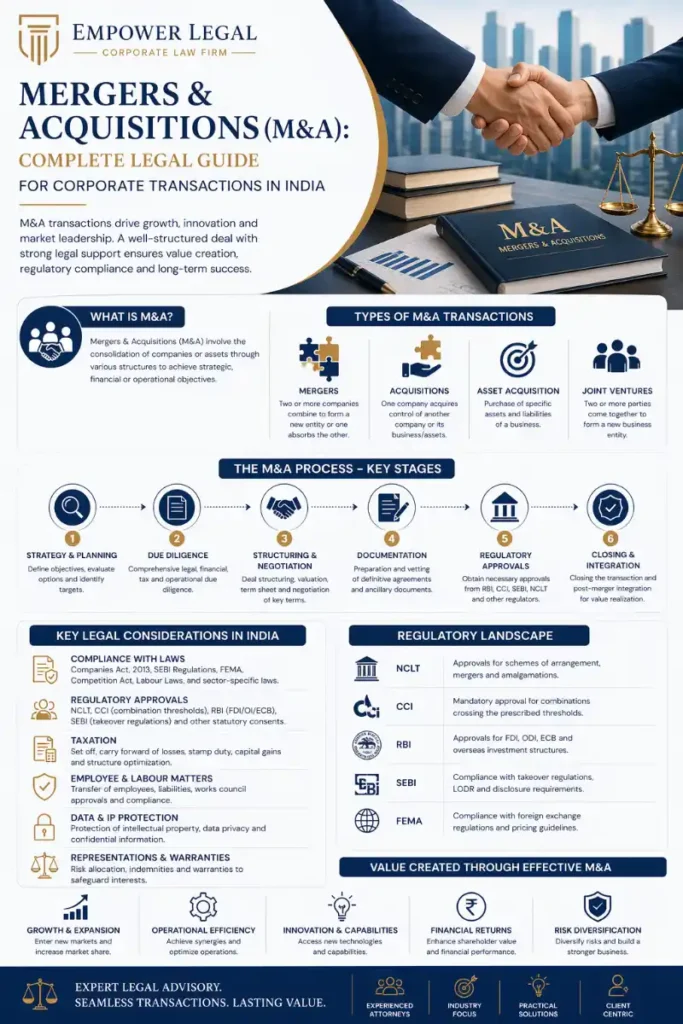
A merger constitutes the combination of two or more companies into a single entity. Additionally, the Companies Act, 2013 governs statutory merger procedures through Sections 230-232. The National Company Law Tribunal (NCLT) exercises exclusive jurisdiction over merger approval processes. Subsequently, companies must file applications under Section 230 for scheme sanction. Horizontal mergers involve companies operating in similar business sectors or product lines. Vertical mergers unite entities at different supply chain stages, enhancing operational efficiency. Conglomerate mergers combine businesses from entirely unrelated industries, promoting diversification. Furthermore, amalgamation under Indian law results in complete dissolution of merging companies. Therefore, understanding these fundamental merger classifications guides appropriate transaction structuring decisions.
Acquisition Structures and Legal Mechanisms
Acquisitions enable one company to purchase controlling interest in another corporate entity. Moreover, asset acquisitions involve purchasing specific business assets rather than equity shares. Share purchase agreements facilitate acquisition of target company equity from existing shareholders. Consequently, the buyer gains control without dissolving the target company’s legal existence. Stock purchase transactions trigger obligations under SEBI Takeover Regulations, 2011 for listed entities. Furthermore, hostile takeovers occur without target management consent, requiring defensive legal strategies. Friendly acquisitions proceed with mutual agreement and cooperative due diligence processes. Business buyout transactions may involve management participation, creating management buyout structures. Therefore, selecting appropriate acquisition mechanisms depends on strategic objectives and regulatory considerations.
Statutory Merger Procedures Under Companies Act
Section 230 of the Companies Act, 2013 establishes the comprehensive merger procedure framework. Initially, the Board of Directors must approve the proposed scheme of amalgamation. Subsequently, companies file applications with the concerned NCLT bench having territorial jurisdiction. The tribunal directs convening of meetings for shareholders and creditors separately. Consequently, approval requires three-fourths majority in value and majority in number. Notice publication in newspapers and communication to regulatory authorities becomes mandatory. Furthermore, the Official Liquidator and Registrar of Companies submit investigation reports. The NCLT evaluates public interest, shareholder protection, and commercial viability aspects. Therefore, successful NCLT approval culminates in legally binding merger effectiveness.
| Merger Stage | Authority | Timeline | Key Requirement |
|---|---|---|---|
| Board Approval | Board of Directors | Day 1 | Resolution under Section 230 |
| NCLT Filing | National Company Law Tribunal | Week 2-3 | Scheme document submission |
| Meetings | Shareholders/Creditors | Month 2-3 | 75% approval required |
| Final Order | NCLT | Month 6-12 | Satisfying public interest |
Regulatory Compliance and Statutory Requirements
Competition Commission of India (CCI) Approval Process
The Competition Act, 2002 mandates pre-merger notification for transactions exceeding specified thresholds. Moreover, Section 5 establishes asset and turnover-based criteria triggering CCI approval requirements. Combinations exceeding Rs. 2,000 crores in assets or Rs. 6,000 crores in turnover require notification. Subsequently, parties must file Form I or Form II within 30 days of execution. The CCI evaluates potential adverse effects on market competition and consumer welfare. Furthermore, investigation under Section 29 may extend scrutiny beyond the initial 30-day period. Failure to notify attracts penalties up to 1% of total turnover or assets. Therefore, timely CCI compliance prevents transaction invalidity and significant financial penalties.
SEBI Takeover Regulations for Listed Companies
The Securities and Exchange Board of India (SEBI) regulates acquisitions of listed company shares. Additionally, the SEBI (Substantial Acquisition of Shares and Takeovers) Regulations, 2011 govern disclosure requirements. Acquiring 5% or more shareholding triggers initial disclosure obligations under Regulation 29. Subsequently, reaching 25% threshold mandates open offer to remaining public shareholders. Regulation 3 prescribes open offer procedures for acquiring control through voting rights. Furthermore, creeping acquisitions allow 5% annual increase beyond 25% without triggering offers. Acquirers must appoint merchant bankers registered with SEBI for managing open offers. Stock exchanges receive continuous disclosure filings ensuring market transparency and investor protection. Therefore, SEBI compliance ensures legitimate acquisition of listed company control.
Reserve Bank of India (RBI) Approvals Under FEMA
The Foreign Exchange Management Act (FEMA), 1999 governs cross-border M&A transactions involving foreign investment. Moreover, the RBI regulates foreign direct investment (FDI) through sectoral caps and approval routes. Automatic route permits M&A in most sectors without prior RBI approval. Subsequently, government approval route applies to sensitive sectors including defense and broadcasting. Overseas direct investment (ODI) by Indian companies requires RBI reporting and compliance. Furthermore, pricing guidelines under FEMA ensure fair valuation in cross-border transactions. Transfer of shares to non-residents requires adherence to sectoral FDI limits. Therefore, RBI compliance legitimizes international M&A transactions and facilitates fund repatriation.
M&A Transaction Process: From Due Diligence to Closing
Comprehensive Due Diligence Framework
Legal Due Diligence: Corporate Records and Compliance Verification
Legal due diligence constitutes systematic examination of target company’s legal standing and liabilities. Moreover, verification begins with certificate of incorporation, memorandum, and articles of association. The due diligence team reviews board resolutions, shareholder agreements, and statutory registers. Subsequently, examination extends to material contracts, intellectual property rights, and litigation records. Regulatory compliance verification covers tax filings, environmental clearances, and labor law adherence. Furthermore, title verification of immovable properties and asset ownership becomes critical. Contingent liabilities, pending litigations, and regulatory notices receive thorough scrutiny. Therefore, comprehensive legal due diligence identifies risks, facilitates informed decisions, and supports valuation.
- Certificate of Incorporation and Corporate Structure Documents
- Memorandum and Articles of Association
- Board Resolutions and Shareholder Meeting Minutes
- Material Contracts and Commercial Agreements
- Intellectual Property Ownership and Licenses
- Pending Litigation and Regulatory Investigations
Financial Due Diligence and Valuation Analysis
Financial due diligence examines historical financial statements, accounting policies, and revenue recognition practices. Additionally, auditors verify asset valuations, liability provisions, and off-balance sheet obligations. The investigation covers cash flow patterns, working capital requirements, and debt servicing capacity. Subsequently, quality of earnings analysis identifies sustainable versus one-time revenue streams. Tax due diligence evaluates pending assessments, disputed tax liabilities, and transfer pricing compliance. Furthermore, valuation employs discounted cash flow, comparable company analysis, and precedent transaction methods. Financial modeling incorporates synergy benefits, integration costs, and projected growth assumptions. Therefore, rigorous financial due diligence supports negotiation positioning and purchase price determination.
Transaction Documentation and Definitive Agreements
Letter of Intent and Term Sheet Negotiation
The letter of intent (LOI) outlines preliminary transaction terms and conditions agreed between parties. Moreover, LOIs typically include proposed purchase price, payment structure, and exclusivity provisions. Non-binding clauses permit parties to withdraw without liability before definitive agreement execution. Subsequently, binding provisions cover confidentiality, exclusivity period, and expense sharing arrangements. Break-up fees compensate parties if transactions terminate due to specified trigger events. Furthermore, due diligence timelines, regulatory approval expectations, and closing conditions receive documentation. Term sheets serve similar purposes but often employ more concise, bullet-point formatting. Therefore, well-drafted LOIs streamline negotiations while preserving flexibility during due diligence.
Share Purchase Agreement and Asset Purchase Agreement Drafting
Share purchase agreements (SPA) govern transfer of target company equity from sellers to buyers. Additionally, SPAs include representations and warranties regarding corporate status, financial condition, and compliance. Indemnification clauses protect buyers against undisclosed liabilities and breach of representations. Subsequently, purchase price adjustment mechanisms address working capital variations and earn-out provisions. Closing conditions enumerate regulatory approvals, third-party consents, and material adverse change clauses. Furthermore, non-compete and non-solicitation covenants prevent seller competition post-transaction. Asset purchase agreements specifically identify transferred assets, assumed liabilities, and excluded items. Therefore, meticulous drafting ensures enforceability, allocates risks appropriately, and minimizes post-closing disputes.
Escrow Arrangements and Closing Mechanisms
Escrow accounts hold portions of purchase consideration pending satisfaction of post-closing conditions. Moreover, escrow arrangements secure indemnification obligations for specified survival periods post-closing. Independent escrow agents, typically banks or legal firms, administer escrow accounts neutrally. Subsequently, release triggers include expiration of indemnity periods or mutual agreement. Earn-out escrows hold deferred consideration pending achievement of performance milestones. Furthermore, adjustment escrows accommodate working capital true-ups based on closing date financials. Closing checklists enumerate document deliveries, regulatory confirmations, and payment instructions. Therefore, structured escrow mechanisms balance seller liquidity needs with buyer protection requirements.
Jurisdictional Forums and Legal Remedies
The National Company Law Tribunal (NCLT) exercises principal jurisdiction over merger and amalgamation matters. Moreover, NCLT benches operate across multiple cities including Chennai, Mumbai, Delhi, and Kolkata. Appeals against NCLT orders proceed to the National Company Law Appellate Tribunal (NCLAT). Subsequently, the Supreme Court of India entertains appeals from NCLAT decisions. District Courts handle contractual disputes arising from share purchase or asset purchase agreements. Furthermore, arbitration clauses in M&A agreements provide alternative dispute resolution mechanisms. The Competition Appellate Tribunal (COMPAT) was merged into NCLAT for competition law appeals. Therefore, understanding jurisdictional architecture ensures appropriate forum selection for dispute resolution.
| Forum | Jurisdiction | Location | Appeal Mechanism |
|---|---|---|---|
| NCLT | Merger/Amalgamation | Multiple Benches | NCLAT |
| NCLAT | Appeals from NCLT | New Delhi | Supreme Court |
| CCI | Competition Clearance | New Delhi | NCLAT |
| SEBI | Listed Company Takeovers | Mumbai | Securities Appellate Tribunal |
| High Court | Writ Jurisdiction | State Capitals | Supreme Court |
Cross-Border M&A Transactions and International Considerations
Outbound Acquisitions by Indian Companies
Indian companies increasingly pursue overseas acquisitions for market access and technology acquisition. Moreover, outbound acquisitions require RBI approval under the Overseas Direct Investment (ODI) route. Automatic route permits investments up to specified limits in certain countries and sectors. Subsequently, government approval route applies to investments in sensitive jurisdictions or strategic sectors. Valuation guidelines mandate fair pricing determined through internationally accepted valuation methodologies. Furthermore, annual performance reports to RBI ensure ongoing compliance monitoring. Tax structuring considerations include Double Taxation Avoidance Agreements (DTAA) and withholding tax optimization. Therefore, strategic structuring of outbound acquisitions optimizes regulatory compliance and tax efficiency.
Inbound Acquisitions and Foreign Investment Compliance
Foreign companies acquiring Indian entities must comply with FDI policy and sectoral caps. Additionally, Press Note 3 of 2020 mandates government approval for investments from neighboring countries. Beneficial ownership disclosure requirements identify ultimate controlling persons in acquisition structures. Subsequently, downstream investment regulations apply when foreign-owned Indian companies make further investments. Pricing guidelines under FEMA require fair market valuation for share transfers. Furthermore, transfer pricing regulations ensure arm’s length pricing in related-party transactions. Form FC-TRS filings with RBI document share transfer transactions involving non-residents. Therefore, comprehensive FEMA compliance legitimizes foreign acquisition of Indian business assets.
Tax Structuring and Optimization Strategies
Direct Tax Implications Under Income Tax Act
Capital gains tax applies to sellers transferring shares or business assets in M&A transactions. Moreover, long-term capital gains on listed equity shares attract 10% tax beyond Rs. 1 lakh. Short-term capital gains on equity shares incur 15% tax under Section 111A. Subsequently, unlisted share transfers trigger 20% long-term capital gains tax with indexation benefits. Business restructuring provisions under Sections 47 and 2(19AA) provide exemptions for qualifying amalgamations. Furthermore, carry forward of losses and unabsorbed depreciation becomes available post-merger. Minimum Alternate Tax (MAT) considerations affect effective tax rates for corporate acquirers. Therefore, strategic tax planning optimizes post-transaction tax efficiency and preserves transaction economics.
Indirect Tax Considerations: GST and Stamp Duty
Goods and Services Tax (GST) implications arise from transfer of business as going concern. Additionally, going concern transfers may qualify for GST exemption if specific conditions are satisfied. Share transfers generally remain outside GST scope as securities transactions. Subsequently, stamp duty applies to share transfer instruments at rates varying across states. The Indian Stamp Act and state stamp acts govern stamp duty applicability and rates. Furthermore, asset transfers attract stamp duty based on asset location and transaction value. Proper valuation certificates support stamp duty assessments and prevent subsequent disputes. Therefore, indirect tax planning addresses GST registration transfers and stamp duty optimization.
Sector-Specific M&A Regulations and Approvals
Banking sector mergers require Reserve Bank of India approval under Banking Regulation Act. Moreover, insurance company amalgamations need Insurance Regulatory and Development Authority (IRDAI) clearance. Telecom sector acquisitions involve Department of Telecommunications (DoT) approval for license transfers. Subsequently, pharmaceutical company mergers trigger Drug Controller General of India (DCGI) notifications. Real estate transactions require state-level approvals under respective land revenue regulations. Furthermore, infrastructure sector deals necessitate clearances from sector-specific regulatory authorities. Aviation industry consolidation involves Directorate General of Civil Aviation (DGCA) approvals. Therefore, sector-specific regulatory navigation ensures comprehensive compliance across specialized industries.
- Banking Sector: RBI approval under Banking Regulation Act, 1949
- Insurance Sector: IRDAI clearance under Insurance Act, 1938
- Telecom Sector: DoT approval for license and spectrum transfers
- Pharmaceutical Sector: DCGI notifications and CDSCO compliance
- Power Sector: Central/State Electricity Regulatory Commission approvals
M&A Dispute Resolution and Legal Remedies
Breach of Representations and Warranty Claims
Breach of representations in share purchase agreements triggers buyer indemnification rights. Moreover, materiality thresholds and basket amounts limit claims to significant breaches. Sellers provide representations regarding corporate status, financial condition, and regulatory compliance. Subsequently, buyers must demonstrate reliance, breach, and resultant damages for successful claims. Survival periods specify duration during which representation breaches remain actionable. Furthermore, sandbagging provisions address scenarios where buyers had actual knowledge of breaches. Caps limit aggregate indemnification liability, typically as percentage of purchase price. Therefore, well-structured indemnification mechanisms balance protection needs with transaction certainty.
Material Adverse Change and Deal Termination
Material adverse change (MAC) clauses permit transaction termination if target’s condition deteriorates significantly. Additionally, MAC definitions exclude general economic conditions, industry-wide effects, and regulatory changes. Courts interpret MAC clauses narrowly, requiring fundamental and permanent adverse changes. Subsequently, pandemic impacts, natural disasters, and force majeure events test MAC applicability. Specific performance remedies compel transaction completion despite seller reluctance. Furthermore, reverse termination fees compensate targets when buyers withdraw for permitted reasons. Litigation over MAC invocations often involves complex factual and legal determinations. Therefore, precise MAC drafting and objective determination criteria minimize interpretational disputes.
Arbitration and Alternative Dispute Resolution
Arbitration clauses in M&A agreements provide confidential and expedited dispute resolution mechanisms. Moreover, institutional arbitration under ICC, SIAC, or LCIA rules ensures procedural efficiency. The Arbitration and Conciliation Act, 1996 governs domestic and international commercial arbitrations. Subsequently, seat of arbitration determines applicable procedural law and supervisory court jurisdiction. Emergency arbitrator provisions enable interim relief before constitution of arbitral tribunals. Furthermore, mediation and conciliation offer settlement-oriented alternatives before formal arbitration commencement. New Delhi International Arbitration Centre (NDIAC) promotes institutional arbitration for commercial disputes. Therefore, arbitration provides sophisticated dispute resolution suited to complex M&A disagreements.
Enforcement of Foreign Judgments and Awards
Foreign arbitral awards receive enforcement in India under the New York Convention framework. Moreover, the Arbitration Act’s Part II governs foreign award enforcement through competent courts. Reciprocating territory judgments become executable under Section 13 of the Code of Civil Procedure. Subsequently, non-reciprocating territory judgments require fresh substantive suits for enforcement. Cross-border insolvency recognition follows UNCITRAL Model Law principles under Insolvency and Bankruptcy Code. Furthermore, bilateral investment treaties provide investor-state dispute settlement mechanisms for protected investments. International Centre for Settlement of Investment Disputes (ICSID) awards receive automatic recognition. Therefore, understanding enforcement mechanisms ensures effective realization of cross-border dispute resolution outcomes.
Post-Merger Integration and Compliance Monitoring
Regulatory Filings and Compliance Obligations
Post-merger regulatory filings ensure transparency with statutory authorities and stakeholders. Moreover, Form INC-28 with the Registrar of Companies confirms NCLT order filing. Stock exchanges receive intimation regarding merger effectiveness for listed companies. Subsequently, SEBI receives post-acquisition disclosures updating shareholding patterns and control changes. Tax authorities receive intimations regarding Permanent Account Number (PAN) surrender of merged entities. Furthermore, GST registration transfers or fresh registrations address indirect tax compliance. Employee Provident Fund Organization (EPFO) receives notifications for employee transfer and liability assumption. Therefore, systematic post-merger compliance prevents regulatory penalties and maintains corporate good standing.
Integration of Corporate Systems and Governance
Corporate governance integration harmonizes board structures, committee compositions, and decision-making protocols. Additionally, human resources integration addresses employee transfers, compensation harmonization, and cultural alignment. Information technology systems integration enables unified operations, data management, and cybersecurity frameworks. Subsequently, financial reporting consolidation establishes unified accounting policies and reporting systems. Compliance management systems integrate regulatory obligations across merged entity operations. Furthermore, brand integration strategies align marketing, customer communication, and stakeholder engagement. Supply chain integration optimizes vendor relationships, inventory management, and distribution networks. Therefore, comprehensive integration planning realizes anticipated synergies and operational efficiencies.
Employee Rights and Labor Law Compliance
The Industrial Disputes Act, 1947 protects employee rights during corporate restructuring transactions. Moreover, Section 25FFA mandates compensation to retrenched workers in transfer of undertakings. Employees of transferor companies automatically transfer to successor entities under merger schemes. Subsequently, service continuity and accrued benefits receive protection under applicable labor laws. Standing orders under the Industrial Employment (Standing Orders) Act require amendment post-merger. Furthermore, collective bargaining agreements with trade unions need renegotiation or assumption. Provident fund, gratuity, and other statutory benefits transfer to the merged entity. Therefore, labor law compliance protects employee interests and prevents industrial disputes.
Intellectual Property Transfer and Protection
Trademark transfers require recordal with the Controller General of Patents, Designs and Trademarks. Additionally, patent ownership changes necessitate assignment registration under the Patents Act, 1970. Copyright transfers in merger schemes receive automatic effect subject to formal recordation. Subsequently, domain name transfers follow registry-specific procedures and authentication requirements. Trade secret protection requires confidentiality agreements and information security protocols post-merger. Furthermore, licensing agreements require novation or assignment to ensure continuity post-transaction. Technology transfer agreements may need regulatory approvals depending on transaction structure. Therefore, comprehensive IP transfer ensures asset protection and prevents post-merger disputes.
Common Legal Issues and Strategic Remedies
Hostile Takeover Defense Mechanisms
Poison pill strategies dilute hostile acquirer’s shareholding through preferential allotments to friendly investors. Moreover, white knight arrangements involve soliciting friendly third-party offers countering hostile bids. Crown jewel defense involves disposing valuable assets making the target less attractive. Subsequently, golden parachute provisions provide lucrative severance to management deterring hostile acquisitions. Pac-man defense turns tables by target company launching counter-bid for hostile acquirer. Furthermore, litigation strategies challenge acquirer’s regulatory compliance or financing arrangements. Staggered board structures prevent immediate control change by classifying director elections. Therefore, layered defense mechanisms protect shareholder interests against opportunistic hostile acquisitions.
Regulatory Hurdles and Clearance Strategies
Competition concerns may trigger detailed CCI investigation extending approval timelines significantly. Additionally, behavioral remedies require acquirers to commit operational changes addressing competition concerns. Structural remedies involve divesting overlapping business divisions to independent third parties. Subsequently, modified transaction structures may satisfy regulatory concerns while preserving core objectives. Pre-filing consultations with CCI facilitate smoother approval processes through advance feedback. Furthermore, economic analysis and market studies support arguments against adverse competitive effects. Expedited review procedures apply to transactions clearly not raising competition concerns. Therefore, proactive regulatory strategy accelerates approvals and preserves transaction certainty.
Minority Shareholder Protection and Oppression Remedies
Sections 241-246 of the Companies Act provide remedies against oppression and mismanagement. Moreover, minority shareholders can petition NCLT alleging prejudicial conduct by majority shareholders. Oppression occurs when majority exercises powers in manner burdensome to minority interests. Subsequently, mismanagement involves conducting affairs in manner prejudicial to company or shareholders. NCLT may order share purchase by majority, modification of company articles, or winding up. Furthermore, class action suits under Section 245 permit collective shareholder actions. Derivative actions enable shareholders to sue on behalf of company against directors. Therefore, robust minority protection mechanisms ensure equitable treatment in corporate restructuring.
Fraudulent Transactions and Clawback Provisions
The Insolvency and Bankruptcy Code, 2016 addresses fraudulent and preferential transactions. Additionally, undervalued transactions within specified lookback periods may be set aside. Preferential transfers favoring certain creditors over others trigger avoidance actions. Subsequently, transactions defrauding creditors or defeating insolvency processes face invalidation. Resolution professionals possess powers to recover assets through clawback mechanisms. Furthermore, criminal prosecution under Bharatiya Nyaya Sanhita (BNS), 2023 addresses fraudulent transaction participants. Sections related to cheating, criminal breach of trust, and forgery apply. Therefore, transaction structuring must ensure bona fide consideration and legitimate commercial purposes.
Government Departments and Enforcement Agencies
The Ministry of Corporate Affairs oversees company law compliance and NCLT administration. Moreover, the Serious Fraud Investigation Office (SFIO) investigates complex corporate frauds. The Enforcement Directorate probes money laundering and foreign exchange violations in M&A transactions. Subsequently, the Central Bureau of Investigation (CBI) handles corruption allegations involving public sector enterprises. State police economic offenses wings investigate financial frauds under state jurisdiction. Furthermore, the Directorate of Revenue Intelligence examines customs and foreign trade violations. Income Tax Department scrutinizes tax evasion and transfer pricing manipulation allegations. Therefore, understanding enforcement architecture helps maintain proactive compliance and risk mitigation.
| Department/Agency | Jurisdiction | Relevant Laws | Contact |
|---|---|---|---|
| Ministry of Corporate Affairs | Company Law Compliance | Companies Act, 2013 | www.mca.gov.in |
| SEBI | Securities Market Regulation | SEBI Act, 1992 | www.sebi.gov.in |
| Competition Commission | Anti-competitive Practices | Competition Act, 2002 | www.cci.gov.in |
| Reserve Bank of India | Foreign Exchange Compliance | FEMA, 1999 | www.rbi.org.in |
| Enforcement Directorate | FEMA Violations | PMLA, 2002 | Headquarters: New Delhi |
Strategic M&A Advisory and Professional Engagement
Engaging Experienced M&A Legal Consultants
Specialized M&A lawyers provide strategic guidance throughout complex transaction lifecycles. Moreover, experienced counsel navigates regulatory requirements across Competition Act, SEBI regulations, and FEMA provisions. Senior advocates bring deep expertise in NCLT proceedings, CCI approvals, and dispute resolution. Subsequently, boutique corporate law firms offer personalized attention and partner-level involvement. Large full-service firms provide multidisciplinary teams covering tax, labor, and intellectual property. Furthermore, international law firms facilitate cross-border transactions with global regulatory coordination. Legal consultants conduct due diligence, draft transaction documents, and negotiate commercial terms. Therefore, selecting appropriate legal representation significantly impacts transaction success and risk mitigation.
Investment Bankers and Financial Advisors
Investment bankers identify potential acquisition targets or strategic buyers matching client objectives. Additionally, financial advisors conduct business valuation using appropriate methodologies and market comparables. Merchant bankers registered with SEBI manage open offer processes for listed company acquisitions. Subsequently, fairness opinions from independent valuers support board decisions and shareholder communications. Deal structuring advice optimizes tax efficiency, financing arrangements, and consideration mechanisms. Furthermore, post-merger integration consultants facilitate operational consolidation and synergy realization. Transaction coordinators manage timelines, documentation flows, and closing checklist execution. Therefore, comprehensive advisory teams enhance transaction execution quality and stakeholder confidence.
Cost Considerations and Fee Structures
Legal fees for M&A transactions typically follow success-based or time-based billing structures. Moreover, retainer arrangements provide dedicated legal support throughout transaction duration. Success fees align advisor compensation with transaction completion and value realization. Subsequently, disbursements cover filing fees, stamp duty, and third-party professional charges. NCLT filing fees depend on transaction value under prescribed fee schedules. Furthermore, CCI combination filing fees range based on transaction value thresholds. Stock exchange and registrar fees apply for listed company transactions. Therefore, transparent fee discussions and engagement letters establish clear cost expectations upfront.
Timeline Expectations and Transaction Velocity
Simple M&A transactions without regulatory complications may complete within 6-9 months. Additionally, complex multi-jurisdictional deals involving CCI and sectoral approvals extend to 12-18 months. NCLT merger approval processes typically require 6-12 months from initial filing. Subsequently, CCI Phase I review completes within 30 days for non-problematic combinations. Phase II investigations extend timelines by 180 days for detailed competition assessment. Furthermore, listed company open offers require minimum 20 working days post-public announcement. Fast-track merger provisions under Section 233 expedite procedures for specific qualifying transactions. Therefore, realistic timeline planning manages stakeholder expectations and ensures adequate preparation.
Recent Developments and Emerging Trends
Digital economy M&A transactions increasingly involve fintech, e-commerce, and technology platforms. Moreover, data privacy considerations under Digital Personal Data Protection Act affect due diligence scope. Environmental, social, and governance (ESG) factors influence acquisition decisions and valuation parameters. Subsequently, special purpose acquisition companies (SPACs) provide alternative paths to public markets. Private equity and venture capital drive consolidation in startup and growth-stage sectors. Furthermore, distressed M&A through insolvency resolution processes creates acquisition opportunities. Cross-border investments from sovereign wealth funds and pension funds increase deal activity. Therefore, staying current with market trends ensures competitive positioning and opportunity identification.
Read More
- Foreign exchange Litigation: How to find the Best Legal Support?
- Empower Legal: Corporate Law firm | Company Lawyers 24/7
- Real-Life NCLT Cases: Empower Legal’s Success Stories: Corporate Attorneys in Chennai
- Company Law Compliance Services | Trusted Expert Solutions
- Unraveling Corporate Legal Complexities: Navigating NCLT for Your Business Success
Frequently Asked Questions About Mergers and Acquisitions
A simple merger without regulatory complications typically requires 6-9 months from board approval to NCLT final order. Fast-track mergers under Section 233 may complete slightly faster for qualifying transactions.
CCI approval becomes mandatory when the combined entity exceeds asset thresholds of Rs. 2,000 crores in India or Rs. 8,000 crores globally, or turnover exceeds Rs. 6,000 crores in India or Rs. 24,000 crores globally.
Essential documents include the scheme of amalgamation, board resolutions, financial statements, valuation reports, compliance certificates, shareholder and creditor lists, and objections if any from regulatory authorities.
SEBI mandates open offers to public shareholders when acquirers cross 25% shareholding threshold. Detailed disclosure requirements, pricing norms, and timelines are specified under SEBI Takeover Regulations, 2011.
Remedies include indemnification claims for representation breaches, specific performance for compelling transaction completion, termination rights with break-up fees, and damages for contractual violations through litigation or arbitration.
Legal Disclaimer: This article provides general information about mergers and acquisitions under Indian law. It does not constitute legal advice for specific situations. Parties contemplating M&A transactions should consult experienced corporate lawyers for customized guidance addressing their particular circumstances, jurisdictional requirements, and commercial objectives.
About Empower Legal: Empower Legal is a leading corporate law firm providing comprehensive M&A advisory, regulatory compliance, and transactional support. Our experienced team assists clients across industries with merger approvals, acquisition structuring, due diligence, and post-transaction integration. Contact us for expert legal consultation on your corporate restructuring needs.