
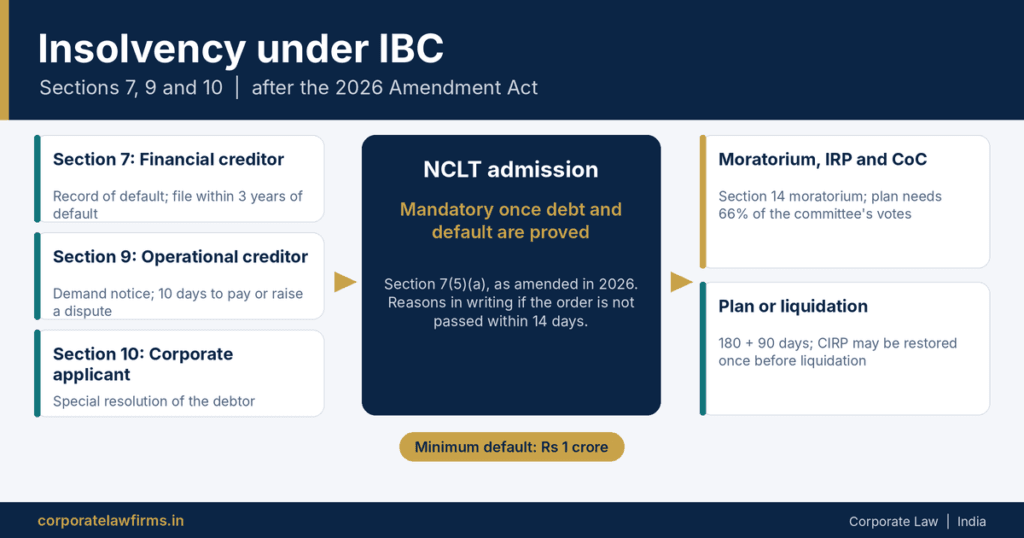
Insolvency under IBC refers to the corporate insolvency resolution process (CIRP) under the Insolvency and Bankruptcy Code, 2016 (IBC), which lets creditors take a defaulting company to the National Company Law Tribunal (NCLT) for a time-bound resolution or liquidation. Sections 7, 9 and 10 are the three ways to start it. The Code was substantially amended by the Insolvency and Bankruptcy Code (Amendment) Act, 2026, most of whose provisions came into force on 26 May 2026, and this guide reflects that position.
Who can start insolvency under IBC?
- Financial creditor (Section 7): a bank, a financial institution or any person to whom a financial debt is owed. A group of allottees in a real estate project can also act as financial creditors, subject to the threshold of at least 100 allottees or 10 percent of the total allottees in the same project, as upheld in Manish Kumar v. Union of India (2021).
- Operational creditor (Section 9): a supplier of goods or services, or an employee, owed an operational debt.
- Corporate applicant (Section 10): the corporate debtor itself, through a special resolution.
Minimum default
The Code requires a minimum amount of default, which has been Rs 1 crore since the notification of March 2020. Verify the current threshold, as it is set by the Government.
What changed in 2026
- Mandatory admission: Section 7(5)(a) now requires admission once the debt and the default are established. This overturns the view in Vidarbha Industries Power v. Axis Bank (2022) that the NCLT had a discretion to decline admission.
- Time-bound orders: under Sections 7, 9 and 10, the NCLT must record reasons in writing if it does not admit or reject an application within 14 days.
- Proof of default: a record of default kept by a financial institution with an information utility is recognised as sufficient evidence of default.
- Withdrawal: Section 12A has been substituted, as explained below.
- Creditor-initiated resolution (CIIRP): a new Chapter IV-A allows notified financial creditors, subject to the prescribed approvals, to start an out-of-court resolution in which the board stays in place under the supervision of a resolution professional, with a timeline of 150 days extendable by 45 days.
- Restoration of CIRP: before a liquidation order, the NCLT may restore the CIRP once, on the application of the committee of creditors with 66 percent of the vote, for up to 120 more days.
- Clean slate and other reforms: the rule that claims not covered by an approved plan stand extinguished is now in the statute, and enabling provisions for group and cross-border insolvency have been added, which await rules.
Rules and regulations under the amended Act are still being issued, so check the current text before filing.
Section 7: financial creditor
1. File an application before the NCLT in the prescribed form with the record of the default, such as the one from the information utility, and the name of the proposed resolution professional.
2. The NCLT examines whether a debt and a default exist. If they do, the application has to be admitted. This was the position in Innoventive Industries v. ICICI Bank (2017), and the 2026 amendment restores it after the discretion recognised in Vidarbha.
3. The creditor must file within the limitation period, which is three years from the date of default, as held in B.K. Educational Services v. Parag Gupta (2018), subject to the Limitation Act.
Section 9: operational creditor
1. Send a demand notice under Section 8, along with a copy of the unpaid invoice or the demand notice for payment.
2. The corporate debtor has 10 days to pay or to give notice of a dispute that existed before the demand.
3. If there is no payment and no genuine pre-existing dispute, file the application before the NCLT. In Mobilox Innovations v. Kirusa Software (2017), the Supreme Court held that an application is rejected where a pre-existing dispute exists in the form of a real and substantial dispute and not a feeble claim.
4. The NCLT admits or rejects the application, and it must record reasons if it does not decide within 14 days.
Effect of admission
- A moratorium under Section 14 begins, which stops suits, enforcement and recovery against the debtor, and the transfer of its assets. It also covers proceedings by a surety against the corporate debtor under a guarantee.
- An interim resolution professional takes charge of the management, and the powers of the board are suspended.
- A committee of creditors is formed with the financial creditors, and it appoints the resolution professional and votes on the plan. A resolution plan needs the approval of at least 66 percent of the voting share, as per Section 30(4).
- The Code provides 180 days, extendable by 90 days, within an overall limit of 330 days including litigation. In Essar Steel India v. Satish Kumar Gupta (2019), the Supreme Court read the outer limit as directory in suitable cases. Check the current text of Section 12, as the 2026 amendment stresses time-bound steps.
- If no plan is approved, the debtor goes into liquidation, unless the NCLT restores the CIRP once on the committee’s application, as described above.
Withdrawal and settlement
Under the substituted Section 12A, an application admitted under Section 7, 9 or 10 can be withdrawn only with the approval of 90 percent of the voting share of the committee of creditors. Withdrawal is not allowed before the committee is constituted, or after the first invitation for resolution plans has been issued. Parties therefore often settle before admission. The Supreme Court has said that the Code is a resolution process and not merely a recovery tool.
Eligibility to submit a resolution plan
Section 29A bars certain persons, such as wilful defaulters and the promoters of accounts that have been classified as non-performing for a period, from submitting a plan, subject to the conditions.
Practical tips
- A creditor should check the proof of the default, the limitation and the existence of a dispute before filing.
- Since admission is now mandatory once the debt and the default are proved, a debtor should reply to the notice in time and settle or resolve the genuine disputes before an application is filed.
- Directors should understand the effect on the management, and the duties explained in our guide on director duties.
- MSMEs may use the pre-packaged insolvency route under the Code, subject to the conditions.
The Code is available at India Code, and the NCLT and the IBBI publish the procedures on their sites.
Frequently Asked Questions
What is the minimum default for a CIRP application?
Rs 1 crore at present, as notified by the Government. Verify the current amount.
Can the NCLT still refuse a Section 7 application after default is proved?
Not ordinarily. The 2026 amendment to Section 7(5)(a) makes admission mandatory once the debt and the default are established, which reverses the discretion recognised in Vidarbha Industries Power v. Axis Bank (2022).
Can a creditor file under Section 7 and Section 9 together?
No. The route depends on whether the creditor is a financial or an operational creditor.
What is a pre-existing dispute?
A genuine dispute about the debt that arose before the demand notice, which can defeat a Section 9 application.
How long does the CIRP take?
The Code provides for 180 days with an extension of 90 days, within an overall limit of 330 days including litigation. In practice many cases have taken longer, and the 2026 amendment stresses time-bound steps.
Can the parties settle after admission?
Yes, through Section 12A, with the approval of 90 percent of the voting share of the committee of creditors. Under the 2026 amendment, withdrawal is not allowed before the committee is constituted or after the first invitation for resolution plans.
This article is general legal information and not a substitute for advice on your specific matter. Rules, rates and timelines change; verify the current position and consult an advocate before acting.