
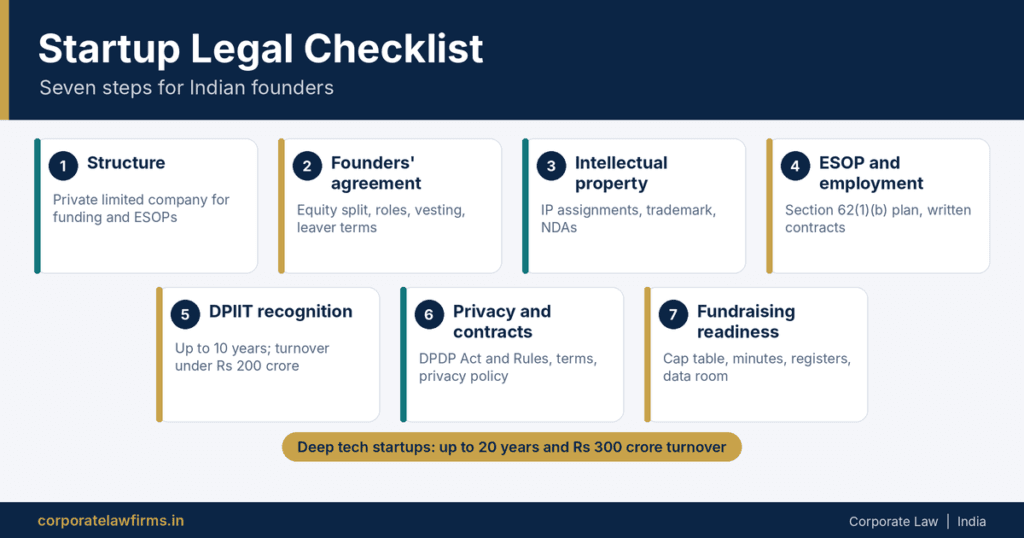
A startup legal checklist is a list of the legal steps that a founding team should complete in the first months of a business, to protect the ownership, the ideas and the investors’ confidence. Many disputes among founders and funding delays arise from the gaps that this checklist addresses.
1. Startup legal checklist: choose the structure and incorporate
Decide between a private limited company, an LLP or a partnership, as explained in our guide on company vs LLP vs partnership. Venture-backed startups mostly use the private limited company, and the procedure is explained in our guide on company incorporation under the Companies Act 2013.
2. Founders’ agreement and shareholding
- Record the equity split, the roles, the decision-making and the vesting of the founders’ shares, usually over a period of years with a cliff.
- Include the exit and the good leaver and bad leaver terms, deadlock, and the non-compete during the term.
- The details are carried into the shareholders’ agreement at the time of investment, as explained in our guide on the shareholders’ agreement.
3. Intellectual property
- Sign IP assignment agreements under which each founder and each employee or contractor assigns the rights in the code, designs, content and inventions to the company. Under the Copyright Act, 1957, the first owner of a work made by an independent contractor is the contractor unless there is a written assignment.
- Register the trademark for the brand name and the logo, and run a search first.
- Protect the confidential information through non-disclosure agreements, and the open-source licences must be reviewed.
4. ESOP and employment
- An Employee Stock Option Plan is created under Section 62(1)(b) of the Companies Act, 2013 and the rules, with a special resolution of the shareholders. The plan sets the pool, the vesting, the exercise price and the treatment of leavers.
- Startups recognised by the DPIIT have some relaxations for the grant of options to promoters and directors who hold more than 10 percent, for up to ten years from incorporation. Check the current rules.
- Issue written employment contracts with confidentiality, IP assignment and the notice terms. Check the validity of non-compete clauses after the employment, as Section 27 of the Contract Act restricts them.
- Comply with the labour laws, the Shops and Establishment law, the provident fund and the POSH requirements where applicable.
5. DPIIT recognition and tax benefits
Apply for recognition under the Startup India scheme on the National Single Window System. Under the DPIIT notification of February 2026, an entity can be recognised as a startup for up to 10 years from incorporation, provided its turnover has not exceeded Rs 200 crore in any financial year and it works on innovation or scalable business. A separate deep tech category allows up to 20 years and a turnover of up to Rs 300 crore, with additional documents. Companies, LLPs, registered partnership firms and cooperative societies can apply. Benefits can include a tax holiday for three consecutive years out of the first ten, which needs a separate certificate of eligibility, and easier compliance. The angel tax on share issues was abolished by the Finance (No. 2) Act, 2024 with effect from 1 April 2025, but take advice on the current law before you raise funds.
6. Contracts, privacy and compliance
- Use written contracts with customers, vendors and partners, with the terms of payment, liability and the termination.
- Publish the terms of use and the privacy policy, and plan for the data protection duties under the Digital Personal Data Protection Act, 2023 and the DPDP Rules, 2025, which are being brought into force in phases up to May 2027, where personal data is handled.
- Register for the GST, the Shops and Establishment and the other licences, as needed for the sector, and plan the annual filings, as set out in our guide on annual compliance for companies and LLPs.
- Check foreign investment and the sector-specific rules if the business involves foreign money or a regulated activity, such as fintech, health or education.
7. Fundraising readiness
Keep the cap table, the minutes, the statutory registers and the contracts in order. A clean data room speeds up the diligence. Use a term sheet, then the definitive documents with the investor, and file the share allotment with the ROC and the foreign investment reports with the RBI, where applicable.
The Acts are on India Code.
Frequently Asked Questions
When should founders sign the founders’ agreement?
As early as possible, ideally at the time of incorporation, and before any outside investment.
Why is an IP assignment needed?
Without a written assignment, the company may not own the work created by the founders or the contractors.
What is vesting?
A mechanism by which the founders earn their shares over time, so that a founder who leaves early does not keep the full holding.
Do I need DPIIT recognition?
It is optional, but it can give access to the benefits and the schemes, subject to eligibility.
Is an ESOP possible in an LLP?
No. ESOPs are a feature of companies, since an LLP does not issue shares.
What are the first compliances after incorporation?
The commencement of business declaration, the registered office verification, the appointment of the auditor and the bank account, as set out in the incorporation process.
This article is general legal information and not a substitute for advice on your specific matter. Rules, rates and timelines change; verify the current position and consult an advocate before acting.