
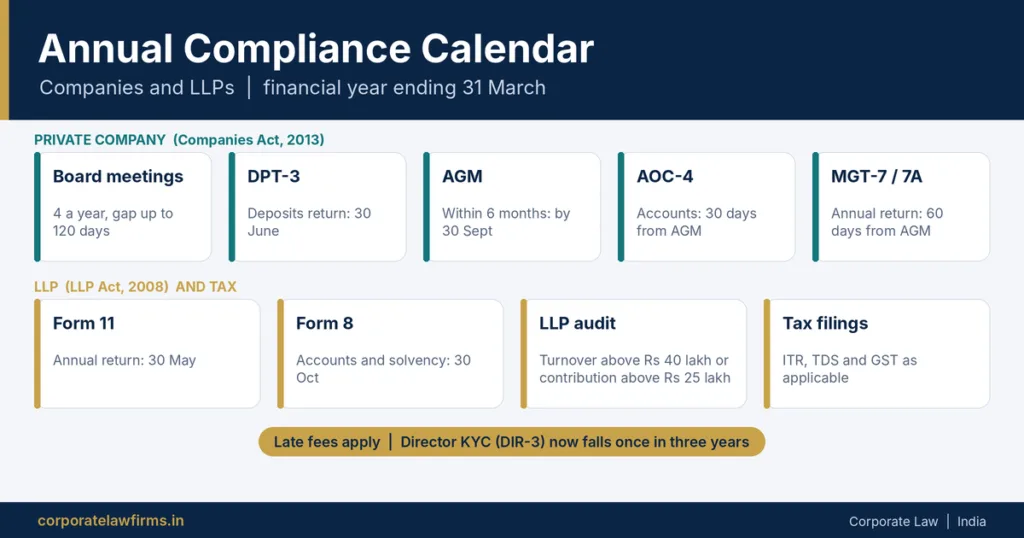
Annual compliance is the set of filings and meetings that a company or LLP must complete every year to remain in good standing with the Registrar of Companies (ROC) and the tax authorities. Missing them leads to additional fees, penalties, and in the end the director’s disqualification or the striking off of the entity.
Annual compliance for a private limited company
Under the Companies Act, 2013, the main yearly requirements are as follows. Dates are based on a financial year ending on 31 March, and they are subject to the extensions that the Ministry may grant.
1. Board meetings: at least four in a year, with the gap between meetings not exceeding 120 days (Section 173).
2. Financial statements: the preparation of the balance sheet, profit and loss account and the Board’s report, and the audit by the statutory auditor, as set out in our guide on director duties.
3. Annual General Meeting (AGM): within six months of the end of the financial year, that is by 30 September, with a notice of at least 21 days.
4. Form AOC-4: filing of the financial statements with the ROC within 30 days of the AGM.
5. Form MGT-7 or MGT-7A: the annual return within 60 days of the AGM.
6. Director KYC (DIR-3 KYC): every director who holds a DIN must complete it. Under the amended Rule 12A, effective from 31 March 2026, the full KYC is required once in three financial years and not every year, and a change in the director’s details must be updated through the full form. Confirm the current cycle and due date on the MCA portal before filing.
7. Form DPT-3: return of deposits or outstanding receipts of money, by 30 June.
8. Form MSME-1: half-yearly return on the outstanding payments to micro and small enterprises beyond 45 days, where applicable, due by 31 October for April to September and by 30 April for October to March.
9. Disclosure of interest and statutory registers: the directors’ disclosures at the first board meeting of the year, and the up-to-date registers.
10. Auditor appointment and ADT-1: where an auditor is appointed or reappointed.
11. Other filings such as the return of allotment, the change of directors, charges and the beneficial ownership filings, when the event occurs.
LLP annual compliance
Under the Limited Liability Partnership Act, 2008:
- Form 11 (annual return) by 30 May.
- Form 8 (statement of account and solvency) by 30 October.
- LLP audit where the turnover exceeds Rs 40 lakh or the contribution exceeds Rs 25 lakh, as per the Rules.
- Income tax return and the other tax filings.
- Filing of changes in partners, designated partners and the registered office, within the time allowed.
The difference between a company and an LLP in compliance is one of the factors in our guide on company vs LLP vs partnership.
Tax and other compliances
- Income tax return and the tax audit, where it applies, as per the due dates in the Income-tax Act, 2025, along with the advance tax and the TDS returns.
- GST returns monthly or quarterly, and the annual return, where the entity is registered.
- Provident fund, ESI and the professional tax returns, where applicable.
- Shops and Establishment and the other licence renewals.
Consequences of default
- Additional fees for the late filing of forms, which increase with the period of delay. For LLPs, the late fee is Rs 100 per day of delay.
- Penalties on the company and the officers in default, as provided by the Act.
- Disqualification of directors under Section 164, where the company has not filed the financial statements or returns for three continuous years.
- Striking off of the name of the company by the ROC, for the failure to file the returns for a continuous period, subject to the notice and the Act.
Practical tips
- Prepare a compliance calendar with the due dates and the responsible person.
- Keep the books up to date, and close the accounts early.
- Hold the board meetings and the AGM on time, and keep the minutes.
- File small corrections quickly, since the cost of late filing accumulates.
- Review the filing requirements every year, as the forms and the due dates change.
The filings are made on the MCA portal, and the Acts are on India Code.
Frequently Asked Questions
Is annual compliance required even if the company has no business?
Yes. A dormant company must still file its accounts and returns, though it may opt for the dormant status in appropriate cases.
What is the due date for the AGM?
Within six months from the end of the financial year, usually 30 September.
What is the late fee for AOC-4 and MGT-7?
An additional fee that depends on the period of delay, as per the MCA fee rules. Check the current fee schedule.
Do LLPs need an AGM?
No. LLPs do not have a statutory AGM, but they file Forms 11 and 8.
Can directors be disqualified for non-filing?
Yes, under Section 164, if the filings are not made for three continuous financial years.
Who is responsible for the filings?
The company and its officers in default, and the board must ensure that the compliance is done.
This article is general legal information and not a substitute for advice on your specific matter. Rules, rates and timelines change; verify the current position and consult an advocate before acting.