
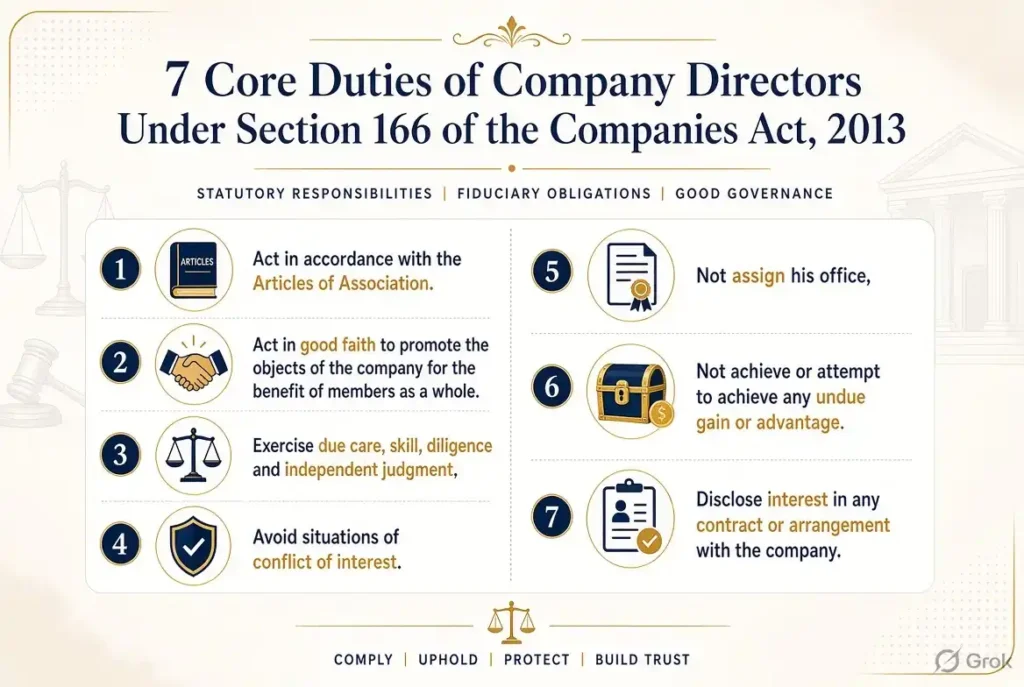
Section 166 of the Companies Act, 2013 sets out statutory duties that directors must observe while acting in the governance of a company. These duties operate alongside the company’s Articles, other provisions of the Act and the facts of each transaction.\
Key Legal Obligations of Company Directors Pursuant to Section 166, Companies Act, 2013
1. Act according to the Articles
A director must act in accordance with the Articles of the company and within the legal framework governing the company’s affairs.
2. Act in good faith
Directors must act in good faith to promote the objects of the company for the benefit of its members as a whole, while also having regard to the interests identified by the statute, including the company, employees, shareholders, community and protection of the environment.
3. Exercise care, skill and diligence
The statute requires directors to exercise due and reasonable care, skill and diligence and to exercise independent judgment. Directors should therefore understand material decisions and not simply approve matters without appropriate consideration.
4. Avoid conflicts of interest
A director should not place himself or herself in a situation where there is a direct or indirect interest that conflicts, or possibly may conflict, with the interests of the company. Potential conflicts should be disclosed and managed in accordance with law.
5. Do not obtain undue gain
A director must not obtain, or attempt to obtain, undue gain or advantage for himself or herself, relatives, partners or associates. Where undue gain is made, statutory consequences can follow.
6. Do not assign the office
The office of director is a personal statutory position. Section 166 restricts assignment of the office, reinforcing the responsibility attached to the appointment.
7. Understand the consequences of breach
Section 166 contains consequences for contravention. Directors should therefore maintain appropriate board processes, declarations, records and conflict-management procedures.
Practical governance checklist
Before a material decision, directors should review the Articles, identify conflicts, obtain necessary information, record deliberations and seek professional advice where the transaction involves significant legal or financial risk.
Conclusion
Section 166 is a practical governance provision. Directors should treat their statutory duties as an ongoing responsibility rather than as a formality limited to board meetings.