
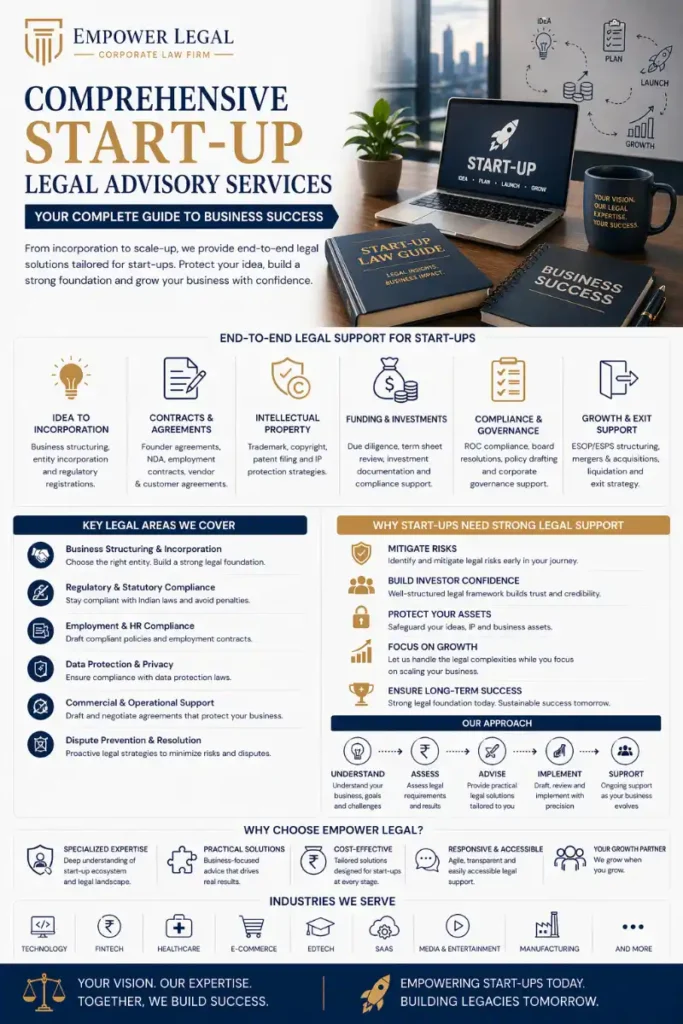
Starting a business in India requires navigating complex legal frameworks and regulatory requirements. Empower Legal: Corporate Law Firm provides comprehensive start-up legal advisory services to entrepreneurs across Chennai and beyond. Our experienced team of corporate lawyers specializes in helping start-ups establish strong legal foundations from inception to growth. Understanding the legal landscape is crucial for every entrepreneur seeking sustainable business success. This guide explores essential legal services, compliance requirements, and strategic advisory that start-ups need. Whether you’re launching a fintech venture or an e-commerce platform, professional legal support ensures regulatory compliance. Expert guidance helps avoid costly mistakes while maximizing growth opportunities in today’s competitive market.
Understanding Start-Up Legal Framework in India
The Foundation of Business Entity Formation
Choosing the right business structure is the first critical decision every entrepreneur must make. Consequently, this choice impacts taxation, liability protection, fundraising capabilities, and operational flexibility throughout your business journey. Private Limited Company registration offers limited liability protection and attracts investors more effectively than other structures. Furthermore, LLP registration services provide partnership flexibility with corporate benefits for professional service providers. One Person Company formation suits solo entrepreneurs who want corporate structure without multiple shareholders. Additionally, Section 8 company registration serves non-profit organizations seeking tax benefits and credibility. Each structure has distinct advantages under the Companies Act, 2013 and requires careful evaluation. Therefore, consulting experienced start-up lawyers ensures alignment between business goals and legal structure. Professional company incorporation services streamline the registration process with ROC and relevant authorities.
- Private Limited Company: Limited liability, easy fundraising, separate legal entity
- Limited Liability Partnership: Partnership flexibility with limited liability protection
- One Person Company: Solo entrepreneur structure with corporate benefits
- Proprietorship: Simple structure with full owner control but unlimited liability
- Section 8 Company: Non-profit organizations with tax exemption benefits
Start-Up India Registration and DPIIT Recognition
Start-up India certification provides significant benefits including tax exemptions and easier compliance procedures. Moreover, DPIIT recognition services unlock access to government tenders and priority patent examination facilities. Tax exemption under Start-up India applies for three consecutive years under Section 80IAC. Subsequently, recognized start-ups enjoy self-certification benefits for environmental and labor laws for five years. Angel tax advisory becomes crucial as Section 56(2)(viib) exemptions require proper DPIIT recognition. The certification process involves meeting eligibility criteria regarding incorporation date, turnover limits, and innovation focus. Therefore, legal consultants for new business help prepare documentation and ensure compliance with all requirements. Professional assistance increases approval rates and accelerates the recognition process significantly.
| Benefit Type | Description | Duration |
|---|---|---|
| Tax Exemption | 80IAC income tax benefit | 3 consecutive years |
| Self-Certification | Labor and environment laws | 5 years |
| Patent Benefits | 80% rebate on filing fees | Lifetime |
| Tender Access | Government procurement priority | Ongoing |
Regulatory Compliance and Statutory Requirements
Essential Registration and Licensing Framework
GST registration for start-ups becomes mandatory when annual turnover exceeds Rs. 40 lakhs for services. Additionally, TAN and PAN registration are fundamental requirements for salary payments and income tax purposes. ESI and PF registration apply when employee count reaches specified thresholds under respective acts. Professional tax registration varies by state; Tamil Nadu requires registration within 30 days of establishment. Furthermore, trade license from local municipal corporations ensures legal operation of business premises. MSME registration services provide benefits including priority sector lending and government scheme access. Consequently, start-up compliance services ensure timely registration and renewal of all statutory licenses. ROC compliance services include annual return filing, financial statement submission, and maintaining statutory registers.
- Obtain PAN and TAN from Income Tax Department within 15 days
- Register for GST if turnover exceeds threshold or interstate supplies occur
- Complete ESI registration within 15 days of applicability threshold
- File PF registration within one month of hiring eligible employees
- Secure professional tax registration as per state-specific timelines
- Apply for trade license from respective municipal corporation authorities
- Obtain MSME/Udyam registration for accessing government benefits and schemes
Annual Compliance Calendar for Start-Ups
Annual compliance for start-ups involves multiple filings with different regulatory authorities throughout the year. ROC annual return filing (MGT-7) must be completed within 60 days of the AGM. Moreover, financial statement filing (AOC-4) requires submission within 30 days after AGM completion. Income tax return filing deadlines vary based on audit requirements and business structure. GST returns need monthly or quarterly filing depending on turnover and registration type. Furthermore, TDS returns require quarterly submission to avoid penalties and interest charges. DIR-3 KYC for directors must be filed annually by September 30th to maintain active status. Therefore, engaging affordable start-up lawyers ensures systematic compliance and avoids penalties or prosecution.
Intellectual Property Protection Strategies
Trademark and Brand Protection Services
Securing Your Brand Identity
Trademark registration Chennai protects your brand name, logo, and distinctive business identifiers from infringement. Consequently, registered trademarks provide exclusive rights for ten years with unlimited renewal possibilities. Brand protection services include conducting comprehensive searches to ensure mark availability before filing applications. The Trademarks Act, 1999 provides legal remedies against unauthorized use of registered marks. Additionally, Madrid Protocol allows international trademark registration through a single application covering multiple countries. IP protection for start-ups should begin early to establish market presence and deter competitors. Furthermore, trademark opposition proceedings require expert handling to defend your application against objections. Professional legal consultants prepare robust responses to examination reports and opposition notices efficiently.
- Comprehensive trademark search across 45 classes and existing registrations
- Strategic class selection based on current and future business expansion
- Application drafting with detailed specification of goods and services
- Examination report response within stipulated timelines to avoid abandonment
- Opposition defense and evidence submission during contested proceedings
- Registration certificate procurement and renewal management services
Patent Filing and Copyright Protection
Patent filing services protect innovative products, processes, and technological solutions from unauthorized commercial exploitation. Start-ups with DPIIT recognition receive 80% fee reduction on patent applications under government schemes. Moreover, copyright registration India protects original literary, artistic, musical, and software works automatically upon creation. The Patents Act, 1970 and Copyright Act, 1957 govern respective protection mechanisms and enforcement procedures. Design registration services protect unique product appearances for ten years under the Designs Act, 2000. Furthermore, trade secret advisory helps maintain confidentiality of proprietary information through contractual mechanisms. IP due diligence becomes essential before fundraising to identify and protect all intellectual property assets. Consequently, technology transfer agreements require careful drafting to balance commercialization with protection objectives.
Data Privacy and Cybersecurity Compliance
Data privacy compliance under the Digital Personal Data Protection Act, 2023 mandates consent management and security protocols. Additionally, IT Act compliance requires reasonable security practices for sensitive personal data protection. GDPR compliance services become necessary when processing European Union residents’ data regardless of location. Cybersecurity legal advisory helps implement technical and organizational measures preventing data breaches and unauthorized access. Furthermore, website terms and conditions must clearly state privacy policies, user obligations, and liability limitations. E-commerce legal services ensure compliance with Consumer Protection Act, 2019 and Information Technology Rules. Therefore, software licensing agreements need careful structuring to protect proprietary code while enabling customer usage. SaaS agreement drafting balances service commitments with appropriate liability caps and data handling clauses.
| Compliance Area | Applicable Law | Key Requirements |
|---|---|---|
| Data Protection | DPDP Act, 2023 | Consent, notice, security |
| Cybersecurity | IT Act, 2000 | Reasonable security practices |
| Consumer Rights | Consumer Protection Act | Disclosure, grievance redressal |
| E-Commerce | IT Rules, 2021 | Seller verification, traceability |
Fundraising and Investment Documentation
Venture Capital and Angel Investment Structures
Venture capital legal services encompass term sheet negotiation, due diligence coordination, and definitive agreement execution. Angel investor agreements typically involve simpler structures compared to institutional funding but require equal attention. Term sheet negotiation establishes valuation, investment amount, equity stake, and governance rights before detailed documentation. Subsequently, seed funding documentation includes subscription agreements, shareholders agreements, and disclosure schedules. Series A funding legal support involves more complex structures with liquidation preferences and anti-dilution protections. Moreover, convertible note agreements provide bridge financing with conversion mechanisms based on future valuation events. SAFE agreement drafting offers flexible funding without immediate valuation determination or maturity dates. Consequently, shareholder agreement preparation defines rights, obligations, and exit mechanisms among all equity holders.
- Review and negotiate term sheet provisions including valuation and investment terms
- Conduct legal due diligence and prepare disclosure schedules comprehensively
- Draft subscription agreement defining share purchase terms and conditions
- Prepare shareholders agreement covering governance, transfer restrictions, exit rights
- Create employment agreements for key management personnel with vesting schedules
- Execute investor rights agreement granting information and protective provisions
- Complete ESOP documentation for employee equity incentive programs systematically
FEMA Compliance for Foreign Investment
FEMA compliance for start-ups governs all foreign investment transactions under Foreign Exchange Management Act, 1999. FDI approval services navigate automatic and government routes based on sector and investment structure. RBI approval for foreign investment becomes necessary for sectors under government approval or beyond prescribed limits. Furthermore, downstream investment advisory ensures compliance when foreign-funded companies invest in other Indian entities. ODI compliance services regulate Indian companies’ overseas investments and establishment of foreign subsidiaries. Foreign investment structuring requires understanding sectoral caps, pricing guidelines, and reporting obligations under FEMA regulations. Additionally, ECB legal services help raise external commercial borrowings within RBI-prescribed parameters and end-use restrictions. Investment agreement drafting must incorporate FEMA-compliant valuation methodologies and transfer pricing considerations carefully.
Employee Stock Option Plans and Equity Management
ESOP implementation services help attract and retain talent through equity-based compensation aligned with growth. Employee stock option plans require board approval, shareholders’ approval, and compliance with Companies Act provisions. Sweat equity advisory enables issuing shares to employees or directors for intellectual property contributions. Moreover, equity dilution planning helps founders maintain control while raising capital through strategic allocation. Cap table management tracks ownership percentages, vesting schedules, and option pools across funding rounds. Furthermore, vesting agreement services define time-based or milestone-based equity release protecting company interests. Founder agreement preparation establishes equity split, roles, responsibilities, and departure provisions among co-founders. Therefore, employment contract drafting must integrate ESOP provisions, confidentiality clauses, and non-compete restrictions effectively.
Commercial Contracts and Business Agreements
Vendor and Service Level Agreements
Vendor agreement drafting establishes procurement terms, quality standards, payment schedules, and dispute resolution mechanisms. Service level agreements define performance metrics, uptime guarantees, support obligations, and penalty provisions. Additionally, master service agreements create framework terms governing multiple transactions between parties over time. Non-disclosure agreements protect confidential information shared during negotiations, partnerships, or employment relationships. Supply agreement preparation covers quantity commitments, pricing mechanisms, delivery schedules, and termination rights. Moreover, distribution agreement structures channel partnerships with exclusivity provisions, territory definitions, and performance targets. Franchise agreement services replicate business models through standardized operations, branding, and support systems. Therefore, collaboration agreements require careful drafting of intellectual property ownership, revenue sharing, and exit provisions.
- Detailed scope of work with specific deliverables and acceptance criteria
- Payment terms including milestones, retention, and invoice processing timelines
- Intellectual property ownership and licensing provisions for created works
- Confidentiality obligations protecting proprietary information and trade secrets
- Liability caps and indemnification clauses allocating risks appropriately
- Termination rights covering breach, convenience, and insolvency scenarios
- Dispute resolution through arbitration, mediation, or specific court jurisdiction
Employment and HR Documentation
Employment contract drafting establishes designation, compensation, benefits, working hours, and termination provisions. Consultant agreements differentiate independent contractors from employees ensuring appropriate tax and statutory treatment. Furthermore, non-compete agreements restrict employees from joining competitors or starting similar businesses post-employment. Confidentiality agreements prevent disclosure of proprietary information during and after employment tenure. HR policy documentation covers leave policies, code of conduct, grievance procedures, and disciplinary actions. Moreover, independent contractor agreements clarify project scope, payment terms, and intellectual property ownership. Internship agreement drafting defines learning objectives, stipend, duration, and confidentiality obligations for student placements. Therefore, professional HR policies ensure compliance with labor laws while protecting business interests effectively.
Sector-Specific Licensing and Regulations
Fintech and Financial Services Compliance
Fintech legal services navigate complex regulatory frameworks under RBI, SEBI, and IRDAI depending on activities. NBFC registration services require net owned funds, fit and proper criteria, and ongoing compliance obligations. RBI license for fintech includes payment aggregator license, prepaid payment instrument authorization, and account aggregator registration. Additionally, payment aggregator license requires minimum net worth, technology certifications, and comprehensive compliance systems. Peer-to-peer lending license mandates NBFC-P2P registration with specific operational restrictions and disclosure requirements. Furthermore, blockchain legal advisory addresses cryptocurrency regulations, smart contract enforceability, and token classification issues. Gaming license India covers skill-based gaming platforms under state laws and central GST provisions. Therefore, regulatory risk management becomes essential given evolving fintech regulations and enforcement actions.
| Fintech Category | Regulatory Authority | Key License Required |
|---|---|---|
| Payment Services | Reserve Bank of India | PA-CB, PPI Issuer License |
| Lending Platforms | Reserve Bank of India | NBFC-P2P Registration |
| Securities Trading | SEBI | Stock Broker License |
| Insurance Tech | IRDAI | Insurance Broker License |
Healthtech and Medical Device Regulations
Healthtech compliance involves navigating regulations under Drugs and Cosmetics Act, Medical Device Rules, and Telemedicine Guidelines. Drug license for healthtech platforms requires state licensing authorities’ approval for medicine storage and distribution. Medical device approval through CDSCO becomes mandatory for devices classified under risk categories II, III, or IV. Furthermore, online pharmacy license requires both drug license and compliance with E-Pharmacy Draft Rules provisions. Clinical Establishment Act registration applies to diagnostic centers and health facilities operating physical establishments. Additionally, data privacy becomes critical given sensitive health information handling under DPDP Act provisions. Telemedicine platforms must comply with Medical Council of India guidelines regarding doctor-patient consultations remotely. Therefore, sector-specific legal advisory ensures compliance while enabling innovative healthcare delivery models effectively.
Food Business and FSSAI Compliance
FSSAI license registration under Food Safety and Standards Act, 2006 covers food manufacturing, distribution, and retail. Basic registration suits small-scale operators with turnover below Rs. 12 lakhs operating within single premises. State license applies for medium-scale businesses with turnover between Rs. 12 lakhs and Rs. 20 crores. Moreover, central license becomes necessary for large businesses, importers, exporters, or multi-state operations. Food business legal services ensure compliance with labeling requirements, quality standards, and hygiene regulations. Furthermore, agritech legal support addresses contract farming, FPO formation, and agricultural commodity trading regulations. Cloud kitchen operations require both FSSAI license and local municipal trade license for operations. Therefore, food safety compliance prevents penalties, prosecution, and reputational damage in consumer-facing businesses.
Business Restructuring and Growth Strategies
Merger and Acquisition Advisory
Merger and acquisition advisory encompasses deal structuring, due diligence, valuation, and post-merger integration planning. Business restructuring services help optimize corporate structure for tax efficiency, operational effectiveness, and regulatory compliance. Cross-border transaction services navigate FEMA regulations, transfer pricing, and international tax treaty provisions. Additionally, due diligence services examine legal, financial, operational, and regulatory aspects comprehensively before transactions. Share purchase agreements define purchase price, warranties, indemnities, and closing conditions for equity acquisitions. Moreover, asset purchase agreements enable selective acquisition of specific business assets without assuming all liabilities. Business acquisition services include target identification, negotiation support, and documentation till deal closure. Therefore, strategic legal advisory maximizes transaction value while minimizing risks and ensuring smooth transitions.
- Conduct comprehensive legal due diligence covering corporate, contracts, IP, litigation
- Structure transaction optimally considering tax implications and regulatory approvals required
- Draft definitive agreements including SPA, SHA, non-compete, and transition services
- Obtain necessary regulatory approvals from CCI, SEBI, sectoral regulators as applicable
- Manage closing conditions including consents, releases, and confirmations systematically
- Execute post-merger integration including board reconstitution and employee transitions
- File statutory intimations with ROC and other authorities within prescribed timelines
International Expansion and Foreign Subsidiaries
International expansion legal support addresses jurisdiction selection, entity formation, and regulatory compliance in target countries. Foreign subsidiary services include incorporation, local director appointments, and ongoing statutory compliance abroad. Branch office setup in India requires RBI approval for foreign companies establishing business presence. Additionally, wholly-owned subsidiaries provide limited liability while enabling full operational control in overseas markets. Joint venture structuring balances control, investment, and risk-sharing between Indian and foreign partners. Moreover, strategic alliance agreements create partnerships without equity participation for specific business objectives. Therefore, cross-border legal advisory considers tax treaties, transfer pricing, and repatriation regulations comprehensively.
Dispute Resolution and Litigation Support
Commercial Arbitration and Mediation Services
Start-up dispute resolution through arbitration provides faster, confidential, and enforceable remedies compared to litigation. Commercial arbitration services under Arbitration and Conciliation Act, 1996 enable parties to resolve disputes privately. Shareholder dispute lawyer assistance becomes critical when co-founder conflicts threaten business continuity and operations. Moreover, contract dispute resolution addresses breach situations through negotiation, mediation, or formal arbitration proceedings. Mediation services offer collaborative problem-solving with neutral facilitators helping parties reach mutually acceptable solutions. Furthermore, arbitration clauses in contracts must specify arbitrator appointment, governing law, and seat of arbitration. Therefore, dispute resolution expertise minimizes business disruption while protecting legal rights and commercial interests.
Litigation in Civil and Commercial Courts
IP litigation services protect trademarks, patents, copyrights, and trade secrets through infringement suits. Chennai High Court has jurisdiction over intellectual property disputes involving significant commercial value. Employment dispute lawyer handles wrongful termination, non-compete violations, and labor law compliance issues. Additionally, partnership dispute resolution addresses disagreements regarding profit sharing, authority, and dissolution under Partnership Act. Commercial Courts Act, 2015 provides specialized forums for commercial disputes exceeding specified value. Moreover, City Civil Court Chennai handles civil disputes below High Court pecuniary jurisdiction limits. Therefore, litigation strategy considers cost, duration, enforceability, and business impact before initiating proceedings.
| Forum | Jurisdiction | Dispute Type |
|---|---|---|
| Commercial Court | Above Rs. 3 lakhs | Commercial disputes |
| High Court Chennai | Above Rs. 20 lakhs | Civil, IP, Writ petitions |
| NCLT Chennai | Company law matters | Oppression, winding up |
| Consumer Forum | Consumer disputes | Deficiency in service |
Regulatory Investigations and Compliance Defense
Internal investigation services help identify compliance violations, fraud, or misconduct before regulatory scrutiny. Legal risk assessment evaluates exposure under various statutes including Companies Act, FEMA, and tax laws. Compliance audit services review statutory registers, board processes, and filing status ensuring complete adherence. Furthermore, regulatory risk management implements controls preventing violations and establishing reporting mechanisms. Whistleblower policy implementation encourages reporting of irregularities while protecting informants from retaliation. ROC show cause notices require careful responses addressing alleged violations with supporting evidence. Additionally, NCLT proceedings under Companies Act involve oppression and mismanagement complaints or insolvency applications. Therefore, proactive compliance culture minimizes regulatory exposure and ensures swift resolution of issues.
Exit Strategies and Business Succession
Strategic Exit Planning and Execution
Exit strategy planning helps founders monetize investments through acquisitions, IPOs, or secondary sales. Business valuation services employ income, market, and asset approaches determining fair enterprise value. Share purchase agreements in exit scenarios include drag-along rights, tag-along rights, and lock-in provisions. Moreover, business sale documentation covers representations, warranties, indemnities, and escrow arrangements protecting both parties. Succession planning ensures smooth leadership transitions through estate planning and ownership restructuring. Additionally, buyback of shares enables companies to purchase equity from shareholders within statutory limits. Liquidation services provide orderly winding up when business continuation becomes unviable or undesirable. Therefore, exit planning requires balancing tax efficiency, timing, and stakeholder interests strategically.
Insolvency and Debt Recovery
Insolvency advisory under Insolvency and Bankruptcy Code, 2016 addresses corporate insolvency resolution processes. NCLT Chennai Bench handles insolvency applications, corporate disputes, and arrangement approvals under IBC. Debt recovery services include filing recovery suits, negotiating settlements, and enforcing security interests. Furthermore, SARFAESI Act enables secured creditors to enforce security without court intervention under specific conditions. Debt Recovery Tribunal Chennai provides specialized forum for financial institution debt recovery exceeding Rs. 20 lakhs. Additionally, winding up procedures under Companies Act require special resolutions, creditor settlements, and liquidator appointments. Therefore, early restructuring discussions prevent insolvency while preserving business value and stakeholder interests.
Location-Specific Legal Services in Chennai
Accessibility and Local Expertise
Start-up lawyer Chennai provides localized expertise understanding Tamil Nadu’s business environment and regulatory framework. Corporate law firm Chennai offers comprehensive services from incorporation to exit with proximity for consultations. Legal services Mogappair ensure accessibility for entrepreneurs in North Chennai with flexible meeting arrangements. Additionally, business lawyer George Town Chennai serves traditional commercial hub with expertise in trading businesses. Chennai corporate lawyer combines national-level expertise with local court representation and government liaison capabilities. Moreover, Ambattur police station area businesses receive prompt legal support for commercial disputes and compliance. City Civil Court Chennai hears civil suits, recovery matters, and commercial disputes below High Court jurisdiction. Therefore, local presence ensures timely advice, court appearances, and relationship with regulatory authorities.
Government Departments and Regulatory Offices
ROC Chennai processes company incorporations, annual filings, and maintains public records for Tamil Nadu companies. Office of Registrar of Firms handles partnership and LLP registrations under respective partnership laws. Additionally, Commercial Tax Department manages GST registrations, assessments, and enforcement within Tamil Nadu jurisdiction. Labour Department offices oversee PF, ESI, contract labor, and other employment law compliance. Income Tax Department offices conduct assessments, scrutiny, and investigation for Chennai-based taxpayers. Furthermore, FSSAI Regional Office Chennai grants food licenses and conducts inspections for food businesses. Controller General of Patents handles patent applications with Chennai office providing regional access. Therefore, understanding department procedures and building relationships facilitates smoother compliance and approvals.
- ROC Chennai: Company incorporation, annual filings, director KYC submissions
- Commercial Tax Office: GST registration, return filing, assessment proceedings
- Labour Commissioner Office: PF, ESI, contract labor, industrial dispute resolution
- Income Tax Office: PAN, TAN, return filing, assessment, appeals
- FSSAI Regional Office: Food license, compliance verification, product approvals
- Controller of Patents: Patent filing, examination response, grant proceedings
- Greater Chennai Corporation: Trade license, building permissions, local clearances
Technology-Driven Legal Solutions
Virtual Legal Advisory and Digital Documentation
Virtual legal advisory enables remote consultations through video conferencing reducing time and travel costs. Digital signature certificates facilitate electronic execution of agreements compliant with Information Technology Act, 2000. Moreover, online company registration platforms streamline incorporation processes with digital document submission and tracking. Legal service packages for start-ups offer fixed-fee structures for defined services providing cost predictability. Quick company registration services expedite incorporation through parallel processing and dedicated coordination. Furthermore, same-day legal consultation availability ensures urgent matters receive immediate attention from experienced lawyers. Legal document automation generates standard agreements efficiently while allowing customization for specific requirements. Therefore, technology integration enhances service delivery speed, accuracy, and client convenience significantly.
Transparent Pricing and Engagement Models
Transparent legal pricing provides upfront cost clarity eliminating surprises and building client trust. Fixed-fee legal packages define scope and cost for routine services like incorporation and compliance. Start-up legal retainer services offer monthly packages covering defined hours for ongoing advisory needs. Additionally, dedicated start-up legal team provides consistent service with deep understanding of business context. Legal budget for new business planning helps allocate resources appropriately across various legal requirements. Moreover, value-based billing aligns legal costs with transaction values ensuring fair compensation for complex matters. Therefore, flexible engagement models accommodate varying start-up budgets while ensuring quality legal support.
Recent Legal Developments Impacting Start-Ups
Bharatiya Nyaya Sanhita and Business Offenses
Bharatiya Nyaya Sanhita, 2023 (BNS) replaced Indian Penal Code introducing revised criminal provisions. Corporate fraud provisions under BNS Section 318 continue penalizing dishonest conduct in business dealings. Cheque bounce cases now proceed under Bharatiya Nagarik Suraksha Sanhita, 2023 (BNSS) replacing CrPC procedures. Additionally, criminal breach of trust provisions under BNS affect director liability for company fund misappropriation. Cyber crimes including data theft and online fraud carry enhanced penalties under BNS technology offense sections. Moreover, intellectual property theft and trademark counterfeiting remain criminal offenses under respective special laws. Therefore, understanding revised criminal law framework helps prevent inadvertent violations and ensures appropriate defense strategies.
Bharatiya Sakshya Adhiniyam and Evidence Standards
Bharatiya Sakshya Adhiniyam, 2023 (BSA) modernized evidence law recognizing electronic records and digital signatures. Electronic contracts and digital agreements receive statutory recognition under BSA provisions facilitating paperless transactions. Email communications constitute admissible evidence subject to authentication and relevance requirements in proceedings. Furthermore, electronic signatures created under IT Act, 2000 carry presumption of authenticity under BSA. Digital forensic evidence including server logs and blockchain records become increasingly relevant in disputes. Moreover, video conference proceedings receive formal recognition enabling remote testimony and hearings. Therefore, maintaining proper digital records and authentication mechanisms strengthens evidentiary position during disputes.
Empower Legal: Corporate Law Firm provides end-to-end start-up legal advisory services in Chennai. Our experienced corporate lawyers specialize in company incorporation, compliance, fundraising, and dispute resolution. Understanding complex regulatory frameworks enables us to deliver practical solutions aligned with business objectives. We combine legal expertise with commercial understanding ensuring cost-effective and timely service delivery. Our client-centric approach focuses on building long-term relationships through consistent quality and responsiveness. Whether you’re launching a new venture or scaling existing operations, professional legal support ensures success. Contact us today for comprehensive start-up legal advisory tailored to your unique business needs.
Read More
- Joint Ventures & Strategic Alliances: Comprehensive Legal Guide for Business Collaborations
- Corporate Contracts & Commercial Law: Comprehensive Legal Guide for Businesses in India
- COMPANY INCORPORATION & BUSINESS SETUP: Complete Legal Guide for Entrepreneurs in India
- Incorporation and formation of a company: Expert Advice and consultation
- Company Law Compliance Services | Trusted Expert Solutions
Frequently Asked Questions
Private Limited Company suits most start-ups seeking investor funding and limited liability protection. LLP works for professional services with partnership flexibility.
Company incorporation typically completes within 7-10 working days with proper documentation. Digital processes and professional assistance expedite registration significantly.
Start-Up India provides three-year tax exemption under Section 80IAC and self-certification benefits. Patent fee rebates and tender access further support recognized start-ups.
File trademark applications early, ideally before public launch or significant marketing investment. Registration takes 12-18 months requiring proactive planning and protection.
Engage experienced start-up lawyers to review valuation, governance rights, and exit provisions. Professional negotiation protects founder interests while securing necessary capital funding.
“`