
In today’s dynamic business environment, joint ventures and strategic alliances have emerged as powerful mechanisms for corporate growth. These collaborative frameworks enable businesses to pool resources, share risks, and capitalize on complementary strengths. Furthermore, they provide access to new markets, technologies, and expertise without full merger or acquisition commitments. Indian companies increasingly leverage these structures to expand operations domestically and internationally. The legal landscape governing such partnerships requires meticulous attention to regulatory compliance, contractual precision, and strategic foresight. Consequently, engaging experienced legal counsel becomes paramount for successful joint venture formation and strategic alliance implementation. This comprehensive guide explores the legal framework, regulatory requirements, documentation essentials, and dispute resolution mechanisms governing business collaborations in India.
Understanding Joint Ventures: Legal Framework and Structural Options
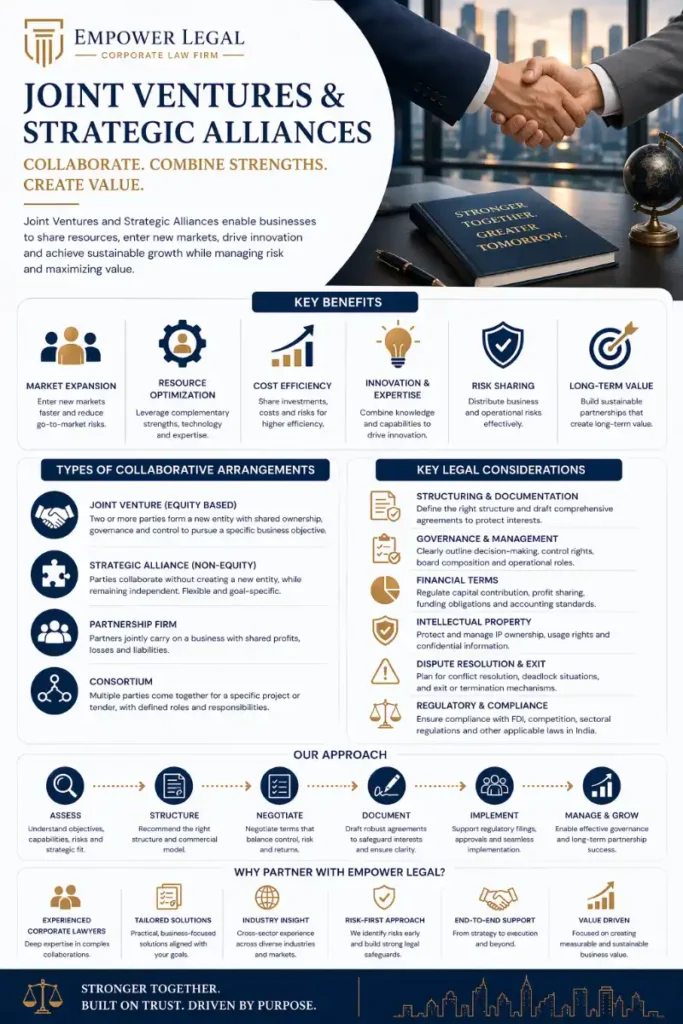
What Constitutes a Joint Venture Under Indian Law
A joint venture represents a business arrangement where two or more parties collaborate toward specific commercial objectives. Unlike traditional partnerships, joint ventures typically focus on finite projects or defined business scopes. The Companies Act, 2013 does not explicitly define joint ventures, yet it provides the structural framework for their operation. Moreover, the Income Tax Act, 1961 recognizes joint ventures for taxation purposes under specific circumstances. The Foreign Exchange Management Act (FEMA), 1999 governs foreign investment in joint ventures, establishing critical compliance parameters. Additionally, the Competition Act, 2002 regulates anti-competitive practices that might arise from joint venture formations. These legislative instruments collectively shape the legal environment within which joint ventures operate throughout India. Therefore, understanding this multifaceted regulatory landscape proves essential for successful joint venture structuring and implementation.
Equity Joint Ventures Versus Contractual Joint Ventures
Equity joint ventures involve the creation of a separate legal entity owned jointly by participating partners. This structure typically manifests as a private limited company under the Companies Act, 2013. Conversely, contractual joint ventures operate without forming a distinct legal entity, relying instead on comprehensive agreements. The choice between these structures depends on various factors including capital requirements, regulatory considerations, and operational objectives. Equity joint ventures offer limited liability protection and perpetual succession benefits to participating entities. However, they necessitate compliance with Companies Act provisions, ROC filings, and corporate governance requirements. Contractual joint ventures provide greater flexibility in terms of structure, profit-sharing mechanisms, and exit strategies. Nevertheless, they expose partners to unlimited liability unless specifically structured through limited liability partnerships. Consequently, careful analysis of business objectives guides the optimal structural choice.
- Equity JV creates separate legal entity with independent existence
- Contractual JV operates through binding agreements without separate incorporation
- Equity structure requires ROC registration and compliance
- Contractual arrangements offer operational flexibility and simpler dissolution
- Tax implications vary significantly between both structures
Strategic Alliances: Collaborative Frameworks Beyond Traditional Joint Ventures
Defining Strategic Alliances in Modern Business Context
Strategic alliances represent cooperative arrangements between businesses that maintain their independent legal identities throughout the collaboration. These partnerships typically focus on specific business functions such as research and development, marketing, or distribution. Unlike joint ventures, strategic alliances rarely involve equity participation or creation of new legal entities. Instead, they operate through detailed collaboration agreements, technology transfer arrangements, or licensing frameworks. The Indian Contract Act, 1872 governs the contractual aspects of strategic alliances, ensuring enforceability and legal validity. Additionally, sector-specific regulations may apply depending on the industry involved in the strategic alliance formation. For instance, pharmaceutical strategic alliances must comply with Drug Controller General of India (DCGI) regulations. Similarly, technology sector alliances face scrutiny under Information Technology Act, 2000 provisions regarding data protection and cybersecurity.
Types of Strategic Alliance Structures Recognized in India
Strategic alliances manifest in various forms depending on collaboration objectives and partner requirements. Licensing agreements allow one party to use another’s intellectual property under specified terms and conditions. Franchising arrangements enable business format replication while maintaining brand consistency across geographical territories. Distribution alliances focus on market access, leveraging existing networks to reach new customer segments efficiently. Research and development collaborations pool technical expertise and financial resources to accelerate innovation outcomes. Manufacturing partnerships optimize production capabilities through shared facilities, technology, or specialized expertise. Marketing alliances combine promotional efforts to enhance brand visibility and market penetration across target demographics. Each structure carries distinct legal implications regarding liability allocation, intellectual property rights, and profit-sharing mechanisms. Therefore, selecting the appropriate alliance structure requires comprehensive analysis of business objectives and risk tolerance.
| Alliance Type | Primary Objective | Legal Documentation | Regulatory Authority |
|---|---|---|---|
| Licensing Agreement | IP Rights Transfer | License Agreement | Controller of Patents |
| Franchising | Business Replication | Franchise Agreement | No Specific Authority |
| Distribution Alliance | Market Access | Distribution Agreement | Competition Commission |
| R&D Collaboration | Innovation Development | Collaboration Agreement | DSIR/DPIIT |
| Manufacturing Partnership | Production Optimization | Manufacturing Agreement | Industry-Specific Bodies |
Regulatory Framework Governing Joint Ventures and Strategic Alliances in India
Companies Act 2013: Structural and Governance Requirements
The Companies Act, 2013 establishes the foundational framework for equity joint ventures structured as company entities. Section 2(6) defines “associate company,” which often encompasses joint venture arrangements involving significant influence without control. Additionally, Section 2(76) addresses “related party” transactions, impacting how joint venture partners conduct inter-company dealings. The Act mandates specific disclosure requirements for related party transactions exceeding prescribed thresholds under Section 188. Furthermore, board composition requirements under Section 149 influence governance structures within joint venture companies significantly. Independent director requirements apply when joint ventures exceed specified paid-up capital or turnover thresholds. The Ministry of Corporate Affairs administers these provisions through the Registrar of Companies (ROC) offices nationwide. Compliance obligations include annual return filings, financial statement submissions, and board meeting documentation. Consequently, joint venture partners must establish robust corporate governance frameworks ensuring continuous regulatory compliance.
Foreign Exchange Management Act (FEMA) and FDI Regulations
FEMA, 1999 governs foreign investment in Indian joint ventures through the Foreign Exchange Management (Non-Debt Instruments) Rules, 2019. The Reserve Bank of India (RBI) administers FEMA provisions, establishing sectoral caps and entry route requirements. Automatic route allows foreign investment in most sectors without prior government approval, subject to sectoral conditions. Government route requires approval from the Department for Promotion of Industry and Internal Trade (DPIIT) for restricted sectors. Press Note 3 (2020) mandates government approval for investments from entities in countries sharing land borders with India. Additionally, downstream investment provisions regulate foreign-controlled Indian companies investing in other domestic entities. Foreign investment exceeding 49% in certain sectors triggers specific approval and compliance requirements under FEMA framework. The Foreign Investment Facilitation Portal (FIFP) streamlines government approval applications for joint ventures requiring regulatory clearances. Therefore, international joint ventures demand meticulous FEMA compliance planning.
Competition Act 2002: Anti-Competitive Concerns and Merger Control
The Competition Act, 2002 regulates joint ventures to prevent anti-competitive practices and abuse of dominant positions. Section 3 prohibits agreements causing appreciable adverse effect on competition within India, potentially impacting certain joint venture arrangements. Section 5 and Section 6 establish merger control thresholds requiring Competition Commission of India (CCI) approval. Joint ventures exceeding specified asset or turnover thresholds must obtain CCI clearance before implementation. The combination regulations assess whether proposed joint ventures create or strengthen dominant positions substantially. Additionally, vertical and horizontal agreements within joint ventures face scrutiny for potential anti-competitive effects. The CCI evaluates market definition, market shares, entry barriers, and competitive constraints during merger review processes. Form I or Form II filings depend on whether the transaction raises competition concerns requiring detailed examination. Consequently, competition law compliance constitutes a critical component of joint venture formation in regulated sectors.
Sector-Specific Regulations Impacting Joint Venture Formation
Banking, Insurance, and Financial Services Joint Ventures
Financial sector joint ventures face stringent regulatory oversight from specialized sectoral regulators beyond general corporate law. Banking joint ventures require Reserve Bank of India approval under the Banking Regulation Act, 1949. The RBI evaluates promoter credentials, business plans, capital adequacy, and corporate governance frameworks before granting licenses. Insurance joint ventures must obtain approval from the Insurance Regulatory and Development Authority of India (IRDAI) under Insurance Act, 1938. The IRDAI assesses financial soundness, management competence, and compliance with regulatory capital requirements during approval processes. Similarly, Non-Banking Financial Company (NBFC) joint ventures require RBI registration under specified categories based on activities. Securities market joint ventures involving stock exchanges or depositories require Securities and Exchange Board of India (SEBI) approval. Each regulator maintains distinct fit and proper criteria, capital requirements, and ongoing compliance obligations. Therefore, financial sector joint ventures demand specialized legal expertise navigating complex regulatory architectures.
Infrastructure, Real Estate, and Construction Sector Collaborations
Infrastructure joint ventures involve collaboration on projects such as highways, airports, ports, and power generation facilities. The Public Private Partnership (PPP) framework governs joint ventures between government entities and private sector participants. Model Concession Agreements provide standardized contractual frameworks for infrastructure project joint ventures across various sectors. Real estate joint ventures typically involve land-owning entities partnering with developers for construction and commercialization projects. The Real Estate (Regulation and Development) Act, 2016 (RERA) mandates registration for real estate projects exceeding specified thresholds. RERA establishes disclosure requirements, escrow account obligations, and completion timeline commitments for real estate joint ventures. State-level RERA authorities administer these provisions, varying slightly across jurisdictions in implementation and enforcement approaches. Additionally, environmental clearances from Ministry of Environment, Forest and Climate Change become necessary for specified project categories. Consequently, infrastructure and real estate joint ventures require comprehensive regulatory compliance spanning multiple governmental authorities.
Essential Documentation for Joint Ventures and Strategic Alliances
Memorandum of Understanding: Preliminary Framework for Collaboration
The Memorandum of Understanding (MOU) establishes the preliminary framework outlining partner intentions and collaboration scope. Although typically non-binding, MOUs serve critical functions in documenting negotiation outcomes and guiding subsequent definitive agreement preparation. Key elements include project objectives, partner responsibilities, preliminary timelines, and exclusivity provisions during negotiation periods. Additionally, MOUs address confidentiality obligations protecting sensitive information exchanged during due diligence and negotiation phases. The Indian Contract Act, 1872 governs enforceability of MOU provisions, particularly regarding binding versus non-binding clauses. Courts examine specific language, context, and conduct to determine whether parties intended legal obligations through MOU execution. Therefore, precise drafting distinguishes between aspirational statements and legally enforceable commitments within MOUs. Legal counsel ensures MOUs adequately protect client interests while maintaining flexibility for ongoing negotiations. Furthermore, well-drafted MOUs facilitate smoother transition to definitive joint venture or strategic alliance agreements.
- Preliminary business objectives and collaboration scope definition
- Roles, responsibilities, and contribution commitments of each partner
- Exclusivity provisions preventing parallel negotiations with competitors
- Confidentiality obligations protecting proprietary information exchange
- Timeline for due diligence completion and definitive agreement execution
- Termination provisions allowing exit from negotiations under specified circumstances
- Governing law and dispute resolution mechanisms for MOU-related disputes
Joint Venture Agreement: Comprehensive Contractual Framework
The joint venture agreement constitutes the definitive legal document governing partner relationships, rights, and obligations comprehensively. This agreement addresses equity contribution, profit-sharing mechanisms, governance structures, and operational management protocols in detail. Capital contribution clauses specify initial investments, subsequent funding obligations, and consequences of default by contributing partners. Management provisions establish board composition, voting rights, reserved matters requiring unanimous consent, and decision-making protocols. Additionally, transfer restrictions prevent unauthorized share transfers, typically requiring right of first refusal or prior partner consent. The agreement incorporates detailed intellectual property provisions addressing ownership, licensing, and usage rights for existing and newly developed IP. Exit mechanisms including put options, call options, drag-along rights, and tag-along rights provide liquidity pathways for partners. Dispute resolution clauses mandate arbitration under the Arbitration and Conciliation Act, 1996, specifying institutional or ad hoc arbitration frameworks. Consequently, comprehensive joint venture agreements minimize future conflicts through meticulous contractual documentation.
Shareholders Agreement: Governance and Control Mechanisms
Shareholders agreements complement Articles of Association, addressing governance matters beyond statutory requirements under the Companies Act, 2013. These agreements establish enhanced minority protection mechanisms, supermajority voting requirements, and deadlock resolution procedures. Board representation provisions ensure proportionate or negotiated representation reflecting partner contributions and strategic importance. Reserved matters provisions require unanimous or supermajority consent for significant decisions like capital restructuring or business diversification. Pre-emptive rights ensure existing shareholders can maintain proportionate ownership during new equity issuances by the joint venture. Anti-dilution protections safeguard shareholder interests against value-diminishing actions or unfavorable financing rounds. Tag-along rights enable minority shareholders to exit alongside majority shareholders during third-party sale transactions. Drag-along provisions allow majority shareholders to compel minority participation in approved exit transactions. Therefore, shareholders agreements provide crucial contractual safeguards complementing statutory protections under corporate law.
Technology Transfer and Intellectual Property Agreements
Technology transfer agreements facilitate knowledge, expertise, and proprietary technology sharing between joint venture or strategic alliance partners. These agreements address licensing terms, usage restrictions, improvement rights, and confidentiality obligations regarding transferred technology comprehensively. The agreement specifies whether licenses are exclusive, non-exclusive, or sole, significantly impacting partner rights and competitive positioning. Field-of-use restrictions limit technology application to specified industries, products, or geographical territories as negotiated. Improvement clauses address ownership and licensing of enhancements, modifications, or derivative works developed during collaboration. Additionally, background IP and foreground IP provisions distinguish pre-existing intellectual property from jointly developed innovations. The Patent Act, 1970, Copyright Act, 1957, and Trade Marks Act, 1999 govern IP protection and enforcement mechanisms. Payments typically include upfront fees, running royalties, milestone payments, or combinations thereof based on technology value. Consequently, technology transfer agreements require specialized IP legal expertise ensuring comprehensive protection.
Non-Disclosure and Confidentiality Agreements
Non-Disclosure Agreements (NDAs) protect sensitive information exchanged during joint venture negotiations and throughout operational collaboration periods. These agreements define confidential information scope, permitted disclosure circumstances, and obligations upon agreement termination. Mutual NDAs bind both parties to confidentiality obligations, whereas unilateral NDAs protect only one party’s information. The Indian Contract Act, 1872 provides the legal foundation for NDA enforcement, with specific performance remedies available under Section 14 of the Specific Relief Act, 1963. Exceptions typically include information already in public domain, independently developed, or legally obtained from third parties. Survival clauses ensure confidentiality obligations continue beyond agreement termination for specified durations, typically three to five years. Additionally, return or destruction provisions require confidential information disposal upon relationship termination. Courts grant injunctive relief preventing unauthorized disclosure when confidentiality breaches threaten irreparable harm. Therefore, robust NDAs constitute essential risk mitigation tools throughout joint venture lifecycles.
Due Diligence: Critical Risk Assessment Before Joint Venture Formation
Legal Due Diligence for Joint Venture Partners
Legal due diligence examines potential partner’s corporate structure, regulatory compliance, litigation history, and contractual obligations comprehensively. This process verifies incorporation documents, board resolutions, shareholder agreements, and regulatory licenses held by prospective partners. Litigation searches across district courts, high courts, Supreme Court, and tribunals identify pending or potential legal disputes. The investigation examines compliance with labor laws, environmental regulations, tax obligations, and industry-specific regulatory requirements. Additionally, due diligence assesses existing contracts for change-of-control provisions, termination rights, or consent requirements triggered by joint venture formation. Intellectual property due diligence verifies ownership, validity, and freedom to operate regarding patents, trademarks, copyrights, and trade secrets.
The process involves searches at Controller General of Patents, Designs and Trademarks, Copyright Office, and relevant international IP offices. Furthermore, real estate due diligence examines title documents, encumbrances, and regulatory approvals for properties contributed to joint ventures. Consequently, comprehensive legal due diligence identifies risks enabling informed decision-making and appropriate contractual protections.
Financial and Tax Due Diligence Considerations
Financial due diligence evaluates partner financial health, historical performance, debt obligations, and contingent liabilities potentially impacting ventures. This examination includes audited financial statements, tax returns, debt agreements, and off-balance-sheet obligations. Tax due diligence assesses compliance with Income Tax Act, 1961, Goods and Services Tax Act, 2017, and applicable state tax legislations. The process identifies potential tax exposures, pending assessments, ongoing disputes with tax authorities, and transfer pricing implications. Additionally, due diligence examines tax efficiency of proposed joint venture structures, considering applicable tax treaties and domestic anti-avoidance provisions.
GST registration status, input tax credit eligibility, and compliance with filing requirements receive detailed scrutiny during assessment. The investigation reviews notices from income tax authorities, GST authorities, or state tax departments indicating potential liabilities. Furthermore, examination of Goods and Services Tax Network (GSTN) portal data verifies return filings and payment histories. Therefore, financial and tax due diligence prevents unexpected liabilities derailing joint venture economics.
Regulatory Approvals and Government Clearances for Joint Ventures
Joint ventures may require multiple regulatory approvals depending on sector, foreign investment levels, and competitive implications. The Department for Promotion of Industry and Internal Trade (DPIIT) processes foreign investment approvals for sectors under government route. Additionally, the Cabinet Committee on Economic Affairs approves proposals involving government equity participation in joint ventures. Sector-specific regulators like SEBI, RBI, IRDAI, or Telecom Regulatory Authority of India grant necessary licenses and approvals. Environmental clearances from State Environment Impact Assessment Authority or Ministry become mandatory for specified project categories.
The Competition Commission of India reviews combinations exceeding prescribed thresholds within thirty days of complete notification. Furthermore, certain technology transfers require approval from the Reserve Bank of India under FEMA provisions governing royalty payments. State governments may require approvals for land acquisitions, industrial licenses, or project-specific clearances depending on location. The Central Bureau of Investigation or Enforcement Directorate may scrutinize transactions raising concerns about corruption or money laundering. Consequently, comprehensive regulatory mapping ensures timely approval procurement and legal joint venture operation.
Taxation Framework for Joint Ventures in India
Joint ventures face complex taxation issues spanning income tax, goods and services tax, and stamp duty considerations. Income tax treatment depends on whether the joint venture constitutes a separate taxable entity or merely contractual arrangement. Corporate joint ventures pay tax at applicable corporate rates under Section 115BAA or 115BAB for manufacturing companies. Pass-through taxation may apply to certain structures like limited liability partnerships registered under Limited Liability Partnership Act, 2008.
Transfer pricing provisions under Section 92 apply to international transactions and specified domestic transactions between associated enterprises. The Goods and Services Tax Act, 2017 governs taxation of supplies within joint ventures, requiring registration when turnover exceeds thresholds. Additionally, contribution of assets to joint ventures may trigger GST liability unless qualifying exemptions apply under notification provisions. Stamp duty implications vary across states based on contributed assets, with Bharatiya Nyaya Suraksha Sanhita, 2023 governing certain aspects. Therefore, tax-efficient structuring requires comprehensive analysis of applicable tax laws and available optimization opportunities.
Dispute Resolution in Joint Ventures and Strategic Alliances
Disputes inevitably arise in joint ventures despite comprehensive documentation and partner alignment during formation stages. Common disputes involve management deadlocks, profit-sharing disagreements, breach of non-compete obligations, and exit valuation conflicts. Effective dispute resolution mechanisms incorporated into joint venture agreements minimize operational disruption and preserve partner relationships where possible. Escalation procedures typically require senior management engagement before invoking formal dispute resolution processes. Mediation provisions enable confidential, facilitated negotiations aiming at mutually acceptable resolutions without adversarial proceedings.
The Arbitration and Conciliation Act, 1996 governs arbitration proceedings, offering faster resolution than traditional litigation. Institutional arbitration through bodies like Indian Council of Arbitration, Mumbai Centre for International Arbitration, or Singapore International Arbitration Centre provides administrative support. Alternatively, ad hoc arbitration allows parties greater procedural flexibility under agreed or statutory rules. Courts intervene minimally under arbitration framework, primarily during enforcement or challenge proceedings under specified grounds. Therefore, well-drafted dispute resolution clauses incorporating appropriate mechanisms significantly impact conflict resolution outcomes.
Litigation Forums for Joint Venture Disputes
When alternative dispute resolution fails, litigation through appropriate judicial forums becomes necessary for resolving joint venture conflicts. Civil courts exercise jurisdiction over contractual disputes under the Code of Civil Procedure, 1908 (CPC), now supplemented by procedural innovations. The National Company Law Tribunal (NCLT) holds jurisdiction over oppression and mismanagement cases under Sections 241-246 of Companies Act. Additionally, NCLT hears winding-up petitions, compromise and arrangement applications, and class action suits involving corporate entities. The National Company Law Appellate Tribunal (NCLAT) hears appeals against NCLT orders, with further appeals to Supreme Court. District courts handle commercial disputes below specified value thresholds under ordinary CPC provisions governing territorial and pecuniary jurisdiction.
Commercial courts established under Commercial Courts Act, 2015 handle high-value commercial disputes exceeding one crore rupees. High courts exercise writ jurisdiction under Article 226 of Constitution for regulatory challenges or enforcement of fundamental rights. Furthermore, specialized tribunals like Debt Recovery Tribunal handle debt-related disputes involving joint venture entities. Consequently, selecting appropriate forums based on dispute nature optimizes resolution prospects.
| Forum | Jurisdiction | Applicable Law | Appeal Forum |
|---|---|---|---|
| Civil Court | Contractual disputes below threshold | CPC, 1908 | High Court |
| Commercial Court | Commercial disputes above ₹1 crore | Commercial Courts Act, 2015 | High Court Division Bench |
| NCLT | Oppression, mismanagement, winding up | Companies Act, 2013 | NCLAT |
| High Court | Writ jurisdiction, original jurisdiction | Constitution, specific statutes | Supreme Court |
| Arbitral Tribunal | Disputes under arbitration agreement | Arbitration Act, 1996 | Court as per Act |
Exit Strategies and Joint Venture Dissolution
Exit planning constitutes a critical component of joint venture structuring, addressing scenarios where partners choose to terminate collaboration. Firstly, Exit mechanisms typically include share purchase rights, put options, call options, or initial public offering participation rights. Buy-sell provisions or Russian roulette clauses resolve deadlocks by enabling one partner to buy the other’s stake. Valuation methodologies—whether book value, fair market value, or formula-based—significantly impact exit economics and must be carefully negotiated. Tag-along rights protect minority shareholders by enabling participation in majority shareholder exit transactions at equivalent terms. Drag-along provisions allow majority shareholders to compel minority participation in third-party sales exceeding specified ownership thresholds. Dissolution procedures address asset distribution, liability settlement, employee treatment, and regulatory compliance during wind-down processes. The Companies Act provisions govern company dissolution, requiring creditor settlements, final accounts, and ROC notifications. Therefore, comprehensive exit provisions incorporated during formation stage facilitate smoother separations when relationships deteriorate.
Legal Support for Joint Ventures: Role of Corporate Law Firms
Structuring Advisory and Documentation Services
Corporate law firms provide essential expertise during joint venture structuring, ensuring optimal legal, tax, and regulatory outcomes. Legal advisors assess business objectives, partner dynamics, and risk tolerance to recommend appropriate structural alternatives. The analysis considers factors including liability protection, tax efficiency, regulatory compliance burdens, and operational flexibility requirements. Furthermore, lawyers draft comprehensive joint venture agreements, shareholders agreements, and ancillary documents protecting client interests effectively. Documentation services include technology transfer agreements, non-disclosure agreements, employment contracts for seconded personnel, and service agreements. Additionally, legal teams coordinate with tax advisors, financial consultants, and sector specialists ensuring holistic transaction execution. The documentation process involves multiple negotiation rounds, incorporating commercial terms while addressing legal risks and compliance obligations. Experienced counsel anticipates potential disputes, incorporating preventive provisions and appropriate dispute resolution mechanisms into documentation. Consequently, engaging specialized corporate law firms significantly enhances joint venture success prospects.
Regulatory Compliance and Government Liaison
Corporate law firms manage regulatory approval processes, interfacing with multiple governmental authorities throughout joint venture formation. Legal teams prepare and file applications with ROC, DPIIT, sectoral regulators, and other relevant governmental departments. They ensure compliance with notification requirements under FEMA, competition law filings with CCI, and industry-specific clearances. Additionally, lawyers coordinate environmental impact assessments, pollution control board approvals, and local authority permissions where required. The regulatory compliance practice includes ongoing advisory regarding changing legal requirements, regulatory updates, and compliance obligations. Law firms conduct compliance audits identifying gaps and recommending corrective actions to avoid penalties or regulatory actions. Furthermore, they represent clients before regulatory authorities during inspections, investigations, or enforcement proceedings related to joint ventures. Government liaison services leverage relationships with officials, facilitating smoother approval processes and addressing regulatory concerns efficiently. Therefore, expert regulatory guidance proves invaluable navigating India’s complex governmental architecture.
Dispute Resolution and Litigation Support
When disputes arise, corporate law firms provide comprehensive litigation and arbitration services protecting client interests throughout proceedings. Dispute resolution teams analyze claims, assess legal merits, and develop strategic approaches optimizing resolution prospects. They represent clients before civil courts, commercial courts, NCLT, high courts, and Supreme Court across varied dispute scenarios. Additionally, lawyers conduct arbitration proceedings under institutional or ad hoc frameworks, managing procedural aspects and evidentiary presentations. Mediation services leverage negotiation expertise, seeking amicable resolutions minimizing relationship damage and preserving business collaborations where feasible. The litigation practice includes obtaining interim reliefs like injunctions, attachment orders, or appointment of receivers protecting assets pending final determination. Furthermore, enforcement services ensure award implementation, navigating execution proceedings under CPC or arbitration enforcement mechanisms. Recovery proceedings before Debt Recovery Tribunals address financial claims arising from joint venture defaults or partner obligations. Consequently, integrated dispute resolution capabilities provide clients comprehensive legal support throughout conflict lifecycles.
Recent Legal Developments Impacting Joint Ventures
The legal landscape governing joint ventures continues evolving through legislative amendments, regulatory notifications, and judicial pronouncements. The Bharatiya Nyaya Sanhita, 2023 (BNS) replaced the Indian Penal Code, impacting criminal liability provisions relevant to fraud or breach of trust in joint ventures. Similarly, the Bharatiya Nagarik Suraksha Sanhita, 2023 (BNSS) replaced the Code of Criminal Procedure, modifying arrest procedures and bail provisions. The Bharatiya Sakshya Adhiniyam, 2023 (BSA) succeeded the Indian Evidence Act, altering admissibility standards for digital evidence in commercial disputes. Recent Companies Act amendments strengthened corporate governance requirements, enhanced disclosure obligations, and expanded director liability provisions.
SEBI regulations increasingly address environmental, social, and governance (ESG) considerations impacting joint venture structuring and reporting obligations. Furthermore, RBI circulars periodically update FEMA provisions, FDI policy, and overseas investment frameworks affecting international joint ventures. Court decisions from Supreme Court and high courts establish binding precedents interpreting contract provisions, fiduciary duties, and shareholder rights. Therefore, continuous monitoring of legal developments ensures joint venture compliance with evolving regulatory requirements.
Relevant Law Enforcement and Regulatory Authorities
Multiple authorities exercise jurisdiction over joint venture-related matters depending on transaction nature and potential violations. The Economic Offences Wing investigates financial frauds, cheating, or criminal breach of trust involving joint venture partners. The Serious Fraud Investigation Office (SFIO) under Ministry of Corporate Affairs examines complex corporate frauds exceeding specified thresholds. Enforcement Directorate enforces FEMA provisions, investigating foreign exchange violations and money laundering allegations involving international joint ventures. Additionally, Central Bureau of Investigation handles corruption cases involving public sector joint ventures or government contract awards.
The Competition Commission investigates anti-competitive agreements, abuse of dominance, or failure to notify combinations as required. State police economic offences cells investigate cheating, forgery, or criminal misappropriation complaints filed by aggrieved joint venture partners. Furthermore, income tax authorities conduct searches, seizures, or investigations regarding tax evasion or aggressive tax planning schemes. GST intelligence authorities investigate fake invoicing, input tax credit fraud, or tax evasion through joint venture structures. Consequently, joint ventures must maintain impeccable compliance avoiding regulatory scrutiny.
- Registrar of Companies: Corporate compliance, annual filings, incorporation matters
- Competition Commission of India: Merger approvals, anti-competitive practice investigations
- Reserve Bank of India: FEMA compliance, foreign investment approvals, banking regulations
- SEBI: Securities market regulations, listing requirements, takeover code compliance
- Income Tax Department: Tax assessments, transfer pricing, tax compliance verification
- GST Authorities: Registration, return filing, tax payment, anti-evasion measures
- Economic Offences Wing: Financial fraud investigations, corporate cheating cases
- Enforcement Directorate: FEMA violations, money laundering investigations
Practical Considerations for Successful Joint Venture Implementation
Beyond legal documentation and regulatory compliance, successful joint ventures require careful attention to operational and relationship management aspects. Cultural alignment between partners significantly influences collaboration effectiveness, decision-making efficiency, and conflict resolution approaches. Governance structures must balance partner interests while enabling decisive management and strategic agility in competitive markets. Communication protocols establishing regular reporting, performance reviews, and strategic planning sessions maintain partner alignment throughout venture duration. Additionally, key performance indicators and success metrics agreed upfront enable objective assessment of joint venture performance. Integration planning addresses systems, processes, personnel, and cultural aspects when combining partner resources into joint venture operations. Risk allocation provisions clearly assign responsibilities for specific risks including market risks, operational risks, and regulatory risks. Furthermore, partner exit scenarios should be anticipated, with mechanisms enabling graceful separations minimizing value destruction for all stakeholders. Therefore, holistic planning spanning legal, commercial, and operational dimensions optimizes joint venture success prospects.
Common Pitfalls in Joint Venture Formation and Management
Joint ventures frequently encounter challenges stemming from inadequate planning, misaligned expectations, or insufficient documentation during formation stages. Ambiguous scope definitions create disputes regarding permissible activities, competitive limitations, and business expansion opportunities. Incomplete documentation leaves critical issues unaddressed, forcing reliance on default legal provisions or requiring expensive renegotiations. Inadequate due diligence exposes ventures to undisclosed liabilities, regulatory non-compliance, or operational deficiencies compromising venture viability. Governance deadlocks arise when decision-making mechanisms fail to address tied votes, partner disagreements, or reserved matter approvals. Additionally, inequitable contribution valuations create resentment when partners perceive unfair treatment regarding capital, intellectual property, or resource contributions. Exit mechanism absence traps partners in failing ventures without viable separation pathways or fair valuation methodologies. Furthermore, regulatory non-compliance results from inadequate compliance frameworks, monitoring systems, or legal advisory engagement throughout venture lifecycle. Therefore, avoiding these pitfalls through comprehensive planning and expert legal guidance significantly enhances joint venture success rates.
Conclusion
Joint ventures and strategic alliances represent powerful mechanisms for business growth, market access, and capability enhancement. However, their complexity demands meticulous legal structuring, comprehensive documentation, and ongoing compliance management. Engaging experienced corporate law firms provides essential expertise navigating regulatory frameworks, protecting partner interests, and optimizing transaction structures. From initial structuring through operational management and eventual exit, legal support proves invaluable at every stage. The evolving regulatory landscape, coupled with sector-specific requirements, necessitates continuous legal monitoring and adaptive compliance strategies. Therefore, businesses considering joint ventures or strategic alliances should prioritize comprehensive legal planning, ensuring robust foundations for successful collaborative ventures.
Read More
- Corporate Governance & Compliance: A Comprehensive Legal Framework
- Empower Legal: Corporate Law firm | Company Lawyers 24/7
- Mergers & Acquisitions (M&A): Complete Legal Guide for Corporate Transactions in India
- Enhance Business Stability with AOA Drafting Services
- Company Law Compliance Services | Trusted Expert Solutions
Frequently Asked Questions About Joint Ventures and Strategic Alliances
Joint ventures typically create separate legal entities or involve equity participation between partners. Strategic alliances operate through contractual agreements without equity investment or entity formation. The distinction impacts liability, taxation, and regulatory requirements significantly.
Only combinations exceeding prescribed asset or turnover thresholds require CCI approval. Most small and medium joint ventures fall below thresholds and proceed without competition clearance. However, anti-competitive agreement provisions apply regardless of size.
Arbitral tribunals constituted per agreement terms handle disputes initially. Courts intervene minimally under Arbitration Act for interim relief or award enforcement. Civil courts or commercial courts enforce arbitral awards after challenge period expiration.
Foreign investment is prohibited in certain sectors like lottery, gambling, and real estate businesses. Other sectors have FDI caps requiring Indian partner majority ownership. Automatic route allows investment without approval in most sectors within caps.
Capital gains tax may apply on asset transfers at fair market value. GST applies unless specific exemptions cover the transaction. Stamp duty varies by state based on asset type and transaction value under respective state laws.
Disclaimer: This article provides general information only and does not constitute legal advice. Readers should consult qualified legal professionals for specific guidance regarding joint ventures, strategic alliances, or business collaborations. Laws and regulations change periodically; verify current provisions before making decisions.