
In today’s dynamic business environment, corporate contracts form the backbone of commercial operations. Businesses across Chennai, Tamil Nadu, and throughout India require expert legal guidance for contract drafting, negotiation, and enforcement. Moreover, understanding commercial law complexities ensures sustainable business growth and risk mitigation. This comprehensive guide explores corporate contracts, commercial litigation, regulatory compliance, and legal remedies available under Indian law. Whether you’re a startup founder, established enterprise, or multinational corporation, professional legal support safeguards your business interests effectively.
Understanding Corporate Contracts in Indian Business Landscape
Fundamentals of Business Contracts Under Indian Contract Act
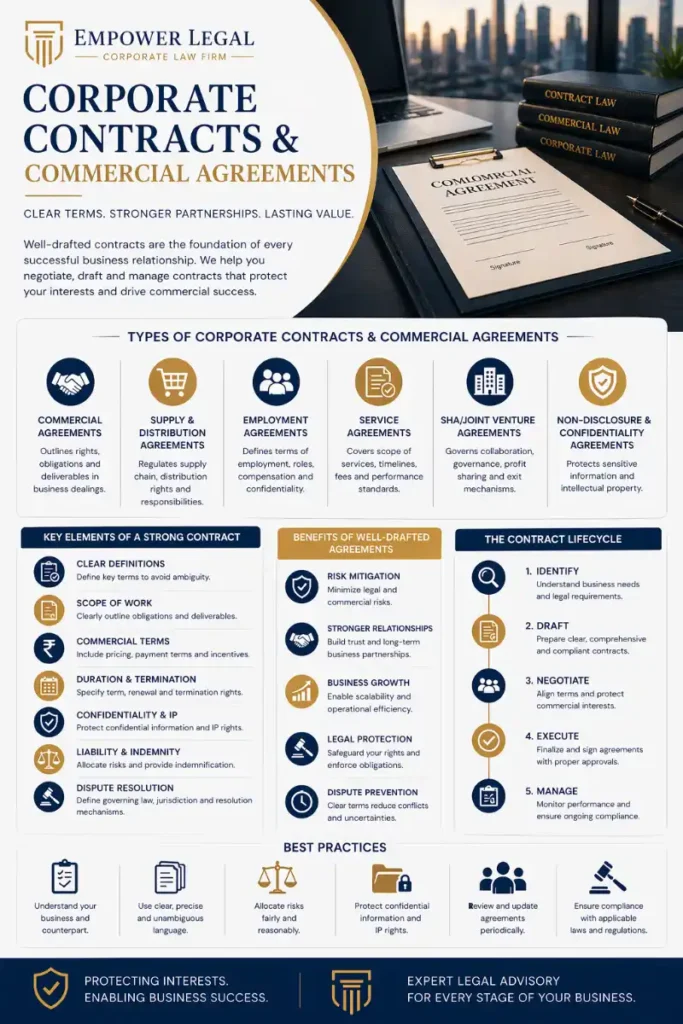
Corporate contracts represent legally binding agreements between business entities governing commercial relationships. The Indian Contract Act, 1872 establishes the foundational framework for all contractual obligations in India. Furthermore, these agreements must contain essential elements: offer, acceptance, consideration, free consent, and lawful object. Business contract attorneys ensure each element meets legal requirements for enforceability. Additionally, contracts protect intellectual property, define service expectations, and establish dispute resolution mechanisms. Companies engaging in mergers, acquisitions, partnerships, or vendor relationships require professionally drafted agreements. Subsequently, well-structured contracts minimize litigation risks and facilitate smooth business operations. Corporate lawyers in Chennai provide specialized services for businesses across manufacturing, technology, healthcare, and service sectors. Consequently, understanding contract fundamentals helps businesses make informed decisions about legal documentation. Expert legal counsel transforms complex legal jargon into actionable business strategies. Therefore, investing in quality contract drafting services protects long-term business interests significantly.
Essential Components of Enforceable Commercial Agreements
Every enforceable commercial contract must incorporate specific critical components for legal validity. Initially, clear identification of contracting parties with accurate legal names and registered addresses is mandatory. The scope of work section defines deliverables, timelines, quality standards, and performance metrics comprehensively. Payment terms specify amounts, currencies, schedules, milestones, and accepted payment methods explicitly. Moreover, confidentiality clauses protect sensitive business information, trade secrets, and proprietary data from unauthorized disclosure. Indemnity provisions allocate liability for losses, damages, or third-party claims arising from contract performance. Force majeure clauses address unforeseen circumstances like pandemics, natural disasters, or government actions. Additionally, termination provisions outline conditions for contract conclusion, notice periods, and exit procedures. Dispute resolution mechanisms specify arbitration venues, governing laws, and jurisdiction for legal proceedings. Commercial law firms in Chennai draft comprehensive agreements incorporating these elements strategically. Therefore, businesses benefit from legally sound contracts that withstand judicial scrutiny effectively.
- Parties identification with registered addresses
- Detailed scope of work and deliverables
- Clear payment terms and schedules
- Confidentiality and non-disclosure provisions
- Indemnification and liability clauses
- Force majeure provisions
- Termination conditions and notice periods
- Dispute resolution and arbitration clauses
- Governing law and jurisdiction specifications
- Amendment and modification procedures
Types of Corporate Contracts for Different Business Needs
Vendor Agreements and Supply Chain Contracts
Vendor agreements establish commercial relationships between businesses and their suppliers for goods or services. These contracts define pricing structures, delivery schedules, quality specifications, and performance standards clearly. Supply chain contracts ensure seamless procurement operations, inventory management, and timely fulfillment of customer orders. Furthermore, master service agreements (MSAs) create framework contracts for ongoing vendor relationships spanning multiple transactions. Distribution agreements authorize vendors to sell products within designated territories under specified conditions. Contract manufacturing agreements outsource production to third parties while maintaining quality control and intellectual property rights. Additionally, procurement lawyers in Chennai help businesses negotiate favorable terms protecting their commercial interests. Service level agreements (SLAs) define measurable performance metrics, uptime guarantees, and penalty provisions for non-compliance. Consequently, well-drafted vendor contracts minimize supply chain disruptions and ensure business continuity. Expert legal guidance optimizes vendor relationships while managing contractual risks effectively throughout the supply chain.
Employment Contracts and HR Documentation
Employment contracts formalize the employer-employee relationship, defining roles, responsibilities, compensation, and working conditions. These agreements must comply with the Industrial Relations Code, 2020, and other applicable labour laws. Executive employment contracts address senior management positions with specialized terms regarding bonuses, stock options, and severance packages. Non-compete agreements restrict employees from joining competitors or starting competing businesses for specified durations. Moreover, non-disclosure agreements (NDAs) protect confidential business information from unauthorized sharing with third parties. Consultancy agreements engage independent professionals for specific projects without creating employer-employee relationships under labour laws. Employee stock option plans (ESOPs) incentivize key talent through equity participation in company growth. Additionally, separation agreements document mutual settlement terms when employment relationships conclude amicably or contentiously. Employment lawyers in Chennai ensure HR contracts comply with statutory requirements while protecting business interests. Therefore, comprehensive employment documentation prevents workplace disputes and facilitates smooth HR operations across organizational hierarchies.
Intellectual Property Licensing and Technology Agreements
Intellectual property licensing agreements grant rights to use patents, trademarks, copyrights, or trade secrets commercially. Technology transfer agreements facilitate sharing of proprietary knowledge, processes, or innovations between businesses or institutions. Software licensing contracts define usage rights, restrictions, support obligations, and update provisions for digital products. Furthermore, trademark licensing allows third parties to use brand identities under controlled conditions preserving brand value. Copyright assignments transfer ownership of creative works from creators to businesses for commercial exploitation. Patent licensing agreements monetize inventions by granting manufacturing or distribution rights to licensees. Additionally, IP lawyers in Chennai structure licensing deals maximizing revenue while protecting intellectual property integrity. White label agreements enable rebranding of products or services for resale under different brand names. Technology outsourcing contracts engage service providers for software development, IT infrastructure, or technical support. Consequently, strategic IP licensing creates new revenue streams while maintaining competitive advantages in knowledge-based industries.
Commercial Litigation and Dispute Resolution Mechanisms
Contract Breach Litigation Under Bharatiya Nyaya Sanhita
Legal Remedies for Contractual Violations
Contract breach occurs when one party fails to perform obligations without lawful justification or excuse. The Bharatiya Nyaya Sanhita (BNS), 2023 addresses criminal aspects of fraud, cheating, or dishonest breach of trust. Civil remedies under contract law include damages, specific performance, injunctions, and rescission of agreements. Consequently, commercial litigation lawyers in Chennai help businesses recover losses from defaulting parties through appropriate legal channels. Liquidated damages clauses pre-determine compensation amounts for specific breaches, streamlining dispute resolution processes. Specific performance compels defaulting parties to fulfill contractual obligations when monetary damages prove inadequate. Moreover, injunctions prevent parties from violating negative covenants like non-compete or confidentiality agreements.
Rescission cancels contracts ab initio, restoring parties to pre-contractual positions in cases of fundamental breach. Additionally, quantum meruit claims recover reasonable value of services rendered when contracts terminate prematurely. Business dispute resolution requires strategic legal planning, evidence gathering, and persuasive advocacy before courts or tribunals. Therefore, experienced litigation attorneys maximize recovery while minimizing business disruption during legal proceedings.
| Remedy Type | Application | Legal Basis |
| Compensatory Damages | Financial losses from breach | Indian Contract Act, 1872 |
| Specific Performance | Unique contracts, land deals | Specific Relief Act, 1963 |
| Injunction | Prevent ongoing violations | Code of Civil Procedure |
| Rescission | Fundamental breach, fraud | Indian Contract Act, 1872 |
| Quantum Meruit | Reasonable value recovery | Contract Law Principles |
Arbitration as Alternative Dispute Resolution
Arbitration provides faster, confidential, and cost-effective dispute resolution compared to traditional court litigation. The Arbitration and Conciliation Act, 1996 governs domestic and international commercial arbitration in India. Arbitration clauses in contracts specify procedures, arbitrator selection, venue, and governing rules for dispute resolution. Furthermore, institutional arbitration through bodies like ICC, SIAC, or LCIA offers structured processes with experienced arbitrators. Ad-hoc arbitration allows parties greater flexibility in designing dispute resolution procedures tailored to specific needs. Emergency arbitration provisions enable urgent interim relief before constitution of full arbitral tribunals. Moreover, arbitration awards generally receive enforcement under the New York Convention across 160+ countries globally. Commercial arbitration lawyers in Chennai represent clients in complex domestic and cross-border arbitration proceedings. Additionally, mediation facilitates negotiated settlements through neutral third-party facilitators preserving business relationships. Consequently, businesses increasingly prefer arbitration for resolving high-value commercial disputes efficiently while maintaining confidentiality throughout proceedings.
Jurisdiction and Forum Selection for Commercial Disputes
Selecting appropriate jurisdiction significantly impacts litigation strategy, procedural timelines, and enforcement prospects. The Code of Civil Procedure, 2024 governs civil litigation procedures, jurisdiction, and appeals in Indian courts. Commercial Courts Act, 2015 establishes specialized commercial divisions for efficient resolution of high-value business disputes. District courts handle commercial disputes valued below Rs. 3 lakhs, while Commercial Courts address higher-value matters. Furthermore, High Courts exercise original jurisdiction over commercial disputes exceeding specified monetary thresholds in their territories. Supreme Court entertains commercial appeals and disputes of national importance under its extraordinary jurisdiction. Additionally, Chennai High Court’s commercial division handles complex corporate litigation for businesses across Tamil Nadu. Madras High Court Bench at Madurai addresses commercial disputes in southern Tamil Nadu districts. George Town Courts in Chennai adjudicate commercial matters for businesses registered in central Chennai areas. Consequently, strategic forum selection based on contract terms, party locations, and subject matter optimizes litigation outcomes significantly.
- Chennai High Court Commercial Division
- Madras High Court Madurai Bench
- District Commercial Courts across Tamil Nadu
- City Civil Court, George Town, Chennai
- Debt Recovery Tribunal (DRT) Chennai
- National Company Law Tribunal (NCLT) Chennai
- Intellectual Property Appellate Board
- Consumer Disputes Redressal Commission
Enforcement of Commercial Judgments and Awards
Successful litigation requires effective enforcement mechanisms to recover awarded amounts from defaulting parties. The Bharatiya Nagarik Suraksha Sanhita (BNSS), 2023 provides procedural framework for executing court decrees and orders. Execution proceedings attach debtor assets including bank accounts, immovable properties, and receivables to satisfy judgments. Furthermore, contempt proceedings punish willful disobedience of court orders, compelling compliance through coercive measures. Garnishee orders intercept payments owed to judgment debtors by third parties, directing funds toward decree satisfaction. Arrest and detention provisions exist for fraudulent debtors attempting to evade legitimate obligations dishonestly. Moreover, cross-border enforcement through bilateral treaties and conventions enables recovery from assets located internationally. Recovery lawyers in Chennai employ strategic enforcement tactics maximizing collection from judgment debtors efficiently. Additionally, insolvency proceedings under Insolvency and Bankruptcy Code, 2016 provide structured mechanisms for debt recovery. Consequently, comprehensive enforcement strategies transform favorable judgments into actual monetary recovery for aggrieved businesses.
Regulatory Compliance and Corporate Governance Requirements
Companies Act Compliance for Corporate Entities
The Companies Act, 2013 establishes comprehensive regulatory framework governing incorporation, management, and dissolution of companies. Annual general meetings (AGMs) require statutory compliance including notice periods, quorum requirements, and resolution documentation. Board meetings must follow prescribed procedures regarding frequency, quorum, voting, and minute recording. Furthermore, statutory registers including member registers, director registers, and charge registers must be maintained accurately. Annual returns filed with Registrar of Companies (ROC) disclose company particulars, shareholding patterns, and financial positions. Financial statements require certification by statutory auditors following Indian Accounting Standards (Ind AS) or relevant frameworks. Moreover, related party transactions need approval through board resolutions and shareholder consent for material transactions. Corporate compliance lawyers in Chennai ensure businesses meet statutory obligations avoiding penalties and prosecution. Additionally, companies must file beneficial ownership declarations under Section 90 preventing anonymous shell companies. Consequently, proactive compliance management prevents regulatory scrutiny while maintaining good corporate governance standards throughout organizational lifecycles.
Foreign Exchange Management and Cross-Border Transactions
Foreign Exchange Management Act (FEMA), 1999 regulates cross-border transactions, foreign investments, and external commercial borrowings. Reserve Bank of India (RBI) issues regulations governing foreign direct investment (FDI), external commercial borrowings, and overseas investments. Foreign investment compliance requires adherence to sectoral caps, approval routes, and reporting obligations. Furthermore, automatic route investments in permitted sectors require post-facto reporting to RBI within specified timelines. Government route investments need prior approval from Department for Promotion of Industry and Internal Trade (DPIIT). Transfer pricing regulations ensure arm’s length pricing for international transactions between associated enterprises. Moreover, advance pricing agreements (APAs) provide certainty regarding transfer pricing methodologies for multi-year periods. FEMA lawyers in Chennai assist businesses navigating complex foreign exchange regulations for international operations. Additionally, compounding applications settle FEMA violations through monetary penalties avoiding criminal prosecution. Consequently, professional legal guidance ensures lawful cross-border transactions supporting international business expansion strategies.
Competition Law and Anti-Trust Compliance
Competition Act, 2002 prevents anti-competitive agreements, abuse of dominant position, and regulates combinations (mergers/acquisitions). Firstly, Competition Commission of India (CCI) investigates anti-competitive practices, imposes penalties, and approves significant business combinations. Anti-competitive agreements include price-fixing, market allocation, bid-rigging, and output restrictions among competitors. Furthermore, vertical agreements between businesses at different supply chain levels require scrutiny for competition concerns. Abuse of dominant position involves unfair pricing, discriminatory practices, or predatory pricing harming market competition. Combination regulations require notification to CCI for transactions exceeding specified asset or turnover thresholds. Moreover, leniency provisions incentivize cartel participants to disclose anti-competitive conduct receiving immunity or penalty reductions. Competition lawyers in Chennai conduct compliance audits, draft competition-compliant agreements, and represent clients before CCI. Additionally, merger control filings require detailed transaction disclosures, market assessments, and competitive impact analyses. Consequently, proactive competition law compliance prevents substantial penalties while facilitating smooth business transactions.
Sector-Specific Regulatory Frameworks
Different industries face specialized regulatory frameworks requiring tailored compliance strategies and expert legal counsel. Banking sector regulations under Banking Regulation Act and RBI guidelines govern financial institutions’ operations. Insurance companies comply with Insurance Regulatory and Development Authority (IRDAI) norms for product design and distribution. Furthermore, telecommunications businesses operate under Telecom Regulatory Authority of India (TRAI) regulations and licensing requirements. Pharmaceutical companies navigate Drug Controller General of India (DCGI) approvals and pharmaceutical pricing authority guidelines.
Healthcare providers comply with Clinical Establishments Act, bio-medical waste management rules, and medical device regulations. Moreover, real estate developers follow Real Estate Regulatory Authority (RERA) requirements for project registrations and customer disclosures. Food businesses adhere to Food Safety and Standards Authority of India (FSSAI) licensing and labeling regulations. Sector-specific lawyers in Chennai provide specialized guidance navigating complex industry regulations effectively. Additionally, environmental clearances from pollution control boards and Ministry of Environment prove essential for manufacturing enterprises. Consequently, comprehensive regulatory compliance across sectors requires specialized legal expertise and continuous monitoring.
Data Protection and Privacy Compliance
Digital Personal Data Protection Act, 2023 establishes comprehensive framework for personal data processing and privacy rights. Data fiduciaries must obtain valid consent before collecting, processing, or sharing personal data of individuals. Purpose limitation requires data usage strictly for disclosed purposes without secondary processing without fresh consent. Furthermore, data minimization principles mandate collecting only necessary data adequate for specified legitimate purposes. Security safeguards including encryption, access controls, and breach notification protocols protect data from unauthorized access. Data principals enjoy rights to access, correction, erasure, and grievance redressal regarding their personal information. Moreover, cross-border data transfers require adherence to prescribed conditions ensuring adequate protection in destination countries. Data protection lawyers in Chennai help businesses implement compliant privacy policies, consent mechanisms, and governance frameworks. Additionally, data protection impact assessments identify risks in processing activities requiring enhanced protective measures. Consequently, robust data protection compliance builds customer trust while avoiding substantial penalties under privacy regulations.
Mergers, Acquisitions and Corporate Restructuring
Due Diligence in M&A Transactions
Due diligence represents systematic investigation of target companies before finalizing mergers, acquisitions, or investment transactions. Legal due diligence examines corporate structure, regulatory compliance, litigation risks, and contractual obligations comprehensively. Financial due diligence analyzes historical performance, asset valuations, liabilities, and financial projections for informed decision-making. Furthermore, operational due diligence assesses business processes, supply chains, customer relationships, and operational efficiencies. Tax due diligence identifies tax liabilities, pending assessments, transfer pricing risks, and optimization opportunities. Intellectual property due diligence verifies ownership, validity, and enforceability of patents, trademarks, and copyrights. Moreover, environmental due diligence assesses compliance with pollution control norms and potential environmental liabilities. M&A lawyers in Chennai coordinate comprehensive due diligence exercises identifying deal-breakers and negotiation leverage points. Additionally, due diligence findings inform transaction structuring, pricing adjustments, and risk allocation through indemnity provisions. Consequently, thorough due diligence prevents post-transaction surprises enabling successful business combinations.
- Corporate structure and shareholding verification
- Material contracts and customer agreements review
- Pending litigation and regulatory investigations
- Employee contracts and labour compliance
- Real estate titles and property encumbrances
- Intellectual property ownership verification
- Tax assessments and contingent liabilities
- Environmental permits and compliance status
- Financial statement analysis and projections
- Regulatory approvals and licensing status
Transaction Documentation and Closing
M&A transaction documentation includes share purchase agreements, asset transfer agreements, and ancillary transaction documents. Share purchase agreements define purchase price, payment terms, representations, warranties, and indemnification provisions comprehensively. Closing conditions specify regulatory approvals, third-party consents, and other prerequisites for transaction completion. Furthermore, disclosure schedules detail exceptions to representations and warranties identified during due diligence processes. Escrow arrangements hold portions of purchase consideration addressing post-closing adjustments or indemnification claims. Non-compete and non-solicitation covenants prevent sellers from competing or poaching employees post-transaction. Moreover, transition services agreements ensure continuity of critical services during post-merger integration periods. Corporate transaction lawyers in Chennai draft comprehensive documentation protecting client interests throughout transaction lifecycles. Additionally, regulatory filings with CCI, SEBI, sectoral regulators, and ROC ensure lawful transaction completion. Consequently, meticulous documentation and closing coordination transform negotiated deals into successfully completed business combinations.
Post-Merger Integration and Compliance
Post-merger integration combines organizational structures, systems, cultures, and operations of merged entities efficiently. Integration planning addresses human resources consolidation, technology system integration, and process harmonization strategies. Regulatory compliance requires updating registrations, licenses, and approvals reflecting the new corporate structure. Furthermore, employee communication and change management programs minimize resistance ensuring smooth organizational transitions. Contract novation or assignment transfers existing commercial agreements to the merged entity with counterparty consents. Customer retention strategies maintain business relationships preventing attrition during integration uncertainties. Moreover, brand consolidation or portfolio rationalization optimizes market positioning post-transaction. Integration lawyers in Chennai facilitate legal compliance during organizational restructuring and consolidation processes. Additionally, synergy realization tracking measures achievement of projected cost savings and revenue enhancements. Consequently, systematic integration planning maximizes transaction value while minimizing disruption to ongoing business operations.
Government Departments and Regulatory Authorities
Corporate businesses interact with multiple government departments and regulatory authorities throughout their operational lifecycles. Ministry of Corporate Affairs (MCA) administers Companies Act through Registrar of Companies offices across India. Department for Promotion of Industry and Internal Trade (DPIIT) handles industrial licensing and foreign investment approvals. Furthermore, Goods and Services Tax Network (GSTN) administers indirect tax compliance for businesses nationwide. Income Tax Department oversees direct tax compliance, assessments, and disputes for corporate taxpayers. Reserve Bank of India regulates banking, foreign exchange, and financial sector activities comprehensively. Moreover, Securities and Exchange Board of India (SEBI) governs capital markets, listed companies, and investment intermediaries. Competition Commission of India enforces competition law preventing anti-competitive practices across industries. State pollution control boards regulate environmental compliance for manufacturing and industrial establishments. Additionally, labour departments enforce employment laws, wage regulations, and workplace safety standards. Consequently, navigating multiple regulatory authorities requires coordinated compliance strategies and expert legal support.
| Authority | Jurisdiction | Key Functions |
| Ministry of Corporate Affairs | Company Law | Company registrations, compliance monitoring |
| Reserve Bank of India | Banking & FEMA | Foreign exchange, banking regulations |
| SEBI | Capital Markets | Securities regulation, investor protection |
| Competition Commission | Anti-trust | Competition law enforcement |
| GSTN | Indirect Taxation | GST compliance, returns processing |
| DPIIT | Industrial Policy | FDI approvals, startup recognition |
Tribunals and Specialized Forums for Corporate Disputes
Specialized tribunals provide expert adjudication for corporate and commercial disputes across various regulatory domains. National Company Law Tribunal (NCLT) handles company law matters including insolvency, mergers, oppression, and mismanagement cases. National Company Law Appellate Tribunal (NCLAT) hears appeals from NCLT orders and Competition Commission decisions. Furthermore, Debt Recovery Tribunal (DRT) facilitates recovery of debts owed to banks and financial institutions. Debt Recovery Appellate Tribunal (DRAT) adjudicates appeals against DRT orders and recovery proceedings.
Income Tax Appellate Tribunal (ITAT) resolves tax disputes between taxpayers and income tax authorities. Moreover, Customs, Excise and Service Tax Appellate Tribunal (CESTAT) handles indirect tax disputes. GST Appellate Tribunal adjudicates goods and services tax disputes across India’s federal tax structure. Intellectual Property Appellate Board addresses patent, trademark, and copyright disputes arising from Controller decisions. Additionally, Securities Appellate Tribunal (SAT) hears appeals against SEBI orders regarding securities market violations. Consequently, tribunal litigation requires specialized expertise understanding technical statutory frameworks and procedural nuances.
Law Enforcement Agencies in Corporate Crimes
Corporate crimes involving fraud, forgery, or criminal breach of trust require investigation by specialized law enforcement. Economic Offences Wing (EOW) investigates financial frauds, Ponzi schemes, and economic crimes involving corporate entities. Central Bureau of Investigation (CBI) handles high-value corruption, banking frauds, and multi-state corporate crime cases. Furthermore, Serious Fraud Investigation Office (SFIO) investigates complex corporate frauds under Companies Act and related statutes. Enforcement Directorate (ED) probes money laundering, foreign exchange violations, and proceeds of crime cases. Directorate of Revenue Intelligence (DRI) investigates customs duty evasion, smuggling, and trade-based money laundering. Moreover, local police stations including Anna Nagar, George Town, and Egmore stations handle initial complaints. Criminal lawyers in Chennai represent corporate clients during investigations and prosecutions by enforcement agencies. Additionally, Bharatiya Sakshya Adhiniyam (BSA), 2023 governs evidence admissibility in criminal proceedings against corporate entities. Consequently, professional legal representation protects corporate interests during criminal investigations and prosecutions.
- Economic Offences Wing (EOW), Chennai
- Central Bureau of Investigation (CBI)
- Serious Fraud Investigation Office (SFIO)
- Enforcement Directorate (ED), Chennai
- Directorate of Revenue Intelligence (DRI)
- Anna Nagar Police Station, Chennai
- George Town Police Station, Chennai
- Egmore Police Station, Chennai
- Cyber Crime Police Station, Chennai
- Commercial Tax Intelligence Wing
Legal Support Services for Corporate Success
Preventive Legal Advisory for Business Protection
Preventive legal advisory helps businesses identify and mitigate risks before they escalate into disputes. Legal audits systematically review contracts, compliance status, and governance practices identifying potential vulnerabilities. Contract review services ensure existing agreements protect business interests and comply with current legal standards. Furthermore, compliance calendars track regulatory filing deadlines preventing inadvertent defaults and associated penalties. Legal opinion services provide authoritative guidance on complex legal issues informing strategic business decisions. Risk assessment frameworks evaluate potential legal exposures from proposed transactions or operational changes. Moreover, policy drafting services create internal governance documents including code of conduct and whistleblower policies. Corporate advisory lawyers in Chennai provide ongoing legal support addressing business challenges proactively. Additionally, legal training programs educate management and staff on compliance requirements and best practices. Consequently, preventive legal services reduce litigation costs while enabling informed, legally compliant business operations.
Specialized Legal Services for Startups and MSMEs
Startups and micro, small, and medium enterprises (MSMEs) require tailored legal support addressing their unique challenges. Business incorporation services facilitate company registration, LLP formation, or partnership firm establishment efficiently. Founder agreements define equity allocation, roles, decision-making authority, and exit provisions among founding team members. Furthermore, investor agreements including term sheets, shareholder agreements, and subscription agreements govern funding relationships. Intellectual property protection through trademark registrations, patent filings, and copyright registrations safeguards innovations. Employee contracts, stock option plans, and HR policies establish compliant employment frameworks supporting growth. Moreover, vendor agreements, customer contracts, and service agreements document commercial relationships systematically. Startup lawyers in Chennai provide cost-effective legal solutions supporting entrepreneurial ventures from inception through growth. Additionally, government scheme registrations including Startup India, MSME certification, and tax incentives maximize available benefits. Consequently, accessible legal support empowers startups and MSMEs competing effectively in dynamic markets.
Ongoing Legal Retainer Services
Legal retainer arrangements provide businesses with dedicated legal counsel available for ongoing advisory and transactional support. Retainer agreements define scope of services, response timelines, and fee structures for predictable legal budgeting. Monthly retainer services typically include contract reviews, compliance guidance, and routine legal consultations. Furthermore, dedicated legal teams develop deep understanding of business operations enabling more strategic, contextual advice. Priority access ensures urgent legal issues receive immediate attention from experienced corporate lawyers. Document repository management maintains organized records of contracts, compliance certificates, and legal correspondence. Moreover, proactive compliance monitoring alerts businesses to regulatory changes affecting their operations promptly. Corporate retainer lawyers in Chennai function as external legal departments for businesses lacking in-house counsel. Additionally, retainer relationships facilitate seamless coordination during crises, transactions, or regulatory investigations. Consequently, retainer arrangements provide cost-effective, responsive legal support fostering long-term business relationships.
International Commercial Law Practice
Cross-border transactions require expertise navigating multiple legal systems, international treaties, and foreign regulations simultaneously. International contract drafting addresses choice of law, jurisdiction, currency, and dispute resolution for multi-jurisdictional agreements. Foreign investment structuring optimizes tax efficiency, regulatory compliance, and repatriation rights for international investors. Furthermore, international arbitration provides neutral forums for resolving cross-border commercial disputes efficiently. Trade compliance ensures adherence to export controls, sanctions, customs regulations, and international trade agreements. Transfer pricing documentation justifies related-party transaction pricing defending against double taxation risks. Moreover, bilateral investment treaty protections shield foreign investors from discriminatory or arbitrary governmental actions. International commercial lawyers in Chennai represent clients in complex cross-border transactions and disputes. Additionally, treaty interpretation services analyze international obligations affecting business operations across multiple countries. Consequently, specialized international law expertise enables successful global business expansion.
Technology and Digital Business Legal Services
Technology businesses face unique legal challenges requiring specialized expertise in digital commerce and innovation. Software licensing agreements define usage rights, restrictions, support obligations, and intellectual property ownership clearly. SaaS agreements establish service delivery terms, uptime commitments, data security, and subscription management processes. Furthermore, API licensing contracts govern third-party integration rights, usage restrictions, and technical support provisions. Privacy policies and terms of service provide legal disclosures required for websites and digital platforms. E-commerce regulations compliance ensures adherence to consumer protection, payment gateway, and digital transaction requirements. Moreover, cybersecurity frameworks address data breach response, incident reporting, and security audit requirements. Technology lawyers in Chennai support fintech, healthtech, edtech, and SaaS companies with specialized legal guidance. Additionally, blockchain and cryptocurrency legal advisory navigates evolving regulatory landscape for digital asset businesses. Consequently, technology-focused legal services enable innovation while managing digital business risks effectively.
Why Choose Empower Legal for Corporate Contract Services
Empower Legal combines deep legal expertise with practical business acumen delivering comprehensive corporate law solutions. Our senior advocates possess extensive experience across diverse industries including technology, manufacturing, healthcare, and services. Client-centric approach ensures personalized attention understanding unique business contexts informing tailored legal strategies. Furthermore, our team maintains current knowledge of evolving regulations including recent legislative changes affecting businesses. Efficient service delivery balances quality legal work with responsive turnaround times meeting business deadlines consistently. Transparent fee structures provide predictable legal costs without hidden charges or billing surprises. Moreover, our Chennai offices in accessible locations facilitate convenient consultations and document signings for clients. Technology-enabled practice management ensures secure document sharing, real-time updates, and seamless client communication. Additionally, our network includes specialized counsel for niche areas providing comprehensive legal coverage. Consequently, businesses partnering with Empower Legal receive exceptional legal support driving commercial success sustainably.
Frequently Asked Questions About Corporate Contracts and Commercial Law
A contract becomes enforceable when it contains offer, acceptance, consideration, free consent, lawful object, and competent parties meeting Indian Contract Act requirements.
Alternative dispute resolution through arbitration, mediation, or conciliation provides faster, confidential, cost-effective resolution preserving business relationships compared to court litigation.
M&A transactions may require Competition Commission approval, SEBI clearance for listed companies, sectoral regulator permissions, and RBI approval for foreign investment transactions.
FEMA governs foreign investments, external borrowings, export-import transactions, and overseas investments through RBI regulations requiring compliance reporting and prior approvals.
IP licensing agreements, confidentiality clauses, assignment provisions, and infringement remedies protect patents, trademarks, copyrights, and trade secrets in commercial contracts effectively.
Take Action: Protect Your Business with Expert Legal Support
Corporate contracts and commercial law complexity demands professional legal expertise protecting your business interests effectively. Empower Legal provides comprehensive legal services from contract drafting through dispute resolution supporting businesses across industries. Our experienced advocates understand the Chennai business environment delivering practical, business-focused legal solutions. Don’t wait until disputes arise—proactive legal planning prevents costly litigation and business disruptions. Contact Empower Legal today for a confidential consultation regarding your corporate contract and commercial law needs. Schedule an appointment at our Chennai offices to discuss how our legal expertise can support your business objectives. Let our senior advocates become your trusted legal partners in building and protecting your commercial success.
Empower Legal: Corporate Law Firm – Your Partner in Business Success
Read More
- Mergers & Acquisitions (M&A): Complete Legal Guide for Corporate Transactions in India
- Empower Legal: Corporate Law firm | Company Lawyers 24/7
- Corporate Litigation: How to find the Best Legal Support?
- Company Law Compliance Services | Trusted Expert Solutions
- Foreign exchange Litigation: How to find the Best Legal Support?