
Import Export Code (IEC) Registration – Trading companies require an Import Export Code before starting cross-border commercial activities in India. Therefore, businesses should obtain IEC registration during the initial setup stage. The Directorate General of Foreign Trade issues IEC under the Foreign Trade (Development and Regulation) Act, 1992. Banks generally require this code for processing foreign remittances connected with imports and exports. Moreover, customs authorities verify IEC details during clearance procedures. Trading companies dealing with machinery, electronics, textiles, chemicals, food products, and e-commerce exports usually require this registration. Proper compliance also helps businesses access export incentives and Government trade facilitation schemes. Jurisdiction depends upon the business location and DGFT regional authorities. Relevant departments include DGFT, Customs, RBI, GST authorities, Income Tax Department, and SEZ authorities. Early registration prevents shipment delays, banking restrictions, and unnecessary regulatory complications during international trade operations.
Import Export Code (IEC) Registration for Trading Companies – Empower Legal – Corporate Law Firm
Understanding the Import Export Code Under Indian Law
IEC is a unique ten-digit business identification number issued by the Directorate General of Foreign Trade. Consequently, companies cannot lawfully conduct most import or export transactions without obtaining this code. The Foreign Trade (Development and Regulation) Act, 1992 and Foreign Trade Policy govern IEC registration and related compliance obligations. Businesses must also comply with FEMA, Customs Act, GST laws, and RBI regulations for foreign exchange transactions. Lawyers examine the business structure, authorized signatories, bank details, and GST registration before filing applications. Additionally, companies should ensure accurate PAN and address records across all regulatory databases. IEC generally remains valid for the lifetime of the entity, subject to annual updates where required. Non-compliance may result in customs delays, banking issues, DGFT penalties, or suspension of trade-related benefits under applicable regulations.
Eligibility Criteria for IEC Registration
Most business entities engaged in international trade can apply for IEC registration through the DGFT portal. Therefore, companies should confirm their legal constitution before submitting applications. Proprietorships, partnership firms, LLPs, private limited companies, public companies, trusts, societies, and certain NGOs may apply if they undertake import or export activities. Foreign companies establishing operations in India may also require IEC depending upon their business structure. Furthermore, applicants should maintain active PAN, bank accounts, and valid business addresses. Basic eligibility requirements include:
- Permanent Account Number of the entity.
- Valid business address proof.
- Active bank account.
- Mobile number and email address.
- Authorized signatory details.
- Digital access for DGFT filing.
- GST registration, where applicable.
- Incorporation documents for companies and LLPs.
Accurate eligibility assessment reduces rejection risks and accelerates DGFT processing.
Key Documents Required for Trading Companies
Proper documentation forms the foundation of a successful IEC registration application. Accordingly, trading companies should organize all supporting records before accessing the DGFT portal. Missing or inconsistent documents often delay approval and require additional clarification. Lawyers usually verify document consistency across PAN, GST, bank, and incorporation records before submission. Additionally, companies should maintain updated corporate records for future amendments and compliance reviews.
| Document | Purpose |
|---|---|
| PAN Card | Primary tax identification |
| Certificate of Incorporation | Entity formation proof |
| Address Proof | Registered office verification |
| Cancelled Cheque | Bank account verification |
| Board Resolution | Authorized signatory approval |
| GST Registration | Indirect tax linkage |
Complete documentation significantly improves approval speed and reduces compliance objections.
Laws Governing IEC and Foreign Trade Compliance
Several Indian laws regulate IEC registration and international trading activities. Consequently, businesses should understand the broader legal framework beyond the DGFT application process. The Foreign Trade (Development and Regulation) Act, 1992 remains the primary legislation governing import-export activities. FEMA, 1999 regulates foreign exchange transactions and reporting obligations. The Customs Act, 1962 governs import and export clearance procedures. GST laws apply to taxable supplies and export documentation. The Companies Act, 2013 regulates corporate governance for registered companies. Civil disputes may proceed under the Code of Civil Procedure, 1908 before competent courts. Fraudulent documents, forged certificates, or cheating may attract the Bharatiya Nyaya Sanhita, 2023. Investigation procedures follow the Bharatiya Nagarik Suraksha Sanhita, 2023, while evidentiary matters follow the Bharatiya Sakshya Adhiniyam, 2023. Proper legal compliance protects trading companies from penalties and operational disruptions.
IEC Registration Process and Government Authorities
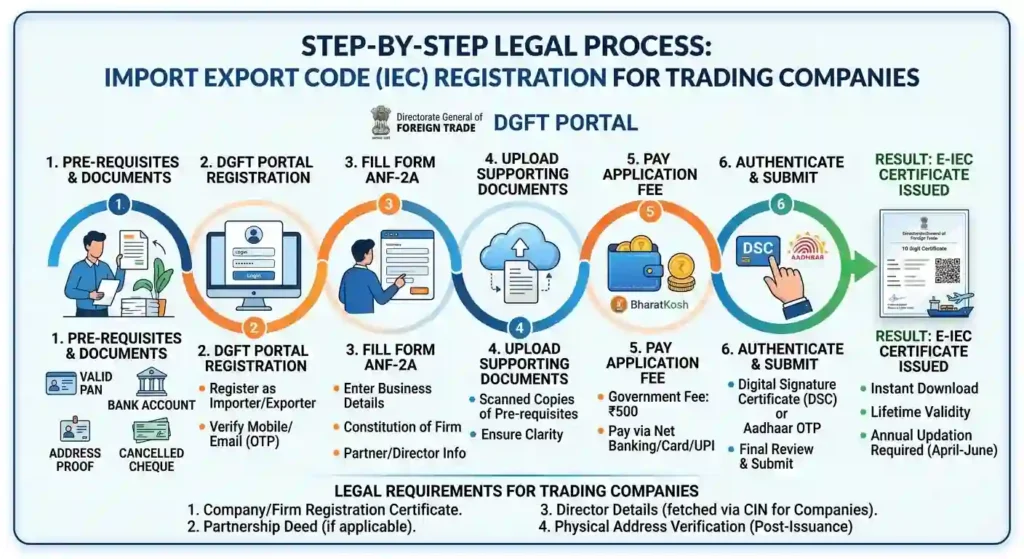
Trading companies should follow the prescribed online procedure to obtain an Import Export Code efficiently. Therefore, applicants should verify every document before submitting the DGFT application. Businesses generally file the application through the DGFT portal using authenticated credentials and supporting documents. Authorities examine the application, verify business details, and issue the IEC upon successful scrutiny. Moreover, applicants should maintain consistency between PAN, GST, bank records, and incorporation documents. Important Government authorities include the Directorate General of Foreign Trade, Central Board of Indirect Taxes and Customs, Reserve Bank of India, GST Department, Income Tax Department, Ministry of Commerce and Industry, Registrar of Companies, and Special Economic Zone authorities where applicable. Timely compliance with post-registration obligations supports uninterrupted international trade and regulatory confidence.
Common Legal Issues and Compliance Risks
Trading companies may face legal challenges before or after obtaining IEC registration. Consequently, proactive legal compliance reduces regulatory disputes and business interruptions. Errors in business information, banking records, or statutory filings frequently delay approvals or create operational risks. Lawyers identify compliance gaps before authorities raise objections. Additionally, regular regulatory reviews strengthen long-term business operations. Common legal issues include:
- Incorrect PAN linkage.
- Address mismatch.
- Invalid bank details.
- Non-updated IEC particulars.
- Customs compliance violations.
- FEMA reporting defaults.
- GST inconsistencies.
- Import policy violations.
- Export documentation deficiencies.
- DGFT notice compliance.
Early legal intervention minimizes penalties and supports smooth import-export operations.
Legal Remedies and Dispute Resolution
Businesses retain several statutory remedies when regulatory disputes affect IEC registration or international trade activities. Therefore, companies should review every departmental communication before responding. Legal professionals prepare replies, representations, appeals, and writ petitions where circumstances justify judicial intervention. Proper documentation strengthens every legal remedy. Furthermore, timely responses frequently prevent prolonged litigation. Available remedies include:
| Legal Issue | Available Remedy |
|---|---|
| IEC rejection | Fresh application or representation |
| DGFT notice | Detailed written reply |
| Customs dispute | Statutory appeal |
| FEMA issue | Regulatory compliance |
| Import restriction | Legal representation |
| Export benefit denial | Departmental appeal |
| Administrative action | High Court remedy where maintainable |
Competent forums include DGFT authorities, Customs authorities, Appellate Authorities, High Courts, and other statutory forums according to applicable law.
Legal Support from Empower Legal – Corporate Law Firm
Empower Legal – Corporate Law Firm delivers comprehensive legal services for businesses engaged in international trade. Accordingly, the firm assists startups, MSMEs, manufacturers, exporters, importers, LLPs, and companies throughout the IEC lifecycle. Lawyers advise clients regarding eligibility, documentation, DGFT filings, FEMA compliance, Customs procedures, GST coordination, and regulatory approvals. Moreover, the firm represents businesses before DGFT authorities, Customs departments, High Courts, appellate forums, and other competent authorities whenever disputes arise. Services include:
- IEC registration advisory.
- Document verification.
- DGFT application filing.
- FEMA compliance.
- Customs advisory.
- Regulatory representation.
- Legal notices.
- Appeal drafting.
Strategic legal support reduces compliance risks while enabling efficient and legally compliant international business operations.
Best Practices After Obtaining IEC Registration
Obtaining an IEC is only the beginning of international trade compliance. Therefore, trading companies should maintain continuous regulatory discipline after registration. Businesses should update IEC details whenever changes occur in company structure, address, directors, bank information, or authorized representatives. Regular verification of DGFT records prevents operational difficulties during import and export transactions. Moreover, companies should reconcile customs documents, GST returns, foreign exchange records, and accounting entries regularly. Proper documentation supports audits and regulatory inspections. Businesses should maintain:
- Import and export invoices.
- Shipping documents.
- Customs declarations.
- Foreign remittance records.
- GST export records.
- Banking confirmations.
- DGFT communications.
- Contractual agreements.
Additionally, legal reviews help identify compliance gaps before penalties arise. Effective compliance management protects business reputation and supports sustainable international trading operations.
Why Choose Empower Legal – Corporate Law Firm
Empower Legal – Corporate Law Firm provides reliable legal assistance for IEC registration and international trade compliance. Accordingly, the firm combines corporate law knowledge with regulatory expertise to support trading companies. Every client receives customized guidance based on business structure, industry requirements, and transaction objectives. Lawyers assist with IEC applications, DGFT compliance, Customs issues, FEMA regulations, GST coordination, and commercial documentation. Furthermore, the firm represents clients before Government departments, tribunals, appellate authorities, and courts whenever required. The legal team focuses on preventing disputes through proper compliance planning. Whether businesses import raw materials, export finished products, or operate global trading platforms, Empower Legal provides practical solutions. Professional legal support helps companies complete registration efficiently and conduct international trade activities with confidence.
Frequently Asked Questions
Q1. Is IEC registration mandatory for import and export businesses in India?
Yes. Most businesses importing or exporting goods and services require IEC registration from DGFT before conducting international trade transactions.
Q2. Which authority issues the Import Export Code?
The Directorate General of Foreign Trade issues IEC registration through its official online portal under applicable foreign trade regulations.
Q3. What documents are required for IEC registration?
Businesses generally require PAN, address proof, bank details, incorporation documents, and authorized signatory information for IEC application processing.
Q4. Can startups and MSMEs apply for IEC registration?
Yes. Startups, MSMEs, proprietorships, partnerships, LLPs, and companies can apply for IEC if they undertake eligible import-export activities.
Q5. What happens if a company trades without IEC registration?
Trading without required IEC may cause customs issues, shipment delays, banking restrictions, and possible regulatory action under applicable laws.
Q6. Why should companies hire a lawyer for IEC registration?
A corporate lawyer ensures accurate filings, verifies documents, handles regulatory issues, and provides compliance support for smooth international trade operations.
Read More
- Shops and Establishments Act Registration: State-wise Requirements
- Professional Tax Registration: State-wise Guide and Procedures
- ESI Registration for Companies: Employee Health Insurance Guide
- EPFO Registration: Provident Fund Compliance for Employers
- GST Registration for Companies: When and How to Register
- Directorate General of Foreign Trade (DGFT) – IEC Registration Portal