
FSSAI License for Food Businesses – Food businesses must comply with Indian food safety laws before commencing operations. Therefore, obtaining the appropriate FSSAI license protects both consumers and businesses. Empower Legal – Corporate Law Firm provides comprehensive legal assistance for FSSAI registration, license renewal, modification, compliance audits, regulatory inspections, product approvals, and food business licensing. Our legal team advises manufacturers, importers, exporters, wholesalers, retailers, cloud kitchens, restaurants, hotels, caterers, food transporters, warehouses, and e-commerce food operators. Every application undergoes detailed legal scrutiny before submission. Furthermore, proper documentation reduces approval delays and regulatory objections. Compliance also strengthens business credibility and consumer confidence. Timely legal guidance minimizes operational risks while ensuring adherence to the Food Safety and Standards Act, 2006 and applicable regulations. Professional legal support ultimately enables businesses to operate confidently within India’s evolving food safety framework.
FSSAI License for Food Businesses: Types and Registration Process – Empower Legal – Corporate Law Firm
Importance of FSSAI Licensing for Food Businesses
Every food business handling manufacture, storage, distribution, transportation, import, or sale requires statutory compliance. Therefore, obtaining the correct FSSAI license remains a legal necessity. Empower Legal – Corporate Law Firm evaluates business activities, turnover, production capacity, and operational scope before recommending the appropriate registration category. Proper licensing protects businesses from penalties, suspension, cancellation, and unnecessary regulatory disputes. Additionally, licensed businesses gain greater consumer trust and commercial opportunities. Regulatory compliance also facilitates participation in government tenders and organized retail markets. Our advocates assist clients throughout application preparation, documentation, regulatory correspondence, and renewal procedures. Careful legal planning significantly reduces compliance risks. Consequently, businesses maintain uninterrupted operations while meeting statutory obligations imposed by the Food Safety and Standards Authority of India and related regulatory authorities.
Legal Framework Governing FSSAI Registration
The Food Safety and Standards Act, 2006 establishes India’s comprehensive food safety framework. Therefore, every Food Business Operator must comply with applicable licensing provisions. The Food Safety and Standards Authority of India regulates licensing, food standards, inspections, enforcement, and compliance. State Food Safety Departments administer licensing within their jurisdictions according to statutory regulations. Our legal team ensures complete compliance before application submission. Additionally, electronic records receive recognition under the Bharatiya Sakshya Adhiniyam, 2023 (BSA) wherever evidentiary requirements arise. Fraud, document forgery, food adulteration involving criminal liability, or related offences may attract relevant provisions under the Bharatiya Nyaya Sanhita, 2023 (BNS), with investigations governed by the Bharatiya Nagarik Suraksha Sanhita, 2023 (BNSS). Proper legal advice protects businesses while reducing regulatory exposure and licensing delays.
Food Businesses Requiring FSSAI Registration or License
Different businesses require different categories of FSSAI approval. Therefore, identifying the correct classification remains essential before commencing operations. Empower Legal – Corporate Law Firm assists numerous Food Business Operators, including:
- Food manufacturers
- Restaurants
- Hotels
- Cafes
- Cloud kitchens
- Bakeries
- Caterers
- Food importers
- Food exporters
- Retail food stores
- Wholesalers
- Food transporters
- Warehousing operators
- Dairy businesses
- E-commerce food platforms
Every business receives individual legal assessment before selecting the applicable registration or licensing category. Furthermore, our advocates ensure statutory compliance according to operational scale, turnover, and business activities. Proper classification prevents licensing disputes and unnecessary regulatory penalties.
Types of FSSAI Licenses
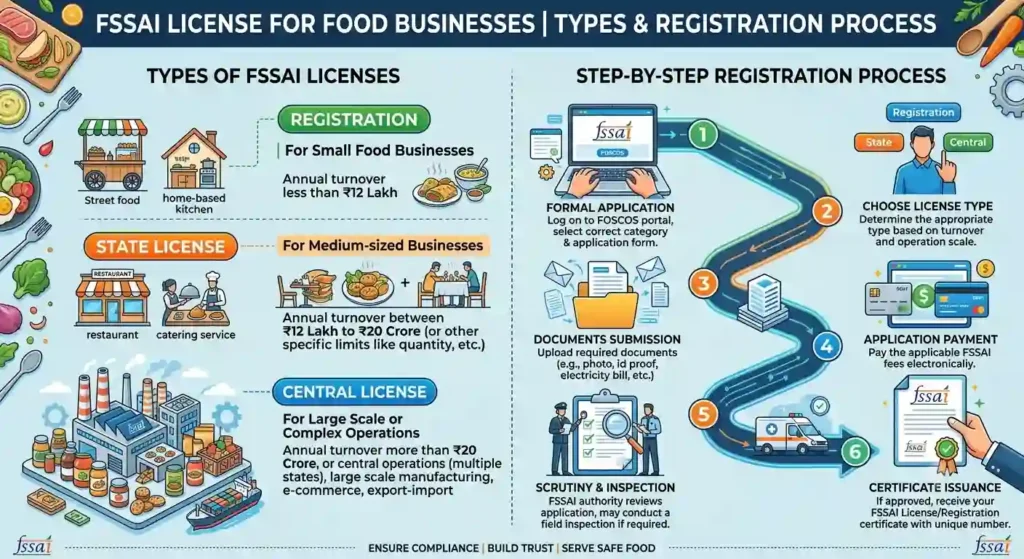
The applicable FSSAI approval depends upon turnover, production capacity, and business operations. Therefore, businesses should obtain the correct category before commencing commercial activities. The three primary categories include Basic FSSAI Registration, State FSSAI License, and Central FSSAI License. Small Food Business Operators generally require Basic Registration according to prescribed eligibility. Medium-sized businesses usually require State Licensing. Larger businesses, importers, exporters, and certain specialized operators commonly require Central Licensing. Our legal team evaluates eligibility before recommending the appropriate category. Additionally, we prepare legally compliant applications supported by complete documentation. Proper licensing strengthens regulatory compliance while reducing inspection-related complications. Consequently, businesses avoid unnecessary penalties and maintain uninterrupted commercial operations across India.
Benefits of Professional Legal Assistance for FSSAI Licensing
Professional legal guidance improves application accuracy while reducing approval delays. Therefore, businesses benefit from experienced regulatory support throughout the licensing process. Our advocates review constitutional documents, business registrations, premises details, food safety management systems, product categories, and operational compliance before filing applications. Proper legal review minimizes documentation errors and regulatory objections. Additionally, our team responds promptly to notices, inspection queries, and licensing authorities whenever clarification becomes necessary. Careful compliance planning also supports future expansion, renewal, modification, and additional product approvals. Consequently, businesses receive practical legal solutions that strengthen statutory compliance while supporting sustainable commercial growth. Empower Legal – Corporate Law Firm remains committed to helping Food Business Operators achieve lawful, efficient, and successful FSSAI registration.
FSSAI Registration Process for Food Business Operators
Obtaining an FSSAI license requires systematic preparation and accurate documentation. Therefore, Empower Legal – Corporate Law Firm guides businesses through every statutory requirement. Our legal team evaluates turnover, manufacturing capacity, food categories, operational locations, and business structure before preparing the application. Proper legal review minimizes regulatory objections and delays. Additionally, applicants should maintain accurate business records, identity documents, premises proof, and food safety compliance documents. Licensing authorities may inspect the business premises whenever applicable. Our advocates also respond to clarification notices and compliance requirements during processing. Every application follows the Food Safety and Standards Act, 2006 and applicable regulations. Consequently, businesses receive legally compliant registrations that support uninterrupted commercial operations while strengthening consumer confidence and regulatory compliance.
Step-by-Step FSSAI Registration Procedure
Food Business Operators should follow a structured process before commencing operations. Therefore, careful planning improves approval efficiency and legal compliance.
- Identify the applicable FSSAI registration category.
- Verify business turnover and operational activities.
- Collect statutory business documents.
- Prepare Food Safety Management documentation.
- Complete the prescribed application.
- Upload supporting documents.
- Pay the applicable government fee.
- Respond to inspection or clarification requests.
- Obtain the FSSAI Registration Certificate or License.
- Display the license at the business premises.
Each stage requires careful legal verification. Furthermore, timely compliance reduces application delays while supporting successful licensing before the competent Food Safety Authority.
Documents Required for FSSAI Registration
Proper documentation forms the foundation of successful FSSAI licensing. Therefore, businesses should maintain complete and accurate statutory records.
- PAN card
- Aadhaar or identity proof
- Address proof
- Business registration certificate
- Partnership deed or incorporation documents
- GST registration, where applicable
- Premises ownership or rental proof
- Food Safety Management Plan
- Product details
- Manufacturing unit information
- Import Export Code, where applicable
- Water analysis report, where required
- Equipment details
- Director or partner information
- Passport-size photographs
Our advocates verify every document before submission. Additionally, legal scrutiny minimizes regulatory objections and improves approval timelines for Food Business Operators.
Common Compliance Issues and Legal Remedies
Food businesses frequently encounter regulatory challenges during operations. Therefore, timely legal intervention protects licenses and commercial continuity.
| Compliance Issue | Legal Remedy | Competent Authority |
|---|---|---|
| Delayed application | Fresh submission or rectification | FSSAI Authority |
| Incorrect license category | License modification | Licensing Authority |
| Show cause notice | Legal reply | Designated Officer |
| License suspension | Statutory representation | Food Safety Authority |
| Food safety inspection | Compliance response | State Food Safety Department |
| Product misbranding | Corrective compliance | FSSAI |
| Food adulteration allegations | Legal defence | Competent Court |
| License renewal delay | Renewal application | Licensing Authority |
Appropriate legal advice helps businesses resolve compliance issues quickly. Consequently, professional representation reduces operational disruptions and regulatory exposure.
Legal Issues Faced by Food Businesses
Food Business Operators encounter several legal risks during commercial operations. Therefore, preventive legal compliance remains essential for sustainable business growth. Common legal issues include:
- License rejection
- License suspension
- License cancellation
- Food adulteration allegations
- Misbranding disputes
- Labelling violations
- Packaging non-compliance
- Hygiene deficiencies
- Regulatory inspections
- Consumer complaints
- Product recall matters
- Import compliance issues
- Food contamination claims
- False advertising concerns
- Renewal disputes
Our legal team evaluates every issue according to statutory provisions and regulatory guidelines. Furthermore, timely legal representation strengthens compliance while minimizing penalties and litigation risks.
Corporate Legal Support for FSSAI Compliance
Empower Legal – Corporate Law Firm delivers comprehensive legal support for Food Business Operators across India. Our professional services include:
- FSSAI Registration
- State License applications
- Central License applications
- License renewal
- License modification
- Compliance audits
- Regulatory inspections
- Legal notices
- Product compliance advice
- Import licensing support
- Food labelling review
- Packaging compliance
- Representation before authorities
- Appeal assistance
- Ongoing compliance advisory
Every service focuses upon statutory compliance and commercial continuity. Additionally, our advocates provide practical legal solutions tailored to business requirements. Comprehensive legal support ultimately protects Food Business Operators while ensuring compliance with India’s evolving food safety regulations.
Government Authorities, Enforcement and Legal Compliance
The Food Safety and Standards Authority of India regulates food safety across the country. Therefore, businesses should understand the responsibilities of every regulatory authority. State Food Safety Departments supervise inspections, sampling, licensing, and enforcement within their jurisdictions. Designated Officers and Food Safety Officers monitor compliance under the Food Safety and Standards Act, 2006. Our legal team represents businesses during inspections, licensing disputes, and regulatory proceedings. Additionally, electronic records receive evidentiary recognition under the Bharatiya Sakshya Adhiniyam, 2023 (BSA). Fraud, forged documents, food adulteration, or related criminal acts may attract relevant provisions under the Bharatiya Nyaya Sanhita, 2023 (BNS), with investigations following the Bharatiya Nagarik Suraksha Sanhita, 2023 (BNSS). Nearby police stations may investigate cognizable offences whenever criminal liability arises. Proper legal compliance significantly reduces enforcement actions, penalties, and operational disruptions.
Courts, Tribunals and Legal Remedies
Food business disputes sometimes require adjudication before statutory authorities or courts. Therefore, selecting the proper legal forum remains essential. Adjudicating Officers decide specified regulatory violations under the Food Safety and Standards Act, 2006. Appeals generally lie before the Food Safety Appellate Tribunal or the jurisdictional High Court where applicable under the governing law. Civil disputes may involve competent Civil Courts, with procedural principles under the Code of Civil Procedure, 1908 (CPC), where applicable. Criminal prosecutions proceed before competent criminal courts under applicable statutes. Our advocates prepare replies to show cause notices, statutory appeals, writ petitions, and compliance representations. Furthermore, preventive legal advice frequently avoids prolonged litigation. Consequently, businesses protect operational continuity while preserving statutory rights through timely legal action and effective regulatory representation.
Conclusion
An appropriate FSSAI license establishes the legal foundation for every compliant food business. Therefore, businesses should obtain the correct registration before commencing operations. Empower Legal – Corporate Law Firm assists manufacturers, importers, exporters, restaurants, cloud kitchens, retailers, wholesalers, warehouses, transporters, and online food businesses throughout the licensing process. Our advocates provide legal support for registration, renewal, modification, inspections, compliance audits, regulatory notices, appeals, and enforcement proceedings. Every application receives detailed legal review according to current food safety regulations. Additionally, our team develops compliance strategies that reduce business risks while supporting sustainable growth. Professional legal guidance improves licensing accuracy, minimizes delays, and strengthens regulatory compliance. Effective legal representation ultimately protects commercial interests while enabling Food Business Operators to conduct business confidently under India’s food safety framework.
Frequently Asked Questions
1. Which FSSAI license is suitable for my business?
The applicable license depends upon turnover, business activities, production capacity, and operational scale under the Food Safety and Standards regulations.
2. Is an FSSAI license mandatory for online food businesses?
Yes. Online food sellers, cloud kitchens, aggregators, and Food Business Operators generally require appropriate FSSAI registration or licensing.
3. Can I modify my existing FSSAI license?
Yes. Businesses may apply for modification when ownership, address, product category, capacity, or operational details change.
4. What happens if I operate without an FSSAI license?
Authorities may impose penalties, suspend operations, prosecute violations, or initiate enforcement under the Food Safety and Standards Act, 2006.
5. How long does FSSAI registration usually take?
Processing time varies according to license category, document accuracy, inspections, and regulatory verification by the competent licensing authority.
6. Why should I hire an FSSAI legal consultant?
Professional legal assistance improves compliance, prepares accurate applications, addresses regulatory notices, and reduces licensing delays and legal risks.
Read More
- Import Export Code (IEC) Registration for Trading Companies
- Shops and Establishments Act Registration: State-wise Requirements
- Professional Tax Registration: State-wise Guide and Procedures
- ESI Registration for Companies: Employee Health Insurance Guide
- EPFO Registration: Provident Fund Compliance for Employers
- Food Safety and Standards Authority of India (FSSAI) – Official Website