
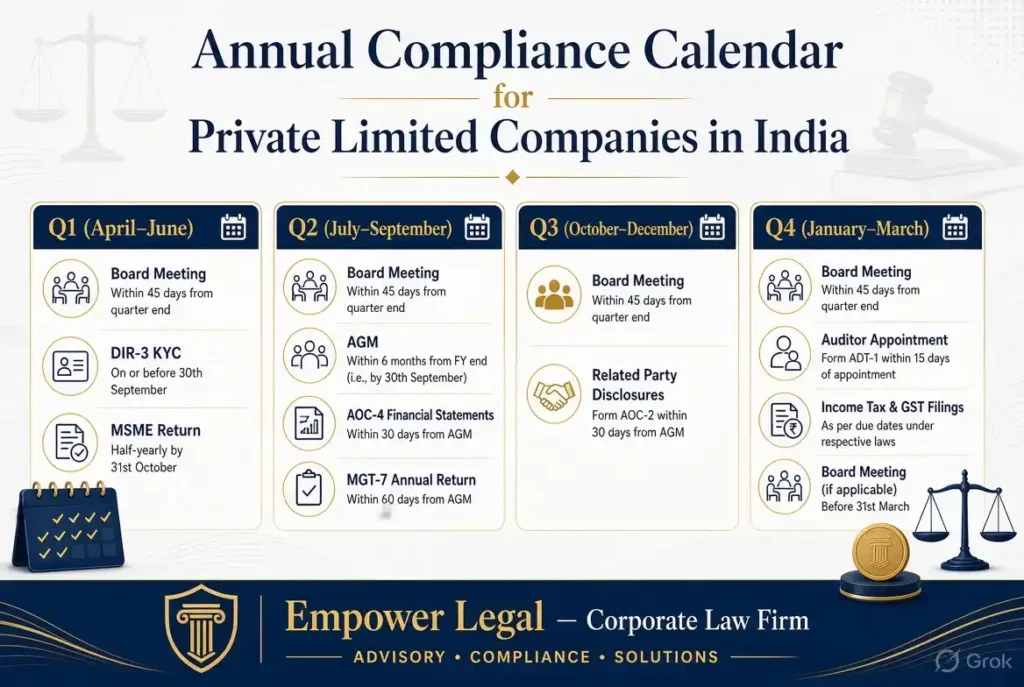
Introduction: Yes — every Private Limited Company registered in India, regardless of turnover or whether it did any business during the year, must complete a defined set of annual filings with the Registrar of Companies (ROC) under the Companies Act, 2013. Missing these deadlines attracts a flat penalty of ₹100 per day of default, per form, with no upper cap — which can add up quickly. This guide lays out the annual compliance calendar in the order it typically falls due.
Annual Regulatory Compliance Schedule for Private Limited Companies in India
The Compliance Year at a Glance
India’s financial year runs from 1 April to 31 March, and most ROC deadlines cluster between September and November, anchored to the Annual General Meeting (AGM) date.
Step 1: Hold Board Meetings Throughout the Year
Every company must hold a minimum of 4 board meetings per year, with a gap of not more than 120 days between two consecutive meetings. At least 7 days’ notice must generally be given to directors, and the quorum is one-third of total directors or two directors, whichever is higher.
Step 2: Complete the Statutory Audit
Every Private Limited Company must undergo a statutory audit by a Chartered Accountant every year, regardless of turnover or whether the company is active. This audit produces the financial statements that later get filed with the ROC.
Step 3: Hold the Annual General Meeting (AGM)
The AGM must be held within six months of the financial year end — i.e., generally by 30 September each year (One Person Companies are not required to hold an AGM).
Step 4: File ADT-1 (Auditor Appointment)
Form ADT-1 must be filed within 15 days of the AGM where an auditor is appointed or reappointed.
Step 5: File AOC-4 (Financial Statements)
First, a private limited company must file Form AOC-4 along with its financial statements, auditor’s report, and board report within 30 days of holding its Annual General Meeting. Consequently, if the company holds its AGM on 30 September, the management must complete this filing by 30 October. In contrast, an One Person Company does not need to hold an Annual General Meeting for these statutory approvals. Instead, the OPC owner must submit Form AOC-4 within 180 days from the close of the financial year.
Step 6: File MGT-7 or MGT-7A (Annual Return)
- MGT-7 applies to companies with paid-up capital of ₹10 crore or more, or turnover of ₹50 crore or more.
- MGT-7A (a simplified version) applies to small companies and OPCs.
Both are due within 60 days of the AGM — typically by around 29 November if the AGM was held on 30 September.
Step 7: File DIR-3 KYC
Every director with a Director Identification Number (DIN) must complete DIR-3 KYC annually, generally by 30 September, to keep their DIN active.
Step 8: File DPT-3, If Applicable
If the company has outstanding loans or money received that is not treated as a deposit, Form DPT-3 must be filed annually, generally on or before 30 June.
Step 9: Income Tax Compliance
Alongside ROC filings, a Private Limited Company must also file its income tax return (ITR-6), generally by 31 October where a tax audit applies, along with the applicable tax audit report (Form 3CA/3CB and 3CD), typically due by 30 September.
Statutory Framework and Deadlines at a Glance
| Compliance | Form | Typical Due Date (if AGM held 30 Sept) |
|---|---|---|
| Board Meetings | — | Minimum 4/year, ≤120 days apart |
| Auditor Appointment | ADT-1 | Within 15 days of AGM |
| Financial Statements | AOC-4 | Within 30 days of AGM (~30 Oct) |
| Annual Return | MGT-7 / MGT-7A | Within 60 days of AGM (~29 Nov) |
| Director KYC | DIR-3 KYC | ~30 September |
| Loans/Deposits Report | DPT-3 | ~30 June |
| Income Tax Return | ITR-6 | ~31 October (with audit) |
Note on exact dates: these are typical timelines assuming a 30 September AGM; actual dates shift if your AGM is held on a different date, and government extensions do occur from time to time. Always confirm current due dates on the MCA portal or with a practising Company Secretary before relying on any date.
Penalties for Non-Compliance
- Late filing of AOC-4 or MGT-7/MGT-7A attracts an additional fee of ₹100 per day of delay, with no maximum cap — a 90-day delay on one form alone can mean ₹9,000 in additional fees.
- Non-filing of AOC-4 and MGT-7 for three consecutive years can lead to disqualification of directors from holding directorship in any company in India for five years, under Section 164(2) of the Companies Act, 2013.
- Persistent non-compliance can ultimately expose the company to being struck off the register.
Practical Checklist
- Calendar all four board meetings for the year in advance, respecting the 120-day gap rule.
- Engage your statutory auditor early enough to complete the audit well before the AGM.
- Hold the AGM by 30 September (unless a valid extension applies).
- File ADT-1, AOC-4, and MGT-7/MGT-7A within their respective windows from the AGM date.
- Complete DIR-3 KYC for every director by the deadline, even if their details haven’t changed.
- Check whether DPT-3 applies to your company’s loan/deposit position.
- Maintain statutory registers and board minutes as part of ongoing secretarial compliance, not just at year-end.
Exceptions and Cautions
- OPCs and small companies have simplified filing requirements (e.g., MGT-7A instead of MGT-7) and no mandatory AGM for OPCs — confirm which category your company falls into.
- Compliance requirements can change with amendments to the Companies Act or MCA rules; this calendar reflects the general framework and should be verified against current MCA notifications each year.
- This article does not cover GST, TDS, or sector-specific regulatory compliance, which apply in addition to the ROC calendar described here.
What Should You Do Next?
Set up a compliance tracker at the start of each financial year mapping every deadline above against your company’s actual AGM date, and engage a Company Secretary or corporate lawyer to handle filings if your internal team lacks the bandwidth — the cost of professional help is consistently lower than the uncapped daily penalties for missed deadlines.
Frequently Asked Questions
Does a company with zero turnover still need to file annual returns?
Yes. Every registered Private Limited Company must file AOC-4 and MGT-7/MGT-7A annually, regardless of turnover or business activity.
What is the penalty for late filing of AOC-4?
₹100 per day of delay, with no upper cap, under Section 137 of the Companies Act, 2013.
Can directors be disqualified for non-filing?
Yes. Failure to file AOC-4 and MGT-7 for three consecutive financial years can disqualify directors from holding directorship in any company for five years.
Is a statutory audit required even for small or inactive companies?
Yes. Every Private Limited Company must have its accounts audited by a Chartered Accountant annually, regardless of turnover or activity level.
Conclusion
Annual ROC compliance is a fixed, non-negotiable obligation for every Private Limited Company in India — including dormant ones. Building a compliance calendar around your AGM date, and treating each deadline as a hard stop, avoids the compounding, uncapped penalties that come with delay. This article is for general legal information only and does not constitute advice on a specific company’s compliance position.
Disclaimer
This article is intended for general legal information only and does not constitute legal advice. Due dates and thresholds are subject to change by government notification; please verify current requirements with a practising Company Secretary or the MCA portal.
Read More
Authoritative Sources / References
- Companies Act, 2013 — Ministry of Corporate Affairs (Sections 92, 137, 164)
- Ministry of Corporate Affairs (MCA) portal — mca.gov.in