
An Annual General Meeting provides shareholders an important platform to review corporate affairs and exercise statutory rights. Section 96 requires companies, except One Person Companies, to hold an AGM annually. Generally, no more than fifteen months may pass between consecutive AGMs. The first AGM must occur within nine months from the first financial year’s closure. Subsequent AGMs generally require completion within six months from financial year closure. The Registrar may grant an extension of up to three months for subsequent AGMs. Therefore, companies should establish an annual compliance calendar well before statutory deadlines. The meeting must ordinarily occur during business hours and follow prescribed location requirements. Additionally, the Articles of Association may impose further procedural requirements. Proper planning reduces regulatory exposure, shareholder disputes, and filing complications. Empower Legal – Corporate Law Firm assists companies with complete AGM planning, documentation, statutory compliance, and corporate legal support.
Annual General Meeting (AGM): Conducting and Compliance – Empower Legal – Corporate Law Firm
Notice, Agenda and Explanatory Statement
An AGM requires proper notice to shareholders and other persons entitled to receive it. Section 101 generally requires at least twenty-one clear days’ notice. Companies may use written or prescribed electronic communication methods. Shorter notice can apply when the statutory consent threshold is satisfied. The notice should clearly state the meeting’s place, date, day, and time. It should also identify the business proposed for consideration. Section 102 requires an explanatory statement for specified special business. Therefore, companies should prepare notices carefully and verify every proposed resolution. Directors should ensure supporting information remains accurate, complete, and consistent. Furthermore, incorrect notices can create challenges concerning resolutions and shareholder rights. Legal counsel can review notice wording, agenda items, explanatory statements, and supporting documents. Consequently, professional review helps companies reduce procedural defects before issuing AGM notices.
Matters Commonly Considered at an AGM
An AGM typically addresses statutory and shareholder matters concerning the company’s financial and governance affairs. Companies may place financial statements, directors’ reports, and auditors’ reports before members. Shareholders may consider declaration of dividends where applicable and appointment matters concerning directors or auditors. The exact agenda depends upon the company’s circumstances and applicable statutory requirements. Therefore, the company secretary should distinguish ordinary business from special business before finalising the notice. Certain resolutions require specific voting thresholds and explanatory disclosures. Additionally, related-party matters, remuneration matters, or other prescribed transactions may require enhanced compliance. Companies should examine the Companies Act, applicable rules, Articles of Association, and sector-specific regulations. Listed entities must also consider applicable SEBI requirements. Consequently, AGM agendas should undergo legal and secretarial review. Empower Legal can assist with agenda preparation, board approvals, resolution drafting, explanatory statements, and shareholder communications.
Quorum, Chairman and Proxies
A valid AGM requires compliance with statutory quorum requirements and proper meeting administration. Section 103 establishes quorum requirements based upon company type and membership structure. The Articles may contain additional provisions where legally permissible. Therefore, companies should verify attendance before commencing substantive business. The chairman should conduct proceedings fairly and maintain proper order throughout the meeting. Members entitled to attend may exercise voting rights personally or through permitted proxies. Section 105 governs proxy-related matters and procedural requirements. Additionally, companies should maintain accurate attendance records and scrutinise proxy instruments where applicable. Disputes concerning quorum or voting can undermine resolutions and create shareholder litigation. Consequently, secretarial personnel should maintain complete meeting records. Legal advisors can guide the chairman when procedural objections arise. Proper meeting administration protects the company’s decisions and demonstrates responsible corporate governance.
Voting, Polls and Electronic Voting
Voting represents a central shareholder right during an AGM. Companies may use voting methods permitted under the Companies Act, Articles, and applicable rules. Section 108 recognises electronic voting subject to prescribed requirements. Eligible companies must follow applicable e-voting procedures and communicate voting arrangements properly. A poll may also become relevant where members exercise applicable statutory rights. Therefore, companies should verify shareholder eligibility, voting entitlements, cut-off dates, and electronic voting arrangements. Listed companies face additional requirements under securities regulations and listing obligations. Furthermore, scrutiniser appointments and reports require careful handling where applicable. Incorrect voting procedures can expose resolutions to challenge. Consequently, companies should conduct technical and legal checks before opening voting facilities. Empower Legal supports e-voting compliance, resolution scrutiny, shareholder communications, poll procedures, and scrutiniser coordination. Strong voting controls improve transparency and reduce avoidable shareholder disputes.
Financial Statements and Annual Reports
AGMs provide shareholders an opportunity to consider the company’s financial performance and statutory reports. Companies must prepare financial statements according to applicable provisions and accounting requirements. The Board’s report and auditor’s report also form important AGM documentation. Therefore, companies should coordinate directors, auditors, finance teams, and secretarial professionals before issuing meeting documents. Section 129 governs financial statements, while Section 134 addresses financial statements and Board reporting requirements. Companies must ensure disclosures remain accurate and internally consistent. Additionally, shareholders should receive documents within prescribed timelines and through permitted communication methods. Failure to complete financial reporting can create additional compliance exposure. Consequently, AGM preparation should begin well before the proposed meeting date. Legal counsel can review governance disclosures and identify potential statutory risks. Proper documentation also assists companies during ROC scrutiny, shareholder disputes, regulatory inspections, and future corporate transactions.
Appointment and Rotation of Directors
Director-related matters frequently appear on AGM agendas. Companies must examine appointment, reappointment, retirement by rotation, eligibility, disclosures, and consent requirements. The Companies Act establishes statutory conditions governing director appointments and shareholder approvals. Therefore, companies should verify director disclosures and eligibility before circulating AGM notices. Certain directors may require shareholder approval according to statutory provisions and company circumstances. Independent director appointments also involve additional requirements for applicable companies. Furthermore, directors must disclose relevant interests and comply with statutory governance obligations. Shareholders may question proposed appointments during the AGM. Consequently, companies should prepare accurate explanatory statements and supporting information. Legal counsel can examine appointment documentation, declarations, board resolutions, shareholder resolutions, and filing requirements. Proper director compliance protects the company from governance disputes and regulatory penalties. Empower Legal assists companies with director appointment, reappointment, resignation, disclosure, and AGM approval procedures.
Statutory Filings After the AGM
AGM compliance continues after shareholders conclude the meeting. Companies must complete prescribed filings with the Registrar of Companies within applicable statutory deadlines. Annual financial statements and annual returns require separate compliance processes under the Companies Act. Section 137 governs filing of financial statements with the Registrar. Companies should also maintain minutes, attendance records, voting results, resolutions, and supporting documents. Therefore, the company secretary should prepare a post-AGM compliance checklist immediately after the meeting. Any delayed filing can attract additional fees or statutory penalties. Furthermore, incorrect filings can create future due-diligence complications. Companies should reconcile approved resolutions against documents eventually filed with the MCA. Legal and secretarial review can identify inconsistencies before submission. Consequently, timely post-AGM compliance protects corporate records and reduces regulatory exposure. Empower Legal provides ROC filing assistance, compliance audits, minutes review, and remediation support following shareholder meetings.
Registrar, MCA and Corporate Compliance
The Ministry of Corporate Affairs and Registrar of Companies play important roles in company-law administration. Companies submit statutory documents and filings through the MCA framework. Therefore, AGM compliance should align meeting records with statutory filings and corporate master data. The Companies Act contains specific consequences for failures involving AGM obligations. Section 97 also empowers the Tribunal to call an AGM when a company defaults. Section 99 addresses punishment for certain defaults concerning AGM provisions. Consequently, companies should treat AGM compliance as a governance responsibility rather than an annual formality. Directors and officers should monitor deadlines through a documented compliance system. Additionally, companies should preserve evidence demonstrating proper notice, quorum, voting, minutes, and filings. Legal counsel can conduct periodic compliance reviews and identify unresolved historical defaults. Empower Legal assists businesses facing ROC notices, filing irregularities, AGM defaults, and corporate governance concerns.
NCLT Remedies for AGM Defaults
The National Company Law Tribunal can become relevant when a company fails to hold its AGM. Section 97 allows the Tribunal to call or direct the calling of an AGM following default. Members can approach the Tribunal under the statutory framework where circumstances justify intervention. Therefore, companies should respond promptly when AGM delays create shareholder or regulatory disputes. Tribunal proceedings can involve directions concerning meeting arrangements and consequential compliance. Additionally, Section 98 provides powers concerning meetings where statutory procedures become impracticable. Companies should therefore avoid allowing procedural disagreements to remain unresolved. Legal counsel can assess whether corrective compliance, shareholder engagement, or Tribunal proceedings offer the appropriate remedy. Proper representation can also help establish the company’s factual circumstances and corrective measures. Consequently, early legal intervention may prevent prolonged corporate litigation. Empower Legal represents companies, directors, and shareholders in NCLT-related corporate governance matters.
Shareholder Remedies and Oppression Concerns
Shareholders may raise legal concerns when AGM procedures undermine their statutory or contractual rights. Examples can include defective notices, exclusion from voting, improper resolutions, misleading disclosures, or governance irregularities. Therefore, companies should address legitimate shareholder concerns before they develop into formal disputes. Depending upon the facts, shareholders may pursue statutory remedies before appropriate corporate forums. Oppression and mismanagement proceedings may also become relevant under the Companies Act. Additionally, disputes concerning resolutions can require examination of Articles, voting records, minutes, and statutory filings. Courts and tribunals assess remedies according to the specific statutory framework. Consequently, shareholders should obtain legal advice before initiating proceedings. Companies should likewise investigate complaints objectively rather than dismissing them automatically. Empower Legal assists shareholders and companies with corporate disputes, resolution challenges, governance complaints, and negotiated settlements. Early dispute resolution can preserve shareholder relationships and reduce litigation costs.
AGM Minutes and Secretarial Records
Accurate minutes provide an essential record of AGM proceedings and shareholder decisions. Companies must prepare and maintain minutes according to the Companies Act and applicable secretarial requirements. Minutes should accurately capture attendance, quorum, discussions, resolutions, voting outcomes, and other legally significant proceedings. Therefore, companies should avoid informal summaries that omit important procedural details. The chairman and responsible officers should review records carefully before finalisation. Supporting documents should remain organised and accessible for future inspection or legal review. Additionally, companies should preserve voting results, scrutiniser reports, notices, explanatory statements, and attendance records. Proper records can become critical during ROC inquiries, shareholder litigation, audits, and corporate due diligence. Consequently, minutes require the same care as statutory filings. Legal counsel can review draft minutes and identify inconsistencies with approved resolutions. Empower Legal provides AGM documentation review, minute preparation support, governance audits, and corporate record management advice.
Listed Companies and SEBI Compliance
Listed companies face AGM obligations under both company law and securities-market regulations. Therefore, their compliance teams must coordinate Companies Act requirements with applicable SEBI regulations and stock-exchange obligations. Listed entities may have additional disclosure, voting, notice, and shareholder communication requirements. Electronic voting and remote participation require careful regulatory coordination. Moreover, material corporate events may require timely disclosures to stock exchanges. Companies should therefore maintain a consolidated AGM compliance calendar covering MCA, ROC, SEBI, and exchange requirements. Any inconsistency between shareholder communications and regulatory disclosures can create significant risk. Consequently, listed companies benefit from specialist corporate legal review before releasing AGM materials. Counsel can assess resolutions, explanatory statements, disclosures, related-party matters, and shareholder communications. Empower Legal assists listed and unlisted companies with integrated AGM compliance. Proper coordination reduces regulatory exposure and supports transparent corporate governance.
Corporate Disputes, Fraud and Criminal Exposure
Most AGM compliance matters remain within corporate and regulatory law rather than ordinary criminal procedure. However, allegations involving fraud, falsification, deception, or dishonest conduct can create additional legal exposure. The Companies Act contains specific provisions addressing corporate fraud and offences. Therefore, companies should investigate serious allegations through appropriate legal and governance channels. The BNS, BNSS, and BSA may become relevant when conduct independently constitutes a criminal offence. These newer criminal laws do not replace Companies Act AGM requirements. Instead, they may govern separate criminal issues arising from corporate conduct. Consequently, companies should avoid treating every AGM disagreement as a criminal matter. Legal counsel should distinguish procedural defects, shareholder disputes, regulatory defaults, and genuine criminal allegations. Police involvement may become appropriate only where a legally cognisable offence warrants investigation. Empower Legal coordinates corporate, regulatory, and criminal-law advice where AGM disputes create overlapping legal risks.
Comprehensive AGM Compliance Support
A properly managed AGM requires preparation before, during, and after the shareholder meeting. Empower Legal – Corporate Law Firm provides end-to-end support for companies seeking reliable AGM compliance. Our assistance can cover board approvals, statutory timelines, notice drafting, explanatory statements, resolutions, voting procedures, minutes, and ROC filings. We also advise directors and shareholders regarding governance disputes and statutory remedies. Furthermore, our lawyers can assist with NCLT proceedings involving AGM defaults or meeting-related disputes. Listed companies can receive coordinated support concerning applicable SEBI and stock-exchange requirements. Private and public companies can also obtain compliance audits for historical AGM irregularities. Therefore, businesses can identify risks before they become regulatory disputes. Our approach focuses on accurate documentation, statutory compliance, practical risk management, and defensible corporate records. Companies should obtain professional advice whenever unusual resolutions, shareholder disputes, delayed AGMs, or regulatory notices arise. Timely legal support can protect directors, shareholders, and corporate interests.
AGM Compliance, Disputes and Legal Remedies
Practical AGM Compliance Checklist
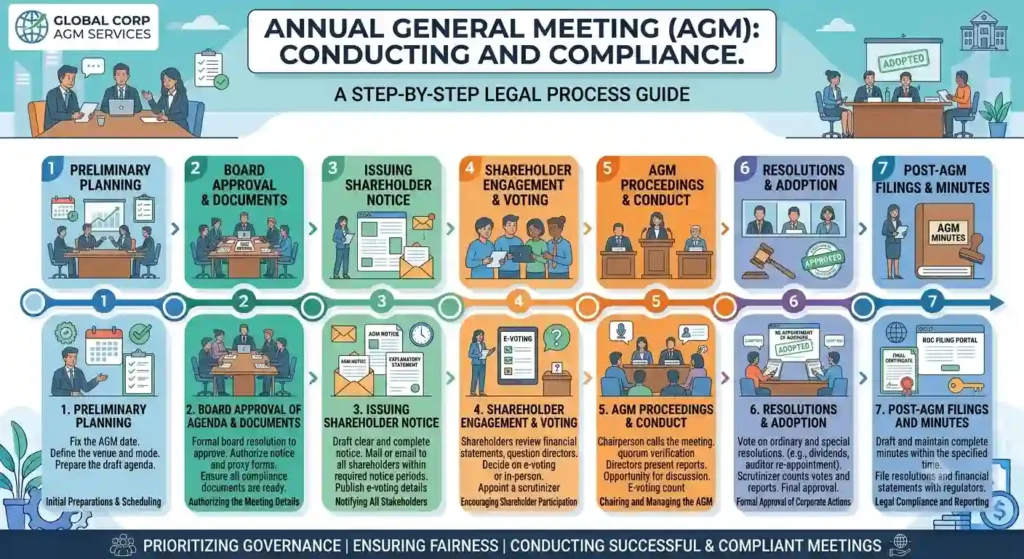
An effective AGM process should follow a documented compliance sequence from board approval through post-meeting filings. Companies should first confirm the statutory deadline and applicable meeting requirements. Next, they should approve the agenda, notice, explanatory statement, financial statements, and supporting documents. The company should then dispatch notices within the prescribed period and establish voting arrangements. Additionally, management should confirm quorum, proxies, scrutiniser arrangements, and meeting logistics. During the AGM, the chairman should follow the approved agenda and address legitimate shareholder questions. Voting results should receive proper documentation and verification. Thereafter, minutes should be prepared and statutory filings completed within applicable deadlines. Therefore, a written checklist reduces omissions and demonstrates responsible governance. Legal counsel can independently audit the entire AGM process. Empower Legal helps companies establish repeatable AGM compliance systems suitable for private companies, public companies, subsidiaries, and growing corporate groups.
Resolving AGM Compliance Failures
Companies should address AGM defaults quickly because delayed correction can increase regulatory and shareholder risks. A missed AGM deadline does not eliminate the company’s continuing statutory obligation. Therefore, directors should immediately assess the reason for default and identify available corrective measures. The Registrar may have relevant powers, while the NCLT can intervene under applicable provisions. Companies should prepare accurate explanations and avoid creating retrospective or inaccurate records. Additionally, statutory filings should reflect the actual circumstances rather than unsupported assumptions. Where shareholder disputes exist, negotiation may provide a practical solution. However, serious disputes may require representation before the NCLT or another competent forum. Legal counsel can evaluate penalties, remedial filings, Tribunal proceedings, and governance corrections. Consequently, early action can reduce continuing exposure and protect stakeholder confidence. Empower Legal provides compliance remediation, regulatory representation, shareholder dispute resolution, and corporate governance advice. A structured corrective strategy helps companies restore compliance responsibly.
Corporate Legal Assistance for AGM Compliance
AGM compliance affects directors, shareholders, auditors, company secretaries, promoters, and corporate management. Consequently, companies should treat the AGM as a significant governance process rather than routine administration. Empower Legal – Corporate Law Firm provides legal assistance across AGM planning, compliance, documentation, disputes, and remedies. Our services include statutory review, notice drafting, resolution preparation, voting advice, minutes review, ROC compliance, and NCLT representation. We also advise on shareholder grievances, director appointments, related-party concerns, and governance disputes. Furthermore, our lawyers can review historical AGM defaults and develop corrective compliance plans. Companies facing MCA or ROC notices can obtain representation and strategic legal advice. Listed companies can receive additional review concerning SEBI and stock-exchange obligations. Therefore, professional assistance can reduce procedural errors and strengthen corporate records. Companies should seek advice early when AGM deadlines, shareholder disputes, voting issues, or regulatory concerns arise. Effective legal support protects corporate governance and promotes sustainable compliance.
Frequently Asked Questions About AGM Compliance
What is an AGM?
An AGM is the annual shareholder meeting required for most companies. Members review statutory matters, financial performance, governance issues, and other permitted business.
When must a company conduct its AGM?
Generally, the first AGM occurs within nine months after the first financial year’s closure. Later AGMs generally occur within six months after financial-year closure.
How much notice does an AGM require?
Section 101 generally requires at least twenty-one clear days’ notice. Shorter notice can apply when the required statutory shareholder consent is obtained.
What happens if a company fails to hold an AGM?
The company may face statutory consequences. Additionally, a member can seek appropriate NCLT intervention under Section 97 for calling the AGM.
Can shareholders challenge AGM resolutions?
Yes, depending upon the circumstances and applicable statutory remedy. Defective notices, voting irregularities, oppression, mismanagement, or other legal violations may support proceedings.
Can legal professionals assist with complete AGM compliance?
Yes. Corporate lawyers can assist with notices, resolutions, voting, minutes, ROC filings, shareholder disputes, regulatory notices, NCLT matters, and compliance remediation.
Read More
- Board Meetings and Resolutions: Legal Requirements and Minutes
- Annual Compliance Calendar for Private Limited Companies
- Environmental Clearances for Businesses: EC and CTE/CTO
- Factory License Under Factories Act 1948: Complete Guide
- FSSAI License for Food Businesses: Types and Registration Process
- Ministry of Corporate Affairs (MCA)