

Employee Stock Option Plans provide employees with contractual rights to acquire company shares later. Therefore, ESOP implementation requires coordinated corporate, securities, employment, accounting, and taxation decisions. In India, the legal route differs between listed and unlisted companies. Unlisted companies primarily follow the Companies Act, 2013 and applicable rules. Listed companies additionally follow SEBI’s Share Based Employee Benefits and Sweat Equity Regulations, 2021. The tax treatment also creates separate employer and employee compliance duties. Moreover, the scheme should address vesting, exercise, lapse, termination, death, disability, resignation, and corporate restructuring. Consequently, employers should create a clear ESOP policy before making grants. Employees should understand their rights before accepting options. A carefully drafted scheme reduces disputes over eligibility, valuation, dilution, and exercise windows. Empower Legal – Corporate Law Firm can assist companies with ESOP structuring, documentation, governance, compliance, and dispute management. The following guide explains the legal framework and practical implementation process.
Understanding the Legal Architecture of ESOPs
Companies Act Framework for Employee Stock Options
Section 62 and Further Issue of Share Capital
Section 62 of the Companies Act, 2013 governs further issue of share capital. It provides the statutory foundation for employee stock option arrangements in qualifying companies. An ESOP normally gives an eligible employee an option to purchase shares later. The option does not itself make the employee a shareholder. Instead, shareholder rights generally arise after valid exercise and allotment. Therefore, companies should distinguish between granted options, vested options, exercised options, and allotted shares. Rule 12 of the Companies (Share Capital and Debentures) Rules, 2014 adds specific requirements for eligible unlisted companies. The scheme normally requires shareholder approval through a special resolution. Furthermore, the explanatory statement should provide material information about the proposed scheme. The company should maintain accurate records of grants, vesting, exercise, and allotment. Consequently, legal review should occur before board approval and shareholder circulation. This approach reduces procedural defects that may later create corporate disputes or regulatory exposure.
Rule 12 Eligibility and Scheme Conditions
Rule 12 establishes important requirements for an employee stock option scheme operated by an unlisted company. The company should first identify every employee category eligible under the applicable statutory framework. It should then examine exclusions affecting directors, promoters, and related employee categories. The scheme should define the grant process, vesting conditions, exercise mechanics, and applicable restrictions. Additionally, the company should establish procedures for resignation, retirement, termination, death, and permanent incapacity. These provisions should remain consistent with the Companies Act and the company’s constitutional documents. A properly drafted ESOP policy should also address adjustments following bonus issues, rights issues, mergers, demergers, or capital reorganisations. Moreover, the company should maintain a reliable option register and supporting resolutions. The following compliance checklist helps management organise implementation:
- Confirm company eligibility and statutory exclusions.
- Review articles of association and existing shareholder agreements.
- Prepare the ESOP scheme and explanatory statement.
- Obtain required board and shareholder approvals.
- Record grants and maintain option-holder documentation.
- Complete allotment and statutory filings after exercise.
Shareholder Approval and Special Resolution
Shareholder approval forms a central procedural safeguard for an ESOP scheme under the applicable Companies Act framework. The board should approve the proposal before placing it before shareholders. The explanatory statement should clearly describe the scheme’s material commercial and legal features. Consequently, employees and shareholders can understand the potential dilution and compensation implications. The resolution should identify the option pool and relevant eligibility framework with sufficient clarity. Furthermore, the company should follow applicable notice, voting, filing, and record-keeping requirements. Management should avoid treating shareholder approval as a routine administrative step. Instead, directors should evaluate whether the proposed scheme aligns with the company’s capital structure and compensation strategy. Any subsequent amendment should receive the approval required under applicable law and the scheme documents. Companies should also examine whether existing investment agreements contain consent rights. Therefore, ESOP implementation requires coordination between corporate counsel, company secretaries, finance teams, and human resources. Proper approvals create a stronger evidentiary record if future shareholders or employees challenge the scheme.
SEBI Requirements for Listed Companies
SEBI SBEB Regulations and Listed Companies
Listed companies must consider the SEBI (Share Based Employee Benefits and Sweat Equity) Regulations, 2021. SEBI currently lists these regulations as amended through December 4, 2025. The framework regulates employee stock option schemes and other share-based employee benefit arrangements. Therefore, a listed company cannot rely solely upon the Companies Act. It must also satisfy applicable securities-market requirements and disclosure standards. The scheme should clearly identify its administrator and applicable governance mechanism. Furthermore, prospective option grantees should receive the disclosures required under the regulatory framework. SEBI rules also prescribe important requirements concerning pricing, vesting, option-holder rights, and scheme administration. The regulations provide a minimum one-year vesting period for ESOS, subject to specified exceptions. Until exercise and share issuance, an option holder does not receive ordinary shareholder rights merely from holding an option. Consequently, listed companies should integrate ESOP administration with their compliance and insider-trading controls. Legal counsel should also review stock-exchange disclosures and continuing obligations whenever material scheme changes occur.
Governance, Disclosure and Committee Oversight
Effective ESOP governance requires clearly assigned responsibility across the board, committees, management, and professional advisers. Listed companies should examine the role of the Nomination and Remuneration Committee under applicable regulations. The committee may oversee compensation structures, scheme administration, eligibility decisions, and compliance processes. Meanwhile, the board remains responsible for statutory governance and appropriate oversight. Finance teams should reconcile option records with accounting records and share capital data. Company secretaries should monitor resolutions, statutory registers, filings, and disclosures. Human resources teams should preserve employee-level grant documentation and communications. Additionally, compliance officers should consider insider-trading restrictions when employees possess unpublished price-sensitive information. The governance framework should include documented approval thresholds and escalation procedures. A practical governance matrix may assign responsibilities as follows:
| Function | Primary responsibility |
|---|---|
| Board | Overall corporate approval and oversight |
| NRC | Compensation and scheme administration |
| Company Secretary | Corporate records and filings |
| Finance | Valuation, accounting, and reconciliation |
| HR | Employee communication and grant records |
| Legal Counsel | Legal drafting and dispute prevention |
Designing the ESOP Commercial Structure
Grant Size, Exercise Price and Dilution
An ESOP scheme should balance employee incentives with shareholder dilution and capital planning. The company should determine the overall option pool after reviewing its present and projected capital structure. Management should also estimate future funding rounds, acquisitions, and employee expansion. The exercise price should reflect the company’s commercial objectives and applicable legal requirements. For listed companies, the SEBI framework permits exercise-price determination subject to applicable accounting requirements. Unlisted companies should separately examine valuation and tax consequences before fixing the exercise price. Furthermore, the company should model dilution under different exercise scenarios. A useful cap-table analysis should show:
- Existing issued equity before ESOP implementation.
- Reserved options under the ESOP pool.
- Granted and outstanding options.
- Vested and exercisable options.
- Potential equity after full option exercise.
Consequently, directors can understand the scheme’s effect on ownership percentages. Employees also receive clearer information about potential economic outcomes. Legal counsel should coordinate the commercial model with valuation advisers and tax professionals.
Vesting, Exercise and Lapse Rules
Vesting determines when an employee earns the right to exercise granted options. Exercise determines when the employee actually purchases shares under the scheme. These concepts should remain clearly separated throughout the ESOP documentation. Listed-company ESOS rules generally require at least one year between grant and vesting, subject to regulatory exceptions. Companies may create graded vesting schedules linked to service or performance. However, performance conditions should remain measurable, objective, and consistently administered. The scheme should specify the exercise window following vesting. It should also state when unexercised options lapse or become forfeited. Additionally, termination provisions require particular care because employment separation can create significant disputes. The policy should address resignation, misconduct, redundancy, retirement, death, and permanent incapacity separately. Employees should receive clear written instructions about exercise procedures and deadlines. Therefore, precise vesting and exercise provisions reduce uncertainty and strengthen enforceability. Counsel should review every trigger against employment agreements and applicable corporate rules.
ESOP Documentation and Implementation
Board Resolutions and Corporate Records
Corporate records provide the foundation for demonstrating valid ESOP implementation. The board resolution should record the scheme proposal, option pool, administration framework, and approval process. Shareholder resolutions should correspond with the final scheme presented for approval. The company should preserve notices, explanatory statements, attendance records, voting results, and statutory filings. Furthermore, grant letters should match the approved scheme without inconsistent commercial terms. The company should maintain a central option register containing employee-level information. That register should track grants, vesting dates, exercises, cancellations, lapses, and outstanding balances. Finance teams should reconcile the register with the company’s share capital records after each allotment. Company secretaries should also review applicable forms and statutory filing deadlines. Therefore, documentation should operate as an integrated compliance system rather than isolated paperwork. A document audit can identify inconsistencies before they become disputes. Empower Legal can review resolutions, scheme rules, grant letters, shareholder approvals, and supporting corporate records before implementation.
Employee Agreements and Communication
An ESOP grant should communicate economic rights without creating uncertainty about employment status or guaranteed returns. The grant letter should identify the number of options and applicable exercise price. It should also state vesting conditions, exercise periods, lapse events, and relevant restrictions. Employees should understand that an option does not automatically represent issued equity. The agreement should explain tax responsibilities and potential changes in tax treatment. Furthermore, employees should receive a practical explanation of resignation, termination, death, and corporate transactions. Companies should avoid promotional statements suggesting that options guarantee future wealth. Instead, communications should explain that share values can rise or fall. Clear disclosures also reduce later allegations concerning misrepresentation or unequal treatment. Human resources teams should maintain evidence showing that employees received and accepted scheme documents. Additionally, electronic acceptance records should remain securely archived. Strong communication creates better employee understanding while protecting the company against avoidable contractual and employment disputes.
Taxation, Accounting and Compliance
ESOP Taxation for Employees and Employers
Perquisite Tax on ESOP Exercise
Indian income-tax rules treat qualifying ESOP benefits as taxable perquisites under specified circumstances. The Income Tax Department explains that the taxable perquisite generally arises when shares are allotted after exercise. The value generally depends on the fair market value on the specified exercise date, less the amount recovered from the employee. For listed securities, prescribed valuation mechanisms apply. For certain unlisted securities, valuation may involve a merchant banker under the applicable tax rules. Therefore, employees should calculate the potential tax cost before exercising options. Employers also carry payroll withholding and reporting responsibilities under applicable tax law. Eligible start-ups may receive statutory tax-deferment benefits subject to prescribed conditions. However, employees should independently verify eligibility before relying upon any deferral. The company should coordinate ESOP administration with payroll, finance, and tax professionals. Furthermore, grant letters should avoid inaccurate tax promises. Proper tax planning helps employees understand the cash-flow implications associated with exercising valuable options.
Capital Gains After Share Sale
Tax consequences may continue after an employee exercises options and later sells the resulting shares. The subsequent transfer can create a capital gains event under applicable income-tax provisions. The calculation depends on the relevant acquisition cost, transfer value, holding period, and applicable tax rules. Therefore, employees should preserve exercise statements, allotment records, valuation documents, and sale contracts. Employers should also provide reliable transaction statements where appropriate. Furthermore, listed and unlisted shares may involve different valuation and transfer considerations. Cross-border employees can face additional complications involving residential status, foreign exchange rules, and treaty provisions. Consequently, tax advice should accompany ESOP planning where international employment exists. Companies should not assume that payroll withholding completely resolves an employee’s later capital gains obligations. Instead, employees should review their individual tax position with qualified advisers. Accurate documentation also becomes important during tax assessments or disputes. A well-administered ESOP system should therefore preserve records throughout the complete lifecycle of each option and resulting share.
Accounting, Valuation and Financial Reporting
Fair Value and Financial Reporting
ESOP accounting requires the company to recognise compensation effects under the applicable accounting framework. The accounting treatment should align with the nature of the award and relevant standards. Listed companies should also consider SEBI requirements concerning scheme disclosures and financial reporting. The company should establish an appropriate valuation methodology for option grants. Valuation may consider exercise price, expected option life, volatility, dividends, and risk-free rates. Therefore, finance teams should retain the assumptions supporting each valuation exercise. Independent valuation advice can improve documentation for complex or high-value grants. The company should also reconcile accounting records with the option register. Any cancellation, modification, repricing, or accelerated vesting may create accounting consequences. Consequently, legal counsel should coordinate with accountants before modifying an existing ESOP. Management should document the business rationale for significant changes. Clear valuation records can also help address employee queries concerning exercise pricing. Strong accounting controls ultimately support accurate financial statements and reduce regulatory questions.
ESOP Compliance Calendar
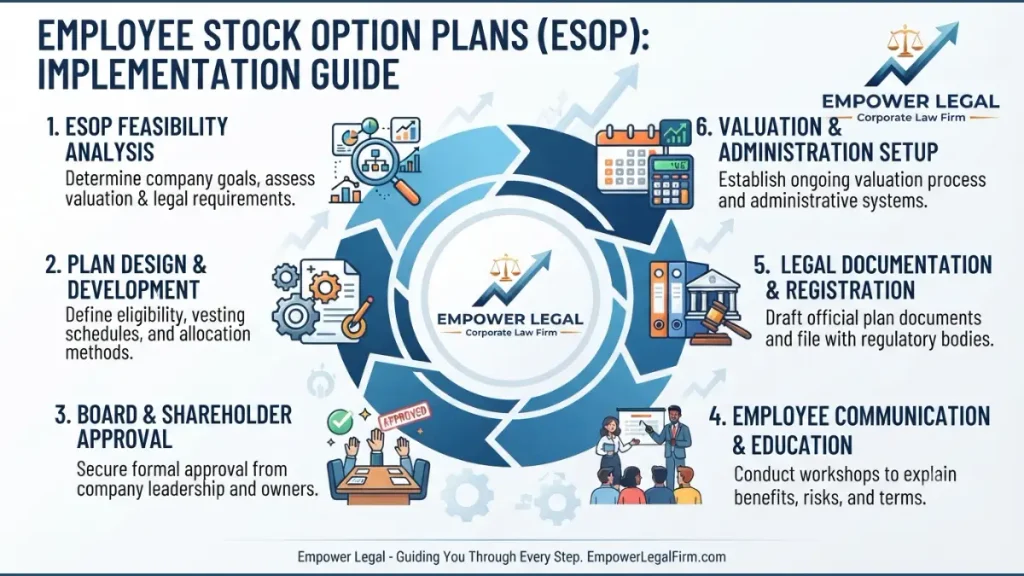
An ESOP compliance calendar helps management coordinate approvals, filings, disclosures, tax obligations, and employee communications. The calendar should identify each event from scheme creation through final exercise. It should also allocate responsibility to specific internal teams and professional advisers. Companies should monitor board meetings, shareholder meetings, grant dates, vesting dates, exercise windows, and allotments. Furthermore, statutory filing deadlines should remain visible within the company’s compliance system. Listed companies should add SEBI and stock-exchange disclosure events to the calendar. Finance teams should separately monitor payroll withholding and tax reporting obligations. The following sequence provides a practical implementation workflow:
- Conduct legal and cap-table due diligence.
- Draft the ESOP scheme and supporting documents.
- Obtain board and shareholder approvals.
- Complete applicable corporate filings.
- Issue grant letters and update option records.
- Monitor vesting and employee eligibility.
- Process exercise requests and share allotments.
- Reconcile records and complete required disclosures.
Consequently, a single compliance dashboard can reduce missed deadlines and inconsistent records.
Disputes, Remedies and Corporate Forums
Common ESOP Legal Issues
ESOP disputes often arise from unclear documents, inconsistent administration, termination decisions, or valuation disagreements. Employees may challenge cancellation after resignation when the scheme language lacks precise treatment. Companies may face allegations concerning discriminatory grants or inconsistent vesting decisions. Shareholders may question excessive dilution or approvals that allegedly departed from corporate authority. Additionally, disputes can arise during mergers, acquisitions, restructuring, or initial public offerings. Fraudulent manipulation of records can create separate corporate or criminal consequences. Therefore, the legal issue should first be classified according to its underlying cause. Common issues include:
- Wrongful cancellation or forfeiture of vested options.
- Disputes concerning exercise deadlines.
- Incorrect employee eligibility decisions.
- Valuation and tax disagreements.
- Breach of grant or employment agreements.
- Shareholder approval and dilution disputes.
- Alleged manipulation of corporate records.
- Fraud, forgery, cheating, or dishonest conduct allegations.
Proper classification helps identify the correct forum, remedy, evidence, and procedural route.
NCLT, NCLAT and Corporate Litigation
The National Company Law Tribunal handles numerous company-law matters under the Companies Act. Its jurisdiction includes matters such as oppression and mismanagement, class actions, capital reduction, and rectification of member registers. Therefore, an ESOP dispute may reach the NCLT when it falls within a statutory company-law jurisdiction. The Chennai Bench exercises jurisdiction over Tamil Nadu and Puducherry. NCLT proceedings require careful assessment because ordinary civil jurisdiction may be restricted where the Companies Act provides a specialised remedy. Appeals from appropriate NCLT orders may proceed before the National Company Law Appellate Tribunal. Meanwhile, the Securities Appellate Tribunal can become relevant for specified SEBI-related appeals. The correct forum therefore depends upon the statutory source of the dispute. Counsel should examine jurisdiction before filing proceedings. A poorly selected forum can cause delay and additional costs. Corporate lawyers should also consider limitation, interim relief, evidence, and available appellate remedies before commencing litigation.
Civil, Criminal and Regulatory Remedies
Different ESOP disputes can require different remedies under Indian law. Contractual disputes may involve civil proceedings, subject to applicable jurisdictional restrictions and statutory remedies. The Code of Civil Procedure, 1908 provides general procedural rules for civil courts. However, the Companies Act can assign specific corporate matters to specialised tribunals. Criminal allegations require separate analysis under the Bharatiya Nyaya Sanhita, 2023 and procedural law under the Bharatiya Nagarik Suraksha Sanhita, 2023. The Bharatiya Sakshya Adhiniyam, 2023 governs evidentiary principles for relevant proceedings. These three criminal-law enactments came into force from July 1, 2024, subject to their statutory commencement provisions. Consequently, allegations involving forged ESOP records, dishonest inducement, or other offences require fact-specific legal assessment. Appropriate remedies may include legal notices, injunction applications, regulatory complaints, tribunal proceedings, civil claims, or criminal complaints. The jurisdictional police station may become relevant where facts disclose a cognisable offence. Legal counsel should preserve digital records and transaction evidence before escalation.
Implementation Strategy for Empower Legal Clients
ESOP Legal Due Diligence and Risk Management
Pre-Implementation Corporate Due Diligence
Before implementing an ESOP, the company should conduct structured corporate and legal due diligence. Counsel should inspect the memorandum, articles, shareholder agreements, financing documents, and existing capitalisation table. Existing investor rights may contain consent, anti-dilution, reserved-matter, or transfer provisions. Therefore, the ESOP should not operate independently from the company’s wider capital framework. The legal team should identify outstanding options, warrants, convertible instruments, and previous employee grants. It should also verify whether previous schemes remain valid and properly documented. Furthermore, the company should assess whether proposed grants could affect control rights or financing covenants. Foreign investment structures may require additional review under applicable foreign exchange regulations. Listed companies require broader securities-law analysis and disclosure planning. Counsel should document identified risks and recommend corrective steps before implementation. This process creates a defensible audit trail for directors and shareholders. Consequently, pre-implementation due diligence can prevent costly amendments and employee disputes after grants have already been issued.
ESOP Policy Drafting and Review
An effective ESOP policy should convert commercial objectives into clear and enforceable legal provisions. The document should define eligible employees and the authority responsible for grants. It should establish grant limits, vesting schedules, exercise conditions, and lapse rules. Termination provisions should distinguish resignation, retirement, misconduct, redundancy, death, and disability. The policy should also address corporate events affecting outstanding options. Additionally, it should provide mechanisms for correcting administrative errors without undermining employee rights. Companies should define confidentiality, data protection, tax responsibility, and dispute-resolution provisions where appropriate. The scheme should remain consistent with the company’s employment contracts and internal compensation policies. Legal counsel should review every cross-reference before approval. Employees should receive a separate grant letter containing their individual commercial terms. This separation allows the main policy to remain stable while employee grants vary. Therefore, a carefully drafted ESOP policy becomes the central governance document for the entire option lifecycle.
Employee Exit, Termination and Dispute Prevention
Employee exits create some of the most sensitive ESOP administration issues. A company should determine the treatment of vested and unvested options immediately after receiving an exit notice. The answer depends upon the scheme, grant letter, applicable law, and employment circumstances. Good-leaver and bad-leaver concepts should receive precise definitions where the company uses them. Furthermore, the exercise window after termination should be expressly stated. Companies should avoid informal decisions that contradict written scheme terms. Human resources should coordinate with finance and legal teams before cancelling or preserving options. Employees should receive a written statement explaining their remaining rights and deadlines. If a dispute arises, the parties should first review the scheme, grant letter, board records, and employee communications. Mediation or negotiated settlement may resolve some contractual disagreements efficiently. However, statutory company-law or regulatory issues may require proceedings before specialised forums. Therefore, consistent exit procedures protect both employees and the company from avoidable litigation.
ESOP Remedies, Professional Support and Final Checklist
Available Legal Remedies for ESOP Disputes
The appropriate ESOP remedy depends on the legal character and urgency of the dispute. A legal notice can demand correction of records or performance of contractual obligations. An injunction may become relevant where continued conduct could cause irreparable harm. Tribunal proceedings may address matters falling within the Companies Act’s specialised jurisdiction. Regulatory complaints may apply where listed-company or securities-law requirements are implicated. Civil proceedings may address appropriate contractual or commercial claims where jurisdiction remains available. Criminal complaints may become relevant where evidence indicates a cognisable offence. Additionally, rectification or correction of corporate records may be necessary after an administrative error. Employees may seek documentary clarification before exercising or abandoning valuable options. Companies may seek declarations concerning scheme interpretation where legally available. The following remedies may therefore form part of an ESOP dispute strategy:
- Contractual demand and legal notice.
- Negotiated settlement or mediation.
- Appropriate interim injunction.
- NCLT or NCLAT proceedings where legally available.
- SEBI or stock-exchange compliance action.
- Civil remedies under applicable jurisdiction.
- Criminal complaint for qualifying offences.
- Rectification of corporate and shareholder records.
Counsel should select remedies after reviewing jurisdiction, limitation, evidence, and statutory bars.
Corporate Compliance Support from Empower Legal
Empower Legal – Corporate Law Firm can support companies through the complete ESOP lifecycle. Legal support can begin with corporate due diligence and continue through scheme implementation. Counsel can review constitutional documents, investor agreements, capitalisation tables, and existing compensation arrangements. The legal team can then draft the ESOP scheme, board resolutions, shareholder resolutions, grant letters, and employee communications. Furthermore, counsel can coordinate with company secretaries, tax professionals, valuers, accountants, and compliance officers. Listed companies may require additional SEBI and stock-exchange compliance support. Unlisted companies require careful Companies Act and MCA compliance. Dispute support can cover legal notices, negotiations, tribunal proceedings, civil claims, and regulatory responses. Criminal-law coordination may also become necessary where alleged fraud or document manipulation arises. For Chennai-based companies, counsel can assess the appropriate corporate forums and territorial authorities. Therefore, professional legal oversight can reduce procedural errors while improving governance. Every ESOP should receive a fact-specific legal review because company structures, employees, investors, and applicable regulations differ.
Final ESOP Implementation Checklist
A legally sound ESOP requires more than a well-written option agreement. The company should integrate corporate approvals, employee documentation, valuation, tax administration, accounting, and continuing compliance. Directors should understand the dilution consequences before approving the option pool. Employees should understand vesting, exercise, lapse, taxation, and exit consequences before accepting grants. Listed companies should additionally monitor SEBI requirements and securities-market disclosures. Unlisted companies should maintain strong Companies Act, MCA, and shareholder records. Furthermore, management should establish an ESOP register and periodic reconciliation process. The final implementation review should confirm:
- Corporate documents permit the proposed arrangement.
- Statutory eligibility has been independently checked.
- Required board approval has been completed.
- Required shareholder approval has been obtained.
- Scheme documents match approved commercial terms.
- Grant letters contain precise employee rights.
- Vesting and exercise procedures are operational.
- Tax and valuation processes are documented.
- Accounting treatment has been reviewed.
- Corporate filings and disclosures are complete.
- Exit procedures are clearly communicated.
- Dispute escalation and record-retention systems are established.
A structured ESOP process supports stronger corporate governance, employee clarity, and long-term legal risk management.
Frequently Asked Questions
FAQ 1: What is an ESOP in India?
An ESOP gives eligible employees an option to acquire company shares later. The option usually becomes exercisable after specified vesting conditions.
FAQ 2: Is shareholder approval required for an ESOP?
Applicable Companies Act rules generally require shareholder approval for qualifying unlisted-company ESOP schemes. The exact approval depends on company status and scheme structure.
FAQ 3: What is the minimum ESOP vesting period?
For listed-company ESOS arrangements, SEBI regulations generally prescribe a one-year minimum vesting period, subject to stated exceptions.
FAQ 4: When does ESOP taxation arise?
ESOP taxation can arise as a salary perquisite when shares are allotted after exercise. Later sale can create a separate capital gains tax event.
FAQ 5: Which forum handles ESOP company-law disputes?
The NCLT may handle disputes falling within its Companies Act jurisdiction. Other disputes can require civil courts, SEBI forums, or other competent authorities.
FAQ 6: Can an employee challenge cancelled ESOPs?
An employee may have remedies when cancellation conflicts with the scheme, grant letter, law, or corporate approvals. The remedy depends on the facts and jurisdiction.